Mental Health & Therapy Psychology
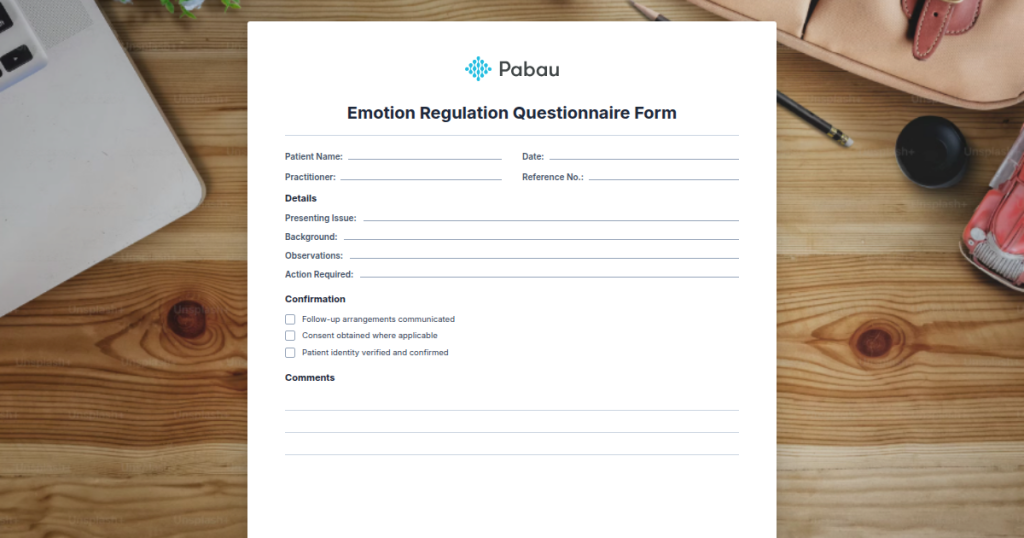
Emotion Regulation Questionnaire Form
What is the Emotion Regulation Questionnaire Form? The emotion regulation questi...

May 8, 2026


Buy now, pay later is now available in Pabau

The Emotion Regulation Questionnaire (ERQ) is a 10-item self-report measure assessing two emotion regulation strategies: cognitive reappraisal and expressive suppression.
Items are rated on a 7-point Likert scale; the short form (ERQ-S) condenses the tool to 6 items for time-limited clinical settings.
Scoring yields continuous subscale means for each strategy, not diagnostic categories; higher reappraisal scores and lower suppression scores typically indicate more adaptive regulation.
Pabau’s digital forms and automated assessment workflows help clinicians administer, score, and integrate emotion regulation results into clinical documentation and treatment planning.
The emotion regulation questionnaire form is a clinician-friendly assessment tool that measures how individuals use two core emotion regulation strategies: cognitive reappraisal and expressive suppression. Developed by Gross and John (2003) at Stanford University, this self-report instrument has become a standard measure in mental health practice, research settings, and psychological evaluations across psychiatry, therapy, and counseling disciplines.
The standard emotion regulation questionnaire contains 10 items rated on a 7-point Likert scale (1 = strongly disagree, 7 = strongly agree). A validated 6-item short form (ERQ-S) was introduced by Preece et al. (2023) for time-pressured settings, making the emotion regulation questionnaire form accessible in busy therapy practices, psychiatric clinics, and intake workflows. The form does not provide diagnostic categories or clinical cut-off scores. Instead, it yields continuous subscale means reflecting each patient’s habitual reliance on reappraisal versus suppression-data that informs treatment planning and helps clinicians understand emotion regulation patterns relevant to anxiety, depression, trauma, and behavioral health goals.
Clinically, the emotion regulation questionnaire form bridges a gap between clinical observation and objective measurement. Rather than relying solely on patient self-description, practitioners gain quantified insight into which emotion regulation strategies clients naturally default to, enabling more targeted intervention in cognitive-behavioural therapy (CBT), dialectical behaviour therapy (DBT), acceptance and commitment therapy (ACT), and trauma-informed approaches.
A validated 10-item and 6-item self-report measure assessing cognitive reappraisal and expressive suppression strategies. Includes scoring instructions and interpretation guidance for mental health practitioners.
Download templateAdministering the emotion regulation questionnaire form is straightforward, whether in intake appointments, ongoing therapy, or as a baseline measure before intervention. The form integrates into digital assessment workflows, allowing clinicians to collect responses electronically, score immediately, and populate session notes automatically.
The emotion regulation questionnaire form is relevant across mental health specialties and clinical settings. Mental health practices use it to standardise emotion regulation assessment; therapy and counselling clinics deploy it to measure CBT and DBT progress; psychiatry clinics incorporate it into initial psychiatric evaluations to understand coping patterns alongside medication decisions; and psychology private practices rely on it for baseline measurement and treatment outcome tracking. Occupational therapists, ADHD specialists, and addiction counsellors also use the emotion regulation questionnaire form to assess self-regulation capacity in clients with dysregulation symptoms.
The emotion regulation questionnaire form delivers concrete clinical value. It introduces objective measurement into emotion regulation assessment, reducing reliance on clinical impression alone. Standardised scoring enables before-and-after comparison, providing tangible evidence of therapeutic progress to both clinician and client-a powerful motivator in long-term therapy. Client portals allow patients to review their own emotion regulation results, fostering insight and accountability. The form is brief enough to repeat monthly without burden, making longitudinal tracking feasible in routine practice. Administratively, the emotion regulation questionnaire form supports compliance documentation (CQC, Care Quality Commission, and professional bodies expect standardised outcome measurement), and its open-source status (free for non-commercial clinical use) eliminates licensing barriers-practitioners simply need the form and scoring guidance.
Cognitive reappraisal is the process of reinterpreting a situation to change its emotional impact. A client who reappraises might encounter a setback and think, “This is a learning opportunity,” rather than “I’ve failed.” Research links high reappraisal use to better mental health outcomes, stronger emotional resilience, and lower symptoms of anxiety and depression. The emotion regulation questionnaire form identifies clients who naturally gravitate toward this adaptive strategy.
Expressive suppression involves suppressing or hiding emotional expression-pushing feelings down rather than processing them. Clients who rely heavily on suppression often appear calm outwardly but experience ongoing internal distress. Long-term suppression is associated with increased physiological stress, rumination, and psychological burden. The emotion regulation questionnaire form quantifies this pattern, signalling that therapeutic work on emotional awareness, acceptance, and cognitive flexibility is warranted. Psychiatric evaluations frequently use emotion regulation results alongside other measures to build a complete clinical picture and tailor intervention approach.
Track emotion regulation results alongside symptom measures (depression, anxiety scales). If a client shows decreasing suppression scores and increasing reappraisal scores over three months of CBT, that’s measurable therapeutic progress-even if self-reported anxiety scores are still moderate. The emotion regulation questionnaire form captures mechanism of change, not just symptom reduction.
When integrating the emotion regulation questionnaire form into therapy practice workflows, clinicians often combine reappraisal and suppression subscale data with presenting concerns to shape treatment. A client with high suppression and a primary anxiety diagnosis benefits from exposure-based therapy and emotion-focused techniques. A client with low reappraisal and depression diagnosis may prioritise cognitive restructuring. The emotion regulation questionnaire form thus bridges assessment and intervention planning.
The American Psychological Association (APA) recognises emotion regulation as a core competency in evidence-based therapy. By including standardised measurement like the emotion regulation questionnaire form, clinicians demonstrate fidelity to best practices and build a stronger empirical record of outcomes. This is especially valuable for insurance documentation, supervision, and practitioner credibility.
Modern practice management platforms like Pabau’s automated workflow system simplify emotion regulation questionnaire administration and scoring. Digital forms eliminate paper scoring errors, automatically calculate subscale means, and flag results for immediate clinical review. Automated practice workflows then prompt the clinician to document emotion regulation findings in the session note template, ensuring consistency and compliance. Some systems auto-populate treatment planning sections with suggested therapeutic targets based on emotion regulation profile-e.g., if suppression is high, the system suggests “Teach cognitive reappraisal techniques” as an intervention goal. This integration reduces administrative burden and keeps emotion regulation assessment visible throughout the client journey, not relegated to a filing drawer.
The Emotion Regulation Questionnaire gives mental health practitioners a brief, validated way to quantify two of the most clinically meaningful emotion regulation strategies: cognitive reappraisal and expressive suppression. Rather than relying on impression alone, clinicians gain continuous subscale data that informs CBT, DBT, ACT, and trauma-focused treatment planning, supports outcome tracking across episodes of care, and creates a clear empirical record for supervision, audit, and insurance documentation.
Digitising the ERQ inside a single practice management platform removes scoring friction and keeps emotion regulation results visible in the patient record at every clinical decision point. Book a demo to see how Pabau’s digital forms, automated workflows, and AI-assisted documentation can integrate the Emotion Regulation Questionnaire into your therapy and mental health practice from intake through long-term outcome tracking.
The original ERQ developed by Gross and John (2003) is a 10-item instrument with 6 cognitive reappraisal items (1, 3, 5, 7, 8, 10) and 4 expressive suppression items (2, 4, 6, 9). The ERQ-S, validated by Preece et al. (2023), is a 6-item short form designed for time-pressured clinical and research settings. Both versions use the same 7-point Likert scale and yield two subscale means (reappraisal and suppression). The ERQ-S preserves the two-factor structure of the original while reducing administration time to under two minutes.
Score the ERQ by averaging the items within each subscale. For the 10-item ERQ, average items 1, 3, 5, 7, 8, and 10 for the cognitive reappraisal subscale, and items 2, 4, 6, and 9 for the expressive suppression subscale. For the 6-item ERQ-S, reappraisal uses items 1, 3, and 5; suppression uses items 2, 4, and 6. Each subscale produces a continuous mean between 1 and 7. There are no diagnostic cut-off scores; interpret each subscale relative to the client’s clinical presentation and treatment goals.
Yes. The Emotion Regulation Questionnaire is freely available from the Stanford Psychophysiology Laboratory for research and non-commercial clinical use. Practitioners do not need to pay licensing fees to administer or score the ERQ within their practice, though the original Gross and John (2003) paper should be cited when the instrument is used in clinical reports or research.
The original ERQ was validated in adult samples (18 years and older), and the strongest psychometric evidence supports its use with adults. A separate version, the Emotion Regulation Questionnaire for Children and Adolescents (ERQ-CA), was developed by Gullone and Taffe (2012) to assess emotion regulation in young people aged roughly 10 to 18. Clinicians working with adolescents should use the ERQ-CA rather than the adult ERQ to ensure age-appropriate language and validation.
There is no fixed protocol, but most practitioners re-administer the ERQ every four to twelve weeks, depending on therapy intensity and treatment goals. Monthly re-administration is feasible for active CBT, DBT, or ACT work targeting emotion regulation directly. Quarterly re-administration is appropriate for longer-term therapy, medication management, or maintenance phases. Pairing ERQ data with symptom measures (e.g., PHQ-9, GAD-7) at the same intervals provides a fuller picture of therapeutic change.