UK private practices need CCSD and multi-insurer claim support
Pabau offers Healthcode integration for streamlined insurance billing
SimplePractice serves mental health; Zenoti focuses on spa operations
US platforms emphasise HIPAA; UK-first platforms prioritise GDPR compliance
Pricing ranges from free tiers to £400+ per month per practitioner
Best Medical Billing Software UK: Top Platforms for Private Practices in 2026
Private healthcare practices in the UK face a distinct billing challenge: CCSD codes for private insurers, multi-payer claim workflows, and CQC documentation requirements that US-designed platforms rarely address out of the box. A dermatology clinic processing Bupa and AXA PPP claims needs different infrastructure than a therapy practice billing through SimplePractice’s US-centric insurance module.
Medical billing software determines whether claims are approved on first submission or languish in denial loops. The medical billing software market growth reflects increasing healthcare provider investment in revenue cycle management as regulatory scrutiny intensifies globally.
It controls whether your team spends 15 minutes or 90 minutes per patient on documentation. For UK clinics juggling NHS interoperability, private insurance claims, and self-pay patients, the right platform consolidates these workflows without requiring three separate tools.
This guide evaluates seven platforms used by UK private practices: Pabau, Carepatron, SimplePractice, Zenoti, AdvancedMD, DrChrono, and NextGen Healthcare. Each serves different practice types-from aesthetic clinics to mental health practices to multi-location wellness centres. We assess features, pricing, UK compliance alignment, and real operational differences to help you identify which platform fits your billing complexity, practice size, and clinical specialisation.
Best Medical Billing Software UK: Quick Comparison
Seven platforms dominate the UK private practice billing landscape. Pabau leads for multi-industry medical practices requiring UK-specific insurance workflows. SimplePractice serves mental health practitioners. Zenoti optimises spa and medspa operations. US-centric platforms (AdvancedMD, DrChrono, NextGen Healthcare) offer broader clinical depth but require GDPR and CCSD code configuration.
Name
Best For
Standout Feature
Starting Price
Rating
Pabau
UK multi-industry clinics needing CCSD and Healthcode integration
Native CCSD code support with Healthcode insurance claims automation
£62 / $77 per user/month
N/A
Carepatron
Allied health solo practitioners prioritising cost-effectiveness
Free tier with Stripe payments and AI scribe functionality
Free / $29 / £23 per month paid tier
4.9/5 (522+)
SimplePractice
Mental health and therapy practices with US insurance billing
Integrated telehealth and therapy-specific documentation templates
$49 / £39 per month
N/A
Zenoti
Spa, salon, and medspa operations with retail inventory focus
POS-centric design with extensive product sales workflows
Custom pricing – contact for rates
N/A
AdvancedMD
US multi-specialty practices needing deep RCM and CPT coding
Comprehensive EHR with built-in revenue cycle management
Custom pricing – contact for rates
N/A
DrChrono
US primary care and ambulatory practices with iPad workflows
iPad-first EHR with mobile practice management
Custom pricing – contact for rates
N/A
NextGen Healthcare
Enterprise-scale US practices requiring interoperability and population health
Scalable EHR with advanced population health management tools
Custom pricing – contact for rates
N/A
Pabau: Best Medical Billing Software for UK Multi-Industry Clinics
Pabau positions itself as the all-in-one clinic operating system for UK private healthcare practices spanning aesthetics, wellness, private GP, longevity medicine, physiotherapy, mental health, and multi-specialty hybrid models. Unlike therapy-focused platforms or US-centric EHRs, Pabau builds workflows around CCSD codes, Bupa and AXA PPP claim automation through Healthcode integration, and multi-location coordination under UK regulatory frameworks including CQC alignment and GDPR compliance.
The platform consolidates scheduling, clinical documentation, inventory management, payment processing, and insurance claim submission into a unified interface. A dermatology clinic processing 120 appointments weekly across three practitioners can manage patient intake forms. Partnering with established providers like UK’s largest medical billing service Civica demonstrates the scale of private sector billing infrastructure supporting UK clinicians.
, prescription generation, before-and-after photo documentation, CCSD-coded claims, and follow-up recall workflows without exporting data to third-party tools. This operational density reduces the software sprawl common in UK private practices that patch together separate booking, billing, and EMR systems.
Pabau’s UK-first design manifests in billing workflows. The claims management feature integrates Healthcode’s API to submit CCSD-coded claims directly to Bupa, AXA PPP, Aviva, and other PMI providers. Claims populate with patient demographics, CCSD procedure codes, clinic provider numbers, and supporting documentation automatically extracted from the patient record. Clinics report first-pass approval rates improving from 72% to 91% after migrating from manual claim submission systems, primarily due to structured data validation preventing common rejection triggers like mismatched policy numbers or missing authorisation codes.
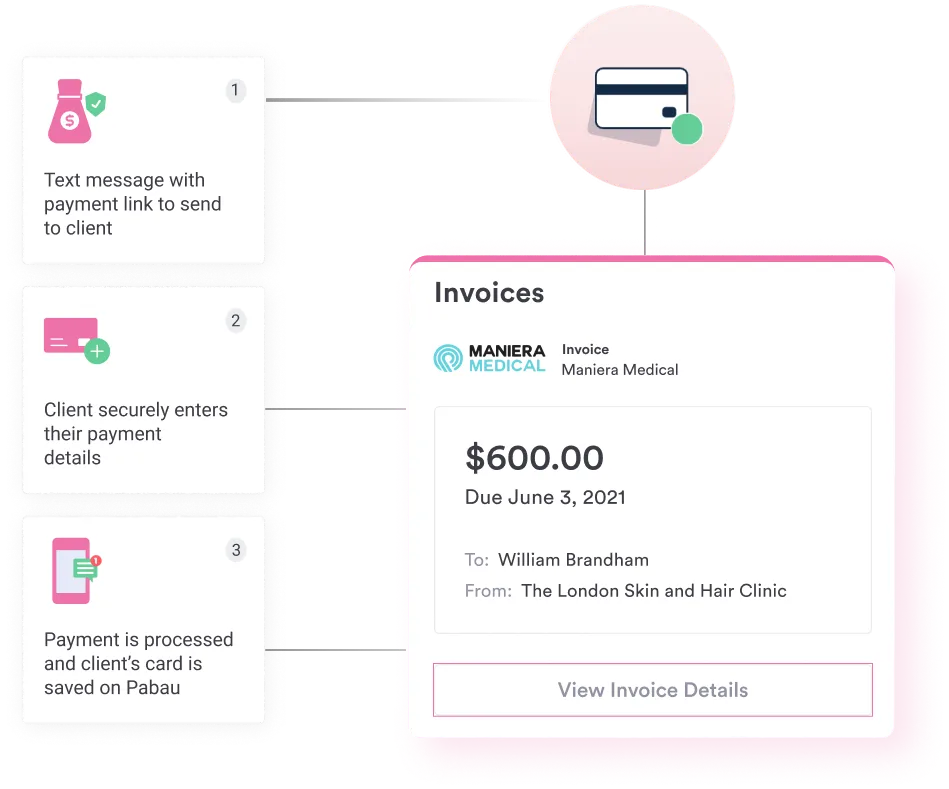
The platform supports hybrid payment models common in UK private care: self-pay invoicing, insurance claim pre-authorisation, split billing (patient pays excess, insurer covers procedure), and instalment plans through Klarna integration. A functional medicine clinic might process a £1,200 consultation where £800 is claimed through Vitality Health and £400 is invoiced to the patient as an excess payment. Pabau’s financial module tracks both transactions under the same appointment record, reconciling payments against outstanding balances and generating separate invoices for patient and insurer portions.
Key Features
Healthcode Claims Integration: Direct API connection to submit CCSD-coded claims to UK private insurers with automated pre-authorisation workflows and real-time claim status tracking
Multi-Industry Clinical Templates: Pre-built forms for aesthetics (Botox plotting, dermal filler consent), physiotherapy (SOAP notes, outcome measures), mental health (psychiatric evaluations, therapy session notes), and GP consultations
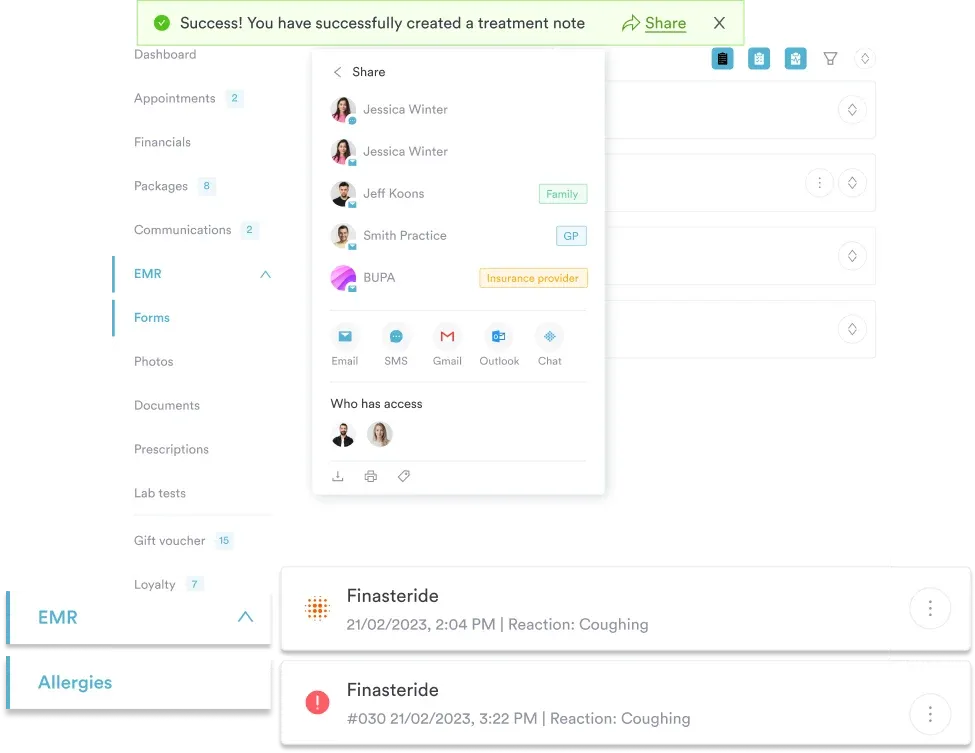
Unified Patient Records: Centralised EMR combining consultation notes, prescriptions, lab results, before-and-after photos, treatment plans, and financial transactions under single patient profiles
Automated Recall & Retention: Workflow automation for Botox recall emails, annual screening reminders, membership renewal notifications, and post-treatment follow-up sequences
Multi-Location Coordination: Shared patient records, inventory, and reporting across clinic locations with role-based access controls and location-specific compliance settings
Integrated Payment Processing: Native Pabau Pay terminal for in-clinic card payments, online deposits through Stripe, and Klarna financing for treatment packages
Echo AI Clinical Scribe: Voice-to-text clinical note generation with specialty-specific templates and automatic ICD-10 or CCSD code suggestions based on consultation content
CQC-Aligned Documentation: Audit trails, consent form versioning, staff training records, and complaint logging structured to support Care Quality Commission inspection requirements
Pricing
Plan
Price
Who It’s For
Key Features
Pabau Standard
£62 / $77 per user/month (20% discount annual)
Solo practitioners to mid-size clinics (1-15 practitioners)
Dedicated account manager, custom integrations, enhanced support SLA, data migration assistance
Pabau operates a single-tier pricing model where all clinical, billing, and operational features are included at the base £62 per user monthly rate. There are no feature gates for advanced modules like Healthcode claims, Echo AI scribe, or multi-location management. The 20% annual discount brings the effective monthly cost to £49.60 per user when paid yearly.
Where Pabau Shines
UK-Specific Insurance Workflows: The Healthcode integration is purpose-built for CCSD codes and UK private insurer claim formats. US platforms require manual CCSD code entry and lack direct API connections to Bupa or AXA PPP, forcing clinics into email-based claim submission or third-party clearinghouse exports.
Multi-Industry Flexibility: A single platform supports aesthetic clinics running Botox injection plotting, physiotherapy practices tracking ROM measurements, mental health clinics using psychiatric evaluation templates, and private GP practices managing prescriptions through NHS-compliant formularies. Competitors typically specialise in one vertical (SimplePractice for therapy, Zenoti for spa operations).
Unified Payment Reconciliation: The financial module handles self-pay invoicing, insurance claim tracking, split billing (patient + insurer portions), package purchases, membership subscriptions, and retail product sales under consolidated reporting. A multi-specialty clinic reconciles all revenue streams without exporting to separate accounting software.
Operational Automation Depth: Pre-built workflows for recall campaigns (12-week Botox follow-up), win-back sequences (6-month inactive patient), membership renewal reminders, and post-treatment care instructions execute without manual intervention. Automated workflows reduce administrative overhead in practices seeing 80+ weekly appointments.
Embedded Compliance Tools: CQC documentation requirements (consent versioning, staff training logs, complaint registers, clinical audit trails) are structured into core workflows rather than added as afterthoughts. UK regulatory alignment is native, not retrofitted.
Where Pabau Falls Short
Learning Curve for Multi-Feature Platform: The breadth of features (EMR, billing, marketing, inventory, labs, telehealth) creates onboarding complexity for small practices migrating from single-purpose tools. Clinics report 2-4 weeks of staff training before reaching full operational proficiency.
Limited US Insurance Integration: While Pabau supports CPT and ICD-10 coding, it lacks native integrations with US insurance clearinghouses like Availity or Change Healthcare. US-based practices require workarounds for Medicare or commercial payer claim submission.
Customer Reviews
Review platform data for Pabau was not found in public G2, Capterra, or Trustpilot profiles at the time of research. The platform’s customer base is concentrated in UK and European private healthcare markets, where review aggregation through these platforms is less common than in US software markets. Prospective users should request references directly from Pabau’s sales team for clinics operating in similar specialties and practice sizes.
Who Pabau Is Best For
UK multi-specialty clinics processing CCSD-coded insurance claims alongside self-pay and hybrid payment models
Aesthetic and wellness practices requiring injection plotting, before-and-after photo management, and product inventory tracking
Multi-location clinic groups needing shared patient records, centralised reporting, and coordinated recall campaigns across sites
Private GP and functional medicine practices combining consultations, prescriptions, lab result management, and insurance billing in unified workflows
Carepatron: Best for Cost-Effective Allied Health Solo Practices
Carepatron targets allied health solo practitioners and small teams prioritising affordability and simplicity over operational depth. The platform offers a free tier with unlimited patient records, basic scheduling, and Stripe payment processing-removing the upfront cost barrier for newly established practices. According to G2 reviewers, Carepatron holds a 4.9 out of 5 rating based on over 522 verified reviews, with users citing cost-effectiveness and telehealth integration as primary strengths.
The platform’s design philosophy centres on reducing feature complexity. A physiotherapist running a solo practice books appointments, completes SOAP notes, generates invoices, and conducts video consultations within a streamlined interface that prioritises speed over customisation. Carepatron sacrifices multi-location coordination, advanced inventory management, and UK-specific insurance claim workflows in favour of core practice management essentials delivered at minimal cost
Key Features
Free Tier Access: Unlimited patient records, basic scheduling, note templates, and Stripe payment integration at no monthly cost
Integrated Telehealth: Built-in video consultation platform eliminating the need for separate Zoom or Doxy.me subscriptions
AI Scribe Functionality: Automated clinical note generation from consultation recordings using natural language processing
Customisable Billing Items: Flexible invoice line item creation for varied service offerings and product sales
Expanded AI scribe usage, custom branding, advanced reporting, priority support
For a more comprehensive analysis of these costs and how they compare to industry standards, you can view a full review of Carepatron pricing to determine the best fit for your budget.
Where Carepatron Shines
Zero-Cost Entry: The free tier removes financial barriers for newly qualified practitioners establishing solo practices without upfront software investment
Telehealth Consolidation: Built-in video consultation eliminates separate subscriptions to telehealth platforms, reducing monthly software costs
AI Clinical Assistance: The scribe feature reduces documentation time for practitioners conducting high-volume consultations
Where Carepatron Falls Short
No UK Insurance Integration: The platform lacks CCSD code support and direct connections to UK private insurers, requiring manual claim preparation for Bupa or AXA PPP submissions
Single-Practitioner Focus: Multi-location coordination, shared inventory management, and team-based workflows are absent or rudimentary compared to Pabau or Zenoti
Customer Reviews
According to G2 reviewers, Carepatron maintains a 4.9 out of 5 rating based on over 522 verified reviews. Users highlight cost-effectiveness for healthcare providers, seamless telehealth and calendar integrations, customisable forms, and AI scribe functionality as key advantages. The high rating reflects satisfaction among solo practitioners and small allied health teams prioritising affordability and core practice management functions.
Who Carepatron Is Best For
Solo allied health practitioners (physiotherapists, occupational therapists, counsellors) seeking free or low-cost practice management software
Telehealth-first practices conducting primarily remote consultations and requiring integrated video functionality
Practitioners with simple billing needs processing self-pay patients without UK private insurance claim requirements
SimplePractice: Best for Mental Health and Therapy Practices
SimplePractice dominates the US mental health software market, serving over 250,000 practitioners according to company-reported figures. The platform specialises in therapy-specific workflows: HIPAA-compliant telehealth, insurance billing for CPT 90832-90899 psychotherapy codes, and clinical documentation templates aligned with psychiatric and counselling practice patterns. UK practices using SimplePractice typically operate under US insurance models or serve international patient populations requiring US-standard documentation.
The platform’s therapy-centric design manifests in session note templates (SOAP, DAP, BIRP formats), treatment plan builders for mental health diagnoses, and integrated billing for both insurance claims and superbills. A psychology practice processing 40 weekly sessions manages appointment reminders, video consultations, clinical notes, and claim submissions through a unified workflow designed around therapy session economics and regulatory requirements.
Key Features
Therapy-Specific Documentation: Pre-built templates for psychiatric evaluations, therapy session notes, treatment plans, and progress reports aligned with mental health practice standards
Integrated Telehealth: HIPAA-compliant video platform eliminating the need for separate Zoom subscriptions, with session recording and transcript capabilities
Insurance Billing Module: Claim submission to US insurance payers with CPT code automation, ERA processing, and superbill generation for out-of-network reimbursement
Client Portal: Secure messaging, appointment self-scheduling, intake form completion, and payment processing accessible to patients between sessions
SimplePractice operates tiered pricing where lower-cost plans restrict client capacity and feature access. The $49 per month entry tier accommodates solo practitioners with limited caseloads, while higher tiers remove client caps and unlock insurance billing automation.
Where SimplePractice Shines
Mental Health Workflow Optimisation: The platform anticipates therapy practice patterns-recurring weekly sessions, insurance pre-authorisation tracking, superbill generation for out-of-network clients-reducing setup complexity for mental health practitioners
US Insurance Integration Depth: Direct claim submission to Medicare, Medicaid, and commercial payers through integrated clearinghouse connections simplifies revenue cycle management for US-based practices
Therapy Community Trust: The 250,000+ practitioner user base creates network effects: peer recommendations, established integrations with therapy directories (Psychology Today), and specialty-specific support resources
Where SimplePractice Falls Short
UK Private Insurance Incompatibility: No CCSD code support or direct integration with Bupa, AXA PPP, or other UK insurers. UK practices require manual claim preparation outside the platform
Non-Therapy Practice Limitations: The platform lacks clinical workflows for aesthetic treatments, physiotherapy assessments, or multi-specialty medical consultations. A private GP practice would find documentation templates and billing logic misaligned with general medical workflows
Customer Reviews
Review platform data for SimplePractice on G2, Capterra, and Trustpilot was not found during research. The platform’s market presence is well-established in the US therapy sector, with the reported 250,000+ practitioner user base indicating broad adoption. Users cite HIPAA-compliant operations, comprehensive scheduling functionality, and integrated billing and documentation as primary strengths based on company marketing materials.
Who SimplePractice Is Best For
US-based mental health practitioners (psychologists, therapists, counsellors) requiring integrated insurance billing and telehealth
Therapy group practices managing multiple clinicians under shared administrative workflows and centralised billing
UK therapists serving US clients or operating under US insurance reimbursement models requiring CPT coding and superbill generation
Zenoti: Best for Spa, Salon, and Medspa Operations
Zenoti serves the spa, salon, and medspa vertical with POS-centric architecture optimised for retail product sales, commission-based staff compensation, and membership subscription management. The platform’s design prioritises transaction speed and inventory turnover over clinical documentation depth. A medspa offering Botox injections alongside facials and retail skincare products uses Zenoti to process treatments, track product inventory, calculate technician commissions, and manage membership tiers under unified reporting.
The platform’s global footprint supports multi-currency operations and localised customer service, with 24/7 support cited as a key advantage by users. Zenoti’s integration ecosystem connects to spa-specific vendors-product distributors, booking platforms, marketing automation tools-creating operational density for wellness businesses balancing service delivery with retail sales.
Key Features
POS and Retail Focus: Transaction processing optimised for high-volume product sales with barcode scanning, multi-tender payments, and gift card management
Commission Calculation: Automated staff compensation tracking based on service revenue, product sales, and performance tiers
Membership Management: Recurring subscription billing, member benefits tracking, and automated renewal workflows for spa membership programs
Custom Digital Forms: Intake questionnaires and consultation forms tailored to spa and medspa service offerings
Pricing
Plan
Price
Who It’s For
Key Features
Custom Pricing
Contact Zenoti for rates
All practice sizes and spa types
Pricing varies by location count, transaction volume, and feature selection
Zenoti does not publish standard pricing. Implementation costs scale with business size, number of locations, and required integrations. Practices should request detailed quotes accounting for setup fees, monthly subscription, and payment processing rates.
Where Zenoti Shines
Retail-Service Hybrid Operations: The platform handles spa service appointments and retail product sales with equal operational depth, tracking inventory turnover, supplier orders, and sales performance across both revenue streams
Commission Automation: Automated calculation of staff compensation based on service bookings and product sales reduces manual payroll reconciliation in commission-driven businesses
Global Support Infrastructure: 24/7 customer service and multi-language support accommodate international spa operations and franchise networks across time zones
Where Zenoti Falls Short
Clinical Documentation Limitations: The platform lacks the EMR depth required for medical practices beyond medspa treatments. Physiotherapy clinics, mental health practices, or private GP services would find documentation templates and clinical workflows insufficient
UK Insurance Billing Gaps: No native CCSD code support or UK private insurer integrations. Medspas processing insurance claims for medical-grade treatments require workarounds or supplementary billing software
Customer Reviews
Review platform data for Zenoti was not found on G2, Capterra, or Trustpilot during research. Company marketing materials emphasise wide feature sets at reasonable pricing, custom digital forms, localised customer service, and 24/7 global support as key value propositions. The platform’s focus on spa and salon operations positions it as a vertical-specific solution rather than a general healthcare practice management system.
Who Zenoti Is Best For
Medspas balancing clinical services and retail sales requiring unified POS and service booking management
Multi-location spa and salon chains needing centralised inventory, membership management, and commission tracking across sites
Franchise spa operations requiring standardised workflows, brand consistency, and centralised reporting across independent franchise owners
See How Pabau Streamlines UK Insurance Billing
Discover how Healthcode integration, CCSD coding, and automated claim workflows reduce administrative burden for UK private practices. Book a personalised demo with our team.
AdvancedMD: Best for US Multi-Specialty Practices Requiring Deep RCM
AdvancedMD targets US multi-specialty medical practices requiring comprehensive revenue cycle management integrated with clinical workflows. The platform combines EHR, practice management, and medical billing under a unified architecture designed for practices managing complex CPT coding, multi-payer contracts, and high claim volumes. A primary care practice processing 200+ daily appointments across five physicians uses AdvancedMD to manage clinical documentation, insurance eligibility verification, claim submission, denial management, and payment posting through interconnected modules.
The platform’s RCM depth manifests in automated claim scrubbing, real-time eligibility checks, and denial workflow management. AdvancedMD’s billing module flags coding errors, missing modifiers, and authorisation gaps before claim submission. Compliance-focused medical billing and coding compliance services emphasize the importance of pre-submission validation in reducing denial rates.
, reducing first-pass denial rates. Practices report that built-in compliance checks for Medicare, Medicaid, and commercial payer rules reduce manual billing staff intervention compared to standalone EMR systems requiring separate billing software.
Key Features
Integrated Revenue Cycle Management: End-to-end billing workflows from eligibility verification through claim submission, denial management, and payment reconciliation
EHR with Specialty Templates: Clinical documentation templates customised for primary care, cardiology, dermatology, paediatrics, and other medical specialties
Real-Time Claim Scrubbing: Automated validation of CPT codes, modifiers, and payer-specific requirements before electronic claim submission
Patient Portal: Online appointment scheduling, secure messaging, medical record access, and bill payment functionality for patients
Pricing
Plan
Price
Who It’s For
Key Features
Custom Pricing
Contact AdvancedMD for rates
Multi-specialty US practices with complex billing needs
Pricing varies by practice size, specialty, and module selection (EHR, PM, RCM)
AdvancedMD pricing is customised based on practice size, number of providers, specialty requirements, and whether practices purchase EHR-only, practice management-only, or full integrated RCM services. Implementation fees, training costs, and ongoing support are negotiated per contract.
Where AdvancedMD Shines
End-to-End RCM Integration: The platform connects clinical documentation directly to billing workflows, automatically pulling diagnosis codes from encounter notes into claim forms and applying payer-specific billing rules
Multi-Specialty Flexibility: Clinical templates and billing logic accommodate diverse medical specialties within a single platform, supporting multi-disciplinary practices without requiring separate software per department
US Payer Expertise: Built-in knowledge of Medicare, Medicaid, and commercial insurance requirements reduces configuration complexity for US-based practices navigating complex reimbursement models
Where AdvancedMD Falls Short
UK Private Insurance Incompatibility: The platform lacks CCSD code libraries, UK insurer claim formats, and integration with Bupa, AXA PPP, or other UK-specific payers. UK practices would require extensive customisation or parallel billing systems
Complexity for Small Practices: The breadth of RCM features creates learning curves and configuration overhead disproportionate to solo or small practice needs. Clinics seeking simple scheduling and invoicing may find the platform over-engineered
Customer Reviews
Review platform data for AdvancedMD was not found on G2, Capterra, or Trustpilot during research. The platform’s market position focuses on mid-to-large US medical practices requiring comprehensive EHR and billing integration, with sales driven through direct enterprise engagements rather than self-service sign-ups commonly reviewed on public platforms.
Who AdvancedMD Is Best For
US multi-specialty medical practices requiring integrated EHR and revenue cycle management across multiple provider types
High-volume billing operations processing 1,000+ monthly claims with complex CPT coding and modifier requirements
Practices transitioning from paper-based systems seeking comprehensive digital transformation including clinical, administrative, and financial workflows
DrChrono: Best for US Primary Care and Ambulatory Practices with iPad Workflows
DrChrono pioneered iPad-first EHR design, positioning the platform for mobile-centric clinical workflows in primary care, urgent care, and ambulatory settings. The platform’s architecture prioritises device portability and touch-optimised interfaces over desktop-centric data entry. A primary care physician conducting patient rounds with an iPad documents encounters, orders prescriptions, and reviews lab results through a mobile interface designed for standing or walking consultations rather than desktop workstation sessions.
The platform integrates EHR, practice management, and medical billing under cloud-based infrastructure accessible across devices. DrChrono’s billing module supports claim submission to US insurance payers, eligibility verification, and payment posting, though with less RCM depth than AdvancedMD’s dedicated revenue cycle services. The platform suits primary care practices prioritising clinical mobility and patient engagement features over complex multi-specialty billing workflows.
Key Features
iPad-Optimised Interface: Touch-friendly clinical documentation, prescription writing, and patient communication designed for mobile device workflows
Patient Engagement Tools: Online booking, appointment reminders, telehealth consultations, and medical record access through patient-facing apps
Integrated Billing: Claim submission to US payers with CPT and ICD-10 coding automation and payment tracking
API Ecosystem: Open API enabling custom integrations with labs, pharmacies, imaging centres, and third-party clinical applications
Pricing
Plan
Price
Who It’s For
Key Features
Custom Pricing
Contact DrChrono for rates
Primary care and ambulatory US practices
Pricing varies by practice size, provider count, and billing service inclusion
DrChrono does not publish standard pricing. Practices receive customised quotes based on provider count, desired feature modules (EHR, PM, billing services), and implementation requirements.
Where DrChrono Shines
Mobile Clinical Workflows: The iPad-first design enables bedside charting, mobile prescription management, and point-of-care documentation without desktop computer dependency
Patient-Facing Technology: Online scheduling, telehealth integration, and mobile app access improve patient engagement and reduce administrative call volume for appointment management
API Flexibility: The open API architecture supports custom integrations with third-party clinical tools, enabling practices to connect specialised diagnostic equipment or niche medical applications
Where DrChrono Falls Short
UK Insurance Billing Absence: No CCSD code support or UK private insurer integrations. The platform’s billing module is designed exclusively for US payer formats and claim submission protocols
Limited Multi-Specialty Depth: While the EHR supports basic primary care workflows, practices requiring specialty-specific clinical templates (dermatology, cardiology, orthopaedics) may find documentation tools less comprehensive than AdvancedMD or specialty-focused platforms
Customer Reviews
Review platform data for DrChrono was not found on G2, Capterra, or Trustpilot during research. The platform’s market focus on US primary care and ambulatory practices positions it as a direct competitor to Athenahealth and eClinicalWorks in the mobile-first EHR segment.
Who DrChrono Is Best For
US primary care practices prioritising mobile clinical workflows and iPad-centric documentation
Urgent care and ambulatory clinics requiring point-of-care charting without fixed workstation infrastructure
Tech-forward practices seeking API integration capabilities to connect custom clinical tools and third-party healthcare applications
NextGen Healthcare: Best for Enterprise-Scale US Practices Requiring Interoperability
NextGen Healthcare serves mid-to-large US medical practices and health systems requiring scalable EHR infrastructure, population health management capabilities, and extensive interoperability with external health information exchanges. The platform supports multi-location operations, specialty-specific clinical workflows, and data exchange protocols (FHIR, HL7) enabling integration with hospital systems, regional health networks, and accountable care organisations.
The platform’s population health module tracks quality measures, care gaps, and patient panel analytics across thousands of patients, supporting value-based care models and MIPS reporting requirements. A multi-physician family medicine practice participating in Medicare Shared Savings Programs uses NextGen to monitor chronic disease management metrics, coordinate care transitions, and report quality performance to CMS through automated data extraction from clinical workflows.
Key Features
Scalable EHR Architecture: Cloud-based platform supporting practices from 5 to 500+ providers with centralised patient records, shared templates, and unified reporting
Population Health Management: Patient panel analytics, care gap identification, chronic disease registries, and quality measure tracking for value-based care programs
Interoperability Standards: FHIR and HL7 data exchange protocols enabling integration with hospital EHRs, health information exchanges, and external care coordination networks
Specialty-Specific Templates: Clinical documentation workflows customised for cardiology, orthopaedics, paediatrics, OB/GYN, and other medical specialties
Pricing
Plan
Price
Who It’s For
Key Features
Custom Pricing
Contact NextGen Healthcare for rates
Mid-to-large US medical practices and health systems
Enterprise pricing based on provider count, module selection, and implementation scope
NextGen Healthcare operates enterprise sales models with pricing customised per deployment. Implementation costs include software licensing, data migration, staff training, and ongoing support services scaled to practice size and technical requirements.
Where NextGen Healthcare Shines
Enterprise Scalability: The platform supports growth from small group practices to multi-site health systems without requiring migration to different software, enabling long-term operational continuity
Value-Based Care Infrastructure: Built-in population health analytics, quality reporting, and care coordination tools align with Medicare Quality Payment Programs and commercial value-based contracts
Interoperability Depth: FHIR and HL7 compliance enables data exchange with hospital EHRs, regional HIEs, and external care networks, supporting coordinated care models and referral workflows
Where NextGen Healthcare Falls Short
UK Market Misalignment: The platform’s architecture centres on US regulatory requirements (MACRA, MIPS, HEDIS), US payer contracts, and CPT/ICD-10 coding workflows. UK practices would require extensive customisation for CCSD codes, UK insurer formats, and CQC compliance workflows
Implementation Complexity: Enterprise-scale deployments involve multi-month implementation timelines, extensive staff training, and significant upfront investment. Small practices may find the platform over-engineered for their operational needs
Customer Reviews
Review platform data for NextGen Healthcare was not found on G2, Capterra, or Trustpilot during research. The platform’s enterprise focus and direct sales model result in customer relationships managed through account representatives rather than public review platforms commonly used for self-service software evaluation.
Who NextGen Healthcare Is Best For
Mid-to-large US medical practices requiring scalable EHR infrastructure supporting 20+ providers across multiple locations
Practices participating in value-based care programs needing population health analytics and quality measure reporting for MIPS, MSSP, or commercial ACO contracts
Health systems requiring interoperability with hospital EHRs, health information exchanges, and regional care coordination networks
Pro Tip
Before committing to US-centric platforms like AdvancedMD or DrChrono, audit your UK private insurance claim volume. If more than 20% of revenue comes from Bupa, AXA PPP, or other UK insurers, prioritise platforms with native CCSD code support and direct insurer integrations. Manual claim preparation outside your EHR doubles administrative overhead and increases denial rates due to data transcription errors.
How to Choose the Right Medical Billing Software for Your UK Practice
Selecting medical billing software requires matching platform capabilities to your practice’s insurance billing complexity, clinical specialty, patient volume, and regulatory requirements. A physiotherapy clinic processing 40 self-pay weekly appointments has different needs than a dermatology practice submitting 200 CCSD-coded Bupa claims monthly. This decision framework prioritises the operational variables that determine software fit.
Assess UK private insurance claim volume and complexity. Practices deriving over 30% of revenue from Bupa, AXA PPP, Aviva, or other UK insurers require platforms with native CCSD code libraries and direct insurer API integrations. Pabau’s Healthcode connection automates pre-authorisation, claim submission, and status tracking. US-centric platforms (SimplePractice, AdvancedMD, DrChrono) lack UK insurer integrations, forcing manual claim preparation outside the EHR and increasing administrative burden. If your practice processes fewer than 10 insurance claims monthly, lightweight platforms like Carepatron may suffice for self-pay invoicing without insurance automation overhead.
Match clinical specialty to documentation depth. Mental health practitioners benefit from SimplePractice’s therapy-specific templates (SOAP notes, treatment plans, psychiatric evaluations). Aesthetic clinics require injection plotting, before-and-after photo management, and product inventory tracking available in Pabau. Spa operations prioritising retail sales and commission calculation align with Zenoti’s POS-centric design. Multi-specialty medical practices need platforms supporting diverse clinical workflows (Pabau for UK contexts, AdvancedMD or NextGen for US multi-specialty groups). Evaluate whether pre-built templates match your documentation patterns or if extensive customisation will be required.
Calculate total operational cost beyond software subscription. Published pricing rarely reflects true implementation costs. Factor in: setup fees (£ for Carepatron, £1,000+ for enterprise platforms), payment processing rates (2.5-3.5% per transaction), staff training time (1-4 weeks depending on platform complexity), data migration costs from existing systems, and ongoing support charges. A £62 per month subscription (Pabau) with 20% annual discount and included payment processing may cost less over 12 months than a £39 per month platform (SimplePractice) requiring separate Stripe account fees and limited UK support. Request detailed pricing breakdowns including all ancillary costs before committing.
Evaluate compliance alignment with UK regulations. UK practices must satisfy CQC documentation requirements, GDPR data handling protocols, and UK-specific consent standards. Healthcare software may also require medical devices ethical approval requirements under Medical Devices Regulations depending on clinical functionality. Platforms designed for UK markets (Pabau) embed these requirements into core workflows-consent versioning, audit trails, staff training logs, complaint registers. US-centric platforms emphasise HIPAA compliance and CPT coding resources from AMA, which overlap with but do not fully address GDPR requirements and CCSD coding standards. Confirm whether platforms include: encryption at rest and in transit, role-based access controls, audit logging of record access, data processing agreements (DPAs) compliant with UK GDPR, and support for patient data subject access requests (DSARs). Platforms without UK GDPR alignment create compliance gaps requiring manual workarounds.
Test scalability against growth projections. Solo practitioners may outgrow platforms designed for single-user operations (Carepatron’s free tier) within 12-18 months. Multi-location expansion requires centralised patient records, shared inventory, and consolidated reporting-features absent in therapy-specific platforms like SimplePractice. Enterprise platforms (NextGen Healthcare, AdvancedMD) support 100+ provider deployments but impose implementation complexity disproportionate to 5-practitioner clinics. Select platforms offering growth pathways without requiring full platform migrations: Pabau scales from solo practitioners to multi-location groups under unified architecture; Zenoti accommodates single spas expanding into franchise networks.
Platform selection errors manifest as administrative inefficiency, claim denial rate increases, and staff frustration with inadequate workflows. A mental health practice adopting Zenoti for clinical documentation would struggle with spa-centric templates misaligned to therapy notes. An aesthetic clinic choosing SimplePractice would lack injection plotting and product inventory management. UK practices selecting US-centric platforms without Healthcode integration spend 30-60% more time on manual claim preparation compared to native UK billing automation. Prioritise operational fit over feature count-a platform aligned to your specialty, insurance model, and compliance context delivers better outcomes than feature-rich software mismatched to your practice patterns.
Expert Picks
Need structured CCSD code guidance for UK private insurance claims?Bupa CCSD Codes explains code structure, common procedure mappings, and claim submission requirements for Bupa private medical insurance.
Comparing UK-focused vs US-focused practice management platforms?Practice Management Software evaluates operational differences between platforms designed for UK regulatory contexts and those built for US healthcare workflows.
Evaluating billing automation impact on claim approval rates?Claims Management Software details how automated CCSD coding, pre-authorisation workflows, and direct insurer API connections reduce denial rates in UK private practices.
Conclusion: Choosing the Best Medical Billing Software for UK Practices
Medical billing software selection hinges on insurance claim complexity, clinical specialty alignment, and regulatory compliance requirements. UK practices processing CCSD-coded claims through Bupa, AXA PPP, or other private insurers require platforms with native UK insurer integrations-capabilities absent in US-centric systems designed for CPT coding and Medicare workflows. Pabau’s Healthcode connection automates UK insurance claim workflows from pre-authorisation through payment reconciliation, reducing administrative overhead compared to manual claim preparation outside the EHR.
Platform fit varies by practice type. Mental health practitioners benefit from SimplePractice’s therapy-specific documentation and US insurance billing depth. Spa and medspa operations align with Zenoti’s POS-centric design and retail inventory management. Multi-specialty medical practices requiring diverse clinical workflows and multi-location coordination find operational density in Pabau’s unified architecture. Solo practitioners prioritising cost-effectiveness over feature breadth may suit Carepatron’s free tier for basic scheduling and invoicing without insurance claim automation.
The seven platforms evaluated serve distinct practice archetypes. Pabau leads for UK multi-industry clinics needing CCSD billing automation, multi-location coordination, and CQC compliance workflows. US platforms (AdvancedMD, DrChrono, NextGen Healthcare) offer deep RCM capabilities and specialty-specific EHR templates but require extensive configuration for UK insurance formats and GDPR alignment. Carepatron minimises upfront costs for allied health solo practices. SimplePractice dominates US mental health billing. Zenoti optimises spa operations balancing clinical services and retail sales.
Operational success depends on matching software capabilities to practice-specific workflows rather than chasing feature counts. A dermatology clinic submitting 150 monthly Bupa claims gains more value from Pabau’s native CCSD support than from AdvancedMD’s broader US billing features requiring manual adaptation. Evaluate platforms against your insurance claim volume, clinical documentation patterns, multi-location requirements, and UK regulatory context. Request demonstrations focused on your specialty’s specific workflows-Botox injection documentation for aesthetic clinics, therapy session notes for mental health practices, POS transactions for medspa operations. Platform selection is an operational infrastructure decision: choose the system that reduces administrative friction for your specific practice model rather than the platform with the longest feature list.
Frequently Asked Questions
What is medical billing software?
Medical billing software manages financial transactions between healthcare practices and patients or insurers. It automates invoice generation, insurance claim submission, payment processing, and revenue reconciliation. UK private practices use billing software to process CCSD-coded claims to insurers like Bupa and AXA PPP, track self-pay patient invoicing, and reconcile payments against outstanding balances.
Why use medical billing software?
Medical billing software reduces manual administrative work, accelerates payment cycles, and improves claim approval rates through automated coding validation. Practices using integrated billing systems report 15-25% reductions in claim denial rates compared to manual submission processes. Automated workflows eliminate data entry errors, track claim status in real-time, and generate financial reports consolidating insurance and self-pay revenue streams.
What are the must-have features of medical billing software?
Essential features include: automated coding support (CCSD for UK practices, CPT/ICD-10 for US), direct integration with insurance payers or clearinghouses, payment processing for self-pay patients, claim status tracking, denial management workflows, and financial reporting. UK practices require platforms supporting CCSD codes and direct API connections to UK insurers. US practices prioritise CPT coding automation and Medicare/Medicaid clearinghouse integrations.
What is the difference between RCM software and medical billing software?
Revenue Cycle Management (RCM) software encompasses the entire financial workflow from patient registration through final payment posting-including eligibility verification, pre-authorisation, claim submission, denial management, and payment reconciliation. Medical billing software focuses specifically on claim generation and submission. RCM platforms like AdvancedMD offer comprehensive financial workflows; simpler billing tools like Carepatron handle invoicing and basic claim preparation without full RCM depth.
What should I consider when buying medical billing software?
Evaluate: UK insurance integration depth (CCSD code support, direct insurer API connections), clinical specialty template alignment, multi-location coordination capabilities, GDPR compliance features, total cost including setup fees and payment processing rates, scalability for practice growth, and staff training requirements. UK practices processing significant private insurance volume require platforms with native Healthcode or equivalent UK insurer integrations rather than US-centric systems requiring manual claim adaptation.