Aesthetics & Beauty Medspa
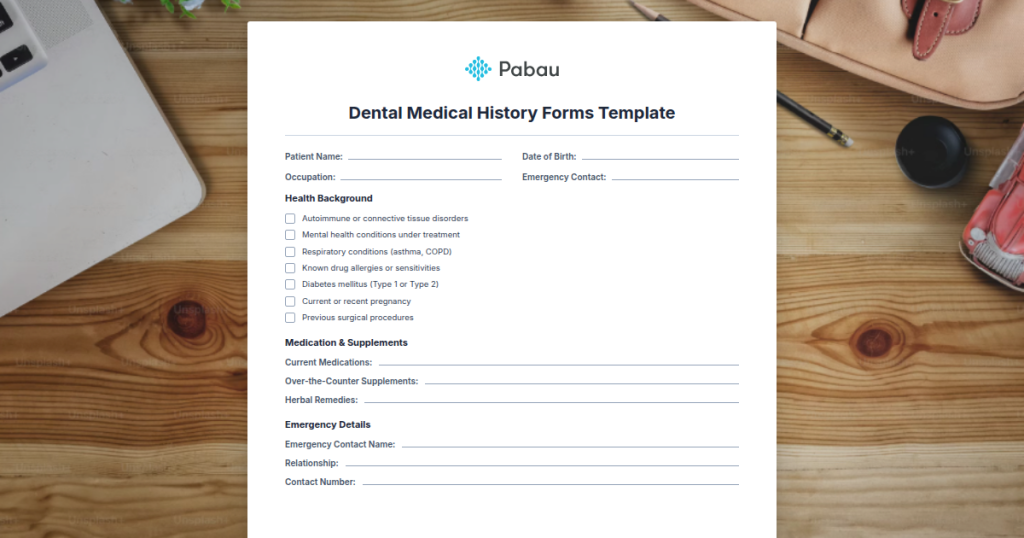
Dental Medical History Forms Template
A dental medical history form template is a standardised patient intake document...

March 16, 2026


Buy now, pay later is now available in Pabau

Document injection sites, units, and product batch numbers for every treatment.
Informed consent and pre/post-care instructions protect clinics and patients.
Structured treatment notes simplify compliance audits and regulatory inspections.
Digital templates link to appointment history and patient photo timelines.
A botox treatment note template is the clinical backbone of aesthetic practice documentation. Recording injection sites, dosage, product details, and patient consent creates a comprehensive record that protects both practitioner and patient throughout the treatment journey. This template captures the precise information regulators, auditors, and follow-up clinicians need to understand each procedure.
Aesthetic clinics operating under CQC oversight, HIPAA compliance, or GDPR standards must maintain clear, structured treatment documentation. A well-designed botox treatment note template reduces documentation time, prevents incomplete records, and demonstrates clinical rigour during inspections. Whether you manage a medspa, dermatology clinic, or aesthetic nursing practice, a standardised template ensures consistency across all practitioners and appointments.
This guide explains what every botox treatment note should include, how to structure your template for maximum clinical clarity, and how to integrate documentation with your clinic’s broader compliance and patient care workflows.
A comprehensive documentation template for recording botulinum toxin treatments, capturing patient information, treatment assessment, injection site mapping, dosage units, product batch tracking, and post-procedure care instructions to maintain clinical standards across aesthetic clinics and medspa practices.
Download templateA botox treatment note template is a structured clinical documentation form designed to record every essential detail of a botulinum toxin injection procedure. Unlike generic progress notes, a Botox-specific template captures the unique data points required for aesthetic injectable treatments: injection site anatomy, unit dosage per area, product batch numbers, and baseline patient assessment.
The template serves three critical purposes. Clinically, it ensures thorough documentation of treatment parameters, contraindications screening, and patient response – information vital if the patient returns for touch-ups or if adverse events require investigation. Legally, it demonstrates informed consent, documented risk disclosure, and adherence to professional standards during regulatory inspections or liability claims. Operationally, it creates a permanent record that supports appointment scheduling, product inventory tracking, and before/after photo timelines.
According to the FDA, aesthetic practitioners administering botulinum toxin must maintain records documenting the product used, dose administered, injection sites, patient consent, and any adverse reactions. The MHRA (UK) similarly requires detailed treatment records for medical device applications. A properly structured botox treatment note template ensures compliance with both US and UK regulatory standards without requiring separate documentation systems.
The template also protects practitioners during CQC inspections or medical defence organisation reviews. Clear, contemporaneous documentation of patient assessment, treatment goals, injection parameters, and post-care instructions demonstrates clinical competence and professional accountability – the foundation of safe aesthetic practice.
A well-structured botox treatment note template works best when completed in real-time during or immediately after the procedure. Completing the form while the treatment is fresh ensures accuracy and prevents documentation gaps that could compromise clinical records during audits or adverse event investigations.
Store the completed template in the patient’s digital or paper record alongside appointment notes and consent forms. Link it to any before/after photography to create a comprehensive treatment timeline that supports clinical decision-making and regulatory compliance.

Digital treatment notes that link to appointment history, product inventory, and patient photos in one unified timeline.

Any aesthetic practice administering botulinum toxin injections needs a structured botox treatment note template. The template works across multiple clinical settings because Botox is administered in diverse practice environments – each with specific regulatory and operational demands.
Medical Spas and Aesthetic Clinics use botox treatment note templates as part of their standard intake and documentation protocol. A medspa managing 40-60 Botox appointments per week benefits from a consistent template that all aesthetic nurses and injectors complete in the same format. This uniformity simplifies manager audits, supports staff training, and ensures regulatory compliance across all appointments.
Dermatology Practices often administer Botox as part of comprehensive skin rejuvenation consultations. A dermatologist documenting Botox alongside laser resurfacing or chemical peels uses the template to keep neurotoxin details distinct from other procedures – crucial for follow-up care and adverse event investigation.
Cosmetic Surgery Clinics offering Botox as an adjunct to surgical procedures (e.g. post-operative brow lift Botox) need clear documentation linking procedural notes to injectable treatments. A structured template ensures the surgical team and injectable specialists communicate through the written record.
Aesthetic Nursing and Nurse Practitioner Practices rely on detailed botox treatment note templates to demonstrate clinical competence and meet professional indemnity insurance requirements. Insurance underwriters specifically review treatment documentation – a complete, consistent template supports claims processing and defence if complications arise.
Solo Practitioners and Small Teams benefit most from downloadable templates. A solo aesthetic nurse injector or a two-person medspa cannot afford custom documentation systems – a free template ensures professional-grade record-keeping from day one.
A structured botox treatment note template transforms how aesthetic clinics document injectable procedures. The benefits extend across clinical safety, regulatory compliance, and operational efficiency.
Clinical Safety. A comprehensive template ensures the next clinician reviewing the record understands exactly what was done, where, and why. Detailed injection site maps and unit allocation guide follow-up procedures and prevent over-treatment.
Regulatory Compliance. CQC inspectors, medical defence organisations, and insurance auditors expect consistent, detailed treatment records. A structured template demonstrates that your practice operates to professional standards. During inspections, reviewers scan multiple notes and confirm consent, risk disclosure, and dosing documentation.
Adverse Event Management. If a patient experiences unexpected reaction, your treatment note provides the foundation for investigation. You can immediately identify product batch numbers, exact injection sites, and dosage – information essential for MHRA adverse event reports or liability claims.
Staff Training and Consistency. When all injectors complete the same template, training becomes standardised. New aesthetic nurses learn expected documentation standards from day one. Over time, the template creates a practice archive showing which techniques and dosages produce the best outcomes – data that informs training and improvement.
Photograph injection sites before and 2 weeks after Botox to document baseline and results. Store photos with the corresponding treatment note in your patient’s digital file. This creates a visual timeline that supports follow-up consultations, helps new clinicians understand what was achieved, and provides evidence of clinical competence during audits. Digital storage (HIPAA/GDPR-compliant) links photos to treatment notes automatically.
The injection site map is the most critical component of a botox treatment note template. Without precise documentation, follow-up clinicians cannot reproduce results and auditors cannot verify safe dosing. A poorly mapped note creates liability risk.
Use standardised anatomical landmarks when recording sites. Instead of vague descriptions, document specific muscles: “corrugator supercilii”, “frontalis”, “orbicularis oculi”. For each area, record exact injection points and units. Example: “Glabella: 4 points, 5 units each = 20 units total.” This granularity supports dose reproducibility and regulatory verification.
Mark injection locations on a face diagram included in your template. A simple line drawing with numbered dots corresponding to site descriptions transforms documentation from written description to visual timeline. This visual clarity supports follow-up and satisfies regulatory requirements.
Document total units and note any changes from previous treatments. If you increased dosage from 20 to 25 units, record the change and clinical reason (e.g. “increased per patient request to address stronger muscle activity”). This prevents over-escalation and documents informed decision-making.
Link template batch numbers directly to inventory management. The batch recorded in the note must match the bottle used. This prevents medication errors and supports product recall management if a batch is compromised.
A comprehensive botox treatment note template includes explicit documentation of informed consent and post-treatment instructions. Reviewers scrutinise whether patients understood risks and received appropriate aftercare. Vague consent (“patient agreed”) fails this test; detailed documentation demonstrates clinical responsibility.
Your template should include checkboxes confirming patients were informed of specific risks: bruising, swelling, asymmetry, muscle weakness, infection, and rare systemic reactions. Document which risks were discussed, whether the patient had prior Botox experience, and any specific concerns. This conversation becomes part of the clinical record.
Post-treatment instructions are equally critical. A well-designed template includes standardised aftercare: no facial massage for 24 hours, avoid hot showers for 24-48 hours, no strenuous exercise for 24 hours, and upright positioning for 4 hours post-procedure. Document whether instructions were provided verbally, in writing, or both.
Document the results timeline: patients expect initial softening within 3-5 days, with full effect by 10-14 days. If a patient returns with concerns (“why is my forehead still wrinkled?”), your treatment note proves you documented realistic expectations. This protects both clinician and patient.
Include follow-up instructions: when to return for assessment (typically 2 weeks), what to do if adverse effects occur, and how to contact the clinic. This demonstrates continuity of care and supports patient safety monitoring.

Need a structured clinical evaluation framework? Psychiatric Evaluation Template demonstrates how detailed assessment forms support clinical documentation across healthcare specialties, including principles applicable to aesthetic pre-treatment screening.
Looking to streamline patient intake digitally? Digital Forms allow aesthetic clinics to capture consent, medical history, and aftercare acknowledgment in one digital workflow before and after Botox treatments.
Want to link treatment notes to patient photos automatically? Before and After Photos feature integrates with treatment documentation to create visual timelines supporting clinical continuity and patient outcome tracking.
Need AI assistance writing clinical notes faster? Echo AI supports clinic teams in generating structured clinical documentation, reducing manual note-writing time while maintaining compliance standards.
A well-structured botox treatment note template is the clinical foundation of safe, professional aesthetic practice. Recording injection sites, dosage, patient consent, and aftercare instructions creates a permanent record that protects practitioners during regulatory inspections, supports continuity of care, and enables rapid response to adverse events.
Whether you operate a solo practice, multi-clinician medspa, or cosmetic surgery clinic, a standardised template ensures every Botox treatment is documented to the same professional standard. The template becomes a training tool, compliance safeguard, and clinical reference that improves treatment outcomes over time.
Download the free template above and integrate it into your clinic’s documentation workflow today.
Patient demographics, pre-treatment consent, detailed injection site mapping with unit allocation, product batch number, and post-treatment instructions. Documentation should capture anatomical landmarks (corrugator, frontalis, orbicularis oculi) and unit quantities per injection point to ensure reproducibility and regulatory compliance.
Use standardised anatomical landmarks and a face diagram. Record specific muscle groups (e.g. “glabella: 20 units across 4 injection points”), mark locations on a diagram, and number corresponding points. This visual-plus-narrative approach ensures clarity for follow-up clinicians and auditors.
The FDA (US) and MHRA (UK) require documentation of product, dose, injection sites, patient consent, and adverse reactions. CQC practices must demonstrate informed consent and professional record-keeping. HIPAA (US) and GDPR (UK/EU) impose data security and retention standards. A structured template satisfies all requirements when completed thoroughly.
Standard UK retention is 7 years from last treatment. US practices follow HIPAA (typically 6 years minimum). Retain longer for minors (until age 25) or active litigation. Check your professional indemnity insurance for specific retention requirements.
Generic notes lack aesthetic-specific details essential for Botox documentation: injection site mapping, unit allocation per area, batch tracking. A Botox-specific template ensures all clinically relevant parameters are captured consistently, reducing documentation gaps and supporting regulatory compliance better than generic forms.
Record product name (Botox Cosmetic, Dysport, Xeomin), batch/lot number, and expiry date. If reconstituted, document diluent type, volume, and date/time. This information is critical for product recall management, adverse event reporting, and demonstrating safe medication handling during audits.