Med Spa Reputation Management: Build a 5-Star Practice
Most med spa owners think their reputation is built in the treatment room. The d...

April 30, 2026


Buy now, pay later is now available in Pabau

Session volume drives profitability-12 to 40 daily appointments scales monthly income significantly
Treatment area pricing varies widely: $150-$500 per session depending on body zone
Fixed overhead averages $18,350 monthly including rent, equipment, and staffing costs
Technician commission structures directly impact take-home pay and clinic margins
Package pricing improves client retention and stabilises revenue flow
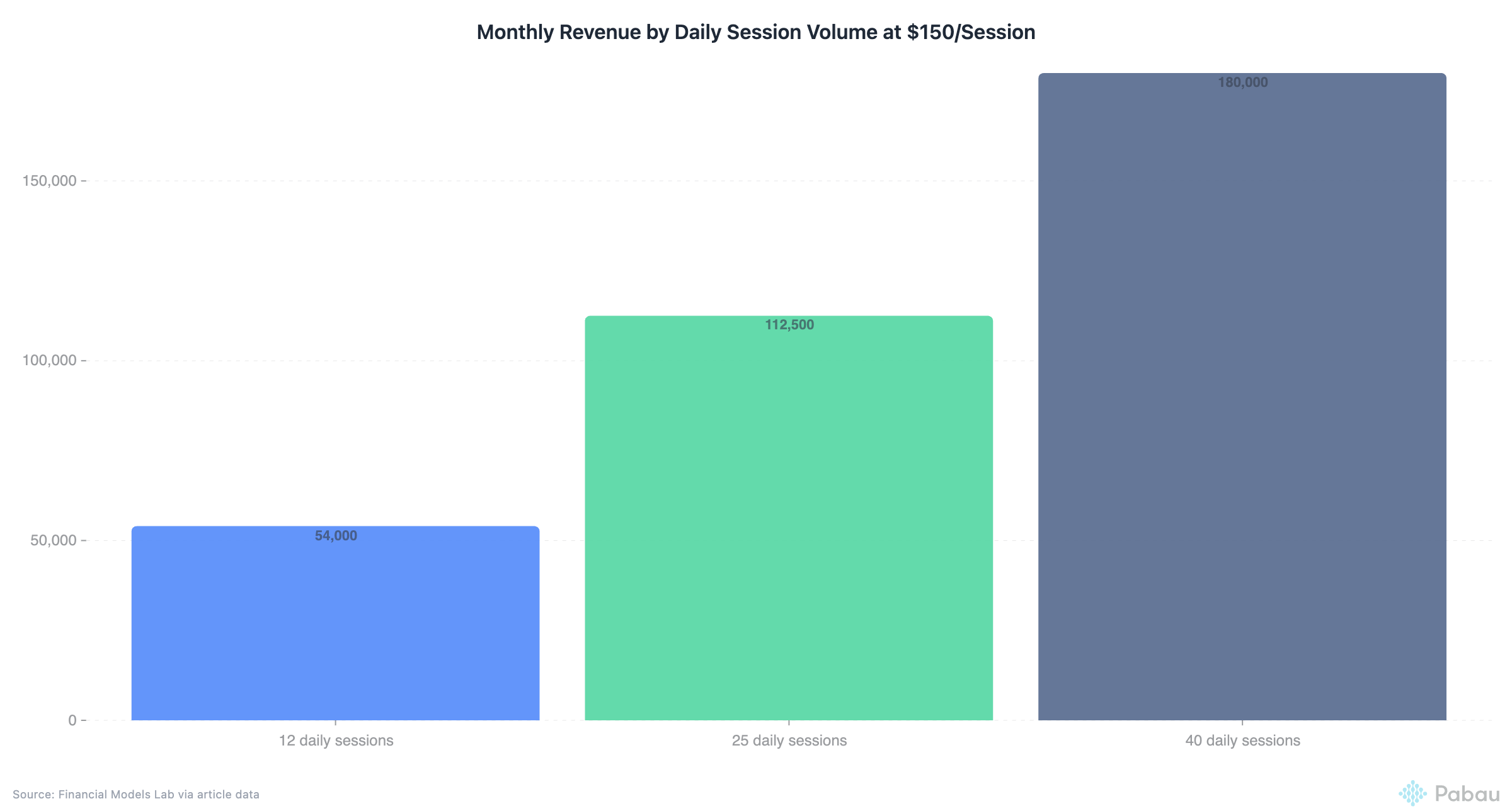
Laser hair removal clinics operate in a market where daily session volume, not just pricing, determines profitability. A clinic serving 12 clients daily at $150 per session generates roughly $54,000 monthly before costs. Scale to 40 daily appointments and that figure reaches $180,000. The gap between these numbers isn’t luck-it’s operational execution.
Owner income depends on more than treatment rates. Fixed overhead, commission splits, equipment depreciation, and booking efficiency all shape the bottom line. Some clinics report owner earnings between $150,000 and $1 million annually, but that range reflects vastly different business models-from solo practitioners in shared spaces to multi-location operations with dedicated staff.
This guide breaks down the financial mechanics of running a laser hair removal clinic. You’ll see how session volume, pricing strategy, operating costs, and profit margins interact. The focus is on the operational decisions that determine whether a clinic reaches $10,000 in monthly profit or $100,000.
Revenue starts with capacity. A single treatment room running 8-hour days can accommodate 8-12 sessions if appointment slots average 45-60 minutes. Clinics with two rooms double that capacity. But actual volume depends on booking efficiency, no-show rates, and how quickly clients move through intake, treatment, and checkout.
According to Financial Models Lab, clinics scaling from 12 to 40 daily visits face a monthly overhead of $18,350. That breakpoint matters. Below 12 daily sessions, covering fixed costs requires aggressive pricing or multi-service revenue. Above 40, additional rooms and staff become necessary, shifting the cost structure entirely.
A clinic averaging $150 per session at three volume tiers generates:
The jump from 12 to 25 sessions often requires adding a second technician or extending operating hours. Moving from 25 to 40 typically demands a second treatment room. Each expansion increases fixed costs before it increases revenue, creating short-term margin compression.
Clinics using laser clinic software to optimise appointment scheduling report 15-20% higher room utilisation. The software flags gaps in the calendar, automates reminders to reduce no-shows, and adjusts slot durations based on treatment type. That efficiency translates directly to more completed sessions per day without adding physical capacity.
Not all sessions generate the same income. Small areas like the upper lip or underarms average $65-$150 per visit. Full legs, back, or Brazilian treatments run $300-$500. A clinic serving mostly small-area clients needs higher volume to hit the same revenue as one focused on full-body packages.
Package deals-typically 6 to 8 sessions sold upfront-improve cash flow and client retention. A client purchasing an 8-session full-leg package at $2,400 ($300 per session) commits revenue immediately. That predictability helps clinics manage overhead fluctuations during slower months.
Pricing reflects equipment capability, geographic market, and the clinic’s competitive positioning. A single diode laser handles most body areas but takes longer per session than newer multi-wavelength systems. That time difference affects how many clients a technician can serve daily, which influences the minimum viable price per session.
Calculate your clinic’s potential monthly income based on session volume, pricing, and operating costs
Industry data shows how session volume scales with revenue at £150 average per session
| Treatment Area | Price Range | Session Time |
|---|---|---|
| Small (upper lip, chin, underarms) | £65-£150 | 10-15 min |
| Medium (bikini, lower legs, forearms) | £150-£250 | 20-30 min |
| Large (full legs, full back, Brazilian) | £300-£500 | 45-60 min |
Compare profit potential across three common clinic structures
Owner performs all treatments with no additional staff. Revenue maxes out at personal capacity (20-25 sessions daily).
Owner splits time between treatments and management. Technician handles additional capacity on commission.
Owner manages 2-3 locations with full staffing at each site. Higher revenue but compressed margins due to scaling costs.
Research from industry suppliers suggests an average of $150 per session as a baseline, but regional variation is significant. Urban markets with higher rent and labour costs push pricing toward $200-$300 for mid-size areas. Rural or suburban clinics may price $100-$150 for the same treatments to remain competitive with local alternatives like waxing or IPL.
Small areas (upper lip, chin, underarms): $65-$150 per session. These treatments take 10-15 minutes, making them ideal for filling short gaps in the schedule.
Medium areas (bikini line, lower legs, forearms): $150-$250 per session. Session length averages 20-30 minutes. This is the volume driver for most clinics.
Large areas (full legs, full back, Brazilian): $300-$500 per session. These require 45-60 minutes and generate the highest per-session revenue but limit total daily capacity.
Clinics that anchor pricing around packages rather than single sessions report better client lifetime value. A 6-session bikini package at $1,200 ($200 per session) is easier to sell than six separate $250 sessions. The upfront payment also reduces payment default risk.
Dynamic pricing-adjusting rates based on demand, time of day, or seasonal trends-is less common in laser clinics than in other aesthetic services. However, strategic discounting during slower months can smooth revenue without permanently devaluing services.
Clients compare laser hair removal to alternatives: waxing costs $50-$100 monthly indefinitely, while shaving adds up to $10-$20 monthly in supplies. Over ten years, waxing totals $6,000-$12,000. Laser clinics position their pricing as a one-time investment that eliminates recurring costs.
That framing only works if the clinic’s total package cost stays below the 5-7 year cumulative cost of waxing. A full Brazilian laser package priced at $3,000 for 8 sessions aligns with this narrative. Pricing it at $5,000 forces clients to rationalise the expense differently, usually through convenience or long-term time savings rather than pure financial comparison.

Pabau's clinic dashboard shows profitability by service, practitioner, and package-so you know which treatments drive margin before the month ends.

Monthly operating costs determine the breakeven point. A clinic generating $100,000 in revenue but spending $95,000 on overhead and labour has $5,000 in profit. Another clinic at the same revenue with $70,000 in costs takes home $30,000. The difference isn’t pricing-it’s cost structure.
According to industry financial models, average monthly overhead for a laser clinic is $18,350. That figure includes rent, equipment leases, utilities, insurance, and core staffing. It doesn’t include variable costs like marketing spend, commission payouts, or consumable supplies (cooling gel, disposable tips).
Rent varies by location. A 1,000-square-foot clinic in a mid-tier suburban market might pay $3,000-$5,000 monthly. Urban or high-visibility locations push that to $8,000-$12,000. Shared medical suites reduce rent but limit branding and client experience control.
Equipment leases or loan payments add $2,000-$5,000 monthly depending on the laser system. Entry-level diode lasers cost $40,000-$60,000 upfront or $1,500-$2,500/month on a 3-year lease. High-end multi-wavelength platforms run $100,000+ and may require $4,000-$5,000 monthly lease payments.
Insurance-general liability, malpractice, and property-typically costs $500-$1,500 monthly for a single-location clinic. Multi-location operations or clinics offering higher-risk procedures face steeper premiums.
Utilities, software subscriptions, and administrative costs (accounting, legal compliance) add another $1,500-$3,000 monthly. Clinics using integrated practice management platforms consolidate scheduling, billing, and reporting into one subscription, reducing per-tool costs.
Staffing is the largest variable cost. A solo practitioner keeps 100% of revenue after fixed costs. Hiring technicians shifts the model entirely.
Commission-based pay is common. Technicians earn 20-30% of session revenue. A technician completing 20 sessions daily at $150 each generates $3,000 in revenue. At 25% commission, the technician takes home $750 daily or $18,750 monthly (assuming 25 working days). According to National Laser Institute, high-volume technicians can reach $9,450 monthly or $113,400 annually under this structure.
Flat salary models pay $3,000-$5,000 monthly regardless of volume. This reduces owner risk during slow months but caps technician earning potential, which can impact retention in competitive labour markets.
Front desk and administrative staff add $2,500-$4,000 monthly per employee. Clinics with strong online booking systems reduce reception workload, sometimes eliminating the need for a full-time front desk role in single-practitioner setups.
Track average treatment time per session type and use it to set realistic daily appointment limits. A clinic booking 45-minute slots for treatments that routinely take 60 minutes will run behind schedule, increasing no-shows and damaging client experience. Adjust slot durations quarterly based on actual completion data.
Profit margin is the percentage of revenue remaining after all costs. Laser hair removal clinics typically operate at 15-35% net margins depending on volume, pricing, and cost discipline.
A clinic generating $100,000 monthly with $70,000 in total costs (fixed overhead plus labour and variables) has a 30% margin-$30,000 profit. Scale that annually and the owner nets $360,000 before taxes. But hitting 30% requires high volume, controlled costs, and minimal downtime.
Solo practitioner (no employees): Revenue minus fixed overhead equals owner take-home. A practitioner completing 15 sessions daily at $200 each generates $90,000 monthly. With $15,000 in rent, equipment, insurance, and software, net income is $75,000 monthly or $900,000 annually. This model maxes out at the practitioner’s personal capacity-around 20-25 sessions daily.
Owner-operator with one technician: The owner splits time between performing treatments and managing operations. Revenue increases to $150,000 monthly (owner + technician). Costs rise to $55,000 (fixed overhead $18,350 + technician commission $30,000 + admin $6,650). Net profit: $95,000 monthly or $1.14 million annually. The owner’s personal treatment time starts to decline as management demands increase.
Multi-location franchise or management model: The owner stops performing treatments entirely. Revenue scales to $300,000+ monthly across 2-3 locations, but costs include multiple leases, equipment, and full staffing for each site. Net margins compress to 15-20% due to management overhead, yielding $45,000-$60,000 monthly per location. Total owner income reaches $135,000-$180,000 monthly or $1.62-$2.16 million annually. However, this model requires significant capital investment upfront-often $200,000-$500,000 to open additional locations.
Laser hair removal demand spikes in spring (March-May) as clients prepare for summer. Fall and winter bookings drop 20-30% in most markets. Clinics selling packages during peak season capture revenue upfront, which smooths cash flow through slower months.
A clinic generating $120,000 in May but only $75,000 in December faces a $45,000 swing. Without package prepayments, that gap requires either a cash reserve or a line of credit to cover fixed costs. Clinics tracking key performance indicators like average revenue per client and package conversion rates can forecast these dips and adjust marketing spend accordingly.
Laser systems last 5-10 years with proper maintenance. A $60,000 laser depreciates roughly $6,000-$12,000 annually. Clinics should budget for replacement or upgrade every 7 years. Delaying replacement risks downtime from equipment failure, which costs more in lost revenue than proactive replacement.
Some manufacturers offer trade-in programs that reduce the net cost of upgrades. A clinic trading in a 5-year-old system might receive $15,000-$20,000 credit toward a $90,000 new model, bringing the out-of-pocket expense to $70,000 or $2,500/month on a new lease.

Need help calculating breakeven session volume? Best Medical Spa Software compares platforms that track revenue per treatment and flag when clinics hit profitability thresholds.
Struggling with client retention after initial packages? Marketing for Clinics covers automated follow-up campaigns and re-engagement strategies that bring clients back for maintenance sessions.
Want to reduce no-shows without hiring front desk staff? Appointment Management Software sends automated SMS and email reminders, cutting no-show rates by 15-20% in most clinics.
Laser hair removal clinic income scales with session volume, pricing discipline, and cost control. A solo practitioner can net $75,000 monthly with 15 daily sessions and lean overhead. Scale to multiple technicians and locations, and owner income reaches $1 million+ annually-but only if margins hold through the expansion.
The financial model is straightforward: revenue per session times daily volume minus fixed and variable costs equals profit. Clinics that optimise scheduling, sell packages, and track per-treatment profitability in real time consistently outperform competitors who focus solely on pricing. The difference between a $150,000 annual income and $1 million isn’t treatment skill-it’s operational execution.
Monthly revenue depends on session volume and pricing. A clinic completing 12 daily sessions at $150 each generates approximately $54,000 monthly. Scaling to 40 daily sessions increases monthly revenue to $180,000. Actual take-home income varies based on fixed overhead (rent, equipment, insurance) and labour costs (technician commissions or salaries).
Owner income ranges from $150,000 to over $1 million annually depending on business model. Solo practitioners with lean overhead can net $75,000 monthly. Multi-location operators or franchise models reach $135,000-$180,000 monthly but require significant upfront capital investment and higher operational complexity.
Startup costs typically range from $100,000 to $250,000. This includes laser equipment ($40,000-$100,000), leasehold improvements for treatment rooms ($20,000-$50,000), initial inventory and supplies ($5,000-$10,000), insurance and licensing ($3,000-$8,000), and 3-6 months of operating capital to cover overhead before reaching breakeven volume.
Session pricing varies by treatment area. Small areas (upper lip, underarms) cost $65-$150. Medium areas (bikini line, lower legs) range from $150-$250. Large areas (full legs, full back) run $300-$500 per session. Most clinics sell packages of 6-8 sessions at a slight discount to improve client retention and upfront cash flow.
Monthly operating costs average $18,350 for fixed overhead including rent ($3,000-$12,000), equipment leases ($2,000-$5,000), insurance ($500-$1,500), and utilities/software ($1,500-$3,000). Variable costs include technician commissions (20-30% of session revenue) and consumable supplies ($500-$1,500 monthly depending on volume).
Profitability increases through high session volume, package sales that lock in upfront revenue, optimised scheduling to reduce treatment room downtime, and automated booking systems that cut no-show rates. Clinics tracking per-treatment profit margins and adjusting service mix toward higher-margin treatments consistently outperform competitors focused solely on pricing adjustments.