Opening a med spa in Texas can be exciting, but before you start offering treatments, it’s crucial to understand the state’s licensing laws.
Texas has strict regulations around who can own, operate, and perform procedures in a medical spa, and for good reason: these rules protect patients, practitioners, and your business.
Proper licensing ensures your med spa operates within legal boundaries, maintains patient safety, and avoids costly penalties.
In this guide, we’ll break down what you need to know about Texas med spa licensing laws so you can build your business on a compliant and confident foundation.
Who can own a med spa practice in Texas?
Texas follows what’s known as the Corporate Practice of Medicine (CPOM) doctrine. In simple terms, this means that only licensed physicians — either an MD (Doctor of Medicine) or a DO (Doctor of Osteopathy) — can own or control a medical practice.
If your med spa offers treatments that are considered the “practice of medicine”, such as Botox, dermal fillers, laser treatments, or prescription-based procedures, then these services must fall under physician supervision.
That typically breaks down this way:
A physician (MD or DO) must own and oversee the medical side of the business.
Nurse practitioners (NPs), registered nurses (RNs), and physician assistants (PAs) cannot legally own or independently operate a med spa that offers medical treatments.
While PAs may hold minority ownership in some cases, the physician must remain the majority owner and retain full control over medical decisions.
Non-physicians can still play a vital role in the business, like managing operations, marketing, or customer service, but they cannot make or influence medical decisions.
Setting up your med spa incorrectly can lead to serious consequences, including license suspension, hefty fines for unlicensed practice, or even forced business closure if your structure doesn’t comply with Texas CPOM laws, as illustrated by a Travis County jury verdict that awarded $10 million after a management company improperly controlled medical decisions.
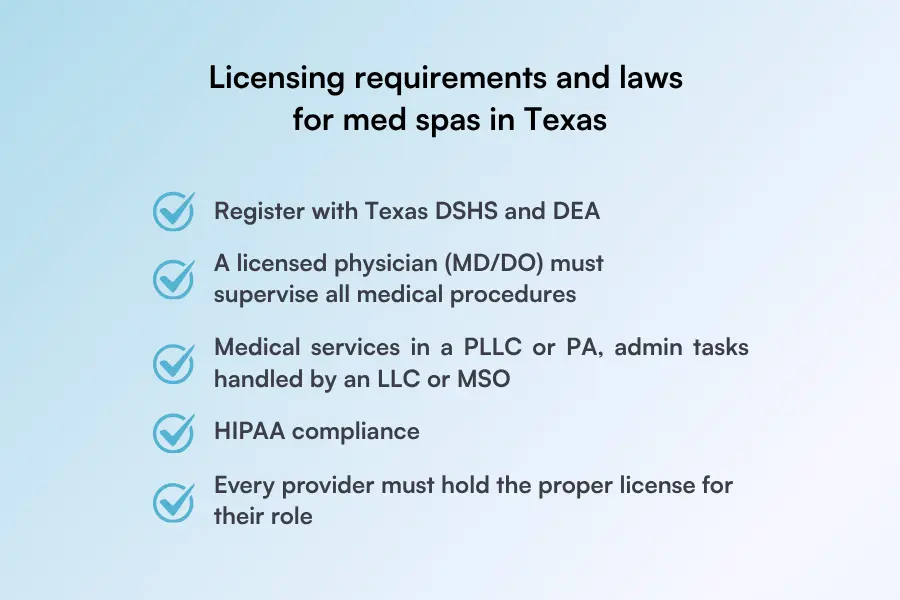
Licensing requirements and laws for med spas in Texas
Once you understand who can own a med spa in Texas, the next step is making sure your business meets all the licensing and legal requirements.
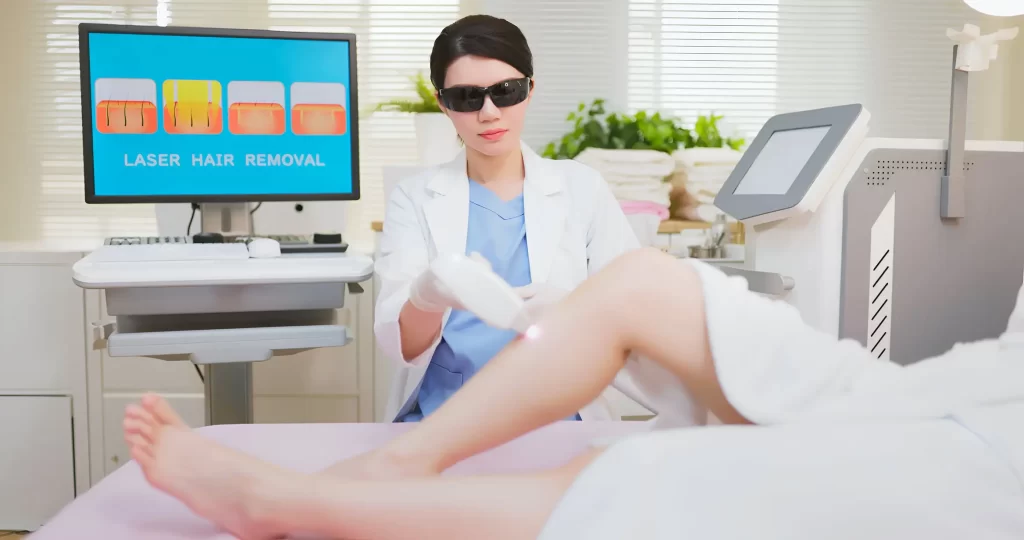
Each laser device must also be inspected and operated under the supervision of a certified Laser Hair Removal Professional.
Additionally, if your med spa administers controlled substances (such as injectables that contain them), your medical practice must obtain a DEA registration in the name of the supervising physician.
This ensures that controlled medications are handled, stored, and prescribed legally and safely.
Medical director requirement
Every Texas med spa that provides medical treatmentsmust have a licensed physician serving as its medical director. This person is responsible for ensuring all treatments are performed safely and in compliance with Texas medical law.
Regularly reviewing patient charts and treatment records to ensure proper care and documentation.
Even if the physician isn’t on-site every day, they must remain actively involved in oversight and decision-making related to patient care.
Business entity setup
Because of Texas’s Corporate Practice of Medicine (CPOM) laws, med spas need to be structured carefully.
The clinical services must operate through a Professional Limited Liability Company (PLLC) or Professional Association (PA) — entities that can only be owned by licensed medical professionals.
Meanwhile, the business and administrative functions (like marketing, scheduling, or payroll) can be handled by a separate LLC or Management Services Organization (MSO). This setup allows non-physicians to manage the business side without violating medical ownership laws.
Most compliant med spas in Texas use this dual-entity model (PLLC + MSO) to balance medical oversight and business operations legally.
HIPAA compliance
Like any healthcare facility, med spas are required to follow the Health Insurance Portability and Accountability Act (HIPAA) to protect patient privacy. This includes securing patient data, ensuring confidentiality during consultations, and properly storing or transmitting medical records.
Failure to comply with HIPAA can result in costly fines, legal action, and damage to your reputation, so investing in compliant software and staff training is essential.
For example, nurses administering injectables must have an active Texas nursing license, and aestheticians must be licensed by the Texas Department of Licensing and Regulation (TDLR).
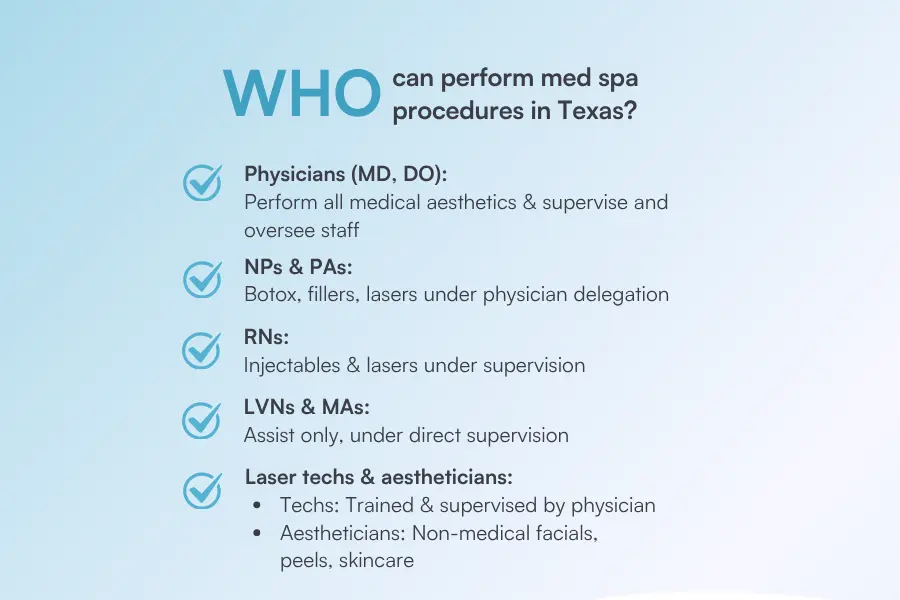
Who can perform med spa procedures in Texas?
Every role, from physician to aesthetician, has specific rules about what they can (and can’t) do.
Understanding these distinctions is key to keeping your med spa compliant and ensuring patients receive safe, high-quality care.
Physicians (MD, DO)
In Texas, licensed physicians (MDs and DOs) have the broadest scope of practice when it comes to aesthetic medical procedures. They can perform virtually all treatments, including injectables, laser services, chemical peels, and IV therapy.
Physicians are also responsible for supervision and oversight of all delegated medical procedures performed by their staff. They must establish written protocols, review treatment plans, and ensure all care is delivered according to state regulations.
It’s also worth noting that starting September 1, 2025, Texas implemented House Bill 3749, known as the Texas IV Therapy Bill. This new law clarifies who can administer IV therapy and under what level of physician supervision, adding new standards for IV hydration and wellness clinics.
Under the law:
A physician may delegate prescribing authority to a physician assistant or advanced practice registered nurse.
Administration of elective IV therapy can be delegated to a physician assistant, advanced practice registered nurse, or registered nurse under proper physician supervision.
Nurse practitioners (NPs) and physician assistants (PAs)
Nurse practitioners (NPs) and physician assistants (PAs) can perform many popular med spa procedures, like Botox, dermal fillers, and laser treatments, but only under delegation from a supervising physician.
They must operate within a collaborative agreement that clearly defines their scope of practice, treatment protocols, and supervision requirements.
This agreement also ensures that a physician remains involved in patient care, reviews procedures, and maintains responsibility for all delegated tasks.
Registered nurses (RNs)
Registered nurses in Texas can also perform injectables, microneedling with PRP, and laser treatments, but only under supervision.
Their supervising provider may be a physician (MD/DO), NP, or PA, but the NP or PA can only supervise if the delegating physician has granted that authority in writing and developed specific treatment protocols.
RNs are not permitted to diagnose patients or create treatment plans independently. Their role focuses on carrying out procedures safely within the bounds of physician-approved guidelines.
Licensed vocational nurses (LVNs) and medical assistants
Licensed vocational nurses (LVNs) have a more limited scope of practice.
They can assist with certain treatments, such as preparing patients or handling equipment, but only under direct, on-site supervision from a physician, NP, PA, or RN. They cannot independently perform injectables, laser procedures, or other medical aesthetics treatments.
Medical assistants (MAs) are even more restricted. While they play an essential role in supporting staff, they cannot perform any medical procedures.
Laser technicians and aestheticians
When it comes to laser and skincare services, laser technicians must complete a state-approved training program and operate only under the supervision of a licensed physician or designated medical professional.
Laser devices must be registered with the Texas Department of State Health Services (DSHS).
Aestheticians, on the other hand, are licensed by the Texas Department of Licensing and Regulation (TDLR) and can perform non-medical skincare treatments such as cleansing facials, exfoliation, masks, and light peels.
However, they cannot perform medical-grade procedures like injectables or laser treatments unless they hold additional certifications and are supervised accordingly.
Explore how your med spa can maintain compliance easily with Pabau
Staying compliant in Texas means keeping close tabs on staff licensing, supervision, and patient documentation, which is no small task for a busy med spa.
That’s where Pabau comes in.
Pabau is an all-in-one practice management software built for medical and aesthetic clinics. It helps you stay organized, compliant, and efficient so you can focus on your clients, not the paperwork.
With Pabau, you can:
Track staff certifications and training to ensure everyone stays qualified.
Set permissions and roles to control who can access or perform specific tasks.
Maintain secure, HIPAA-compliant patient records with ease.
Automate bookings, forms, and scheduling for smoother daily operations.
Pabau makes compliance simple, helping your med spa run safely and professionally from one easy platform.