Musculoskeletal & Pain Management Physical Therapy
Physical Therapy Business Plan: What to Include and Why
Most physical therapy clinic failures happen before the first patient walks in. ...

April 28, 2026


Buy now, pay later is now available in Pabau

MDS 3.0 Section GG is the current federal ADL/functional assessment framework, using a 6-point scale: 01 Independent, 02 Setup or clean-up assistance, 03 Supervision or touching assistance, 04 Partial/moderate assistance, 05 Substantial/maximal assistance, 06 Dependent.
Section GG also includes activity-not-attempted codes: 07 (refused), 09 (not applicable), 10 (not attempted due to environmental limitations), and 88 (not attempted due to medical condition or safety concerns).
Section G of MDS 3.0 was retired effective October 1, 2023 and removed from all federal MDS item sets; federal Medicare RUG-III/RUG-IV support also ended that date. Section G now persists only on the Optional State Assessment (OSA) used by some Medicaid case-mix states, and CMS is phasing this carve-out out as states transition to Medicaid PDPM.
Section GG self-care items (GG0130) and mobility items (GG0170) directly drive PDPM case-mix group assignment and Medicare reimbursement for skilled nursing facilities.
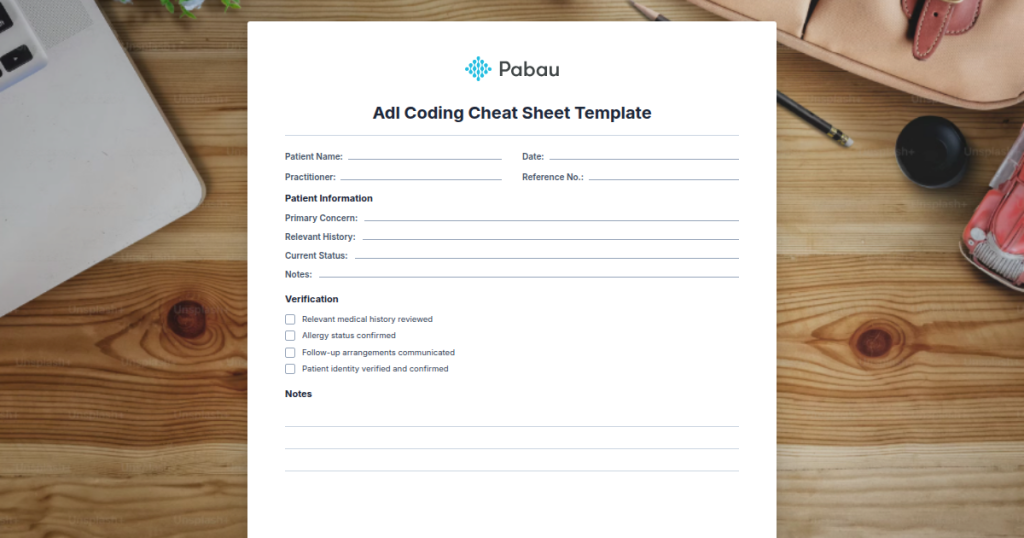
A structured ADL coding cheat sheet template reduces documentation errors and ensures consistent CNA assessment protocols across the interdisciplinary team.
Accurate ADL documentation is the foundation of proper patient care in skilled nursing facilities. This free ADL coding cheat sheet template provides CNAs, MDS coordinators, and nursing staff with a quick-reference guide for coding Activities of Daily Living assessments under MDS 3.0. It defaults to Section GG, which has been the federal standard for ADL/functional assessment since Section G’s retirement on October 1, 2023. The template includes the 6-point functional ability scale, activity-not-attempted codes (07, 09, 10, 88), GG0130 self-care and GG0170 mobility items, decision trees, and practical coding tips. A separate legacy reference for Section G is included for facilities that still complete the Optional State Assessment (OSA) under certain Medicaid case-mix programs.
A ready-to-use reference guide for MDS 3.0 Section GG (the current federal ADL/functional assessment framework after Section G’s retirement on October 1, 2023). Covers the 6-point functional ability scale (01 Independent through 06 Dependent), activity-not-attempted codes, GG0130 self-care and GG0170 mobility items, decision trees, and CNA documentation tips. Includes a legacy Section G reference for the Optional State Assessment used by some Medicaid case-mix states.
Download templateAn ADL coding cheat sheet template is a structured reference document that standardizes how care staff document functional abilities under the Minimum Data Set (MDS) 3.0 framework. In skilled nursing facilities, accurate Section GG coding directly influences case-mix group assignment and reimbursement under the Patient-Driven Payment Model (PDPM). The template consolidates the current MDS coding rules, decision trees, and practical examples into one accessible format that CNAs and coordinators reference during daily assessments. Note: as of October 1, 2023, Section G has been retired from all federal MDS item sets (OBRA and PPS), and Section GG is the operative ADL/functional assessment framework for federal Medicare reimbursement.
The legal and regulatory foundation for ADL coding rests on CMS’s Resident Assessment Instrument (RAI) Manual, which defines what constitutes each functional level. Compliance with these standards protects facilities from audit findings and ensures Medicare/Medicaid reimbursement accuracy. An ADL coding cheat sheet template operationalizes this guidance so assessments remain consistent across shifts and staff.
Using an ADL coding cheat sheet template streamlines the assessment workflow and reduces coding errors. Follow these five operational steps to integrate the template into daily practice:
This template is designed for healthcare teams in skilled nursing facilities, long-term care settings, and rehabilitation units. Certified Nursing Assistants (CNAs) use it as their primary reference during shift observations, ensuring consistent documentation of what they witness. MDS coordinators reference the template when validating CNA assessments and coding ADL sections for Medicare billing submissions. Nursing supervisors use it to train new staff and enforce standardized assessment protocols. Occupational therapists and physical therapists consult the template when coordinating with nursing to reconcile therapy session observations with CNA ADL scores, reducing coding discrepancies that trigger audits.
Compliance and audit readiness: A standardized template ensures all assessments follow CMS RAI Manual guidance, reducing the risk of coding errors flagged during Utilization Review or CMS audits. Documentation consistency demonstrates that your facility applies uniform coding logic across all residents.
Workflow efficiency: Instead of staff consulting printed RAI manuals or jumping between multiple documents, a single-page cheat sheet cuts assessment time by 15-20 minutes per resident. CNAs and coordinators complete more accurate assessments faster.
Documentation clarity: Structured templates with decision trees eliminate subjective interpretation. New staff can follow the flowchart logic without guesswork, accelerating onboarding and reducing training cycles.
Reimbursement accuracy: Coding errors directly lower case-mix points and PDPM reimbursement. By reducing mistakes in self-performance and support coding, your facility improves revenue capture on every MDS submission.
Under PDPM, which replaced RUG-IV for federal Medicare in October 2019 and which has used Section GG (not Section G) as the ADL/functional assessment input since Section G’s retirement on October 1, 2023, a resident’s Section GG self-care and mobility scores directly feed into the nursing and PT/OT case-mix groups. A resident miscoded from “03 Supervision or touching assistance” (higher acuity) to “01 Independent” (lower acuity) on a bed mobility item loses points that may drop them into a lower-paying payment group, potentially costing the facility thousands in lost revenue per stay.
An AI-powered documentation system that reviews CNA notes and cross-checks them against the ADL coding cheat sheet template logic can flag potential coding discrepancies before submission, giving coordinators time to verify and correct. This human-in-the-loop approach combines staff expertise with systematic accuracy checks, protecting reimbursement while maintaining clinical integrity.
Important regulatory context: MDS 3.0 Section G was retired effective October 1, 2023 and removed from all federal MDS item sets (OBRA and PPS assessments). Federal Medicare RUG-III/RUG-IV support also ended on that date. Section G is no longer used for federal Medicare reimbursement under PDPM. The only continuing limited use of Section G is on the Optional State Assessment (OSA) in certain Medicaid case-mix states that still operate a RUG-based payment methodology. CMS has set a hard stop on Section G for Medicaid by 2025, and most states have transitioned (or are transitioning) to Medicaid PDPM, with rollouts starting October 1, 2025 for many states. Facilities should confirm with their state Medicaid program whether Section G via the OSA is still required.
Section G coding scale (legacy reference for OSA only). Where Section G remains in use on the OSA, self-performance is coded 0 (Independent), 1 (Supervision), 2 (Limited assistance), 3 (Extensive assistance), 4 (Total dependence), 7 (Activity occurred only once or twice), or 8 (Activity did not occur). Support is coded 0-3 (No setup or physical help, Setup help only, One-person physical assist, Two-or-more-person physical assist).
Late-loss vs. early-loss ADL terminology (Section G framework). The “late-loss” and “early-loss” ADL categories come from the retired Section G framework. Late-loss ADLs (bed mobility, transfer, eating, toilet use) are the last functions to decline as cognition and strength fail; early-loss ADLs (personal hygiene, bathing, dressing) are often among the first to decline. This terminology is still useful for clinical care planning and interdisciplinary discussion, but it is not the structure used by Section GG. Section GG groups items differently: self-care items (GG0130) – eating, oral hygiene, toileting hygiene, shower/bathe self, upper body dressing, lower body dressing, putting on/taking off footwear; and mobility items (GG0170) – roll left and right, sit to lying, lying to sitting on side of bed, sit to stand, transfers, walking, stairs, and wheelchair use. For federal Medicare coding, use the GG0130 / GG0170 categories rather than the late-loss/early-loss dichotomy.
Audit your facility’s ADL coding patterns quarterly. Pull a random sample of 10-15 MDS submissions and compare CNA flow sheet codes to the submitted MDS section. Reconcile any discrepancies using the cheat sheet’s decision tree logic. This proactive check catches systemic coding errors before external auditors do.
An effective ADL coding cheat sheet template removes ambiguity from daily assessment workflows and anchors your facility’s compliance culture in concrete decision logic. Download the template today, train your team on its structure, and integrate it into shift handoffs and assessment huddles to ensure every resident’s functional status is documented accurately and consistently.
Book a demo with Pabau to explore how digital forms and AI-assisted documentation can automate ADL assessment workflows, cross-check coding against the cheat sheet logic, and reduce the time your MDS coordinator spends on validation and correction cycles.
Section GG is the current federal MDS ADL/functional assessment framework. It uses a 6-point functional ability scale (01 Independent, 02 Setup or clean-up assistance, 03 Supervision or touching assistance, 04 Partial/moderate assistance, 05 Substantial/maximal assistance, 06 Dependent) plus activity-not-attempted codes 07, 09, 10, and 88, organized into self-care items (GG0130) and mobility items (GG0170). Section G – the older framework with a 0-4 self-performance scale and a 0-3 support scale – was retired from all federal MDS item sets on October 1, 2023 and is no longer used for federal Medicare reimbursement under PDPM. Section G persists only on the Optional State Assessment (OSA) in certain Medicaid case-mix states that still use a RUG-based payment methodology, and CMS is phasing this out as states transition to Medicaid PDPM (rollout began October 1, 2025 for many states).
Annual training on the cheat sheet logic is recommended, with refresher huddles quarterly or after significant staff turnover. New CNAs should receive hands-on training pairing them with experienced staff to observe real assessments, then review the template jointly to anchor the coding logic in practice.
No, not for federal MDS submissions. Section G was removed from all federal MDS item sets (OBRA and PPS) effective October 1, 2023, so facilities completing standard MDS 3.0 assessments now code only Section GG. The exception is the Optional State Assessment (OSA), which some Medicaid case-mix states still require – in those states, Section G remains in use on the OSA only, and only until the state transitions to Medicaid PDPM. Confirm with your state Medicaid program whether the OSA (and therefore Section G) still applies to your facility.
Review the resident’s care plan and flow sheets side-by-side with the template. Identify which decision point the team coded differently and discuss whether the resident’s actual performance matches the chosen code. If not, correct the coding before submission. Document the correction reason in the MDS comments field if required by your facility’s compliance policy.