Fertility Reproductive & Sexual Health
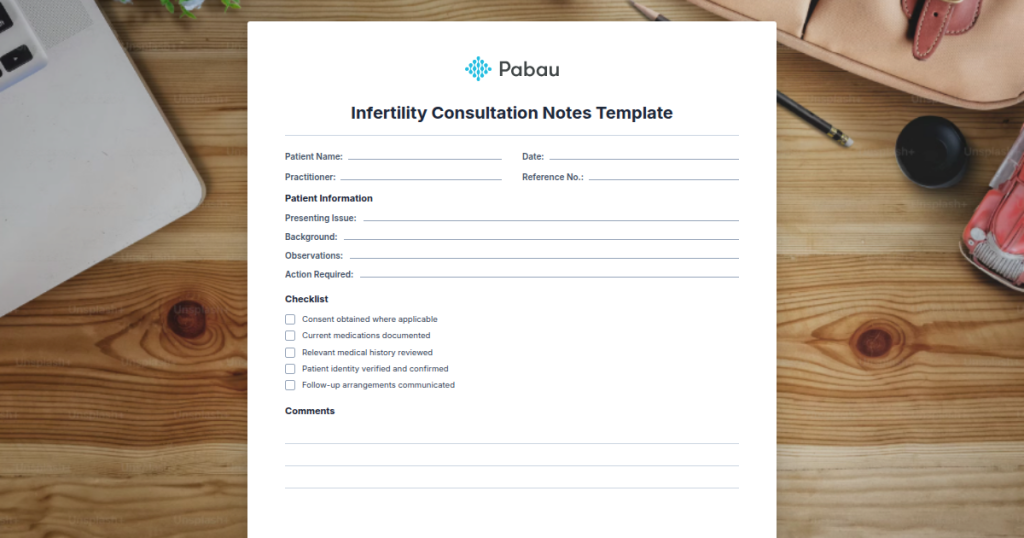
Infertility Consultation Notes Template
Fertility clinics face a unique documentation challenge: capturing complex repro...

April 23, 2026


Buy now, pay later is now available in Pabau

Infertility consultation notes template structures reproductive history, diagnostic findings, and treatment plans in SOAP format
ASRM-aligned documentation covers ovarian reserve testing, hormonal panels, semen analysis, and imaging results critical to fertility assessment
Standardised templates reduce clinical documentation time while improving compliance with informed consent and HIPAA requirements
Pabau’s digital forms and Echo AI support automated clinical note generation from consultation data, reducing manual documentation burden
Fertility clinics face a unique documentation challenge: capturing complex reproductive histories, diagnostic test results, and individualised treatment plans within time-constrained consultations. Many practitioners rely on handwritten notes or generic patient intake forms that miss critical infertility-specific details. An infertility consultation notes template bridges this gap by providing a structured framework aligned with American Society for Reproductive Medicine (ASRM) guidelines, ensuring clinicians document all essential information in one standardised form. This guide explains what to include, how to implement the template in your clinic workflow, and why structured documentation matters for patient outcomes and regulatory compliance.
A ready-to-use SOAP note template covering patient demographics, reproductive history, ovarian reserve assessment, semen analysis findings, imaging results, diagnostic impression, and individualised treatment plan documentation.
Download templateAn infertility consultation notes template is a standardised clinical documentation tool that structures the collection and recording of patient information during fertility evaluations. It uses the SOAP format (Subjective, Objective, Assessment, Plan) adapted specifically for reproductive medicine. The Subjective section captures the patient’s reproductive history, duration of infertility, previous treatments, and personal goals. The Objective section documents examination findings, lab results (hormone levels, semen analysis), and imaging data (ultrasound, hysterosalpingography).
The Assessment section synthesises diagnostic findings into a clinical impression of infertility aetiology. The Plan section outlines recommended investigations, treatment options, and follow-up scheduling. ASRM provides EMR shared phrases and clinical documentation templates that standardise the language fertility providers use when documenting consultations, reducing variation and improving consistency across clinics.
Why templates matter: fertility practitioners manage complex multi-factorial diagnostic criteria. Without a structured template, clinicians often miss critical documentation elements, create inconsistent records that complicate referrals, and spend unnecessary time formatting notes. A well-designed infertility consultation notes template ensures nothing falls through the cracks while speeding up documentation.
Using an infertility consultation notes template in clinical practice follows a five-step workflow integrated into your consultation process:
Digital forms enable real-time template completion during or immediately after the consultation, reducing manual transcription errors. Clinics using Echo AI for automated clinical note generation can dictate findings and have the system populate structured template fields, further accelerating documentation without sacrificing detail.
This template serves multiple fertility care settings and professional roles. Reproductive endocrinologists and fertility specialists use it to document comprehensive diagnostic evaluations and treatment planning. Obstetrician/gynaecologists managing infertility in primary care settings use it to structure referral-ready documentation. Nurse practitioners and physician assistants in fertility clinics rely on templates to ensure completeness and regulatory compliance in their independent or collaborative documentation.
The template also supports fertility clinic software implementations, where structured templates integrate with appointment workflows, enabling seamless data transfer from consultation to billing, lab ordering, and follow-up scheduling. Clinics operating across multiple locations benefit from template standardisation, ensuring patient records maintain consistent quality regardless of which practitioner conducted the consultation.
Compliance and legal protection: Structured infertility consultation notes template documentation demonstrates adherence to ASRM practice guidelines and Title X family planning protocols. Detailed informed consent documentation within the template protects clinics during regulatory review or malpractice defence by showing systematic risk disclosure and patient counselling.
Diagnostic accuracy and clinical outcomes: Standardised templates ensure comprehensive infertility evaluation, reducing missed diagnoses and inappropriate treatment escalation. When all evaluation components are captured systematically, clinicians base treatment decisions on complete information rather than incomplete records.
Operational efficiency: Templates reduce consultation documentation time from 15-20 minutes to 5-10 minutes by eliminating the need to structure notes on the fly. Paperless templates eliminate filing and retrieval delays, enabling instant access to prior notes during follow-up consultations. This accelerates clinical decision-making and improves continuity of care between practitioners.
Referral clarity: When referring to reproductive surgeons or ART specialists, detailed consultation notes from the infertility consultation notes template ensure receiving clinicians understand the diagnostic workup already completed and can avoid redundant testing, saving patients time and cost.
One often-overlooked aspect of infertility documentation is explicit informed consent and risk disclosure. NICE guidelines recommend referral for counselling at all stages of infertility investigation and treatment because the emotional burden of infertility is significant. A comprehensive infertility consultation notes template includes dedicated sections for documenting which treatment risks and success rate ranges were discussed, whether the patient demonstrated understanding, and whether counselling referral was offered or declined.
This documentation layer protects both patient autonomy and clinic liability. Patients need to understand that ovulation induction carries ovarian hyperstimulation risk, IVF involves multiple clinic visits and emotional uncertainty, and male factor interventions may include surgical options. Recording these discussions within the template ensures informed decision-making is systematically demonstrated in the medical record.
Audit your infertility consultation notes template quarterly by selecting 10 random patient records and checking whether the Assessment section explicitly states the infertility aetiology (ovulatory, tubal, male, endometriosis, diminished ovarian reserve, or unexplained). Incomplete diagnostic impressions signal a gap in your template design or clinician training, preventing referral clarity and treatment precision.
Infertility documentation contains some of the most sensitive patient information: reproductive history, sexual function, genetic information, and assisted reproductive outcomes. HIPAA compliance requires encryption of stored consultation notes and access controls limiting viewing to clinicians with legitimate treatment need. When implementing digital infertility consultation notes templates, ensure your client record system includes role-based access controls so billing staff cannot view intimate reproductive history, and ensure all template data is encrypted both in transit (HTTPS) and at rest on clinic servers.
Paper-based templates should be stored in locked cabinets accessible only to clinical staff. If you transition from paper to digital, establish a shredding protocol for old forms and maintain an audit log showing who accessed each patient’s infertility documentation.

Need a framework for comprehensive fertility assessment? Medical Forms at Your Healthcare Practice explains the structural principles behind effective clinical forms, including how to prioritise information hierarchy and reduce cognitive load during rushed consultations.
Looking to streamline note-taking during consultations? Psychiatric Evaluation Template demonstrates how speciality-specific templates structure complex patient assessment in a way that guides clinical thinking and ensures nothing is overlooked.
Want to ensure informed consent is consistently documented? Consent Form Best Practices covers the legal and ethical elements of documented informed consent, applicable across all clinical settings where risks must be explicitly discussed.
An infertility consultation notes template transforms how fertility clinics capture, organise, and use patient information. Structured SOAP documentation ensures no critical diagnostic detail is missed, supports informed consent and counselling referral discussions, and provides referral clarity to specialists. Implementation reduces practitioner documentation burden while improving clinical outcomes through systematic, complete assessment. Whether you adopt a paper template, use Pabau’s digital forms and Echo AI to automate note generation, or integrate a template into existing practice management software, the foundation is the same: standardised, thorough infertility consultation documentation.
The SOAP format (Subjective, Objective, Assessment, Plan) is the standard adopted by most fertility clinics and aligns with ASRM guidelines. Subjective captures patient history, Objective documents exam and test findings, Assessment synthesises diagnosis, and Plan outlines next steps. Some clinics add a Problem List or Prior Treatments section for quick reference.
Complete notes typically span 2-4 pages when handwritten; digital templates often auto-populate common fields, reducing visible length to 1-2 pages on screen. The length reflects the complexity of infertility evaluation-thoroughness matters more than brevity. Rushed, incomplete notes create downstream problems in treatment planning.
Yes. If the male partner is present, document his medical history, surgical history (vasectomy reversal, hernia repair), medication use, and sexual function separately. This clarifies which findings relate to male factor infertility and guides whether further semen analysis or urological referral is needed. If the partner is absent, note this in the record.
Document the recommendation made, the patient’s stated reason for declining, and whether the clinician explored the patient’s concerns or barriers. Record if alternative options were discussed. This protects both patient autonomy and clinic liability by showing informed decision-making was supported even when the patient declined recommended care.
A universal infertility consultation notes template can include sections for both partners but often requires expansion in the male factor or female factor sections depending on who is being evaluated. Dual-purpose templates work best when they have modular fields that clinicians can expand or collapse based on the primary clinical question (are we investigating male factor, female factor, or both?).