Chiropractic Musculoskeletal & Pain Management
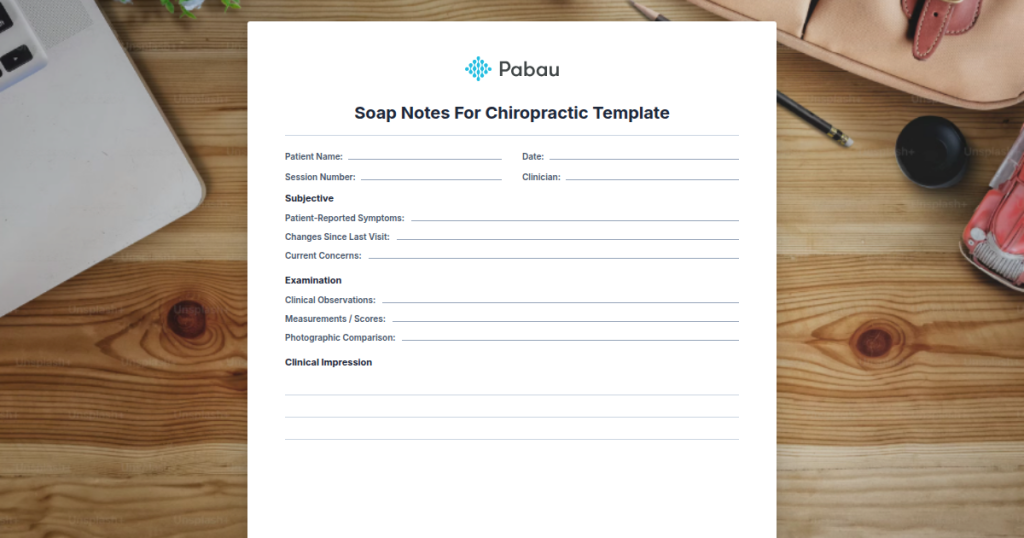
SOAP Notes For Chiropractic Template
What Is a SOAP Notes for Chiropractic Template? A SOAP notes for chiropractic te...

April 22, 2026


Buy now, pay later is now available in Pabau

SOAP notes (Subjective, Objective, Assessment, Plan) are the gold standard for documenting chiropractic patient encounters and are required for insurance billing and legal compliance.
Poor SOAP note documentation leads to claim denials, audit risk, and incomplete clinical records that cannot justify treatment decisions in court.
A well-structured SOAP note captures patient history, examination findings, clinical impression, and specific treatment plans in a standardised format that speeds up note-taking.
Pabau’s digital forms and AI-powered documentation tools automate SOAP note creation, reducing charting time while ensuring compliance.
A SOAP notes for chiropractic template is a standardised documentation form that helps chiropractors systematically record what they observe, assess, and plan during each patient visit. SOAP stands for Subjective, Objective, Assessment, and Plan-four essential sections that together create a complete clinical picture of the patient encounter.
SOAP notes serve three critical functions: they justify treatment decisions to insurance payers, provide legal documentation for personal injury and workers’ compensation cases, and ensure continuity of care across multiple visits. According to the American Chiropractic Association (ACA), structured SOAP notes are the standard of care for all chiropractic practices and are required by most insurance carriers, including Medicare.
The template segments patient information into discrete sections so that clinicians can consistently capture the data needed for billing, compliance audits, and clinical decision-making. Without a structured format, notes become scattered, incomplete, and difficult to defend if a claim is denied or an audit occurs.
A ready-to-use SOAP note template covering subjective patient history, objective examination findings, clinical assessment impressions, and treatment/follow-up plans for chiropractic encounters.
Download templateUsing a SOAP notes for chiropractic template in clinical practice involves five operational steps that mirror real patient workflows:
This workflow becomes faster with practice and accelerates further when digital forms auto-populate fields like patient history and previous visit summaries, allowing clinicians to focus on the unique findings of the current encounter.
This template is essential for several healthcare settings:
Any chiropractic practice management software worth using includes built-in SOAP note templates to speed charting and ensure compliance.
Insurance claim justification: Payers request medical necessity documentation before approving treatment. A complete SOAP note demonstrates that treatment is evidence-based and tied to the patient’s diagnosed condition. Notes lacking objective findings or clear clinical reasoning are routinely denied.
Legal protection: If a patient sues for malpractice or a personal injury attorney requests records, your SOAP notes become the primary evidence of your clinical decision-making. Detailed, contemporaneous notes demonstrate that you evaluated the patient properly and provided standard-of-care treatment.
Treatment continuity: When multiple clinicians care for the same patient, structured SOAP notes allow seamless handoffs. The next clinician can quickly understand what was assessed, what was found, and what progress has been made.
Time efficiency: Standardised templates with dropdown fields and pre-populated data eliminate the need to retype patient history or standard exam findings. AI-powered clinical documentation tools extract key findings from voice dictation, further compressing note creation time.
New patient SOAP notes are longer and more detailed because the clinician is gathering baseline data: complete medical history, family history, surgical history, medications, allergies, and functional status. The objective section includes a full musculoskeletal and neurological examination.
Follow-up visit SOAP notes are shorter but still complete. The subjective section focuses on symptom changes since the last visit: “Pain decreased from 8/10 to 5/10”, “increased cervical range of motion”, or “able to return to work light duty”. The objective section includes only the relevant re-examination findings, not a full repeat evaluation. The assessment updates the diagnosis and notes progress toward goals. The plan adjusts treatment frequency or technique based on response.
Both formats require the same rigour: objective data, clinical reasoning, and a justified treatment plan. Patient management workflows that auto-populate previous visit summaries help clinicians complete follow-up notes faster while maintaining completeness.
Vague assessment language: Writing “patient tolerating treatment well” does not justify continued care. Instead, state specific clinical findings: “cervical range of motion improved 15 degrees on flexion; pain referral pattern resolved to local neck discomfort only.”
Missing objective data: Subjective complaints alone cannot justify chiropractic treatment. Include measurements: range of motion, neurological test results, palpatory findings, functional tests. Payers require objective evidence that the patient’s condition warrants care frequency.
Disconnected plan from assessment: If your assessment documents a thoracic subluxation with referred arm pain, your plan must address thoracic adjustment, not just “continue care.” Spell out the link between diagnosis and treatment.
Incomplete ICD-10 coding: Document the specific spinal region (cervical, thoracic, lumbar, sacral) and laterality where applicable. For example, M99.01 (Segmental and somatic dysfunction of cervical region) is specific enough to bill and is the code Medicare accepts for cervical chiropractic care; “M99.0” alone is a non-billable parent category. Always code to the appropriate region-specific sub-code (M99.01 cervical, M99.02 thoracic, M99.03 lumbar, M99.04 sacral, M99.05 pelvic), and remember that the M99.1x “Subluxation complex (vertebral)” family is generally not accepted by Medicare despite using the word “subluxation.”
Personal injury and workers’ compensation claims require heightened documentation rigour. The patient’s attorney and the insurer’s defence counsel will scrutinise your SOAP notes to assess causation, injury severity, and treatment appropriateness.
Include the mechanism of injury in the subjective section: “Motor vehicle accident, rear-impact collision, patient struck from behind while stationary.” Document the timeline: “Onset of symptoms 2 hours post-accident.” In the objective section, record measurable deficits: “Cervical active range of motion 50% of normal; positive upper limb tension test bilaterally.”
Your assessment must connect the mechanism of injury to the clinical findings: “Acute cervical strain with myofascial dysfunction secondary to motor vehicle accident.” This language demonstrates that the patient’s condition is causally linked to the accident, not pre-existing degenerative change.
HIPAA compliance for medical offices requires that SOAP notes be stored securely, accessed only by authorised staff, and retained for at least 6 years (or per state law, whichever is longer). Electronic SOAP notes must be stored on HIPAA-compliant servers with audit trails that track who accessed each record and when.
Do not include unnecessary personal health information. SOAP notes should not reference a patient’s marital status, employment details beyond functional impact, or social history unrelated to the chief complaint. Each element documented should serve a clinical or billing purpose.
Every SOAP note must support the ICD-10 and CPT codes on the corresponding claim. The assessment section drives diagnosis code selection: M99.01 for cervical segmental dysfunction, M99.03 for lumbar, M54.50 for low back pain as a secondary code. The plan section drives CPT code selection: 98940 (1-2 regions), 98941 (3-4 regions), or 98942 (5 regions) for chiropractic manipulative treatment.
A common audit failure is documenting treatment to three spinal regions (billing 98941) while the objective section only describes findings in two regions. The SOAP note must show measurable findings in every region billed. Payers cross-reference the number of regions documented in the objective section against the CPT code submitted. Practices using claims management software can build region-count validation into the charge entry workflow to catch mismatches before submission.
Paper SOAP notes create bottlenecks at every stage: illegible handwriting delays billing, misfiled charts complicate audits, and manual data entry doubles the documentation burden. Digital SOAP note templates with structured fields for each section eliminate these friction points. Pre-populated dropdown menus for common findings (ROM percentages, orthopedic test results, adjustment techniques) reduce documentation time from 10-15 minutes to 3-5 minutes per encounter.
Pabau’s digital forms allow chiropractic practices to build SOAP templates with structured fields that map directly to billing codes. Echo AI can generate draft clinical notes from encounter data, which the clinician reviews and approves rather than writing from scratch. The result is faster documentation that maintains clinical accuracy and audit readiness.
New patient – acute low back pain: Subjective: “43-year-old male presents with acute low back pain onset 3 days ago after lifting furniture. Pain rated 7/10, worse with flexion, relieved by lying supine.” Objective: “Lumbar ROM flexion 40% of normal, extension 60%. Positive Kemp’s test left. Palpatory tenderness L4-L5 bilateral. Straight leg raise negative bilaterally.” Assessment: “Acute lumbar segmental dysfunction (M99.03) with myofascial component. No radiculopathy.” Plan: “CMT 98941 (3 regions: lumbar, sacral, thoracolumbar junction). Frequency 3x/week for 2 weeks, reassess. Home instructions: ice 15 min every 2 hours, avoid lifting over 10 lbs.”
Follow-up visit – cervical maintenance: Subjective: “Reports 60% improvement in neck stiffness since last visit. Still has morning stiffness lasting 20 minutes.” Objective: “Cervical ROM improved to 75% of normal (was 50% at initial). Negative Spurling’s. Mild hypertonicity C5-C6 right paravertebral.” Assessment: “Improving cervical segmental dysfunction (M99.01). Functional gains documented.” Plan: “CMT 98940 (1-2 regions). Reduce to 1x/week. Re-evaluate in 4 visits for discharge planning.”
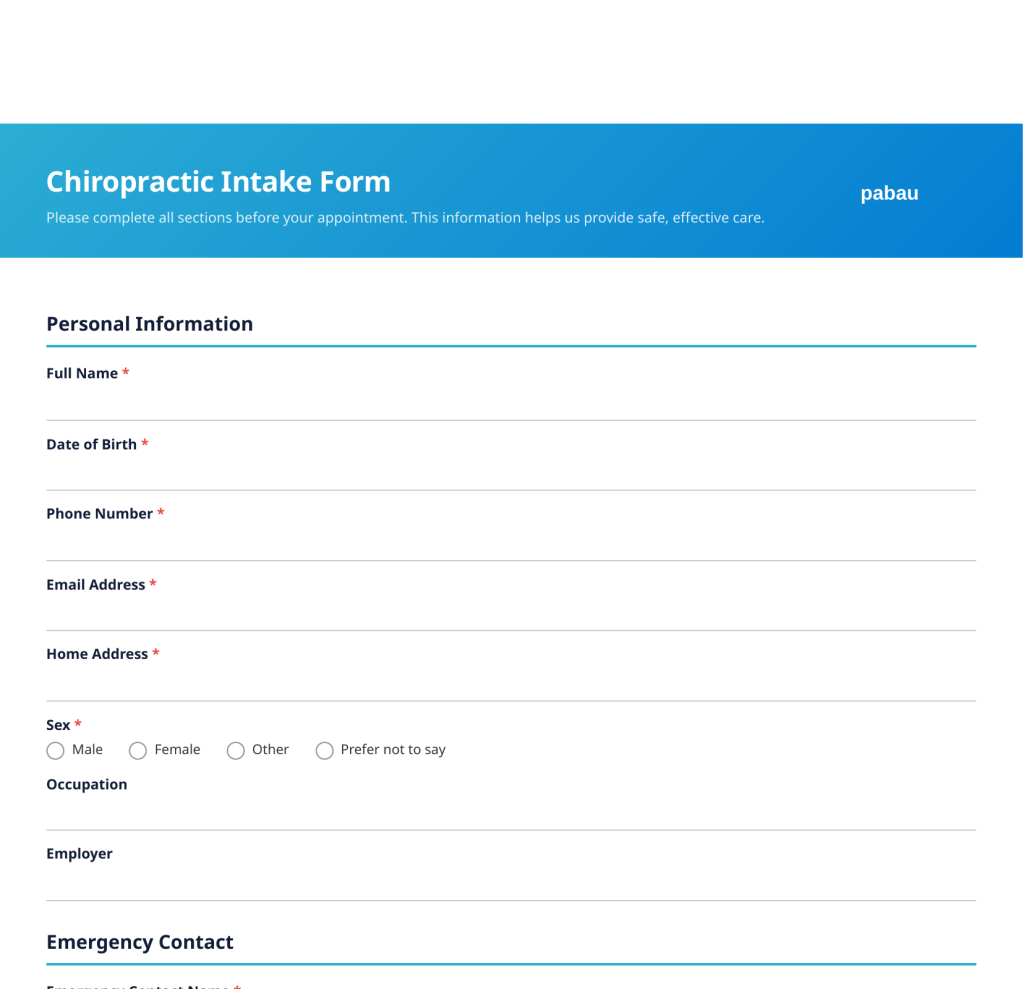
Beyond SOAP notes, your chiropractic practice needs a chiropractic intake form to capture baseline patient data, clinical evaluation templates for specific conditions, and consent forms for high-risk procedures.
A complete documentation system also includes progress note templates for therapy visits, discharge summary templates for case closure, and re-evaluation templates for periodic review of cases exceeding 12-15 visits. Integrating all these forms into a single client record system ensures that every document is linked to the patient encounter and accessible during audits or legal proceedings.
A structured chiropractic SOAP note template turns documentation from an administrative burden into a clinical asset that supports billing accuracy, audit defence, and patient care continuity. Every element – from the subjective complaint through the treatment plan – must connect logically and support the codes on the claim.
Pabau’s digital SOAP note templates, Echo AI-assisted charting, and integrated claims management help chiropractic practices document faster without sacrificing the specificity that payers and auditors require. Book a demo to see how Pabau handles chiropractic documentation workflows from intake through claim submission.
A chiropractic SOAP note must include: Subjective (chief complaint, history of present illness, relevant past medical history); Objective (vital signs, postural assessment, range of motion, orthopedic and neurological tests, palpation findings); Assessment (diagnosis linked to ICD-10 codes, clinical impression); Plan (specific treatment approach, frequency, duration, home care, discharge timeline).
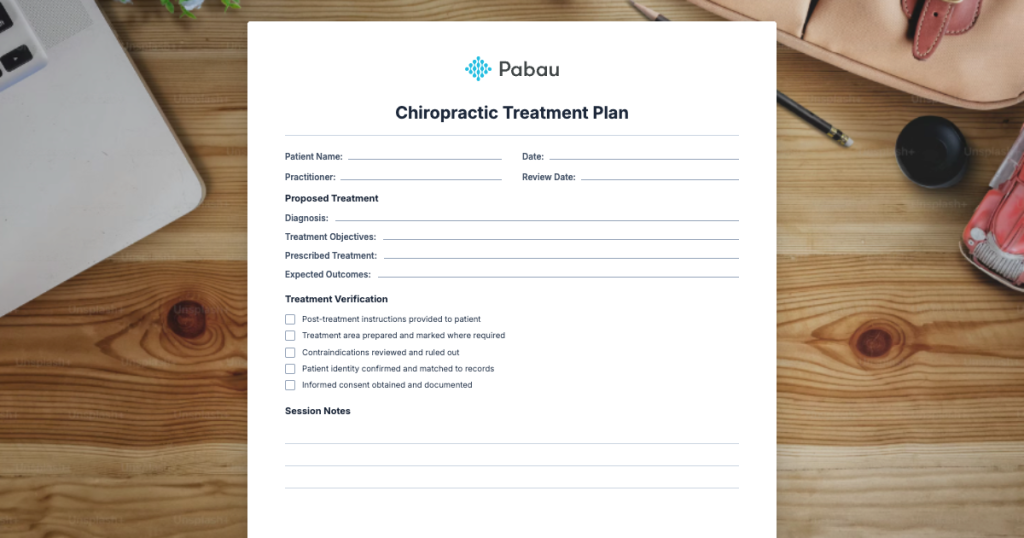
Begin with the subjective: what the patient reports about their condition and symptoms. Document objective findings: range of motion measurements, palpatory findings, orthopedic test results. In the assessment, state the diagnosis and link findings to the clinical impression. In the plan, specify the chiropractic adjustment technique, spinal region, frequency, and expected duration of care. Always connect the plan to the assessment so payers understand why this treatment is medically necessary.
Yes. Medicare, private insurance, and workers’ compensation payers require detailed SOAP notes to justify medical necessity and treatment frequency. Claims submitted without corresponding SOAP notes are routinely denied. SOAP notes also protect you in audits and legal proceedings by demonstrating standard-of-care documentation.
New patient SOAP notes typically range 200-400 words and take 10-15 minutes to document thoroughly. Follow-up visit notes are shorter (100-200 words) and focus on changes since the previous visit. The key is completeness, not length: every element must serve a clinical or billing purpose. Overly brief notes lack justification for treatment; overly verbose notes waste clinician time without adding clinical value.
Yes. SOAP notes are the primary evidence of your clinical decision-making in malpractice suits, personal injury claims, and workers’ compensation disputes. Well-documented SOAP notes that clearly link objective findings to treatment decisions strongly support your defence. Poorly documented notes or notes with gaps and inconsistencies can be used against you. Always document contemporaneously (at or near the time of the encounter) and focus on objective, measurable findings.