Mental Health Mental Health & Therapy
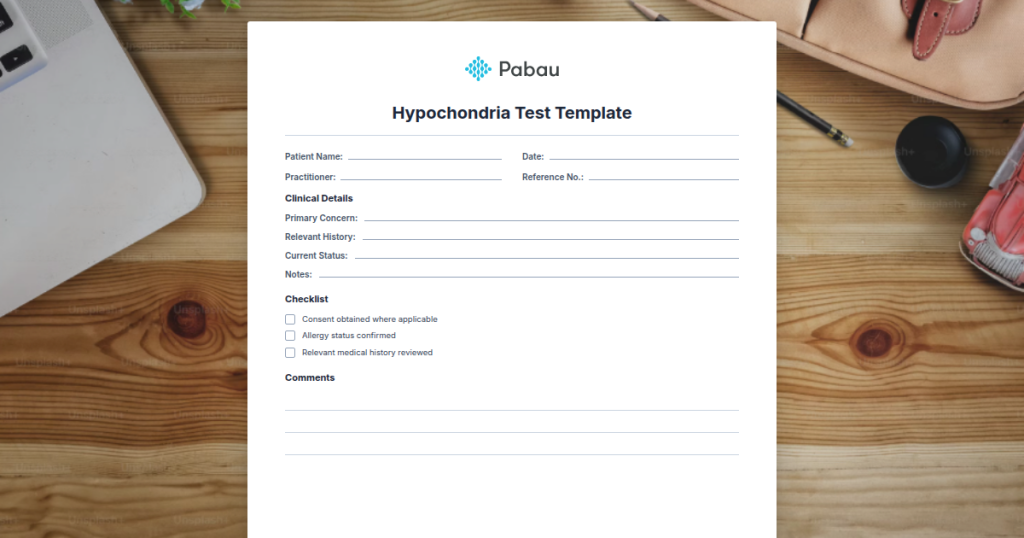
Hypochondria Test Template
A hypochondria test template is a clinician-facing assessment tool designed to s...

April 10, 2026


Buy now, pay later is now available in Pabau

The autism test for adults template is a validated screening tool aligned with DSM-5 (F84.0) and ICD-10 criteria for identifying autism spectrum characteristics in adult patients.
Adult autism screening requires evaluation across four core domains: social communication deficits, restricted interests and repetitive behaviours, sensory sensitivities, and developmental history patterns.
Screening tools like the AQ-10, AQ-50, and RAADS-R are not diagnostic instruments; they are pre-diagnostic aids that signal the need for formal clinical assessment.
Pabau’s digital forms and Echo AI features streamline autism assessment workflows by automating template distribution, scoring calculations, and clinical documentation for practice management.
Adult autism remains significantly underdiagnosed, particularly in women and later-diagnosed individuals who have developed camouflaging strategies throughout their lives. Many adults reach their 30s, 40s, or 50s before receiving an autism spectrum disorder diagnosis. An effective autism test for adults template serves as a critical first-line screening tool for mental health professionals, therapists, psychologists, and primary care clinicians evaluating potential autism spectrum characteristics in their adult patients. This guide explains how to implement a clinical-grade autism test for adults template in your practice, covering validated screening instruments, documentation requirements aligned with DSM-5 and ICD-10 criteria, and integration with digital practice management workflows.
A structured screening questionnaire assessing social communication patterns, sensory sensitivities, and behavioural characteristics aligned with DSM-5 and ICD-10 diagnostic criteria. Ready for immediate clinical use.
Download templateAn autism test for adults template is a clinician-administered or self-report questionnaire designed to identify behaviours, traits, and communication patterns consistent with autism spectrum disorder in adults. Unlike diagnostic instruments requiring specialist assessment, screening templates function as pre-diagnostic tools that help identify individuals who warrant formal neuropsychological or psychiatric evaluation.
According to the American Psychiatric Association, autism spectrum disorder is diagnosed using DSM-5 criteria (code F84.0 in ICD-10) based on persistent deficits in social communication and restricted, repetitive patterns of behaviour, interests, or activities. The World Health Organization’s ICD-11 (released January 2022) harmonizes these criteria and now includes autism in over 35 countries’ healthcare systems. Adult screening templates bridge the gap between patient self-awareness and formal diagnostic assessment by systematically evaluating four diagnostic domains: social-emotional reciprocity, non-verbal communication behaviours, relationship and friendship patterns, sensory sensitivities, and behavioural rigidity.
A critical regulatory requirement: screening templates are not diagnostic instruments and cannot replace formal clinical assessment by qualified mental health professionals. Every template must include a clear disclaimer stating that elevated screening scores indicate the need for comprehensive neuropsychological or psychiatric evaluation, not a definitive autism diagnosis. This distinction protects both clinicians and patients while ensuring compliance with professional standards set by the British Psychological Society and American Psychological Association.
Clinical implementation of an autism test for adults template requires a structured five-step workflow that integrates patient intake, scoring, interpretation, and documentation. Here is the operational process:
Using digital intake forms and automated scoring templates reduces administrative burden and improves accuracy. Pabau’s Echo AI feature can auto-generate clinical documentation summaries from completed screening templates, saving clinicians 10-15 minutes per patient during documentation time.
Clinical teams across multiple specialties use adult autism screening templates to identify undiagnosed autism in their patient populations. Mental health practitioners, therapists, psychologists, and psychiatrists are primary users; however, primary care physicians, occupational therapists, speech pathologists, and educational psychologists also benefit from structured screening.
Structured autism screening templates deliver measurable clinical, operational, and compliance benefits. A validated autism test for adults template reduces diagnostic delays, improves case identification, and supports evidence-based patient care pathways.
Document the specific screening tool used (e.g., AQ-10, RAADS-R) and raw score alongside clinical observations in every patient record. Many diagnostic referrals fail because receiving specialists lack clear documentation of which instruments were administered and what scores were obtained. Consistent scoring notation also supports practice audits and clinical governance reviews.
Multiple validated instruments exist for autism screening in adults. Understanding the strengths and limitations of each instrument helps clinicians select the most appropriate tool for their patient population and clinic workflow.
The Autism Spectrum Quotient (AQ-10) is a rapid 10-item screening questionnaire developed and validated by Allison et al. (2012). The AQ-10 requires approximately 3-5 minutes to complete and offers a quick preliminary assessment. A score of 6 or higher suggests possible autism and warrants further evaluation. The NHS in the United Kingdom distributes the AQ-10 as a downloadable public resource for adult autism screening. Strengths include brevity and ease of scoring; limitations are reduced sensitivity compared to longer instruments.
The 50-item Autism Spectrum Quotient (AQ-50) was developed by Simon Baron-Cohen and colleagues at Cambridge University, published in the Journal of Autism and Developmental Disorders (2001). The AQ-50 takes approximately 15 minutes and evaluates autistic traits across five domains: social skills, attention switching, attention to detail, communication, and imagination. A score of 32 or higher is associated with autism or autism-related diagnosis in approximately 80% of cases in validation studies. The AQ-50 is more sensitive than AQ-10 and suitable for detailed trait assessment in adult populations.
The Ritvo Autism Asperger Diagnostic Scale-Revised (RAADS-R) is an 80-item questionnaire developed by Dr Riva Ariella Ritvo and colleagues, specifically designed to identify autistic adults who have evaded earlier diagnosis due to subclinical presentation or masking. The RAADS-R measures four domains: social relatedness, circumscribed interests, language patterns, and sensory/motor sensitivities. Raw scores range from 0 to 240. The RAADS-R is particularly sensitive for identifying women and professionals who have developed sophisticated social camouflaging strategies over their lifespan. Clinicians commonly use the RAADS-R alongside or in place of the AQ-50 when evaluating suspected late-diagnosed autism.
Complementary assessment tools such as the CAT-Q (Camouflaging Autistic Traits Questionnaire) measure the specific camouflaging and masking behaviours that often prevent diagnosis in high-functioning or female-presenting adults, addressing a critical content gap identified in SERP analysis.
Effective post-screening workflows ensure screening results translate into appropriate clinical action and diagnostic clarity. After administering an autism test for adults template and scoring responses, clinicians must document findings in structured clinical notes that align with diagnostic criteria and support specialist referral decisions.
Adult autism remains underdiagnosed, particularly in women and high-masking presentations where traits emerge later in life. A clinically validated autism test for adults template bridges the gap between initial patient concern and formal diagnostic assessment, enabling systematic identification and appropriate referral pathways. Implementing validated screening tools-AQ-10, AQ-50, RAADS-R-aligned with DSM-5 and ICD-10 criteria ensures your practice identifies autism spectrum disorder accurately while maintaining compliance with professional standards.
Digital practice management systems that support automated form distribution and scoring eliminate manual administration burden and improve documentation consistency. Pabau’s integrated clinical AI tools further streamline post-screening documentation, reducing clinician time investment while improving care quality and patient outcomes. Schedule a demo to explore how Pabau’s autism screening and mental health documentation tools support your diagnostic workflows and practice efficiency.
No. Screening templates identify traits suggesting possible autism and signal the need for formal clinical assessment by a qualified diagnostician. Diagnosis requires comprehensive evaluation including clinical interview, developmental history, and formal psychological or neuropsychological testing administered by a specialist clinician.
The AQ-10 is a brief screening tool suitable for initial case identification in busy clinic settings. The RAADS-R is more comprehensive and sensitive for late-diagnosed presentations and masking; use it when initial screening scores are borderline or when evaluating high-functioning adults suspected of autism.
ICD-10 code F84.0 is used for Autism Spectrum Disorder. The ICD-11 variant is 6A02. DSM-5 code is 299.00 (Autism Spectrum Disorder, severity level determined by support needs: level 1 requiring support, level 2 requiring substantial support, or level 3 requiring very substantial support).
Yes. Intelligence and professional achievement do not exclude autism diagnosis. Many high-IQ adults, particularly women in fields requiring systematic thinking or detail focus, may have compensated for social and sensory difficulties through camouflaging strategies, leading to late diagnosis in adulthood.
Referral pathways vary by region: in the UK, NHS adult autism services or private diagnostic neuropsychologists; in the US, developmental psychiatrists, clinical psychologists with specialisation in neurodevelopmental disorders, or university-based autism centres. Consult your local healthcare guidance for available diagnostic resources.