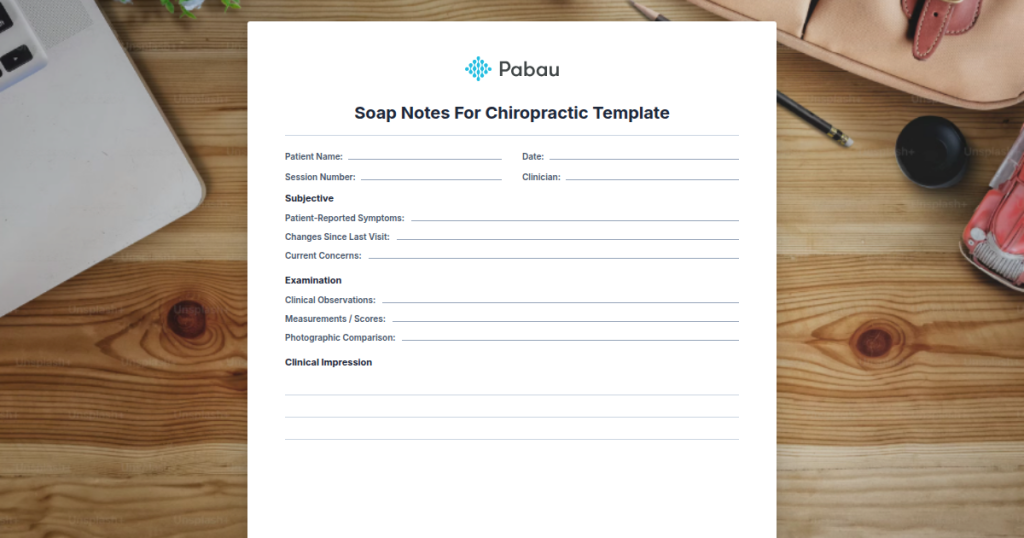
SOAP Notes For Chiropractic Template
What Is a SOAP Notes for Chiropractic Template? A SOAP notes for chiropractic te...

April 22, 2026


Buy now, pay later is now available in Pabau

SOAP notes structure every clinical encounter into four sections: Subjective, Objective, Assessment, and Plan.
Each healthcare specialty adapts the SOAP format to reflect its clinical context – what counts as ‘objective’ in physiotherapy differs from nursing.
CQC Regulation 17 requires UK private clinic records to be accurate, contemporaneous, and auditable – SOAP notes support this directly.
AI-assisted note generation can help practitioners draft SOAP notes faster, though clinical judgement remains the clinician’s responsibility.
Integrating SOAP documentation with practice management software keeps clinical records, scheduling, and billing in one place.
SOAP notes examples appear throughout clinical education – but seeing the format applied to a real patient encounter, across different specialties, is where their practical value becomes clear. A physiotherapist documenting post-surgical rehabilitation works through the same four-section structure as a mental health counsellor recording a CBT session or an aesthetic nurse capturing a Botox consultation. The framework is universal. The language, clinical emphasis, and documentation priorities are not.
SOAP stands for Subjective, Objective, Assessment, and Plan – a system developed by Dr Lawrence Weed at the University of Vermont in the 1960s as part of the Problem-Oriented Medical Record. Weed’s intention was to impose logical structure on clinical documentation, making records easier to read, audit, and act on. Decades later, that intention still holds. In the UK, the Care Quality Commission’s Regulation 17 on good governance requires healthcare providers to maintain accurate, contemporaneous clinical records – and SOAP notes are one of the most widely adopted frameworks for meeting that standard.
This guide breaks down the SOAP notes format with worked examples across five specialties, explains where the format is commonly misapplied, and outlines how structured clinical record tools help private clinics maintain documentation quality at scale.
The four sections of a SOAP note are not equivalent in length or complexity. Each serves a distinct clinical purpose, and confusion between them – particularly between Subjective and Assessment – is one of the most common documentation errors in private practice.
The Subjective section captures what the patient reports. This includes the chief complaint, symptom description, onset and duration, aggravating and relieving factors, and any relevant history the patient shares during the encounter. It is the patient’s account in clinical language – not the clinician’s interpretation. Writing “patient reports sharp left knee pain rated 7/10, worsened by stairs, present for three weeks following a fall” is Subjective. Writing “patient has a grade 2 medial collateral ligament sprain” is not – that is Assessment territory.
The Objective section contains measurable, observable findings. Range of motion readings, vital signs, pain scale scores (clinician-administered), postural assessments, skin condition photographs, medication dosages administered, and functional test results all belong here. The key test: if another clinician reading the note could reproduce the measurement or observation, it belongs in Objective. Opinion, interpretation, and diagnosis do not.
Assessment is where the clinician synthesises the Subjective and Objective data into a clinical interpretation. For diagnostically trained practitioners, this typically includes a diagnosis or differential. For allied health professionals working within their scope of practice, Assessment reflects clinical reasoning – progress toward goals, response to intervention, and any change in clinical status. In the UK, practitioners regulated by the Health and Care Professions Council (HCPC) are required to document clinical reasoning as part of their professional standards.
The Plan section specifies what happens next. Treatment delivered in-session, exercises prescribed, referrals made, follow-up appointments scheduled, patient education provided, and any changes to the existing care plan all belong here. A good Plan section is specific enough that a covering clinician could pick up care without the original practitioner present. “Continue as before” is not a Plan. “Continue manual therapy L4-L5 twice weekly for four weeks, patient to perform home exercise programme (provided in writing), review in four weeks” is.
The following worked examples show how the same four-section structure adapts across clinical contexts. Each example uses realistic clinical language – not textbook summaries – because that is what a CQC inspector, a peer reviewer, or a covering clinician actually reads.
For physiotherapists, physical therapy documentation must track functional progress against measurable baselines. The American Physical Therapy Association (APTA) guidance on clinical documentation emphasises objective measurement as the foundation of progress notes.
S: Patient reports mild anterior knee discomfort rated 3/10 during step-up exercises yesterday. No swelling observed by patient. Reports sleeping better. Motivated and performing home programme consistently.
O: Week 8 post right ACL reconstruction. Active knee flexion 0-118° (improved from 0-102° last session). Extension full and symmetrical. Single-leg squat: 5 reps to 60° with mild quad wobble, no valgus collapse. Step-up test: 10 reps on 20cm step, pain 2/10. Quad circumference right 38cm, left 41cm (deficit 7.3%).
A: Good progress. Flexion improving week on week. Quad strength deficit within expected range for Week 8. Single-leg control adequate for progression to lateral movements. No signs of effusion or irritability.
P: Progress to lateral band walks and lateral step-downs next session. Continue home quad programme. Reduce appointment frequency to weekly from next week. Review quad circumference measurement at Week 10. Patient advised to report any sudden swelling or sharp pain.
Mental health practitioners using clinical documentation for mental health must balance clinical detail with the sensitivity of therapeutic content. The Nursing and Midwifery Council (NMC) and relevant professional bodies emphasise that records should be accurate without reproducing verbatim therapeutic dialogue where it could compromise the therapeutic relationship if accessed.
S: Client reports a difficult week following a conflict with their manager at work. Describes increased rumination in evenings, difficulty falling asleep three nights. States they “catastrophised” the situation initially but were able to apply cognitive restructuring techniques learned in session three. Mood rated 4/10 at session start (5/10 at last session).
O: PHQ-9 score today: 11 (moderate; was 13 at intake). Client visibly tense at session start, posture more relaxed by session midpoint. Engaged with thought record exercise without prompting. Demonstrated accurate identification of cognitive distortions in presented scenario.
A: Client showing functional application of CBT techniques outside sessions – a positive indicator of skills transfer. Mood score fluctuation consistent with situational stressors rather than sustained deterioration. No safeguarding concerns identified. PHQ-9 trend is downward overall.
P: Introduce behavioural activation component next session. Client to complete sleep log this week (form provided). Review PHQ-9 at next session. Continue fortnightly appointments. Next session in 14 days.
Nursing SOAP notes tend to be shorter and more action-focused than those in therapy or allied health settings, reflecting the speed of ward environments. NMC record-keeping standards require that nursing documentation is factual, consistent, and written as close to the time of the event as possible – the principle of contemporaneous recording.
S: Patient reports pain rated 6/10 at surgical site, describes it as “pulling.” States they feel nauseated. No reported dizziness. Requesting additional pain relief.
O: Day 1 post-laparoscopic cholecystectomy. BP 128/84 mmHg, HR 88 bpm, SpO2 98% on room air, temp 37.1°C. Wound site clean and dry, no signs of infection. Drain output 30ml (serosanguinous) in last 4 hours. Last analgesia administered 3h 40min ago.
A: Pain inadequately controlled at current analgesia interval. Vitals stable. Nausea likely post-anaesthetic. No clinical signs of complication.
P: Administer prescribed PRN analgesia. Offer anti-emetic as prescribed. Reassess pain and nausea in 30 minutes. Continue 4-hourly observations. Notify surgical team if pain exceeds 7/10 or temperature rises above 37.5°C.
Aesthetic SOAP notes serve a dual function: clinical record and medicolegal protection. Aesthetic and skin clinic documentation must capture pre-treatment assessment, treatment parameters, and post-treatment findings with enough specificity that any adverse event can be traced to a specific product, dose, and injection site. The General Medical Council’s Good Medical Practice guidance on record keeping applies to all registered medical practitioners, including those working in private aesthetic settings.
S: Patient presents for follow-up Botox treatment to glabella and forehead. Reports satisfaction with previous treatment (10 weeks ago). States forehead lines have “almost returned.” No new medical history changes. No current medications. Denies pregnancy. Allergies: none known. Informed consent reviewed and re-signed.
O: Glabella: dynamic lines grade 3/4 at rest, full animation. Forehead: mild dynamic lines, grade 2/4. Frontalis muscle bulk moderate. No ptosis observed. No residual effect from previous treatment evident. Product used: botulinum toxin type A 50 units/ml. Glabella: 20 units across 5 injection points (4u per point). Forehead: 12 units across 6 injection points (2u per point). Total: 32 units. Batch number recorded.
A: Treatment delivered within standard parameters. No immediate adverse reaction. Patient tolerated procedure well.
P: Post-procedure care instructions provided verbally and in writing. Patient to avoid strenuous exercise, lying flat, and alcohol for 24 hours. Two-week review booked. Patient to contact clinic if any asymmetry, ptosis, or bruising beyond expected mild post-injection. Photographs taken and stored in patient record.
Chiropractic documentation for chiropractic practice management typically uses SOAP notes to capture spinal assessment findings alongside treatment technique specifics. HCPC registrants working in chiropractic and osteopathy settings are expected to document not only what was treated but why – linking clinical findings to treatment rationale.
S: Patient reports lower back pain rated 5/10, centralising compared to last week when it radiated to left buttock. Describes improvement with walking. Morning stiffness reduced to 20 minutes (was 40 minutes at initial assessment). Performing prescribed McKenzie exercises twice daily.
O: Lumbar flexion 60° (was 45° at initial assessment), extension 15° (was 8°). SLR negative bilaterally. L4/L5 segmental restriction reduced – improved joint play on provocation testing. Paravertebral muscle guarding: mild, decreased from moderate. Posture assessment: mild anterior pelvic tilt noted.
A: Centralisation of symptoms is a positive prognostic indicator. Range of motion improving across two sessions. Neurological signs absent. Response to treatment consistent with mechanical lower back presentation.
P: High velocity low amplitude (HVLA) manipulation L4/L5. Soft tissue therapy bilateral erector spinae. Progress McKenzie programme to extension in lying – patient demonstrated technique. Add anterior pelvic tilt correction exercises. Next appointment in one week. Reassess at session 6.
SOAP is the most widely recognised clinical note format, but it is not the only one. Understanding where it differs from alternatives helps practitioners choose the right framework for their clinical context – or recognise when their software is using a variant without labelling it as such.
Clinical documentation tools increasingly offer multiple note formats. Knowing which one fits your specialty matters more than defaulting to what the software presents first.
| Format | Structure | Best Suited For | Key Difference from SOAP |
|---|---|---|---|
| SOAP | Subjective, Objective, Assessment, Plan | Most clinical specialties | Baseline – all others are adaptations |
| BIRP | Behaviour, Intervention, Response, Plan | Mental health and counselling | Replaces Subjective/Objective with observed Behaviour; removes diagnostic Assessment |
| DAP | Data, Assessment, Plan | Therapy and social work | Combines Subjective and Objective into a single Data field – faster to write |
| POMR | Problem list, notes, care plan | Complex multi-problem patients | Organises notes by problem rather than by encounter |
| SOAPIE | SOAP + Implementation, Evaluation | Nursing | Adds implementation and post-intervention evaluation steps |
Mental health practitioners in particular often find BIRP notes more suited to their workflow because the format aligns with behavioural observations rather than clinical measurements. SOAP notes examples in mental health settings sometimes feel forced precisely because the Objective section – designed for vital signs and range of motion data – requires creative adaptation when the only observable data is behavioural. That adaptation is legitimate, but practitioners should document their clinical reasoning for the format they use when working under professional bodies like the British Association for Counselling and Psychotherapy (BACP).

Pabau brings SOAP note templates, AI-assisted documentation, consent forms, and patient records into one platform – so your clinical workflow stays connected from the first appointment to the final follow-up.

The most persistent documentation errors in private practice are not about missing information – they are about information appearing in the wrong section. A CQC inspection or a peer review process will identify these patterns quickly, and over time they undermine the value of the record as a clinical and medicolegal document.
Patient-reported pain scores (where the patient rates their own pain) belong in Subjective. Clinician-observed functional indicators – how the patient moves, their posture, their facial expression during assessment – belong in Objective. A note that places a patient’s verbal pain rating in the Objective section signals to any reviewer that the practitioner does not fully understand the framework. The safe clinical documentation guide outlines how to separate these data types cleanly.
Plans that contain no specificity are nearly useless as clinical records. “Continue treatment” does not tell a covering practitioner what treatment, at what frequency, for what duration, or toward what goal. Every Plan section should answer: what, when, who is responsible, and what triggers escalation. Practitioners working in physiotherapy EMR systems will often find that structured note fields force this specificity – which is exactly the point.
Not every clinician reading this is a diagnostically trained practitioner. Physiotherapists, occupational therapists, and aesthetic nurses all write SOAP notes – but they are not all writing diagnoses. Assessment for a non-diagnosing clinician might read: “patient demonstrating improved functional capacity consistent with treatment goals” rather than naming a condition. Scope of practice governs what belongs in Assessment, and the HCPC’s standards of proficiency for each registered profession are the reference point for UK practitioners.
Notes written hours or days after an encounter are not contemporaneous. The General Medical Council’s Good Medical Practice guidance requires that records are made at the time of the clinical encounter or as soon as practicable afterwards. For UK private clinics, this matters particularly where records may be subject to a CQC inspection or a patient access request under GDPR. AI-assisted note generation tools can significantly reduce the time between clinical encounter and completed documentation, helping practitioners maintain contemporaneous records without adding significant administrative burden.
In aesthetic and cosmetic clinics especially, SOAP notes frequently omit explicit references to consent obtained, contraindications checked, and post-care instructions provided. These are not optional details – they are the medicolegal foundation of the note. Digital consent and intake forms linked directly to patient records make it straightforward to reference completed consent within the SOAP note without rewriting the content, keeping documentation efficient and audit-ready.
Audit five random SOAP notes from your practice each month – not for completeness alone, but for structural accuracy. Ask whether the information in each section genuinely belongs there. Plans without specifics and Objective sections containing patient-reported data are the two patterns most likely to cause problems during a CQC inspection or peer review. A 15-minute monthly audit prevents documentation drift before it becomes a systemic issue.

Need a ready-to-use clinical note framework for social work settings? SOAP Notes for Social Work: A Complete Guide covers how to adapt the SOAP format for case management and safeguarding documentation.
Looking for a psychiatric evaluation framework that works alongside clinical notes? Psychiatric Evaluation Template provides a structured guide for comprehensive mental health assessments in private practice.
Want to understand what CQC inspectors actually look for in clinical records? Care Quality Commission: Role and Regulatory Requirements explains how CQC evaluates documentation standards across private healthcare settings.
Exploring AI tools to support faster clinical documentation? Pabau Echo AI assists practitioners with note drafting and documentation workflows, keeping records structured without slowing down clinical time.
SOAP notes work because they impose a consistent logical structure on encounters that are, by nature, variable. A physio seeing twelve patients in a day, a counsellor managing a complex caseload, and an aesthetic nurse running a busy injectable clinic are all dealing with different clinical content – but they all benefit from a framework that separates what the patient reports, what the clinician observes, what it means, and what happens next.
The examples in this guide reflect how that framework operates under real clinical conditions, not just in training scenarios. Getting the structure right matters for continuity of care, for regulatory compliance under frameworks like the CQC’s governance requirements, and for the legal defensibility of clinical records. Practice management platforms that integrate structured note templates with patient records, consent forms, and scheduling remove the friction from good documentation – making it the path of least resistance rather than an administrative afterthought.
Reviewed against current HCPC standards of proficiency, GMC Good Medical Practice guidance, and CQC Regulation 17 record-keeping requirements.
The four components are Subjective (what the patient reports), Objective (measurable clinical findings), Assessment (the clinician’s interpretation or reasoning), and Plan (what happens next). Each section serves a distinct purpose – mixing information across sections is one of the most common documentation errors in clinical practice.
A physical therapy SOAP note for a post-ACL patient might read: S: mild anterior knee pain 3/10 during step-ups. O: knee flexion 0-118°, single-leg squat 5 reps with mild quad wobble. A: good progress, no effusion signs. P: progress to lateral movements, reduce to weekly appointments, review quad strength at Week 10. Each section stays within its lane – observation in Objective, interpretation in Assessment.
SOAP notes are a specific type of progress note – they use a structured four-section format. Progress notes is a broader term covering any documentation of an ongoing clinical encounter. Some practitioners use BIRP, DAP, or narrative formats as their progress note structure. SOAP notes are the most widely used structured format across healthcare specialties.
Yes, though the format requires adaptation. The Objective section in mental health SOAP notes typically captures observable behavioural indicators and validated scale scores (such as PHQ-9 or GAD-7) rather than physical measurements. Some mental health practitioners prefer BIRP notes, which are structured around behavioural observations rather than clinical data – both are accepted in UK private practice settings.
Length depends on encounter complexity. A straightforward follow-up appointment might produce a SOAP note of 150-250 words. An initial assessment or complex presentation warrants more detail. The principle, as reflected in NHS and GMC guidance, is that notes should be as long as clinically necessary – not padded for appearance, not shortened to the point of losing clinical meaning. Every section should contain enough information for a covering clinician to continue care safely.
A physical therapy SOAP notes example for a lower back patient might include: S: patient reports 5/10 pain, centralising from last week’s left buttock radiation, morning stiffness reduced to 20 minutes. O: lumbar flexion 60° (up from 45°), SLR negative bilaterally, mild paravertebral guarding. A: centralisation is a positive prognostic sign, mechanical presentation responding to treatment. P: HVLA manipulation L4/L5, progress McKenzie programme, review at session 6.