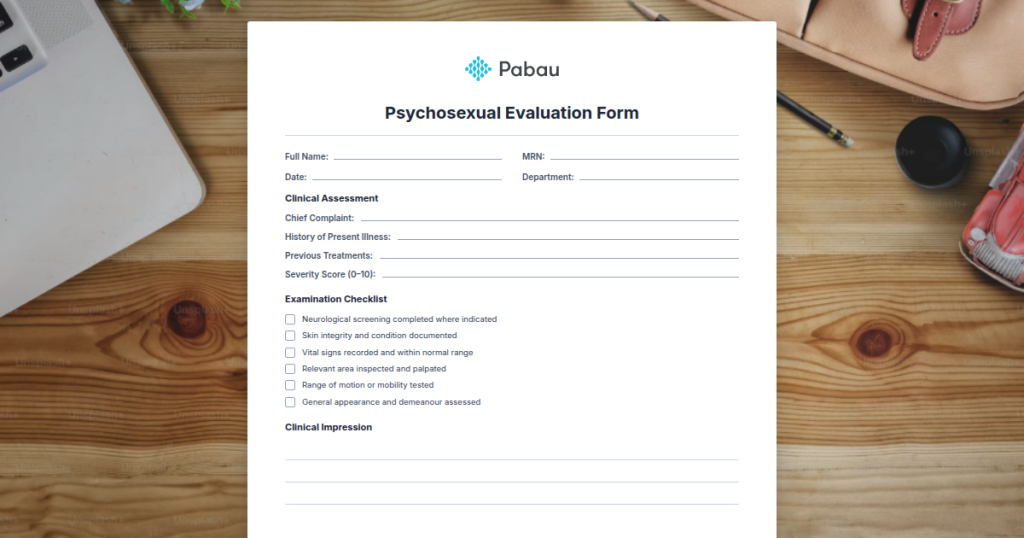
Psychosexual Evaluation Form
What is a Psychosexual Evaluation Form? A psychosexual evaluation form is a stan...

April 22, 2026


Buy now, pay later is now available in Pabau

Therapeutic interventions span psychological, physical, and behavioural modalities – each with distinct evidence bases and documentation requirements.
NICE and the APA recommend CBT as a first-line intervention for depression and anxiety, with EMDR endorsed for PTSD.
Accurate clinical documentation of therapeutic interventions is a regulatory requirement under CQC, HCPC, and BACP standards.
Outcome measurement should be built into the intervention workflow, not added retrospectively.
Practice management systems can support therapeutic intervention tracking, scheduling, and digital form delivery across multidisciplinary teams.
Most clinicians can name a dozen therapeutic interventions without pausing. Fewer can explain how they select, document, and measure outcomes across those modalities within a single clinic workflow. That gap – between knowing an intervention exists and operationalising it consistently – is where clinical quality breaks down. This guide to therapeutic interventions is written for practising clinicians, practice managers, and multidisciplinary teams who need a working reference: what the main intervention categories are, what the evidence says, how to document them, and how clinic systems can support the full delivery cycle.
The term covers a wide spectrum. Mental health practices may focus primarily on psychological modalities such as Cognitive Behavioural Therapy (CBT) or Dialectical Behaviour Therapy (DBT). Physical therapy clinics work with movement-based and rehabilitative therapeutic interventions. Occupational therapists, speech therapists, and integrative medicine practitioners each operate within their own intervention frameworks. What unites them is the need for consistent selection criteria, structured documentation, and measurable outcomes.
Therapeutic interventions are commonly grouped by the mechanism through which change is produced – cognitive restructuring, behaviour modification, physical rehabilitation, expressive modalities, or systemic relational work. Understanding these categories helps clinicians match interventions to presenting problems and justify clinical decisions in records.
Cognitive Behavioural Therapy (CBT) remains the most extensively researched psychological intervention in modern clinical practice. According to NICE clinical guideline CG90, CBT is a recommended first-line treatment for depression, and NICE guideline CG113 recommends it for anxiety disorders. This evidence base makes CBT a logical anchor for therapy clinics building treatment protocols. Clinicians selecting CBT should document the specific model variant (standard CBT, trauma-focused CBT, CBT for psychosis), session frequency, and the rationale for selection.
Dialectical Behaviour Therapy (DBT), originally developed by Marsha Linehan for borderline personality disorder, has since demonstrated effectiveness across a broader population. It combines individual therapy, skills group training, telephone coaching, and therapist consultation – each component needing separate documentation within the clinical record. Acceptance and Commitment Therapy (ACT) sits within the third wave of cognitive behavioural therapeutic interventions and has strong Cochrane-reviewed evidence for chronic pain, anxiety, and depression management. Where CBT focuses on challenging unhelpful thoughts, ACT works through psychological flexibility and values-based action.
Psychodynamic therapy and Interpersonal Therapy (IPT) address relational and developmental patterns rather than discrete symptoms. They typically involve longer treatment episodes and require session notes that capture process dynamics – not just symptom ratings. Mindfulness-Based Cognitive Therapy (MBCT) is NICE-recommended for preventing depressive relapse in patients with three or more previous episodes, which makes accurate treatment history documentation a prerequisite for appropriate intervention selection.
Behavioural therapeutic interventions operate on the principle that behaviour is learned and can be modified through structured techniques. Behavioural Activation targets depression by increasing engagement with rewarding activities, making it one of the lower-intensity therapeutic interventions suitable for primary care and stepped-care pathways. Exposure and Response Prevention (ERP) is the primary evidence-based approach for OCD, requiring graded hierarchy planning and detailed session records tracking exposure progress.
Motivational Interviewing (MI) is widely used across addiction treatment, behaviour change programmes, and chronic disease management. SAMHSA treatment improvement protocols and multiple Cochrane reviews support its effectiveness in increasing patient engagement with change. Unlike structured weekly therapy, MI may be delivered in brief contacts across multiple settings – primary care, wellness clinics, and community health teams – which means documentation must capture the format and duration of each contact accurately.
Physical therapy and physiotherapy deliver therapeutic interventions through movement, exercise, manual techniques, and electrophysical modalities. For a physical therapy practice, documenting therapeutic interventions means capturing the specific exercise prescription, equipment used, sets and repetitions, patient response, and any adverse events. Generic notes – “patient completed exercises” – do not meet HCPC documentation standards and create medico-legal exposure.
Occupational therapy interventions focus on enabling participation in daily activities through skill-building, environmental adaptation, and cognitive rehabilitation. Occupational therapy clinics often run group programmes alongside individual sessions, which require separate consent, separate session records, and aggregate outcome data. Physical rehabilitation interventions for musculoskeletal conditions frequently involve multidisciplinary teams – physiotherapist, occupational therapist, and pain psychologist working in parallel – which increases the documentation burden and the importance of a shared record.
The evidence hierarchy for therapeutic interventions is well-established. At the top sit Cochrane systematic reviews and randomised controlled trial meta-analyses. NICE clinical guidelines synthesise this evidence into treatment recommendations clinicians can apply directly to practice. The American Psychological Association’s clinical practice guidelines serve a similar function for US-based practitioners.
For post-traumatic stress disorder, NICE guideline NG116 recommends Eye Movement Desensitisation and Reprocessing (EMDR) alongside trauma-focused CBT as first-line therapeutic interventions. The World Health Organization’s mental health guidelines also endorse EMDR for PTSD – a rare example of a single modality receiving dual international endorsement. Clinicians documenting EMDR should record the number of sets, target memory, SUDs (Subjective Units of Distress) scores at the start and end of each session, and the installation phase progress.
Schema Therapy has a growing evidence base for personality disorders and complex trauma presentations, though it falls outside current NICE guidance for most primary diagnoses. Solution-Focused Brief Therapy (SFBT) is supported by meta-analytic evidence for a range of presenting problems but is often used as a supplementary approach rather than a primary therapeutic intervention. Clinicians in private practice frequently combine modalities – CBT techniques with ACT principles, for example – which creates a documentation challenge: the clinical record must clearly state the primary framework and any supplementary approaches used.
Evidence classification matters beyond treatment selection. Commissioners, payers, and regulatory bodies may query whether an intervention was appropriate for a presenting problem. A clinical record that references the specific NICE guideline, APA recommendation, or peer-reviewed rationale for the chosen therapeutic intervention provides the audit trail needed if that question arises. This is particularly important in psychiatry and complex mental health settings.

Pabau gives multidisciplinary teams a single platform to document therapeutic interventions, send outcome measures digitally, and coordinate care across locations – without switching between systems.

Documentation of therapeutic interventions is not optional. The Health and Care Professions Council (HCPC) sets out record-keeping standards that apply to physiotherapists, occupational therapists, psychologists, and a range of other regulated professions. The British Association for Counselling and Psychotherapy (BACP) ethical framework includes clear obligations around record-keeping for counsellors and psychotherapists. The Care Quality Commission (CQC) in England will inspect clinical records as part of its assessment of whether care is safe, effective, and well-led.
Effective documentation of therapeutic interventions captures five elements. First, the presenting problem and clinical rationale for the selected intervention. Second, the specific modality, model, and delivery format (individual, group, remote). Third, session content at a level of detail that would allow a colleague to continue the intervention without a handover conversation. Fourth, the patient’s response – functional changes, reported experience, and any adverse reactions. Fifth, progress against agreed goals or standardised outcome measures.
SOAP notes – Subjective, Objective, Assessment, Plan – remain a widely used framework for structuring intervention records. They work well across psychological, physical, and occupational therapeutic interventions because the four-field structure is modality-agnostic. A guide to writing effective SOAP notes covers how this structure applies across different clinical contexts. The Plan field, in particular, should document the next intervention, any homework set for the client, and the review date.
Paper-based records create problems for multidisciplinary teams. When a physiotherapist, occupational therapist, and psychologist are all delivering therapeutic interventions for the same patient, paper notes held in different locations make continuity of care harder to maintain and audit trails harder to produce. Digital clinical records – with structured templates per intervention type, time-stamped entries, and role-based access – address these problems directly.
Practice management platforms that support digital forms enable clinicians to send standardised outcome measures to clients before or after each session. PHQ-9 and GAD-7 for psychological therapeutic interventions, Oxford Knee Score for physical rehabilitation, and COPM for occupational therapy – these can be completed digitally, with scores feeding directly into the clinical record. This removes the manual transcription step that introduces errors and delays. AI-assisted clinical note tools can further support accurate documentation by structuring dictated or typed notes into consistent formats, which is particularly useful for high-volume therapy practices.
Audit your current session note templates against your registration body’s documentation standards at least once per year. HCPC, BACP, and CQC have each published updated guidance on clinical record-keeping in the last three years. A short internal audit – reviewing five random clinical records against the standard – takes under an hour and reveals gaps before a formal inspection does.
Outcome measurement is the mechanism through which therapeutic interventions are evaluated. Without structured data collection, clinicians rely on subjective impression – which is susceptible to confirmation bias and difficult to defend if outcomes are questioned. The NHS England Improving Access to Psychological Therapies (IAPT) programme mandated session-by-session outcome measurement for all psychological therapeutic interventions from its inception, producing one of the largest datasets on therapy outcomes in the world.
Selecting the right outcome measure depends on the intervention type and presenting problem. For anxiety and depression-focused therapeutic interventions, PHQ-9, GAD-7, and WEMWBS are routinely used in UK practice. For physical therapeutic interventions, condition-specific measures such as the Oswestry Disability Index, the Knee Injury and Osteoarthritis Outcome Score (KOOS), and the Patient-Specific Functional Scale are more appropriate. For occupational therapy interventions, the Canadian Occupational Performance Measure (COPM) captures functional goals in a patient-centred format.
The timing of measurement matters as much as the choice of measure. Pre-intervention baseline, mid-treatment review, and post-intervention closure are the three minimum data points for most outcome measurement frameworks. Some therapeutic interventions – particularly those addressing chronic conditions or complex trauma – benefit from longer follow-up data collected at three and twelve months. Building these data collection points into the booking workflow, rather than relying on clinicians to remember to send questionnaires, increases completion rates considerably.
Aggregated outcome data has a secondary function beyond individual care. It supports practice management decisions – which therapeutic interventions are producing the best outcomes for which presenting problems, which clinicians may benefit from additional training or supervision, and whether the practice can demonstrate effectiveness to commissioners or insurers. Clinics running outcome tracking across their full client population generate the kind of data that supports both quality improvement and business development conversations.

Need a structured note-writing framework for therapy records? SOAP Notes for Social Work provides a complete guide to writing effective clinical notes across therapeutic contexts.
Working in a mental health or psychology practice? Mental Health EMR Software covers how purpose-built practice management tools support documentation, scheduling, and outcome tracking for therapy teams.
Managing a multidisciplinary team delivering physical and occupational therapeutic interventions? Occupational Therapy Software outlines the workflow and documentation features most relevant to OT practices.
Looking for safer, more consistent clinical note practices? Safer Clinical Notes sets out practical standards for documentation quality across intervention types.
Therapeutic interventions are the core of clinical practice across mental health, physical rehabilitation, and allied health. What separates high-quality intervention delivery from adequate care is not which modality is selected – it is the consistency with which selection is justified, delivery is documented, and outcomes are measured. NICE and APA guidelines provide the evidence framework. HCPC, BACP, and CQC standards set the documentation floor. The gap between those frameworks and actual clinical records is where quality improvement work tends to live.
For practice managers and clinic owners, the operational question is how to embed those standards into the workflow without adding administrative burden to clinicians. Digital records, structured note templates, and automated outcome measure dispatch make consistent documentation of therapeutic interventions achievable at scale. The data those systems generate – on outcomes, on session completion, on intervention types delivered – becomes a meaningful practice asset over time. Therapy practice management platforms designed with these workflows in mind reduce friction at every stage of the intervention cycle.
Reviewed against current NICE clinical guidelines, APA clinical practice recommendations, HCPC record-keeping standards, and BACP ethical framework documentation obligations.
The main categories are psychological (CBT, DBT, ACT, psychodynamic therapy), behavioural (Behavioural Activation, ERP, Motivational Interviewing), physical and rehabilitative (physiotherapy, occupational therapy), and expressive or systemic modalities (art therapy, family therapy, narrative therapy). Each category has its own evidence base, delivery format, and documentation requirements. Most multidisciplinary clinics work across several categories simultaneously.
A treatment typically refers to a specific clinical procedure, medication, or medical process aimed at resolving a condition. A therapeutic intervention is a structured, evidence-informed action – psychological, physical, or behavioural – intended to improve functioning, reduce symptoms, or support recovery. Interventions are often one component of a broader treatment plan, delivered over multiple sessions with defined goals and outcome measures.
Most clinicians use SOAP notes (Subjective, Objective, Assessment, Plan) or equivalent structured formats. Good documentation records the presenting problem, selected intervention and rationale, session content, patient response, and next steps. Regulatory bodies including the HCPC and BACP publish specific record-keeping standards that documentation must meet. Digital systems with customisable note templates make consistent documentation more manageable across high-volume practices.
Evidence-based therapeutic interventions are those with demonstrated effectiveness in randomised controlled trials, systematic reviews, or meta-analyses, and which are recommended in clinical guidelines. Examples include CBT for depression and anxiety (NICE CG90, CG113), EMDR for PTSD (NICE NG116), DBT for borderline personality disorder, and Motivational Interviewing for behaviour change and addiction. The APA and Cochrane Library are authoritative sources for evidence classifications across modalities.
In mental health care, therapeutic interventions are selected based on the presenting diagnosis, patient preference, and available evidence. A stepped-care model is common in NHS and many private settings – lower-intensity therapeutic interventions such as guided self-help or Behavioural Activation are offered first, with higher-intensity modalities like DBT or EMDR reserved for more complex presentations. Outcome measures are used at each step to determine whether escalation is warranted.
Common tools include PHQ-9 and GAD-7 for psychological therapeutic interventions addressing depression and anxiety, WEMWBS for wellbeing, and condition-specific measures such as the Oswestry Disability Index for back pain or COPM for occupational therapy. Measures are typically administered at intake, mid-treatment, and discharge. Digital delivery through practice management platforms increases completion rates and enables aggregate outcome analysis across the full patient population.