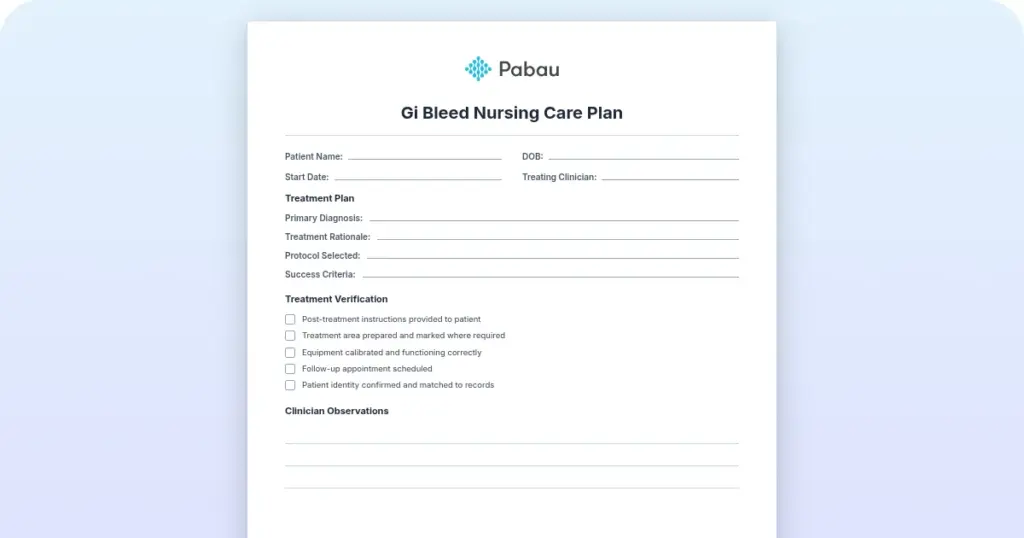
GI bleed nursing care plan
A GI bleed nursing care plan is a structured document for a patient with gastroi...

1
Last Updated: Oct 15, 2026

Therapeutic interventions divide into psychological, behavioral, and physical categories, and each one carries its own evidence base and documentation requirement.
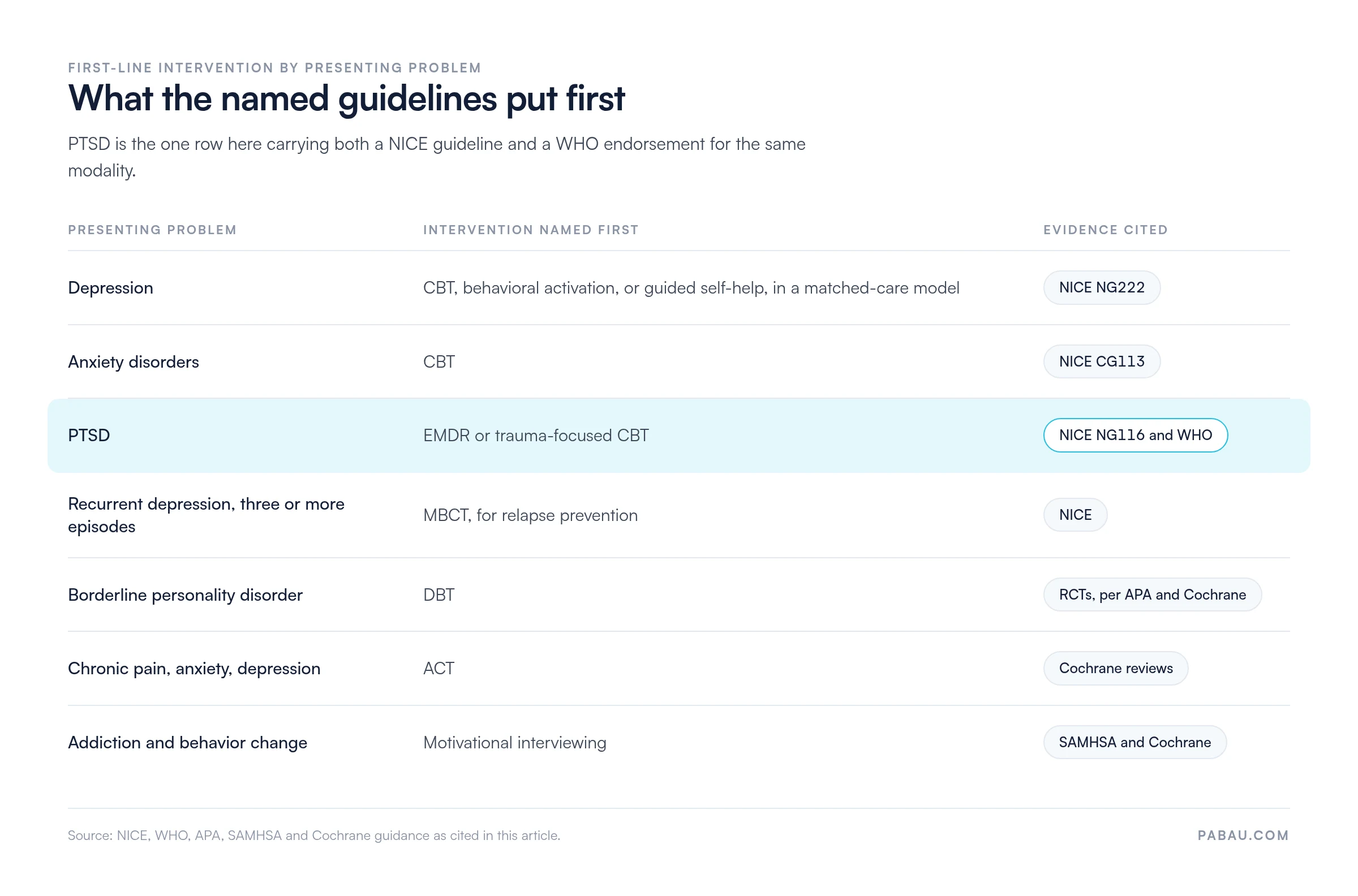
NICE and the APA put CBT first for depression and anxiety, and NICE NG116 names EMDR for PTSD.
Record the specific model variant, the delivery format, and the guideline behind your choice, not just the modality name.
US record-keeping answers to state licensing boards and payer contracts, while HIPAA governs how the record is stored and shared.
Schedule outcome measures at baseline, mid-treatment, and discharge inside the booking workflow, so nobody has to remember to send them.
A therapeutic intervention is any structured, evidence-informed action taken to reduce symptoms, improve functioning, or support recovery. The category covers CBT and DBT, exposure work, motivational interviewing, physical rehabilitation, and occupational therapy. What varies between practices is how consistently each one gets selected, recorded, and measured.
Volume is what makes that consistency worth engineering. CDC data records 57.2 million US physician office visits with a mental disorder as the primary diagnosis. Mental health teams work with psychological modalities, while physical therapy and occupational therapy teams deliver movement-based and rehabilitative work. All of them answer the same three questions: why this intervention, what happened in the session, and did the patient improve?
This guide pairs each intervention with the guideline that recommends it, then with the documentation and outcome measure it specifically requires. That pairing is what a payer or an inspector asks about, and it is the part you build once and reuse.
Interventions are usually grouped by the mechanism that produces the change:
Grouping them this way helps you match an intervention to a presenting problem. It also gives you the language to justify that choice in the record.
Cognitive behavioral therapy (CBT) is the most extensively researched psychological intervention in clinical practice. NICE NG222 lists it as one of several first-line options for depression, alongside guided self-help and behavioral activation in a matched-care model. NICE guideline CG113 recommends it for anxiety disorders.
That evidence base makes CBT a sensible anchor for a practice building treatment protocols. When you select it, record the model variant, the session frequency, and the reason you chose it. Trauma-focused CBT and CBT for psychosis are separate protocols, so the record should name which one you are running. A CBT cheat sheet keeps technique names consistent across a team’s notes.
Dialectical behavior therapy (DBT) was developed by Marsha Linehan for borderline personality disorder. It has since shown effectiveness across a wider population. DBT combines individual therapy, skills group training, telephone coaching, and therapist consultation. Each of those four components needs its own entry in the clinical record.
Acceptance and commitment therapy (ACT) sits in the third wave of cognitive behavioral work, with Cochrane-reviewed evidence for chronic pain, anxiety, and depression. Where CBT challenges unhelpful thoughts, ACT works through psychological flexibility and values-based action. Both rely on the client being able to name what they feel, so early sessions often build that vocabulary first. A letting go of resentment worksheet gives clients a structured way to practice that vocabulary between sessions.
Psychodynamic therapy and interpersonal therapy (IPT) address relational and developmental patterns rather than discrete symptoms. They usually run longer, and their session notes need to capture process dynamics as well as symptom ratings. Mindfulness-based cognitive therapy (MBCT) is NICE-recommended for preventing depressive relapse in patients with three or more previous episodes. That makes an accurate treatment history a prerequisite for choosing it.
Behavioral interventions treat behavior as learned, and therefore changeable through structured technique. Behavioral activation targets depression by increasing engagement with rewarding activities. Its low intensity makes it a fit for primary care and stepped-care pathways. Exposure and response prevention (ERP) is the primary evidence-based approach for OCD, and it needs graded hierarchy planning plus session records tracking exposure progress.
Motivational interviewing (MI) is used across addiction treatment, behavior change programs, and chronic disease management. SAMHSA treatment improvement protocols and several Cochrane reviews support it for increasing patient engagement. MI is often delivered in brief contacts rather than weekly sessions, across primary care and community health teams. So the record has to capture the format and duration of every contact.
Physical therapy, known as physiotherapy outside the US, works through movement, exercise, manual technique, and electrophysical modalities. Documenting one session means recording the exercise prescription, the equipment, sets and repetitions, patient response, and any adverse event. A note that says “patient completed exercises” fails that standard and creates medico-legal exposure.
Occupational therapy focuses on participation in daily activities, through skill-building, environmental adaptation, and cognitive rehabilitation. Practices often run group programs alongside individual sessions. Those need separate consent, separate session records, and aggregate outcome data.
Musculoskeletal rehabilitation frequently runs across a physical therapist, an occupational therapist, and a pain psychologist working in parallel. That raises the documentation load and makes a shared record far more useful than three separate ones.
The evidence hierarchy here is well established. Cochrane systematic reviews and meta-analyses of randomized controlled trials sit at the top. NICE clinical guidelines turn that evidence into recommendations you can apply directly. The American Psychological Association’s clinical practice guidelines do the same job for US practitioners.
For post-traumatic stress disorder, NICE guideline NG116 recommends Eye Movement Desensitisation and Reprocessing alongside trauma-focused CBT as first-line options. The World Health Organization’s mental health guidelines endorse EMDR for PTSD as well, which is a rare double for a single modality. An EMDR session record needs four specifics. Log the target memory, the number of sets, and the installation phase progress. Add SUDs (subjective units of distress) scores at the start and the end.
The map below collects those recommendations. What it shows is a small set of well-evidenced defaults, each tied to a named guideline.
Two approaches sit just outside that map. Schema therapy has a growing evidence base for personality disorders and complex trauma, though it falls outside current NICE guidance for most primary diagnoses. Solution-focused brief therapy (SFBT) has meta-analytic support across several presenting problems, and tends to be used as a supplement rather than a primary intervention. Solution-focused work often begins with a life checklist self-assessment template, giving clients a concrete starting point for goals.
Clinicians in private practice routinely combine modalities, running CBT technique alongside ACT principles. That creates a documentation problem worth solving early. The record has to state the primary framework, then name any supplementary approaches used.
Evidence classification matters well past treatment selection. Commissioners, payers, and regulators may ask whether an intervention suited the presenting problem. A record that cites the specific NICE guideline or APA recommendation behind the choice answers that question without a reconstruction exercise months later.
Documentation standards come from whoever regulates you. In the US that means state licensing boards and payer contracts, with HIPAA governing how the record is stored and shared. Payers can also set their own note requirements as a condition of reimbursement.
In the UK, the Health and Care Professions Council (HCPC) sets record-keeping standards for physical therapists, occupational therapists, and psychologists. The British Association for Counselling and Psychotherapy (BACP) ethical framework covers counselors and psychotherapists. The Care Quality Commission (CQC) inspects clinical records in England as part of judging whether care is safe and well-led.
Whichever body you answer to, a defensible intervention record captures five elements:
SOAP notes remain the most widely used structure for holding those five elements. Subjective, objective, assessment and plan are modality-agnostic fields, which is why they work across psychological, physical, and occupational work. Use the plan field for the next intervention, any homework set, and the review date.
Paper records break down as soon as more than one profession is involved. A physical therapist, an occupational therapist, and a psychologist may all treat the same patient. Notes held in three places slow continuity and make an audit trail harder to produce.
Practice management software like Pabau holds those records in one system instead. You get a note template per intervention type, time-stamped entries, and role-based access for each profession.
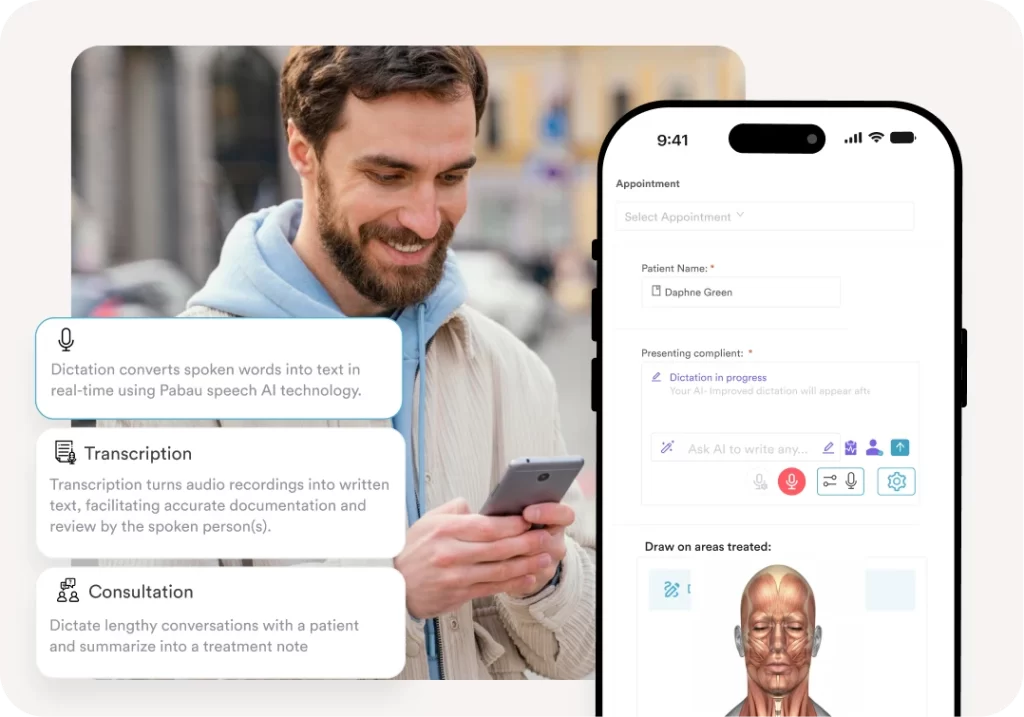
Digital forms let you send a standardized outcome measure to a client before or after a session, with the score landing straight in the record. That removes the manual transcription step that introduces errors and delay. For a high-volume therapy caseload, dictating the note and letting the software structure it cuts the most keyboard time.
Audit your session note templates against your licensing board’s or registration body’s standards once a year. Pull five records at random and score them against the standard. It takes under an hour, and it surfaces the weak spots before an inspector or a payer does.
Outcome measurement is how you evaluate an intervention. Without structured data you are left with clinical impression, which is vulnerable to confirmation bias and hard to defend when questioned. NHS England’s Improving Access to Psychological Therapies (IAPT) program mandated session-by-session measurement from the start. That produced one of the largest therapy outcome datasets in the world.
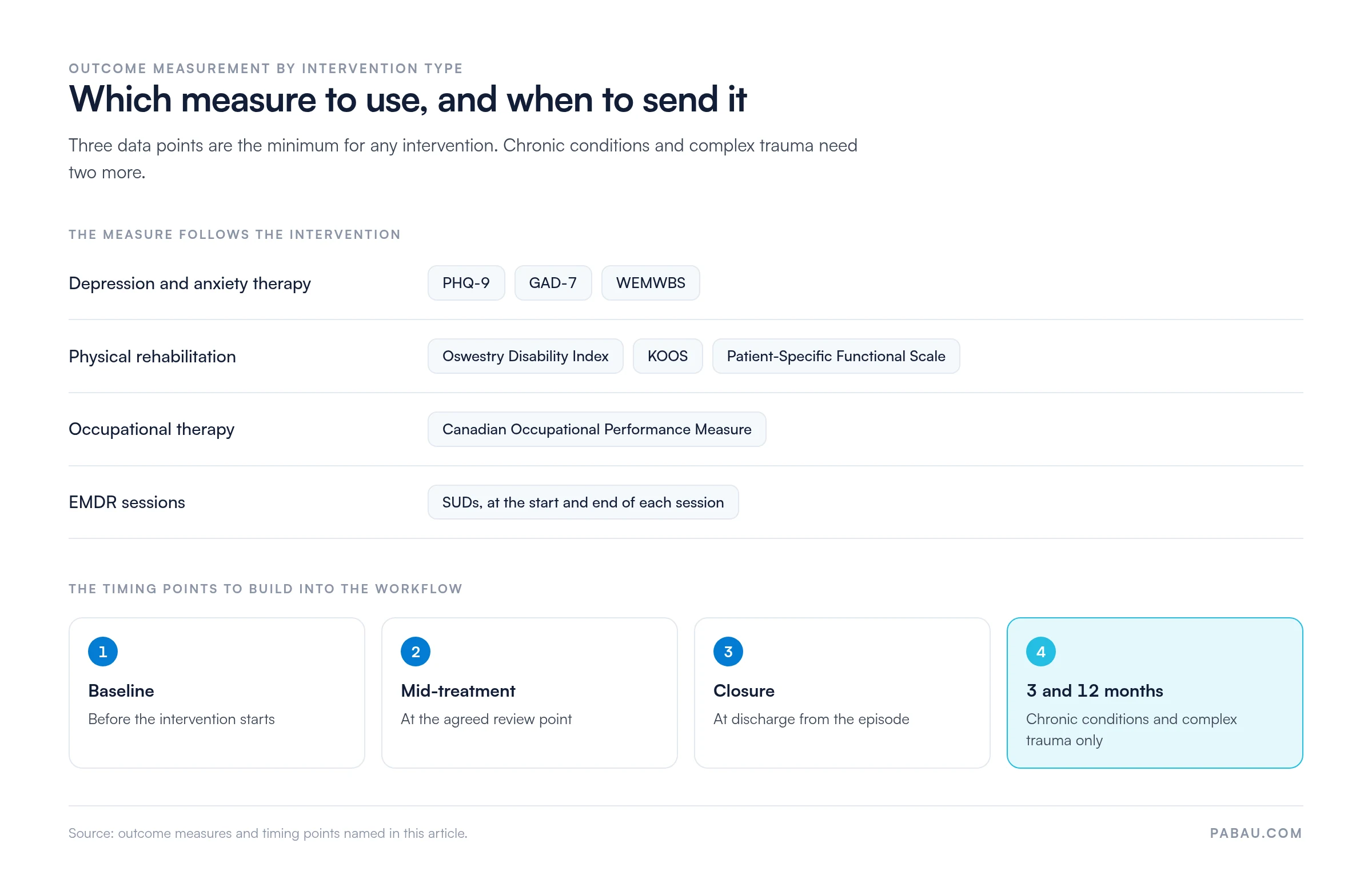
The right measure depends on the intervention and the presenting problem. PHQ-9, GAD-7, and WEMWBS cover depression, anxiety, and wellbeing. Physical rehabilitation uses condition-specific measures such as the Oswestry Disability Index, the Knee Injury and Osteoarthritis Outcome Score (KOOS), and the Patient-Specific Functional Scale.
Occupational therapy uses the Canadian Occupational Performance Measure (COPM), which captures functional goals in the patient’s own terms. A ready-made PHQ-9 and GAD-7 template saves you rebuilding the two most common ones from scratch.
Timing matters as much as the choice of measure. Baseline, mid-treatment review, and closure are the three minimum data points. Chronic conditions and complex trauma benefit from follow-up at three and twelve months. Build those points into the booking workflow rather than relying on a clinician to remember, and completion rates rise sharply.
Aggregated data does a second job beyond individual care. It shows which interventions produce the best outcomes for which presenting problems, and which clinicians would benefit from additional supervision. It also lets you demonstrate effectiveness to a commissioner or an insurer, which is a commercial conversation as much as a clinical one.
Most therapy practices run this workflow across three or four tools. Session notes live in one system, outcome questionnaires get emailed from another, and the calendar sits somewhere else again. Every handoff between them is a place for a score to go missing.
Pabau keeps those pieces in one client record. You can hold a note template per intervention type and send a PHQ-9 or COPM questionnaire from the record itself. Returned scores sit against the appointment that generated them. Pabau Scribe, our AI scribe, drafts the session note from dictation, so the detail is captured while it is still fresh.
Every subscription includes every feature, so a multidisciplinary team gets the same record whether the appointment is a physical therapy session or a psychology review. Our software for therapy practices coordinates that across locations, so the outcome data you collect is usable the day a questionnaire comes back.

Pabau gives multidisciplinary teams one platform for intervention notes, digital outcome measures, and care coordination across locations. No switching between systems to finish a single record.

Modality choice matters less than most training implies. Two practices can run the same CBT protocol and produce very different records. Only one of those records will hold up when a payer asks why that intervention was chosen.
So pick the interventions your caseload needs, then spend the effort on the repeatable parts. A note template per modality, a named guideline behind each selection, and an outcome measure that goes out automatically. That is the version of consistency a multidisciplinary team can maintain without anyone policing it.
The trade-off is upfront work. Building templates and scheduling questionnaire dispatch costs a few days you would rather spend with patients. In return you get a dataset you can defend and improve on, instead of a filing cabinet nobody wants opened. Book a demo to see how Pabau handles intervention notes and outcome tracking for a therapy team.

Seeing thought blocking in session? Thought blocking explains what the sign indicates and how to record it in a session note.
Teaching distress tolerance in DBT? DBT distress tolerance skills walks through the skills and how clients practice them between sessions.
Running motivational interviewing in brief contacts? Motivational interviewing cheat sheet keeps the core techniques and phrasing within reach.
Writing treatment plans for a psychology caseload? Psychology treatment plan template gives you a goal, intervention and review structure to fill in.
Want a simple activity for clients? Kindness worksheet gives clients 10 guided acts of kindness plus a closing reflection to complete together.
They fall into four groups. Psychological interventions include CBT, DBT, ACT, and psychodynamic therapy. Behavioral interventions include behavioral activation, exposure and response prevention, and motivational interviewing. Physical and rehabilitative work covers physical therapy and occupational therapy. Expressive and systemic modalities cover art therapy, family therapy, and narrative therapy. Most multidisciplinary practices run several groups at once.
A treatment is usually a specific procedure, medication, or medical process aimed at resolving a condition. A therapeutic intervention is a structured, evidence-informed action intended to improve functioning or reduce symptoms. Interventions are often one component of a broader treatment plan, delivered across several sessions with defined goals and outcome measures.
Most use SOAP notes, meaning subjective, objective, assessment and plan, or an equivalent structured format. A good record names the presenting problem, the intervention and the reason for it, the session content, the patient’s response, and the next step. Licensing boards and registration bodies such as the HCPC and BACP publish the standards a record has to meet.
CBT has the strongest evidence for depression and anxiety, under NICE NG222 and CG113. EMDR and trauma-focused CBT lead for PTSD under NICE NG116. DBT is best evidenced for borderline personality disorder, and motivational interviewing for addiction and behavior change. Each designation rests on randomized controlled trials, systematic reviews, or meta-analyses.
Stepped care starts with the lowest-intensity option that suits the presentation. Guided self-help or behavioral activation comes first, with DBT or EMDR held back for more complex cases. Outcome measures at each step decide whether the patient moves up. Patient preference and available evidence sit alongside diagnosis in that decision.
PHQ-9 and GAD-7 cover depression and anxiety, and WEMWBS covers wellbeing. Physical rehabilitation uses the Oswestry Disability Index or KOOS, and occupational therapy uses the COPM. Send each one at intake, mid-treatment, and discharge. Digital delivery through a practice management platform raises completion rates and makes population-level analysis possible.