Primary & Preventive Care
Adrenocorticotropic Hormone ACTH Template
Download Your Free Adrenocorticotropic Hormone (ACTH) Test Template Adrenocortic...

April 23, 2026


Buy now, pay later is now available in Pabau

Standardised metabolic acidosis assessment ensures consistent diagnostic documentation across your clinic.
ABG and electrolyte interpretation becomes faster with a structured template workflow.
Differential diagnosis support reduces missed cases and improves clinical safety.
Digital form automation eliminates manual data entry and transcription errors.
Compliant documentation protects your clinic during regulatory audits and patient reviews.
A metabolic acidosis template is a structured clinical assessment form that guides practitioners through the systematic evaluation of patients presenting with metabolic acidosis. This template incorporates arterial blood gas (ABG) parameters, electrolyte panels, anion gap calculations, and clinical history fields to support accurate diagnosis. By standardising how metabolic acidosis is documented and assessed, the template improves diagnostic consistency, reduces documentation time, and ensures nothing is missed during the evaluation process. Clinics using metabolic acidosis templates report faster assessment cycles and clearer diagnostic reasoning in patient records.
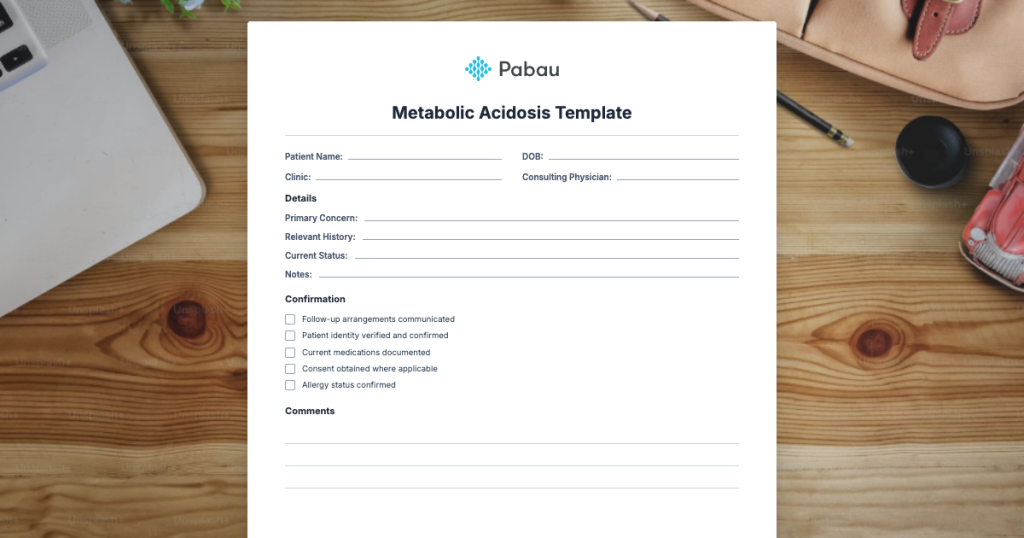
A ready-to-use clinical evaluation form covering patient demographics, presenting symptoms, ABG parameters (pH, HCO3, PaCO2), serum electrolytes, anion gap calculation, assessment findings, and differential diagnosis documentation for metabolic acidosis workup.
Download templateA metabolic acidosis assessment template is a clinical documentation tool that formalises how practitioners evaluate and record findings in patients with acid-base disturbances. The form captures the essential diagnostic workflow: initial symptom presentation, vital signs, blood gas results, serum electrolytes, calculated anion gap, and final assessment conclusions. In clinical practice, metabolic acidosis diagnosis depends on systematic interpretation of ABG values (particularly pH below 7.35 and bicarbonate below 22 mEq/L) alongside electrolyte abnormalities and clinical context. Comprehensive understanding of the pathophysiology and diagnosis of metabolic acidosis ensures practitioners apply evidence-based diagnostic criteria consistently. alongside electrolyte abnormalities and clinical context. The template ensures every practitioner follows the same diagnostic pathway, reducing variation and improving consistency across your clinic or multi-location practice.
From a regulatory and safety perspective, metabolic acidosis assessment templates serve an important purpose. Detailed documentation of diagnostic reasoning-including what ruled out respiratory causes and how anion gap classification informed differential diagnosis-demonstrates clinical competence and protects your clinic during audits or peer review. NCBI StatPearls clinical resources highlight that systematic anion gap-based classification (high anion gap versus normal anion gap metabolic acidosis) is fundamental to narrowing the diagnostic differential and selecting appropriate treatment. Research on treatment of chronic metabolic acidosis demonstrates that accurate diagnosis leads to disease-modifying interventions. A structured template embeds this logic directly into your assessment workflow, ensuring the reasoning is documented.
Whether your clinic operates across a single location or multiple sites, a standardised metabolic acidosis template ensures that every practitioner documents the assessment the same way. This consistency is critical when multiple clinicians review the same patient or when cases are escalated for specialist input. The template also supports digital forms integration, allowing automatic population of patient demographics and past results, which speeds up the assessment process and reduces manual transcription errors.
Using the metabolic acidosis template involves a structured five-step process that mirrors standard clinical assessment protocols. Each step is designed to collect the information needed for accurate diagnosis and treatment planning, while the template’s built-in logic supports differential diagnosis reasoning.
The entire workflow takes 5-10 minutes once you’re familiar with the template. In digital form environments with AI-assisted documentation, the template can pre-populate patient data and suggest differential diagnoses based on entered lab values, further reducing assessment time.

Pabau's digital forms automatically organise patient data and support clinical decision-making across your practice locations.

The metabolic acidosis assessment template is designed for clinicians across medical specialties who evaluate patients for acid-base disturbances. Private practice GPs use the form when assessing acute presentations (dyspnoea, fatigue, confusion) to rule in or out metabolic acidosis as the underlying cause. Metabolic health practitioners, functional medicine clinicians, and wellness providers increasingly encounter patients with metabolic concerns-the template provides a structured approach to assessment rather than ad-hoc documentation.
In IV therapy clinics, the template supports pre-treatment screening and monitoring, ensuring that patients with underlying metabolic derangements are identified before infusion protocols are initiated. Functional medicine practices investigating chronic fatigue, autoimmune conditions, or metabolic dysfunction often order ABGs as part of extended assessment; the template standardises how these results are interpreted and documented. Integrative medicine practitioners benefit from the form’s emphasis on differential diagnosis reasoning, which aligns with multi-factorial investigation approaches.
Multi-location practices and clinics with multiple practitioners gain the most from metabolic acidosis templates. When team members use the same form, patient records are consistent regardless of which clinician performs the assessment. This consistency is essential for clinical handovers, peer review, and compliance audits. Practices using metabolic health practice management software can embed the template directly into the patient record system, making it available to all authorised team members in real time.
Diagnostic consistency and safety. Standardised assessment reduces the risk of missing significant findings. Every patient receives the same structured evaluation, ensuring that critical lab parameters are reviewed and differential diagnosis reasoning is documented. This consistency protects your clinic from audit findings or medicolegal challenges based on incomplete documentation.
Faster assessment and reduced documentation burden. Rather than writing free-form notes, practitioners complete pre-structured fields, which speeds up the assessment process and eliminates the need to transcribe handwritten findings into electronic records. Multi-practitioner clinics report time savings of 15-20% on assessment-related admin per patient.
Automated data population and calculation. Digital versions of the template automatically pull patient demographics from the record and calculate anion gap based on entered electrolyte values. This automation eliminates manual calculation errors and ensures the diagnostic logic is applied consistently. Practitioners focus on clinical reasoning rather than arithmetic.
Compliance and audit readiness. Detailed metabolic acidosis assessments demonstrate clinical competence and methodical diagnostic reasoning. During regulatory inspections, examiners see that your clinic follows evidence-based protocols and documents decisions systematically. This reduces compliance risk and strengthens your clinic’s reputation.
Support for team training and onboarding. New team members using the template learn the clinic’s diagnostic approach immediately. The form’s structure teaches assessment order, decision logic, and documentation expectations. Experienced practitioners maintain consistency while less experienced staff follow proven pathways.
Flag metabolic acidosis cases with anion gap >12 or pH <7.30 immediately for escalation. Use the template's risk field to highlight high-acuity findings so team members prioritise urgent cases and ensure patients receive timely specialist referral if needed.
Arterial blood gas interpretation is the foundation of metabolic acidosis diagnosis. The three critical ABG parameters-pH, HCO3 (bicarbonate), and PaCO2 (partial pressure of carbon dioxide)-tell you whether metabolic acidosis is present and whether respiratory compensation is appropriate. MedlinePlus clinical resources define metabolic acidosis as a condition where pH falls below 7.35 and HCO3 drops below 22 mEq/L due to loss of bicarbonate or retention of hydrogen ions.
Normal blood pH is tightly maintained between 7.35 and 7.45. When this range is disrupted, buffer systems and respiratory/renal compensation mechanisms activate to restore balance. Evidence-based approaches to diagnosis and management of metabolic acidosis emphasize systematic ABG interpretation as the foundation for treatment decisions. In metabolic acidosis, the respiratory system attempts compensation by hyperventilating to blow off carbon dioxide and raise pH. The expected respiratory response can be calculated using Winter’s formula: expected PaCO2 = (1.3 × HCO3) ± 2. If the actual PaCO2 is higher than this prediction, concurrent respiratory acidosis is also present-a more serious condition requiring urgent intervention.
The metabolic acidosis assessment template guides you through this interpretation by providing dedicated fields for each ABG value and space to document whether respiratory compensation is adequate. A patient with pH 7.28 and HCO3 of 15 with PaCO2 of 28 shows appropriate respiratory compensation (calculated expectation is 1.3 × 15 ± 2 = 17-21, but actual is 28, meaning respiratory effort is insufficient-a red flag). Documentation of this discrepancy demonstrates your clinical reasoning and alerts team members to the severity of the case.
Once metabolic acidosis is confirmed, anion gap classification narrows the differential diagnosis dramatically. The anion gap represents unmeasured serum ions (primarily proteins and organic acids) and is calculated as: [Na+] − ([Cl−] + [HCO3−]). A normal anion gap is 8-16 mEq/L (some labs use 10-12 depending on electrolyte method). When anion gap exceeds 16, high anion gap metabolic acidosis is present, pointing toward specific causes: lactic acidosis, diabetic ketoacidosis, uraemia, or ingestion of toxins. When anion gap remains normal despite low HCO3, the diagnosis shifts to normal anion gap acidosis, typically caused by bicarbonate loss (diarrhoea) or renal acid retention (renal tubular acidosis).
This classification is essential because high anion gap acidosis requires urgent investigation for life-threatening conditions like sepsis-related lactic acidosis or uncontrolled diabetes. Understanding the treatment of acute metabolic acidosis helps clinicians recognize when immediate intervention is critical like sepsis-related lactic acidosis or uncontrolled diabetes. Normal anion gap acidosis, while still serious, usually points toward more straightforward causes. Your metabolic acidosis assessment template embeds this decision point directly into the form, ensuring practitioners calculate anion gap, document the result, and use it to guide differential diagnosis. The template transforms anion gap from an abstract lab value into actionable clinical information.

Need to document clinical assessments faster? Digital forms software automates template deployment across your practice and eliminates paper-based workflows.
Want AI assistance with clinical note generation? Echo AI integrates with your assessment templates to suggest diagnoses and streamline documentation based on entered findings.
Managing assessments across multiple locations? Metabolic health EMR software centralises templates and ensures consistency across your clinic network.
A metabolic acidosis assessment template transforms how your clinic evaluates and documents patients with acid-base disturbances. By standardising ABG interpretation, anion gap classification, and differential diagnosis reasoning, the template improves diagnostic safety, reduces documentation time, and ensures consistent quality across your practice. Whether you’re a private GP, metabolic health specialist, or multi-location clinic, implementing a structured assessment form ensures that no critical findings are missed and that every patient record documents your clinical reasoning clearly. Start with the free Metabolic Acidosis Assessment Form above, customise it to match your clinic’s workflow, and integrate it into your digital documentation system for maximum efficiency.
Normal arterial blood pH ranges from 7.35 to 7.45. Metabolic acidosis occurs when pH falls below 7.35, indicating increased acidity in the blood. This drop happens because bicarbonate (HCO3) levels fall (below 22 mEq/L) due to bicarbonate loss or hydrogen ion retention, reducing the blood’s buffering capacity.
Anion gap represents unmeasured serum ions and is calculated as [Na+] − ([Cl−] + [HCO3−]). A normal anion gap is 8-16 mEq/L. High anion gap (>16) metabolic acidosis points toward serious conditions like lactic acidosis or ketoacidosis. Normal anion gap acidosis suggests bicarbonate loss or renal dysfunction. Anion gap classification guides your differential diagnosis and urgency of treatment.
Use Winter’s formula to calculate expected PaCO2: (1.3 × HCO3) ± 2. If the patient’s actual PaCO2 matches or is lower than this predicted value, respiratory compensation is adequate. If actual PaCO2 is higher than expected, concurrent respiratory acidosis is present, signalling more severe illness requiring urgent intervention.
Watch for dyspnoea (shallow, rapid breathing), fatigue, confusion, headache, and nausea. In severe cases, patients may exhibit Kussmaul respiration (deep, laboured breathing). Chronic presentations may include unexplained lethargy or poor exercise tolerance. Any patient with these symptoms plus risk factors (diabetes, kidney disease, sepsis, diarrhoea) warrants ABG testing and metabolic acidosis assessment.
Yes. Digital versions of the metabolic acidosis assessment form can be embedded into your EMR or practice management software, allowing automatic population of patient demographics and automatic anion gap calculation. This integration reduces manual data entry, eliminates transcription errors, and ensures consistent application of diagnostic criteria across your clinic.
High anion gap (>20) metabolic acidosis requires urgent investigation and likely specialist referral. This finding indicates serious underlying pathology-sepsis-related lactic acidosis, uncontrolled diabetes (ketoacidosis), severe kidney disease, or toxin ingestion. Escalate immediately, initiate relevant diagnostic testing (serum lactate, glucose, ketones, renal function), and consider ICU referral depending on pH severity and clinical presentation.