Mark Brave

Nutrition intake form
A nutrition intake form is a structured questionnaire that records a patientR...

7
Last Updated: Oct 22, 2026
Free PDF 3 pages, print-ready Clinician-reviewed
A metabolic acidosis template is a structured form for recording the findings that confirm, classify and explain metabolic acidosis in one patient record. It captures presenting symptoms, medical history, vital signs, arterial blood gas (ABG) values, serum electrolytes, kidney markers, and your interpretation and treatment plan.
Metabolic acidosis is confirmed when pH falls below 7.35 and bicarbonate (HCO3) drops below 22 mEq/L on the blood gas. From there, the anion gap and Winter’s formula tell you the likely cause and whether breathing is compensating. A standardized form can help every practitioner work through those checks in the same order.
A printable PDF assessment form covering patient and physician details, presenting complaints, medical history and vital signs. It records ABG values (pH, PaCO2, HCO3, PaO2), sodium, potassium, chloride, BUN and creatinine, then closes with diagnosis, treatment plan and follow-up fields.
Start from scratch, or upload this PDF or any form you already use, and Pabau's AI Form rebuilds it with tick boxes, text fields and a signature. Attach it to the treatment once, and every patient gets it on time.
AI Form rebuilds the consent, history and aftercare forms you already use. You review each one, then publish.
Patients complete forms on their phone before they arrive, so the front desk stops retyping paper.
Every signed form is versioned and attached to the treatment record, ready when you need it.
Set how long a consent stays valid. Returning patients skip forms they have already signed.
Supports HIPAA and GDPR compliance AES-256 encryption 4.8 on G2 4.7 on Capterra Trusted by 4,000+ practices worldwide

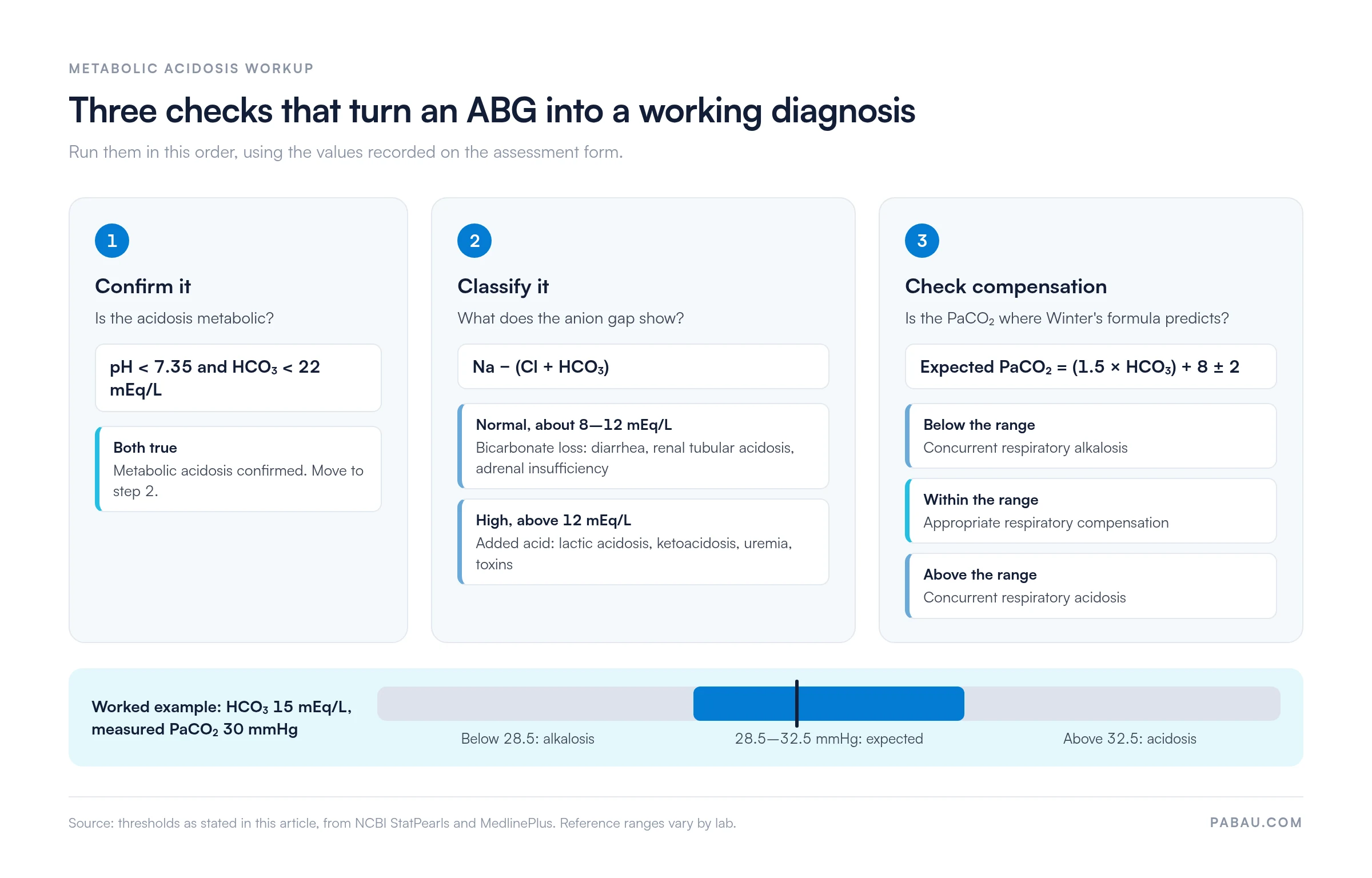
Metabolic acidosis is confirmed when pH is below 7.35 and bicarbonate is below 22 mEq/L.
The anion gap, calculated as Na − (Cl + HCO3), is normally about 8–12 mEq/L, and a higher value points to added acid.
Winter’s formula, expected PaCO2 = (1.5 × HCO3) + 8 ± 2, shows whether breathing is compensating appropriately.
A PaCO2 above the predicted range signals concurrent respiratory acidosis, and one below it signals concurrent respiratory alkalosis.
The PDF has no anion gap line, so record the calculated value in the interpretation section.
A metabolic acidosis assessment template is a clinical documentation tool that sets out how practitioners evaluate and record suspected acid-base disturbances. The form captures the diagnostic workflow in order: presenting symptoms, vital signs, blood gas results, serum electrolytes and the final assessment.
Diagnosis depends on reading ABG values (pH below 7.35 and bicarbonate below 22 mEq/L) alongside electrolyte abnormalities and clinical context. A sound grasp of the pathophysiology and diagnosis of metabolic acidosis helps practitioners apply evidence-based diagnostic criteria consistently. The template means every practitioner follows the same diagnostic pathway, whether your practice runs from one site or several.
Detailed documentation of diagnostic reasoning also matters for audits and peer review. It shows what ruled out respiratory causes and how the anion gap shaped the differential diagnosis. NCBI StatPearls notes that classifying acidosis by anion gap, high versus normal, is central to narrowing the differential and choosing treatment.
Research shows that treating chronic metabolic acidosis (for example with alkali therapy) can slow disease progression in chronic kidney disease. Consistent records matter most when several clinicians review the same patient or escalate a case for specialist input. Kept as a digital form, the completed assessment sits in the patient record beside earlier notes. The next clinician then sees the history without a paper file.
Completing the form takes five steps that mirror a standard acid-base assessment. Each step collects what you need for diagnosis and treatment planning.
The template suits clinicians in any specialty who evaluate patients for acid-base disturbances. Primary care physicians use it for acute presentations such as dyspnea, fatigue or confusion, to rule metabolic acidosis in or out. Metabolic health practitioners, functional medicine clinicians and wellness providers use it to replace ad-hoc notes with a structured assessment.
In IV therapy practices, the form supports pre-treatment screening, so patients with underlying metabolic problems are identified before an infusion starts. Functional medicine practices investigating chronic fatigue or metabolic dysfunction may order ABGs as part of an extended workup. The form standardizes how those results are interpreted and recorded.
Practices with several practitioners or locations gain the most. When the whole team uses the same form, records stay consistent whoever performs the assessment. That consistency supports clinical handovers, peer review and compliance audits.
Diagnostic consistency and safety. Standardized assessment reduces the risk of missing significant findings. Every patient receives the same structured evaluation, so critical lab values are reviewed and the differential is documented. Complete records also help your practice answer audit queries and medicolegal challenges.
Less documentation work. Practitioners complete pre-structured fields instead of free-form notes, which speeds up the assessment. A digital version also removes the step of transcribing handwritten findings into electronic records.
Clear calculation steps. The form puts the electrolytes and ABG values on facing sections, so the anion gap and Winter’s check are quick to work out by hand. Writing out each calculation makes arithmetic errors easier to catch at review. In a digital version, you can add a dedicated field for the calculated gap.
Audit readiness. Detailed assessments show methodical diagnostic reasoning. During inspections, reviewers can see that your practice follows evidence-based protocols and documents decisions systematically.
Training and onboarding. New team members learn the practice’s diagnostic approach from the order of the form. Its structure teaches assessment sequence, decision logic and documentation expectations. Less experienced staff follow a proven pathway, and experienced practitioners stay consistent.
Flag cases with an anion gap above 12 mEq/L or a pH below 7.30 for prompt review. Note high-acuity findings in the interpretation section so team members prioritize urgent cases and refer patients to a specialist in time.
Arterial blood gas interpretation is the foundation of a metabolic acidosis diagnosis. Three values matter most: pH, HCO3 (bicarbonate) and PaCO2 (partial pressure of carbon dioxide). Together they show whether metabolic acidosis is present and whether respiratory compensation is appropriate. MedlinePlus clinical resources define metabolic acidosis as pH below 7.35 with HCO3 below 22 mEq/L, caused by bicarbonate loss or hydrogen ion retention.
Normal blood pH is held between 7.35 and 7.45. In metabolic acidosis, the lungs compensate by increasing ventilation to blow off carbon dioxide and raise pH. Winter’s formula predicts the expected PaCO2 as (1.5 × HCO3) + 8 ± 2. A PaCO2 within that range means compensation is appropriate.
A higher value signals concurrent respiratory acidosis, which needs urgent attention. A lower value signals concurrent respiratory alkalosis, a second primary disorder that also belongs in the diagnosis.
The form gives each ABG value its own field, with space under interpretation to record whether compensation is adequate. Take a patient with pH 7.28, HCO3 15 mEq/L and PaCO2 30 mmHg. The expected PaCO2 is 1.5 × 15 + 8 = 30.5, giving a range of 28.5–32.5 mmHg. A PaCO2 of 30 sits inside it, so respiratory compensation is appropriate. Had it measured 36 mmHg, the note would record a concurrent respiratory acidosis.
Once metabolic acidosis is confirmed, the anion gap narrows the differential diagnosis. It reflects unmeasured serum anions, mainly proteins and organic acids, and is calculated as [Na+] − ([Cl−] + [HCO3−]). A normal anion gap is about 8–12 mEq/L, though reference ranges vary by lab and method. Above 12 mEq/L, high anion gap metabolic acidosis points to lactic acidosis, diabetic ketoacidosis, uremia or toxin ingestion.
When the gap stays normal despite a low HCO3, the cause is usually bicarbonate loss through diarrhea or renal acid retention from renal tubular acidosis. Endocrine causes belong in that differential too, since adrenal insufficiency can produce a normal anion gap acidosis.
The split matters because a high anion gap acidosis calls for urgent investigation of conditions such as sepsis-related lactic acidosis or uncontrolled diabetes. Normal anion gap acidosis is still serious but usually has a more straightforward cause. The form runs these checks in a fixed order, summarized in the three steps below.
Many practices still print this kind of form, fill it in by hand, then scan it into the patient file. Values get retyped, and the interpretation can end up filed apart from the lab results it depends on.
In Pabau, the practice management platform we build, you can rebuild the form as a digital form with fields for each ABG value and electrolyte. Add one more field for the calculated anion gap, and the completed form saves to the patient record beside treatment notes and earlier assessments. Practices that also treat weight management can keep these assessments in the same weight loss clinic software they use for bookings and follow-ups.
Pabau Scribe, our AI scribe, helps you draft clinical notes faster, so the history and examination write-up takes less time. The result is one record per patient, with the numbers and the reasoning together.

Pabau’s digital forms keep ABG values, electrolytes and your interpretation in one patient record. Every practitioner works through the same assessment, at any of your locations.

The value of this form comes from the order it imposes: confirm, classify, then check compensation. Run those three checks every time, and a mixed disorder that one ABG value would hide shows up on the record.
Start by downloading the PDF and adding a line for the calculated anion gap to your own copy. Then agree on the reference ranges your lab reports, so every practitioner reads the same thresholds. Book a demo to see how Pabau keeps acidosis assessments, lab values and clinical notes in one patient record.

Need the electrolyte values first? Basic Metabolic Panel template records the routine panel your acidosis assessment draws on.
Managing raised blood glucose too? Hyperglycemia nursing care plan gives you a structured plan for assessing and managing patients with high blood glucose.
Supporting patients with chronic kidney disease? Renal diet meal plan helps you give kidney patients practical guidance on what to eat.
Managing assessments across multiple locations? Metabolic health EMR software keeps templates and patient records consistent across every site.
Normal arterial blood pH ranges from 7.35 to 7.45. Metabolic acidosis occurs when pH falls below 7.35, indicating increased acidity in the blood. This drop happens because bicarbonate (HCO3) levels fall (below 22 mEq/L) due to bicarbonate loss or hydrogen ion retention, reducing the blood’s buffering capacity.
Anion gap represents unmeasured serum ions and is calculated as [Na+] − ([Cl−] + [HCO3−]). A normal anion gap is about 8–12 mEq/L, though labs vary. A high anion gap (above 12) points toward serious conditions like lactic acidosis or ketoacidosis. Normal anion gap acidosis suggests bicarbonate loss or renal dysfunction. Anion gap classification guides your differential diagnosis and urgency of treatment.
Use Winter’s formula, (1.5 × HCO3) + 8 ± 2, to calculate the expected PaCO2. If PaCO2 falls within the predicted range, compensation is appropriate. A value above it indicates concurrent respiratory acidosis, and a value below it indicates concurrent respiratory alkalosis.
Watch for deep, rapid breathing (hyperventilation), fatigue, confusion, headache and nausea. In severe cases, patients may show Kussmaul respiration, a deep, labored breathing pattern. Chronic presentations may include unexplained lethargy or poor exercise tolerance. Any patient with these symptoms plus risk factors (diabetes, kidney disease, sepsis, diarrhea) warrants ABG testing and a metabolic acidosis assessment.
Yes. You can build a digital version in your EMR or practice management software, with fields for each electrolyte and the anion gap. Completed forms save to the patient record, which cuts manual data entry and transcription errors. Every practitioner then applies the same diagnostic criteria across your practice.
A high anion gap above 20 mEq/L requires urgent investigation and likely specialist referral. It indicates serious underlying pathology, such as sepsis-related lactic acidosis, uncontrolled diabetes (ketoacidosis), severe kidney disease or toxin ingestion. Escalate immediately and start relevant testing (serum lactate, glucose, ketones, renal function). Consider ICU referral depending on pH severity and clinical presentation.