ADHD Assessment Mental Health & Therapy
Neurodivergent Test Template
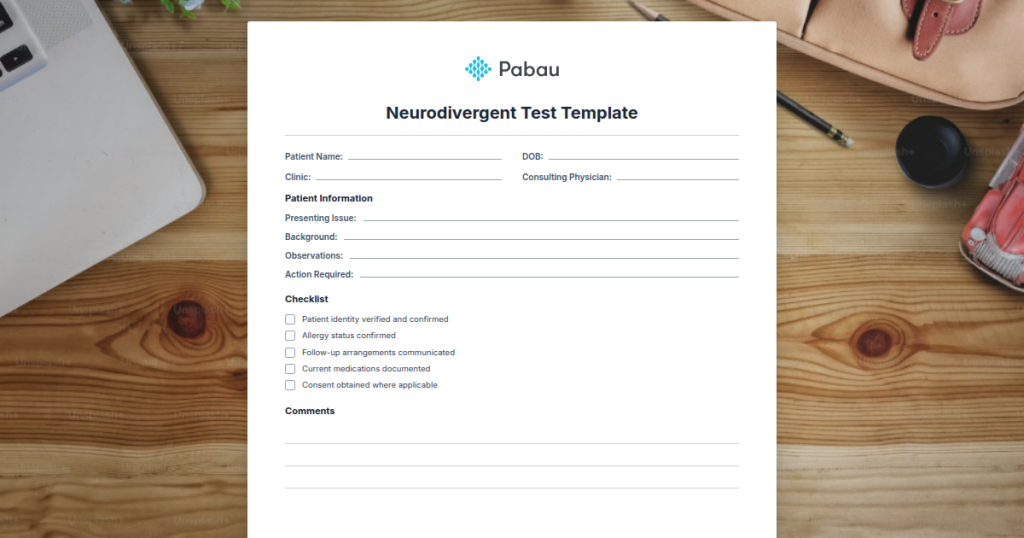
A neurodivergent test template is a clinician-facing screening form that healthc...

April 3, 2026


Buy now, pay later is now available in Pabau

TAT uses ambiguous picture cards to assess personality and emotional patterns through storytelling.
The Thematic Apperception Test Template streamlines administration, scoring, and clinical documentation.
Professional training and APA compliance are essential for valid TAT interpretation.
Digital TAT templates improve record-keeping accuracy and HIPAA-compliant storage of responses.
The Thematic Apperception Test (TAT) is a widely used psychological assessment tool that reveals personality traits, emotional functioning, and cognitive patterns through client responses to ambiguous picture stimuli. Created by Henry Murray and Christiana Morgan in the 1930s, this projective test remains a cornerstone of clinical psychology practice.
A structured Thematic Apperception Test Template transforms this complex assessment into a systematic, clinically organised process. Rather than managing loose response sheets and handwritten notes, practitioners using a professional template gain standardised recording formats, built-in scoring rubrics, and interpretation frameworks that align with contemporary psychology practice management workflows.
This guide explains what the Thematic Apperception Test Template includes, how to implement it in your assessment workflow, and why clinical psychology teams choose structured documentation for this projective measure.
A ready-to-use assessment form covering picture stimulus presentation, client response recording, narrative analysis prompts, scoring documentation, and interpretation summary sections for comprehensive psychological evaluation.
Download templateThe Thematic Apperception Test is a projective psychological assessment that presents clients with 31 ambiguous picture cards (in the full standard set) or a subset of 10-20 cards selected for clinical relevance. Clients respond to each image by describing what they see, the characters’ thoughts and feelings, and the likely outcome of the scene. Their narratives reveal underlying personality structures, emotional concerns, conflict patterns, and adaptive functioning.
A structured Thematic Apperception Test Template provides clinicians with documented protocols for stimulus presentation, standardised response recording sheets, and scoring frameworks that ensure consistency across administrations and compliance with professional guidelines. The template includes sections for capturing demographic data, administration notes, verbatim response transcripts, scoring criteria application, and interpretive summaries anchored to contemporary psychoanalytic and cognitive theory.
Clinical validity depends on precise documentation. Professional TAT administration requires specific training in stimulus presentation, response elicitation, and thematic analysis-areas where a structured template supports accuracy and reduces documentation errors. The American Psychological Association (APA) emphasises standardisation in projective test administration, making a documented Thematic Apperception Test Template essential for evidence-based practice and regulatory compliance in both private practices and institutional settings.
Effective administration of the Thematic Apperception Test Template follows a structured five-step workflow that ensures clinical rigour and complete documentation:
Digital templates can integrate directly with your digital assessment forms system, allowing responses to flow seamlessly into the client record and triggering automated compliance flags for HIPAA documentation standards.
Professional TAT administration typically requires 60-90 minutes for the full assessment, including stimulus presentation, response recording, and initial thematic analysis. Using a structured template reduces post-session documentation time significantly-clinicians report 30-40% faster record completion compared to free-form note-taking.
Structured assessment templates have become standard in clinical psychology practice. Here’s why a Thematic Apperception Test Template is essential:

Pabau's psychology practice software integrates digital assessment forms with secure client records, automating TAT documentation and compliance tracking.

The Thematic Apperception Test Template is used across multiple clinical and professional settings:
Clinical psychologists and licensed therapists administering comprehensive personality assessments, diagnostic evaluations, or treatment planning sessions. The TAT reveals personality organisation and emotional conflict patterns that inform therapeutic approach and treatment prognosis.
Psychiatric practices and psychiatrists conducting diagnostic workups for complex mental health presentations. TAT findings help differentiate between personality pathology, affective disorders, and thought disturbance by examining narrative coherence, emotional integration, and reality testing.
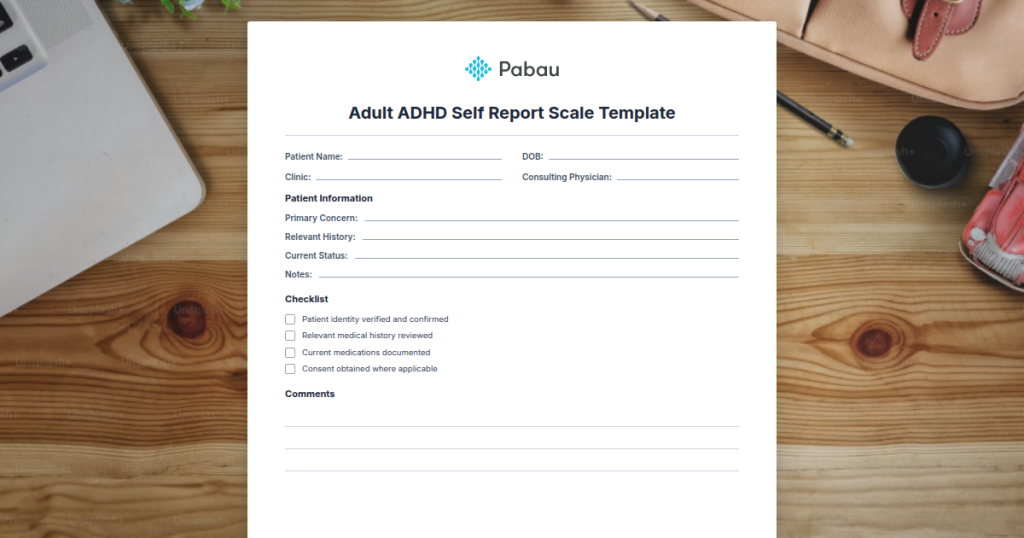
ADHD assessment specialists and developmental psychologists evaluating attention, impulse control, and narrative organisation in children and adolescents. Variations of the TAT (such as the Children’s Apperception Test) are routinely used in comprehensive ADHD evaluations to assess executive function and emotional regulation.
Occupational therapy and neurorehabilitation teams assessing cognitive and emotional recovery following brain injury or neurological illness. The TAT’s narrative demands reveal cognitive flexibility and emotional awareness restoration, informing rehabilitation planning.
University psychology clinics and training programmes where doctoral students learn projective testing under supervision. A structured template accelerates learning by providing clear scoring frameworks and interpretive guidance.
Adopting a structured Thematic Apperception Test Template delivers measurable operational and clinical benefits:
Audit your TAT administration protocols annually. Compare your Thematic Apperception Test Template responses against published norms for age and clinical population. This quality assurance step identifies interpreter drift and strengthens the validity of your assessment conclusions. Document audits in your practice’s clinical governance file.
Contemporary psychological assessment has evolved beyond paper-based protocols. Modern clinical teams integrate projective tests like the TAT with objective measures (symptom questionnaires, cognitive testing) and structured diagnostic interviews to create comprehensive multimethod evaluations. The Thematic Apperception Test Template fits seamlessly into this integrated approach by providing standardised documentation that bridges qualitative narrative analysis with quantified thematic scoring.
Psychology practices increasingly expect assessment tools to integrate with electronic health records, generate compliance reports, and support real-time supervision or consultation. A digital Thematic Apperception Test Template stored in a psychology practice management system meets these expectations by centralising assessment data, automating compliance tracking, and enabling secure access for supervision and peer review.
The template also supports evidence-based practice by making TAT findings searchable and aggregatable across your client population. Over time, you can identify patterns in how specific client presentations (trauma history, personality pathology, neurodevelopmental conditions) manifest in TAT narratives, informing your diagnostic accuracy and treatment selection.

Need a complete assessment framework? Psychiatric Evaluation Template complements TAT administration with structured diagnostic interview sections and multimethod assessment integration.
Looking to streamline intake and initial assessment? Digital intake forms capture initial presentation data, clinical history, and screening questionnaires that contextualise TAT interpretation within the broader assessment battery.
Want to automate clinical documentation? AI-assisted clinical note generation transcribes TAT responses and generates thematic summaries, reducing post-session documentation time while maintaining clinical detail.
The Thematic Apperception Test Template transforms a complex projective assessment into a systematic, clinically organised process. By standardising stimulus presentation, response recording, scoring, and interpretation, the template ensures diagnostic validity, supports professional compliance, and dramatically reduces documentation burden. Whether you’re a solo practitioner or a multi-clinician psychology clinic, a structured TAT template is essential infrastructure for contemporary assessment practice.
Download your free Thematic Apperception Test Template today and integrate it into your assessment workflow. Your clinical documentation will be cleaner, your scoring more rigorous, and your compliance posture stronger.
The TAT and Rorschach are both projective tests, but they assess different constructs. The TAT uses narrative picture stimuli to reveal personality organisation, interpersonal patterns, and emotional concerns. The Rorschach uses inkblots to assess perceptual organisation, thought processes, and emotional responsiveness. Both are best used as part of a multimethod assessment battery, not in isolation.
Yes. The TAT is a restricted professional assessment requiring graduate-level training in psychological testing and interpretation. Licensing requirements vary by jurisdiction, but most states and countries require doctoral-level psychologists or supervised practitioners to administer and interpret the TAT. Check your local regulatory body (APA, BPS, HCPC) for specific credentialing standards.
Full TAT administration with 20-30 cards typically takes 60-90 minutes. Scoring and interpretation can take an additional 30-60 minutes depending on response length and thematic complexity. Using a structured Thematic Apperception Test Template reduces interpretation time by 30-40% compared to unstructured note-taking.
The standard TAT is designed for adolescents and adults (age 14+). For children ages 3-10, the Children’s Apperception Test (CAT) uses simpler picture stimuli depicting animals in familiar scenarios. The CAT assessment template follows the same structured administration and scoring principles as the adult TAT.
Store your completed Thematic Apperception Test Template in an encrypted EHR system that meets HIPAA security requirements (end-to-end encryption, audit logging, access controls). Ensure all client identifying information is handled according to your practice’s data protection policy. Digital templates stored in compliant practice management software automatically enforce these protections.
Yes. A complete Thematic Apperception Test Template with documented administration protocol, verbatim responses, and scored thematic analysis is ideal for clinical supervision and peer review. It allows your supervisor to evaluate your test administration technique, interpretation reasoning, and diagnostic conclusions without reconstructing scattered notes.