

Primary & Preventive Care Wellness
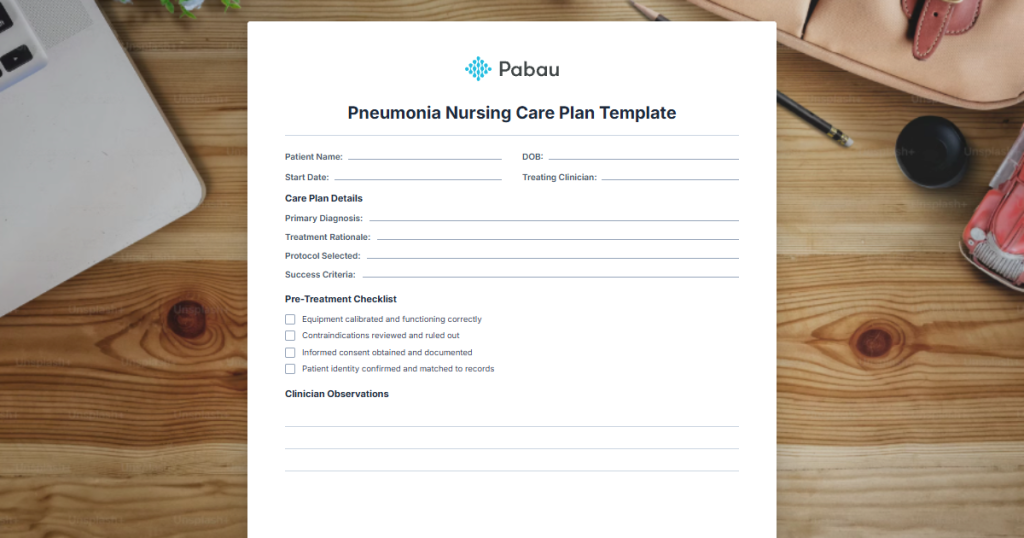
Pneumonia Nursing Care Plan Template
Pneumonia remains a leading cause of hospitalisation and morbidity in acute care...

April 1, 2026


Buy now, pay later is now available in Pabau

Systematic care plan structure ensures comprehensive assessment and intervention documentation for acute bowel obstruction.
NANDA-I diagnoses and NIC/NOC frameworks standardise nursing responses across multidisciplinary teams.
Evidence-based protocols reduce complications, guide escalation decisions, and improve patient safety margins.
Standardised templates accelerate charting while maintaining clinical accuracy and regulatory compliance.
A comprehensive small bowel obstruction nursing care plan template provides structured guidance for healthcare teams managing acute abdominal emergencies. This framework organises patient assessment data, nursing diagnoses, intervention protocols, and measurable outcomes into a single clinical reference-eliminating guesswork and ensuring consistent, evidence-based care delivery across shifts and settings.
A systematic nursing care plan template covering patient assessment criteria, NANDA-I nursing diagnoses, evidence-based interventions, NOC outcome measures, and monitoring parameters for acute and post-operative small bowel obstruction management.
Download templateA small bowel obstruction nursing care plan is a structured clinical document that synthesises assessment findings, nursing diagnoses, and intervention protocols into a single care pathway. It defines the nursing role in managing patients presenting with mechanical or functional obstruction of the small intestine-whether post-operative, traumatic, or from adhesions.
The template integrates NANDA-I approved nursing diagnoses (such as Ineffective Gastrointestinal Tissue Perfusion, Acute Pain, and Risk for Deficient Fluid Volume), Nursing Interventions Classification (NIC) actions, and Nursing Outcomes Classification (NOC) criteria. This alignment with standardised taxonomies ensures compatibility with electronic health records and facilitates multidisciplinary communication.
Beyond documentation, the care plan serves a legal and clinical safety function. It creates an audit trail of clinical reasoning, demonstrates adherence to professional standards, and protects both patient and practitioner. Joint Commission and CMS require evidence-based care planning for accreditation and reimbursement.
Implementing a small bowel obstruction nursing care plan follows five operational steps grounded in real clinical workflow:
The care plan is dynamic-update it within 24 hours of any significant change in patient condition, diagnostic test results, or treatment modifications. This ensures the documented plan remains clinically accurate and reflects real-time clinical judgment.
This template serves multiple clinical settings and practitioner roles:
Consistency across shifts and teams: A standardised template ensures every nurse documents the same assessment parameters and interventions in the same sequence. This eliminates missed cues, reduces communication gaps during handoffs, and prevents task duplication or omission.
Faster decision-making under pressure: Emergency presentations demand rapid triage and action. A pre-built framework accelerates the process of identifying diagnoses and selecting interventions. Nurses spend less time deciding what to assess and more time delivering care.
Compliance with regulatory standards: Joint Commission, CMS, and state boards of nursing mandate that care plans demonstrate evidence-based reasoning and measurable outcomes. Templates grounded in NANDA-I, NIC, and NOC satisfy these requirements automatically, reducing audit risk.
Improved patient safety margins: Structured monitoring with defined escalation thresholds (e.g. “contact surgeon if abdominal girth increases >3 cm, or rigidity develops”) prevents delayed recognition of complications. Documented outcome targets enable objective evaluation of care effectiveness rather than subjective impressions.
Enhanced legal protection: Complete documentation demonstrates that care was planned, delivered, and evaluated according to professional standards. This is critical in litigation or regulatory investigations-the care plan becomes the narrative evidence of nursing judgment and action.
Integration with digital workflows: Digital care plan forms within practice management systems link to patient timelines, medication administration records, and lab results. This reduces manual data entry errors and centralises clinical information.
Audit your completed care plans monthly. Flag instances where documented diagnoses or outcome targets were not revised after significant clinical changes. This identifies training gaps-e.g. if obstructed patients aren’t having pain reassessed post-intervention, teach the team the 30-minute post-intervention assessment standard. Prevention culture beats reactive incident management.
Early recognition of bowel obstruction severity guides urgency and treatment intensity. Document these parameters in the assessment section:
Secure client portals allow post-discharge monitoring: patients can report alarm symptoms (renewed vomiting, severe pain, inability to pass stool) electronically, triggering rapid clinical review and re-admission decision.
Use objective descriptors, not subjective labels. Instead of writing “patient has abdominal pain,” document: “Patient reports sharp, constant epigastric pain radiating to right lower quadrant, 8/10 severity, unrelieved by position change, onset 6 hours ago.”
Link interventions to outcomes. Record: “Administered morphine 4 mg IV at 14:30. Reassessed pain at 15:00-patient reports pain now 4/10, able to rest. Bowel sounds remain absent. Plan: continue monitoring q2h, escalate if pain increases or peritoneal signs develop.”
Document multidisciplinary communication. Note: “Contacted surgeon Dr Chen at 16:15 regarding rigid abdomen and elevated WBC (18.2). Surgeon ordered stat CT abdomen. Plan: expedite imaging, prepare patient for possible emergency laparotomy.” This creates an audit trail of clinical escalation.
AI-assisted documentation tools like Echo AI clinical note generation can transcribe verbal assessments into structured templates, reducing charting time whilst maintaining detail and accuracy.
Managing complex care plans across multiple patients demands integrated software. Book a demo with Pabau to explore how digital forms, patient portals, and AI-assisted documentation streamline nursing workflows whilst ensuring every assessment and intervention is documented to regulatory standard.

Need structured intake forms for acute patients? Capture Forms automates initial assessment and creates real-time dashboards for multidisciplinary visibility.
Want templates aligned with nursing standards? Psychiatric Evaluation Template demonstrates how to structure comprehensive assessments using NANDA-I and outcome taxonomies.
Need post-discharge monitoring? Pre- and Post-Care modules allow patients to report complications remotely, triggering alerts for urgent review.
A comprehensive small bowel obstruction nursing care plan template transforms clinical documentation from a compliance burden into a clinical safety tool. By anchoring assessment, diagnoses, interventions, and outcomes to standardised frameworks (NANDA-I, NIC, NOC), teams achieve consistency, reduce delays in escalation, and demonstrate evidence-based reasoning under pressure. Whether managing post-operative recovery or acute medical emergencies, this template accelerates sound clinical decision-making whilst protecting patient safety and regulatory standing.
Physician orders prescribe treatments (medications, diagnostic tests, dietary restrictions). A nursing care plan documents the independent and collaborative nursing actions that implement those orders, monitor responses, and adjust based on patient outcomes. The care plan is the nursing narrative of clinical reasoning.
Yes. Many EHR systems allow import of pre-built care plan templates that populate assessment sections, diagnosis dropdowns, and intervention checklists. Digital implementation accelerates documentation and reduces transcription errors.
Update the care plan within 24 hours of admission and again if the patient’s condition changes significantly (e.g. fever develops, pain escalates, new diagnostic findings). Most institutions require review every 48 hours minimum. Always reassess outcomes every shift.
The primary bedside nurse documents the initial care plan within 24 hours of admission. All nurses caring for the patient are responsible for updating it based on their assessments and actions. The charge nurse or clinical educator reviews for completeness before submission.
The template is a framework, not a mandate. Select NANDA-I diagnoses that match your patient’s actual findings. A post-operative day 1 patient with normal bowel function may only need “Acute Pain” and “Risk for Infection”-not all five template diagnoses. Customisation is expected.
A documented care plan with defined outcome targets and escalation thresholds prevents missed cues and delays in treatment. For example, if the plan states “escalate to surgeon if abdominal girth increases >3 cm,” all nurses follow that standard, reducing variation and complications.