Musculoskeletal & Pain Management Sports Medicine
ITB Syndrome Exercises Handout Template
What Is an ITB Syndrome Exercises Handout Template? The iliotibial band is a thi...

March 17, 2026


Buy now, pay later is now available in Pabau

Standardised Neer’s Test template streamlines shoulder impingement assessment documentation
SOAP note structure ensures compliance with clinical record-keeping standards
Digital template reduces assessment time and improves documentation consistency
Supports differential diagnosis by capturing range of motion and pain response data
Shoulder pain is one of the most common conditions physiotherapists and orthopaedic practitioners encounter. Accurate assessment is critical. The Neer’s test template provides a standardised framework for documenting this essential clinical evaluation, ensuring your records capture the exact findings needed for diagnosis and treatment planning.
Shoulder impingement syndrome affects function and quality of life. Clinicians need quick, reliable assessment tools that produce consistent documentation. A structured Neer’s test template eliminates guesswork about what to record and how to interpret findings, allowing your team to focus on patient care rather than form completion.
This guide walks through the clinical purpose of Neer’s Test, how to use a standardised template in your practice, and why structured documentation matters for compliance and patient outcomes.
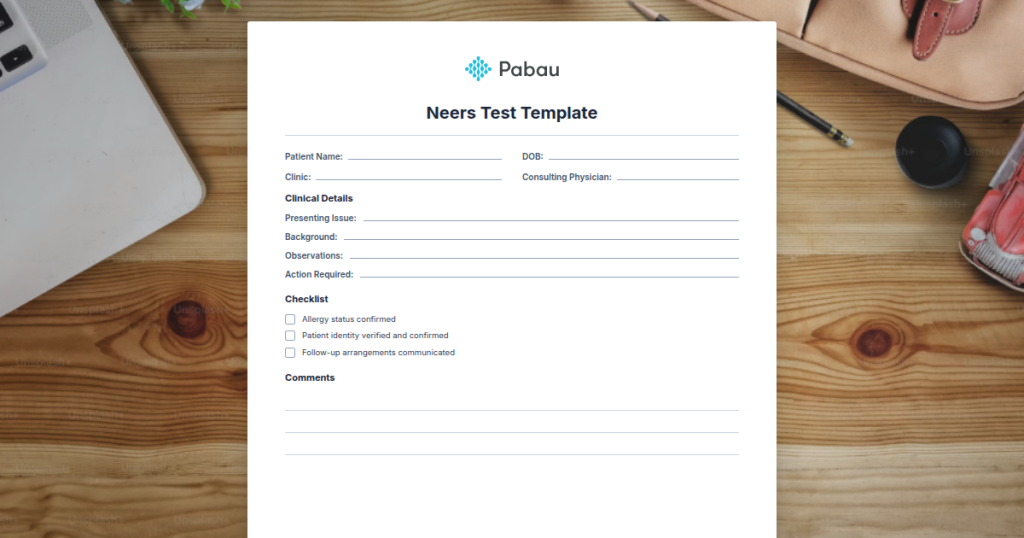
A standardised clinical assessment form for documenting Neer’s Test findings, shoulder impingement screening, pain response, and range of motion evaluation within a structured SOAP note framework.
Download templateNeer’s Test is a clinical special test used to identify subacromial impingement syndrome. The test involves passively elevating the patient’s arm into flexion while the scapula is stabilised, reproducing pain that suggests rotator cuff or subacromial space pathology. A positive test indicates potential impingement but is not diagnostic in isolation; clinical correlation with other findings is essential.
A structured Neer’s test template documents each element of this assessment: baseline pain levels, range of motion, test response, and clinical interpretation. This standardised approach ensures all practitioners capture the same data points, reducing variability and supporting accurate clinical decision-making. Templates also embed best practices from clinical guidelines and professional standards.
From a compliance perspective, standardised documentation aligns with HCPC Standards of Proficiency and CSP (Chartered Society of Physiotherapy) record-keeping guidelines. Templates enforce consistency, reduce omissions, and provide an audit trail demonstrating that assessments followed recognised clinical protocols. For practices operating under CQC scrutiny or managing patient liability, this documentation discipline is a regulatory safeguard.
A well-designed template guides clinicians through the assessment workflow step by step, reducing assessment time and improving consistency. The following framework outlines how to complete the Neer’s test template effectively in clinical settings.
Templates that integrate with digital forms and capture systems allow you to complete assessments during the appointment and immediately transfer data into the patient’s clinical record, eliminating transcription errors and freeing time for patient interaction.
Seeing how structured clinical records integrate assessment templates into your daily workflow can transform how your team documents and manages shoulder cases. A short demo shows how templates reduce duplication and improve audit readiness.
Physiotherapists are the primary users. Private practice physiotherapists managing shoulder cases, NHS physiotherapy services running high-volume clinics, and sports medicine teams all benefit from a structured assessment framework. Consistency matters when multiple practitioners review the same patient record.
Osteopaths and sports massage therapists performing shoulder assessments can adapt the template to their scope of practice. The core assessment logic-passive range of motion, pain response, test interpretation-applies across manual therapy disciplines. A standardised form ensures that whether a client sees one practitioner or multiple team members, the same assessment standards apply.
Occupational therapists evaluating functional shoulder mobility and impingement impact on activities of daily living use Neer’s Test to quantify baseline limitation. The template becomes a reference point for measuring progress after intervention. Multi-disciplinary teams benefit most: shared documentation reduces redundant testing and ensures coordinated care.
Compliance and legal protection: Standardised documentation demonstrates that your practice follows recognised clinical protocols. CQC inspectors, patient solicitors, and professional bodies judge clinical competence partly through record quality. A template audit trail shows consistent, defensible decision-making.
Workflow efficiency: Completing a structured form takes less time than writing free-text notes. Practitioners spend less time on documentation and more time on hands-on assessment. Digital versions integrate directly into the patient record, eliminating the transcription step entirely.
Documentation clarity: When all shoulder assessments follow the same structure, pattern recognition becomes easier. Clinicians quickly spot missing data, inconsistencies, or red flags that warrant referral. A patient’s 10-visit trajectory is instantly readable because each record has identical fields and formatting.
Data consistency for outcome tracking: When pain scores, range of motion measures, and test results are recorded in standardised fields, you can track progress across sessions and calculate treatment efficacy. Templates enable outcome measurement, which is increasingly expected for private practice credibility and NHS commissioning.
Record Neer’s Test findings immediately alongside your treatment plan. Document whether findings support manual therapy, exercise prescription, imaging referral, or multi-modal intervention. This creates an explicit causal link-“Test was positive; therefore we are prescribing rotator cuff loading”-that demonstrates clinical reasoning and justifies the intervention chosen.
Neer’s Test is sensitive for subacromial impingement but not specific. Many conditions mimic impingement: cervical radiculopathy, rotator cuff tendinopathy, glenohumeral instability, acromioclavicular joint dysfunction, and thoracic outlet syndrome. A positive Neer’s Test alone is not diagnostic. The template should capture multiple assessment findings-range of motion, strength testing, palpation findings, neurological screening, and other special tests-to build a complete clinical picture.
Protocols such as comprehensive shoulder assessment frameworks incorporate Neer’s Test alongside Hawkins-Kennedy, Painful Arc, and rotator cuff strength testing. When your template includes prompts for differential considerations-“Rule out: cervical radiculopathy, AC joint pathology, instability”-clinicians are less likely to anchor on a single positive test and more likely to investigate alternative diagnoses.
demonstrates how structured protocols guide rehabilitation. Need guidance on documenting clinical impressions safely? Safer Clinical Notes covers best practices for clear, legally defensible note-writing. Want to automate assessment documentation? Echo AI can generate structured clinical notes from voice, freeing you to focus on hands-on assessment.
The Neer’s test template transforms shoulder assessment from a loose clinical process into a standardised, compliant, and efficient workflow. By capturing baseline pain, range of motion, test response, and clinical interpretation in consistent fields, you improve documentation quality, support differential diagnosis, and create an audit trail demonstrating clinical competence. Download the template today and integrate it into your shoulder assessment protocol to elevate clinical consistency across your team.
A positive Neer’s Test, characterised by pain during passive shoulder flexion between 60-120 degrees (the “painful arc”), suggests subacromial impingement. However, a positive test alone is not diagnostic of impingement syndrome. It must be interpreted alongside other findings such as Hawkins-Kennedy Test results, range of motion, strength testing, and imaging to reach a clinical diagnosis.
Neer’s Test is sensitive (detects true cases of impingement effectively) but has moderate specificity. Many patients with positive tests do not have structural impingement; conversely, some patients with impingement may have false-negative tests. This is why clinicians use multiple tests and clinical reasoning to confirm impressions.
Record the baseline pain level, exact range of motion (e.g. 85 degrees), pain location and character, test response (positive/negative), and your clinical interpretation. Avoid diagnostic certainty (e.g. do not write “patient has impingement”). Instead, frame findings as supporting a working hypothesis: “positive Neer’s Test suggests impingement; recommend imaging to exclude structural pathology.” This demonstrates evidence-based reasoning and protects you legally.
Yes. Standardised templates are ideal for multi-practitioner practices. Consistency across team members ensures that whether a patient sees one physiotherapist or rotates between clinicians, the same assessment standards and documentation fields apply. This reduces confusion and supports continuity of care.
Digital templates eliminate transcription by capturing assessment data directly into the patient record during the appointment. Results sync automatically, reducing errors and freeing clinician time. Integrated systems allow you to cross-reference Neer’s Test findings with imaging orders, treatment notes, and outcome measures in one searchable record.