ADHD Assessment Mental Health & Therapy
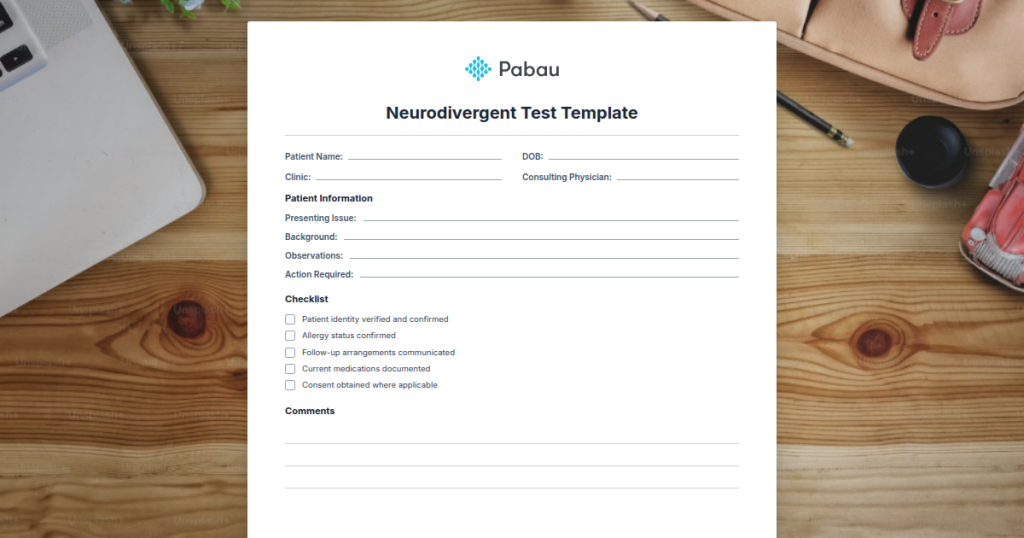
Neurodivergent Test Template
A neurodivergent test template is a clinician-facing screening form that healthc...

April 3, 2026


Buy now, pay later is now available in Pabau

DBT worksheets systematically track emotional and interpersonal progress.
Four core modules target mindfulness, emotion regulation, distress tolerance, and interpersonal skills.
Digital worksheet storage in compliant EHR systems reduces data security risks.
DBT worksheets align with NICE-recommended evidence-based mental health protocols.
Therapists customise worksheets within practice management software for client-specific goals.
A DBT therapy worksheet is a structured therapeutic tool that helps mental health professionals deliver evidence-based Dialectical Behaviour Therapy with consistency and measurable progress. These worksheets guide clients through four core skill modules-mindfulness, emotion regulation, distress tolerance, and interpersonal effectiveness-while creating a documented record of treatment sessions and homework compliance.
For therapy clinics, mental health practices, and private therapists, a dbt therapy worksheet system streamlines clinical documentation while keeping clients engaged in their recovery. Rather than managing scattered paper forms or unlinked digital files, integrating worksheets into a practice management system that supports mental health documentation ensures all therapeutic work is stored securely, tracked consistently, and easily retrievable during supervision or regulatory audits.
This guide explains what DBT worksheets accomplish, how therapists use them across clinical modules, which practice types benefit most, and how to keep digital worksheet records compliant with GDPR and HIPAA standards. We also show how digital DBT worksheets connect to session notes, treatment plans, and progress metrics within a unified clinical system.
A structured clinical worksheet for tracking emotional regulation, distress tolerance, mindfulness, and interpersonal effectiveness during DBT therapy sessions. Includes diary card tracking, skills practice logs, and progress documentation suitable for individual and group therapy formats.
Download templateA DBT therapy worksheet is a structured clinical document designed to operationalize Dialectical Behaviour Therapy principles within individual sessions, group skills training, and homework assignments. Developed by Marsha Linehan’s DBT development research at the University of Washington, DBT combines cognitive-behavioural techniques with acceptance-based strategies to treat complex emotional and behavioural difficulties, particularly borderline personality disorder and emotion dysregulation. Peer-reviewed research on the DBT clinical evidence base research confirms its efficacy across multiple randomised controlled trials in reducing self-harm, suicidal behaviour, and emotional dysregulation.
The worksheet format translates DBT’s four core modules-Mindfulness, Emotion Regulation, Distress Tolerance, and Interpersonal Effectiveness-into practical, client-friendly exercises that therapists guide during sessions. Each worksheet section maps to a specific skill domain. A worksheet might ask clients to identify a triggering event, describe their emotional and physical response, rate their distress level, and document which skill they used to manage the situation.
From a clinical governance perspective, DBT worksheets serve as contemporaneous clinical records. They evidence informed treatment decisions, justify session-to-session interventions, and demonstrate fidelity to the DBT model for supervision, peer review, and regulatory compliance. Under NICE guideline CG78, DBT is recognised as an evidence-based treatment for borderline personality disorder requiring structured documentation. Professional bodies including the British Association for Counselling and Psychotherapy (BACP) and the Health and Care Professions Council (HCPC) recommend systematic documentation of therapeutic work. DBT worksheets meet these standards by creating a clear audit trail of client progress, therapist decisions, and skill acquisition over the treatment course.
Using a DBT therapy worksheet effectively requires structuring the session around the worksheet’s modules while maintaining therapeutic flexibility. Here are five core steps therapists follow when implementing worksheets in clinical work.

Storing completed DBT worksheets in a centralised clinical system ensures secure access, automated progress tracking, and compliance-ready documentation.

DBT therapy worksheets are essential across multiple mental health and therapeutic settings. Psychology practices and therapy clinics using DBT as their primary treatment modality depend on structured worksheets to maintain fidelity to the model and track client skill acquisition. Individual therapists and counsellors treating clients with borderline personality disorder, emotional instability, or self-harm behaviours find worksheets indispensable for organising session work and documenting progress.
Psychiatry clinics integrating DBT skills training alongside medication management use worksheets to coordinate care. Group therapy facilitators running DBT skills-training groups rely on standardized worksheets to keep all participants aligned on module content and homework assignments. Occupational therapy teams treating trauma and emotional regulation use adapted DBT worksheets alongside sensory and functional recovery work.
Adolescent mental health services-including NHS-commissioned CAMHS teams and private youth counselling services-adapt DBT worksheets for younger clients by simplifying language and adding visual elements. The Royal College of Psychiatrists provides guidance on CAMHS DBT adaptations for adolescents and how the therapy is tailored across different clinical populations. Eating disorder treatment programs use DBT worksheets to address the emotional dysregulation underlying restrictive or binge-eating behaviours. Substance misuse and addiction services employ DBT worksheets to build distress tolerance and interpersonal skills as part of recovery programming. Any practice offering evidence-based mental health treatment will find worksheets valuable for documenting therapeutic progress, supporting supervision, demonstrating regulatory compliance, and engaging clients in structured skill-building work.
DBT worksheets deliver multiple clinical and operational benefits beyond their primary therapeutic function. From a compliance standpoint, they create contemporaneous clinical records that satisfy GDPR data retention requirements in the UK and HIPAA documentation standards in the US. Regulatory bodies including the Care Quality Commission (CQC) and HCPC expect evidence of structured, documented therapeutic work-DBT worksheets demonstrate this systematically. The CQC mental health inspection framework sets out what inspectors look for when reviewing clinical records and therapeutic documentation standards.
Progress tracking becomes quantifiable. By rating distress levels, tracking skill use, and documenting session-to-session changes on worksheets, therapists build an objective dataset showing treatment efficacy. This supports clinical supervision conversations, enables early identification of clients not progressing as expected, and justifies continuation or modification of the treatment plan to funders and external auditors. When worksheet storage moves into a secure electronic record system, supervisors can review the full archive instantly rather than hunting through paper files.
Client engagement increases when worksheets are used consistently. Clients see their own progress documented across weeks and months, which reinforces the value of learning new skills. Homework completion rates improve when worksheets provide clear, structured practice assignments-clients know exactly what to do between sessions. For therapists, worksheets reduce cognitive load during sessions. Rather than trying to remember all the details of a client’s presentation while also facilitating skills teaching, the worksheet acts as an external scaffold.
From a liability and professional standards perspective, documented evidence of informed consent, therapeutic decision-making, and skill-building reduces risk during complaint investigations or supervision reviews. Should a client dispute the care received, the worksheets provide a clear record of what was addressed and how the client responded. Multi-location practices and group therapy environments benefit from standardized worksheets that ensure all clients receive equivalent quality and structure regardless of which therapist or location they attend.
Track homework completion and skill barriers on the worksheet itself. At the start of each session, review the previous week’s worksheet and note which assigned skills the client practised and which they avoided. Ask ‘What got in the way of using this skill?’ Document the barrier (fear, lack of opportunity, forgot) and problem-solve collaboratively. This transforms worksheets from passive records into active therapeutic tools that deepen the client’s insight into their own change process.
DBT’s four core modules represent distinct skill domains, and worksheets are organised to teach each systematically. Understanding the module structure helps therapists and clients see how individual skills fit into the larger treatment architecture.
DBT mindfulness core skills module is the foundation module. DBT mindfulness worksheets teach clients to observe their thoughts and emotions without judgment, notice present-moment sensations, and accept internal experiences rather than fight them. Worksheets in this module often include grounding exercises (the Five Senses technique), breathing patterns, and body-scan meditation logs. Emotion Regulation worksheets teach clients to understand their emotional responses, identify emotion triggers, and build skills to manage intense feelings. The worksheet breaks down emotional experience into prompting events, interpretations, and resulting emotions-mirroring cognitive-behavioural principles.
Distress Tolerance worksheets focus on crisis survival. Rather than changing emotions (the goal of emotion regulation), distress tolerance teaches clients to survive acute crises without making things worse. Worksheets introduce TIPP (Temperature shock, Intense exercise, Paced breathing, Paired muscle relaxation), distracting skills, and self-soothing techniques. Interpersonal Effectiveness worksheets teach assertive communication, boundary-setting, and relationship skills. Clients learn DEAR MAN (state your objective clearly, express emotions, assert needs, reinforce benefits, stay mindful of the other person’s perspective), GIVE (maintain the relationship, validate the other person), and FAST (be fair to yourself, apologise only for actual wrongs, stick to your values, take care of yourself).
Therapists select which module to focus on based on the client’s presenting crisis and treatment stage, with worksheets anchoring the learning for each module. Mental health EMR systems can organise worksheets by module, making it easy to track which skills a client has practised and which need reinforcement.
A structured approach to DBT worksheet progression-spanning weeks and months-creates a measurable trajectory that informs treatment decisions and demonstrates clinical value to supervisors and funders.
Weeks 1-4: Skill Introduction. During the initial phase, worksheets focus on introducing one skill per module and practising it in session. Clients may report low familiarity with the skills and high distress ratings. Worksheets ask clients to rate confidence using the skill (0-10 scale) and barriers to home practice. Progress looks like small increases in skill attempts, even if outcomes aren’t yet perfect. Document these attempts on the worksheet-early effort is clinically meaningful.
Weeks 5-12: Skill Consolidation. As clients become familiar with skills, worksheets shift focus to deepening practice and identifying real-world situations where skills apply. Distress ratings should begin declining if the client is applying skills consistently. Worksheets now prompt generalisation questions: “When else could you use this skill?” and “How did using this skill affect your relationship with your partner?” This phase usually shows measurable progress-clients report fewer self-harm urges or shorter crisis episodes.
Months 4-6: Integration and Refinement. Worksheets become more flexible. Rather than following a prescribed sequence, therapists and clients together design worksheets that target the client’s specific triggers and chosen skills. Progress manifests as increased autonomy-clients begin filling out worksheets between sessions without therapist prompts, sometimes proactively identifying situations where they want skill coaching. AI-powered clinical documentation tools can help therapists summarise worksheet data and track trends in skill use automatically.
Months 6+: Maintenance and Relapse Prevention. Worksheets shift to maintenance mode. Sessions may space out to every two weeks, and worksheets focus on sustaining gains, preparing for anticipated stressors, and developing a relapse-prevention plan. Therapists and clients review the full archive of completed worksheets to celebrate how far the client has progressed-a powerful motivational moment. Storing this complete worksheet archive in a secure clinical system allows supervisors to see the full trajectory, funders to understand treatment intensity and outcomes, and clients to witness their own change tangibly.

How do you build mental health clinical documentation workflows? Psychology Practice Management Software guides therapists through essential features for organising client records, session notes, and treatment plans in one secure system.
What digital form tools support structured therapy assessments? Digital Forms for Clinical Documentation enables therapists to create custom intake worksheets, session questionnaires, and progress-tracking forms linked directly to client records.
How do you ensure therapy documentation stays compliant? Compliance Management Software for Mental Health automates audit trails, retention policies, and access controls so therapy documentation meets GDPR and HIPAA standards automatically.
DBT therapy worksheets are proven tools for building structure, documenting progress, and supporting evidence-based mental health treatment. Whether you’re a solo therapist introducing DBT to your practice or managing a multi-location service delivering DBT group skills training, worksheets provide the consistent framework clients need to learn and apply new emotional regulation and interpersonal skills.
The transition from ad-hoc therapy notes to structured worksheets requires initial setup time-selecting or designing your worksheets, training therapists on the protocol, and establishing secure storage. But the return comes quickly: improved client engagement through visible progress, reduced session planning burden thanks to clear structure, and documentation that satisfies regulatory audits and supervision requirements.
When worksheet storage moves from paper files or scattered digital documents into a unified clinical record system, the benefits multiply. Therapists access worksheets instantly, clients see their own progress across months, and supervisors review fidelity to the DBT model without hunting through fragmented records. Starting with a simple, evidence-based DBT therapy worksheet template-and committing to consistent use across all clients-is the first step toward building a scalable, compliant, and clinically effective DBT practice.
The four core modules-Mindfulness, Emotion Regulation, Distress Tolerance, and Interpersonal Effectiveness-each have associated worksheets. Within each module, therapists use specific worksheets like the DBT Diary Card (for daily monitoring), Chain Analysis (for understanding problem patterns), and skills-practice worksheets (for learning TIPP, DEAR MAN, GIVE, FAST, and other techniques).
A DBT Diary Card is a daily tracking worksheet that clients complete between sessions. Clients rate their urges to self-harm or engage in problem behaviours (0-10), their emotional pain (0-10), and which skills they used each day. Therapists review the diary card at the start of sessions to identify patterns, celebrate skill use, and adjust treatment priorities based on the data.
The four modules are Mindfulness (present-moment awareness), Emotion Regulation (managing intense emotions), Distress Tolerance (surviving crises without making things worse), and Interpersonal Effectiveness (assertive communication and boundary-setting). Each module is taught systematically, and worksheets scaffold learning within each domain.
While worksheets can be adapted for self-directed learning, DBT was designed as a therapist-guided treatment. Worksheets without therapist coaching may be less effective because the therapist’s role-validating the client, shaping skill use, and troubleshooting barriers-is central to DBT’s efficacy. Self-help resources should supplement, not replace, therapy.
Chain Analysis is used when a client engages in a problem behaviour (self-harm, impulsive spending, substance use). The worksheet maps the entire sequence: the prompting event → interpretations and thoughts → emotional build-up → urges → the behaviour itself → consequences. This analysis helps therapist and client understand how to interrupt the chain at key points using skills.
Therapists use worksheets to document homework assignments (specific skills to practise, diary cards to complete) and review completed work at the start of the next session. If compliance is low, therapists problem-solve with the client: “What got in the way?” and “How can we make homework easier?” This collaborative approach builds intrinsic motivation rather than relying on punishment.