Mental Health & Therapy Psychiatry
Antisocial Personality Disorder Test
What is an Antisocial Personality Disorder Test? An antisocial personality disor...

April 6, 2026


Buy now, pay later is now available in Pabau

ASPD diagnosis requires comprehensive clinical evaluation, not online self-assessment
A downloadable antisocial personality disorder test supports structured intake and documentation
DSM-5 requires evidence of conduct disorder before age 15, but ASPD can only be diagnosed at age 18 or older
ICD-10 code F60.2 enables accurate billing and clinical record-keeping for ASPD assessments
An antisocial personality disorder test is a structured clinical assessment tool designed to help mental health professionals systematically evaluate behavioral patterns, interpersonal functioning, and psychological characteristics associated with ASPD. This type of screening tool is not a diagnostic instrument on its own; rather, it supports the comprehensive clinical evaluation process that includes patient interviews, collateral information, and direct observation.
Unlike consumer-facing online quizzes, a clinician-administered antisocial personality disorder test provides standardized questions aligned with DSM-5 diagnostic criteria established by the American Psychiatric Association. This ensures consistency in assessment, reduces documentation gaps, and creates a foundation for clinical decision-making and treatment planning.
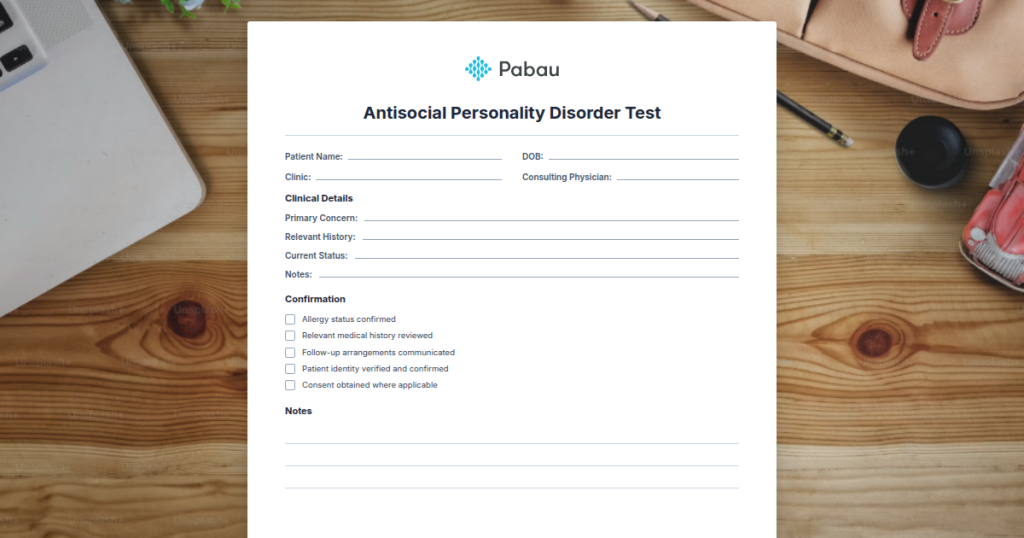
A comprehensive screening tool for clinicians to assess potential signs and symptoms of antisocial personality disorder in patients. Supports structured clinical evaluation, treatment planning, and documentation aligned with DSM-5 criteria and ICD-10-CM code F60.2.
Download templateThe legal and regulatory context is critical. In many jurisdictions, ASPD assessment is initiated through court-ordered evaluations rather than routine clinical practice. Healthcare providers must understand that this personality disorder has significant forensic, liability, and risk management implications. A properly structured antisocial personality disorder test helps clinicians document findings with precision and neutrality, protecting both patient privacy and clinical integrity.
Using an antisocial personality disorder test effectively requires understanding the workflow and clinical context. The test functions as a structured intake component, not as a standalone diagnostic conclusion. Here are the five operational steps clinicians follow:
Key implementation principle: The antisocial personality disorder test is a data-gathering tool within a comprehensive assessment, not a test that produces a diagnosis by itself. Always combine structured assessment findings with clinical judgment, historical records, and direct observation.
Mental health professionals across multiple settings benefit from a standardized antisocial personality disorder test. Psychiatrists use it during initial diagnostic evaluations when court-ordered or patient-initiated assessment is required. Psychologists administer it as part of comprehensive personality evaluations and forensic assessments.
Licensed therapists and counselors incorporate this test into intake workflows when treating patients with suspected or confirmed ASPD. Substance abuse counselors find it invaluable because ASPD frequently co-occurs with addiction; screening enables integrated treatment planning. Clinical social workers use the test to inform case management decisions and risk assessments in community mental health settings.
Correctional psychologists and forensic evaluators rely on structured antisocial personality disorder tests during incarcerated offender assessment and release planning. Academic clinicians and researchers use validated assessment tools to ensure methodological rigor in studies examining personality pathology, treatment outcomes, and longitudinal trajectories.
Structured assessment standardizes evaluation across clinicians and improves consistency in how ASPD traits are identified and documented. Without a consistent framework, assessment becomes subjective and vulnerable to bias.
A well-designed antisocial personality disorder test clarifies clinical documentation. Practitioners record specific behavioral examples against defined criteria, creating objective records that withstand clinical audit, peer review, and legal scrutiny. This reduces liability risk when assessments inform high-stakes decisions (risk evaluation, court testimony, treatment planning).
Regulatory alignment is automatic when using a DSM-5-anchored test. Clinicians document findings using diagnostic language recognized by insurers, courts, and licensing boards. This enables accurate ICD-10-CM coding (F60.2 for Antisocial Personality Disorder) and ensures billing compliance.
Patient safety and treatment planning improve when assessment is comprehensive. Structured screening identifies co-occurring substance use disorders, aggression risk, and interpersonal patterns that inform treatment modality selection. Practitioners can differentiate ASPD from other personality disorders or secondary behavioral presentations (conduct disorder, intermittent explosive disorder, substance-induced changes).
Workflow efficiency accelerates when intake forms are digital. Using AI-powered clinical documentation to analyze assessment responses reduces note-writing time while maintaining clinical depth.
Antisocial personality disorder diagnosis is complex and requires understanding both DSM-5 and ICD-10 frameworks. The disorder involves a pervasive pattern of violating others’ rights that persists into adulthood. Critically, the DSM-5 requires evidence of conduct disorder symptoms before age 15, but the ASPD diagnosis itself can only be formally assigned to individuals aged 18 or older. Key diagnostic features include deceitfulness, impulsivity, irritability, recklessness, irresponsibility, and notably, lack of remorse for harm caused.
A critical distinction exists between ASPD and related concepts. Sociopathy and psychopathy are lay terms sometimes used interchangeably with ASPD, but they lack precise clinical definitions. The Hare Psychopathy Checklist-Revised (PCL-R) is a clinician-administered instrument measuring psychopathic traits; it requires specialized training and is distinct from a screening antisocial personality disorder test.
No standardized screening test for ASPD is publicly available that can independently diagnose the disorder. As Cleveland Clinic explains, ASPD assessment relies on clinical interview, behavioral history, and comprehensive evaluation. Online self-assessment tools cannot diagnose this personality disorder; they serve educational purposes only.
DSM-5 lists seven criteria for ASPD diagnosis. At least three must be present, with evidence of conduct disorder onset before age 15. The individual must be at least 18 years old for a formal ASPD diagnosis. The criteria are: failure to conform to social norms regarding lawful behavior; deception for personal profit or pleasure; impulsivity or failure to plan ahead; irritability and aggressiveness indicated by repeated physical fights or assaults; reckless disregard for safety of self or others; consistent irresponsibility in work or financial obligations; and lack of remorse after hurting, mistreating, or stealing from another.
ICD-10-CM code F60.2 identifies Antisocial Personality Disorder for billing and documentation purposes. This code triggers appropriate reimbursement, enables proper clinical record tracking, and ensures compliance with mental health coding requirements across all care settings. Clinicians use this code when ASPD is the primary diagnosis or a relevant secondary condition affecting treatment planning.
The Personality Inventory for DSM-5 (PID-5) is an alternative dimensional assessment tool available through the American Psychiatric Association. It measures personality trait domains that support ASPD evaluation, though it requires integration with structured clinical assessment rather than standalone use.
Clinicians face several assessment challenges when evaluating ASPD. Patient minimization is the most common: individuals with this personality disorder often underreport harmful behaviors, lack insight into impact on others, and may deliberately deceive assessors. The antisocial personality disorder test framework helps counteract this by requesting specific behavioral examples and cross-referencing responses against collateral information.
Distinguishing ASPD from Conduct Disorder (the under-18 precursor diagnosis) requires careful developmental history. The antisocial personality disorder test should include items addressing childhood behavioral patterns to assess continuity.
Comorbidity with Substance Use Disorder complicates assessment. Substance use itself can produce behavioral patterns resembling ASPD. The structured test format helps clinicians separate personality pathology from substance-induced behavioral changes by examining baseline functioning before and after substance use history.
Documentation requirements vary by jurisdiction and clinical setting. A downloadable antisocial personality disorder test ensures practitioners meet regulatory expectations around informed consent (especially in court-ordered evaluations), clinical detail, and ethical neutrality when assessing this sensitive diagnosis.
A downloadable antisocial personality disorder test is an essential tool for mental health practitioners conducting comprehensive personality disorder assessments. Structured evaluation aligned with DSM-5 criteria and ICD-10-CM coding improves documentation quality, reduces liability, and supports evidence-based treatment planning.
Using standardized assessment tools ensures consistency, enables proper clinical documentation, and helps clinicians distinguish ASPD from related conditions. Whether you’re a psychiatrist, psychologist, therapist, or clinical social worker, this template supports systematic, professional evaluation of antisocial personality disorder traits.
Ready to implement structured assessments in your practice? Pabau’s mental health EMR platform enables digital form administration, automated documentation, and HIPAA-compliant storage all in one system. Book a demo today to see how digital assessment tools can streamline your intake process while improving clinical quality.
An online assessment cannot diagnose ASPD. Only a licensed mental health professional conducting a comprehensive evaluation can assess personality disorder diagnosis. If you’re concerned about personality traits affecting your relationships or functioning, consult a mental health provider.
ASPD diagnosis requires a thorough clinical interview, behavioral history assessment, collateral information (family, employment, legal records), and evaluation against DSM-5 criteria by a qualified mental health professional. Assessment is often court-ordered rather than patient-initiated.
DSM-5 requires evidence of at least three of seven criteria: failure to conform to social norms, deception, impulsivity, irritability/aggressiveness, recklessness, irresponsibility, and lack of remorse. The individual must be at least 18 years old, with evidence of conduct disorder symptoms before age 15. ASPD cannot be formally diagnosed before age 18.
ASPD is the DSM-5 diagnostic term for antisocial personality disorder. Sociopathy and psychopathy are lay terms without precise clinical definitions. Psychopathy, as measured by the Hare PCL-R, describes a specific trait profile including callousness and manipulation; it overlaps but differs from ASPD diagnosis.
No single standardized test diagnoses ASPD independently. Clinical assessment combines structured interviews, behavioral history analysis, and psychological evaluation. Tools like the Personality Inventory for DSM-5 support assessment but require integration with comprehensive clinical judgment.
ASPD treatment is challenging because individuals often lack motivation for change and insight into problem behaviors. Cognitive-behavioral therapy, dialectical behavior therapy, and structured risk management approaches may support behavioral change in motivated patients. Treatment focus typically emphasizes reducing harm and managing risk rather than personality restructuring.