

Mental Health Mental Health & Therapy
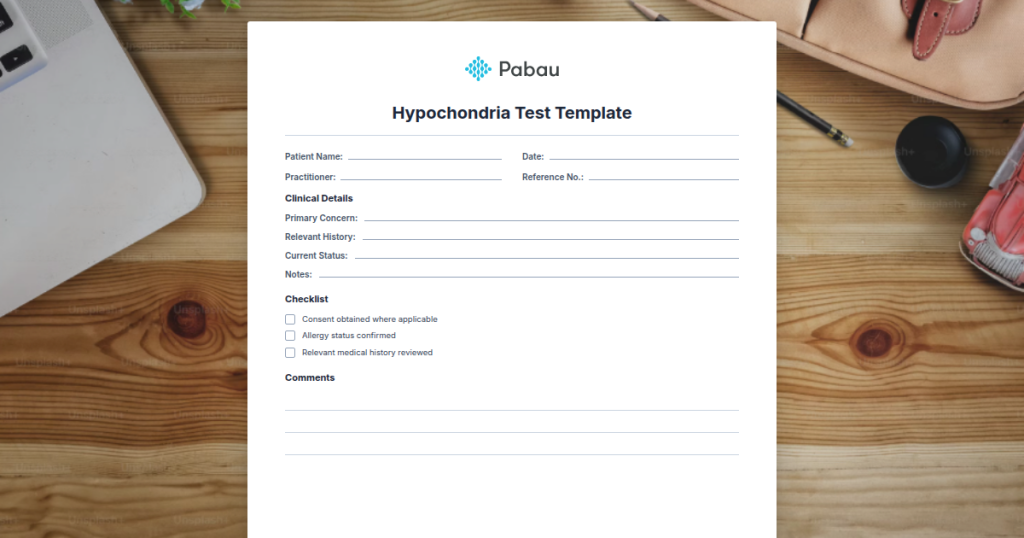
Hypochondria Test Template
A hypochondria test template is a clinician-facing assessment tool designed to s...

April 10, 2026


Buy now, pay later is now available in Pabau

An allergy skin test results chart template systematically documents reactions to allergens during skin prick testing (SPT) or patch testing, enabling accurate diagnosis and treatment planning.
Results are read 15-20 minutes after allergen application; a positive reaction is typically defined as a wheal at least 3mm greater than the negative control.
Histamine serves as the positive control, saline as the negative control-both are essential to validate skin reactivity and rule out false results.
Pabau’s digital forms feature streamlines the documentation workflow, reducing manual charting errors and automatically flagging clinically significant reactions.
Most clinics still rely on paper charts or disorganised spreadsheets to record allergy skin test results. Charts get lost, measurements are inconsistent, and critical reaction data is buried in patient files. An allergy skin test results chart template solves this by creating a structured, standardised way to document every test-ensuring no reaction goes unrecorded and clinicians can compare findings across sessions.
A comprehensive diagnostic tool that documents patient reactions to various allergens during skin prick testing or patch testing procedures. Includes wheal and flare measurement grids, grading scales (+1 to +4), positive and negative control sections, allergen panel breakdowns (food, environmental, drug), and clinical interpretation guidance.
Download templateAn allergy skin test results chart template is a clinical documentation form used by dermatologists, allergists, and immunologists to record and interpret skin prick test (SPT) or intradermal test reactions. The template captures the patient’s allergic response to specific allergens by measuring the size of the wheal (raised, fluid-filled bump) and flare (surrounding redness) that develop 15-20 minutes after allergen application.
The template serves as both a real-time testing worksheet and a permanent clinical record. It documents which allergens were tested, the exact measurements of each reaction, control validation (positive histamine and negative saline), and a grading scale interpretation-typically ranging from negative (-) or 0 to +4 (very strong reaction). This structured format ensures consistent measurement methodology across all practitioners in a clinic.
Clinically, the chart enables rapid identification of specific allergen triggers. A patient with seasonal rhinitis might show strong reactions to birch pollen but no reaction to dust mite-immediately guiding treatment decisions. The template also supports compliance with regulatory standards from ASCIA, AAAAI, and EAACI, which require standardised documentation of allergen testing and result interpretation.
A well-designed template transforms the testing process into a systematic workflow. Follow these five operational steps to ensure accurate documentation and clinical safety:
Throughout the process, the template serves as both a checklist and a permanent record. Each section-allergen selection, control validation, measurement accuracy, grading, and interpretation-builds on the previous step, ensuring no critical detail is overlooked.
A standardised allergy skin test results chart template reduces documentation errors, improves clinical consistency, and supports audit readiness. When multiple practitioners test the same patient or when testing is repeated over time, a consistent template ensures measurements and interpretations are directly comparable. This is particularly important for monitoring disease progression or evaluating treatment response.
The template also protects clinical governance. GDPR and HIPAA compliance require secure storage of test results. A structured digital template (paired with Pabau’s AI-assisted documentation) ensures patient data is captured consistently, reducing the risk of incomplete or illegible records that create compliance gaps during audits. Regulators expect to see evidence that clinically significant findings-such as anaphylaxis risk or severe drug allergies-are clearly flagged and acted upon.
Converting paper charts into a digital system saves clinics an average of 8-12 hours per week. Pabau’s clinic software integrates allergy testing documentation directly into patient records, eliminating duplicate entry and enabling one-click recall of historical results. Book a demo today to see how dermatology practices are scaling allergy testing operations without sacrificing accuracy.
This template is essential for any healthcare setting performing skin prick testing or intradermal testing. Dermatology clinics use it to diagnose contact allergies and evaluate suspected drug sensitivities. Aesthetic and medical spa clinics apply it before procedures (e.g. pre-treatment allergen screening for cosmetic injectables). Allergy and immunology practices rely on it for diagnosis of environmental and food allergies. Primary care and functional medicine clinics use it when investigating chronic inflammatory conditions. Even occupational health teams use variants for workplace exposure assessment.
The template supports multi-disciplinary use. Nurses conduct the testing and record initial measurements; clinicians interpret results and make treatment decisions; administrative staff file the completed chart as part of the permanent medical record. A clear, standardised template reduces handoff errors between roles.
Standardised measurement accuracy: A structured grid ensures every allergen is tested using the same methodology. Measurement consistency across all practitioners means serial testing produces directly comparable data, enabling clinicians to track changes in sensitisation over months or years.
Reduced documentation burden: Pre-printed or digital templates eliminate the need to write out allergen names and control labels for every test. Clinicians focus on measurement and interpretation rather than paperwork. This is especially valuable in high-volume clinics performing 20+ tests daily.
Regulatory compliance support: A systematic template ensures all required elements-consent, control validation, measurement methodology, and interpretation-are documented. Auditors and regulators expect to see evidence that skin prick testing was performed according to clinical standards. A complete chart provides that evidence immediately.
Patient safety and clinical decision-making: Clear documentation of positive results, control validation, and any unusual findings reduces the risk of missed diagnoses or inappropriate treatment. When results are ambiguous (e.g. borderline wheal size), the template prompts clinicians to consider retesting or blood testing alternatives.
The wheal is the raised, fluid-filled central bump that indicates a localised allergic reaction. The flare is the surrounding redness and swelling, reflecting a broader inflammatory response. Both measurements matter. According to PMC clinical standards, the most accurate method is to measure the wheal’s average diameter (longest dimension plus perpendicular dimension, divided by two) rather than estimating size visually. A wheal measuring 8mm with a 5mm flare suggests a strong specific IgE response, while a large flare with no wheal may indicate skin irritation rather than true allergy.
Record both measurements on your template because they tell different stories. Some allergen extracts are known to produce prominent flares without corresponding wheals-this is not an allergy, but the template flags it so clinicians don’t misinterpret the finding. Other allergens produce strong wheals but minimal flares-typically indicating a well-defined, clinically relevant sensitivity.
A positive skin test does not automatically equal allergy. The clinical history must match the test result. A patient with no history of peanut reactions but a +3 wheal to peanut allergen may have sensitisation without clinical allergy-a distinction that changes management. Your template should include space for symptom correlation: does the patient report symptoms consistent with this allergen exposure? The American Academy of Allergy, Asthma and Immunology (AAAAI) emphasises that SPT results guide diagnosis but do not replace clinical judgment.
Grading scales vary by institution. Some use +1 to +4; others use mild/moderate/severe. Your template should specify which scale is in use. Pre-test medication review is equally critical-antihistamines taken within 2-5 days suppress reactions and produce false negatives. Your template must include a checkbox confirming medication hold compliance before testing begins.

Need standardised testing protocols? Dermatology EMR workflows outline the clinical best practices for conducting and documenting SPT across multi-practitioner clinics.
Want to automate result interpretation? Digital forms in Pabau can auto-calculate grading scales and flag results requiring clinical follow-up.
Looking for compliance guidance? HIPAA compliance best practices ensure your allergy testing records meet regulatory standards for secure storage and audit readiness.
An allergy skin test results chart template transforms testing from a scattered, error-prone process into a precise clinical workflow. By standardising measurement, validating controls, and documenting interpretation, the template ensures every test generates reliable, auditable results. Whether you are managing a single practitioner or a multi-location clinic, a structured template reduces errors, improves patient outcomes, and simplifies compliance. Download the template above and integrate it into your clinic today-then book a demo with Pabau to see how digital documentation can eliminate manual charting entirely.
Results are read 15-20 minutes after allergen application. Measure the wheal diameter in millimetres and compare it to the negative (saline) control. A wheal at least 3mm greater than the negative control is typically considered positive. Grade the reaction using the standardised scale (+1 to +4 or mild/moderate/strong) and cross-reference against the patient’s clinical history to confirm relevance.
Most clinics use a +1 to +4 scale or descriptive terms (mild, moderate, strong, very strong). A -, 0, or negative indicates no reaction. +1 (mild) typically means a wheal 3-5mm larger than negative control. +2 (moderate) is 6-10mm larger. +3 (strong) is 11-15mm larger. +4 (very strong) is 16mm or larger. Your template should specify which scale your clinic uses for consistency.
Standard panels vary by region and clinical need. Environmental panels typically include tree pollens, grass pollens, dust mites, and mould spores. Food panels cover common allergens like peanut, tree nuts, milk, eggs, soy, wheat, fish, and shellfish. Drug panels test penicillin, cephalosporin, and other common medications. Cosmetic or occupational panels are customised to specific patient exposures. Your template should clearly label which allergens are being tested in each session.
The wheal is the raised central bump (indicates localised allergic reaction and IgE response). The flare is the surrounding redness and swelling (indicates broader inflammatory response). Both are measured separately and recorded on the chart. A true positive allergy typically shows both wheal and flare. A large flare without a wheal may indicate skin irritation rather than allergy.
Paper templates work clinically, but digital templates offer significant advantages: reduced transcription errors, automatic grading calculations, searchable historical data, secure cloud backup for GDPR/HIPAA compliance, and one-click access during follow-up visits. If managing multiple practitioners or high test volumes, digital documentation scales better and reduces the risk of lost or illegible charts.