CCSD Codes
CCSD Code H5100: Haemorrhoidectomy (Excision of Haemorrhoids)
What is CCSD Code H5100: Haemorrhoidectomy? CCSD Code H5100 represents excisiona...

March 18, 2026


Buy now, pay later is now available in Pabau

CPT code 96127 is the primary ADHD screening CPT code, reimbursed at roughly $4.58 per instrument by Medicare
Pair 96127 with an E/M code (99213 or 99214) using modifier 25 to bill the office visit separately
Paediatric developmental screening uses 96110, while comprehensive ADHD testing requires 96136 and 96130 series codes
Document the standardised instrument name, raw score, interpretation, and clinical decision to support every claim
Most payers allow up to 4 units of 96127 per encounter when you administer multiple validated screening tools
Choosing the correct ADHD screening CPT code directly affects your reimbursement and claim approval rates. However, many clinicians either underbill by bundling screening into the office visit or overbill by using full evaluation codes for a brief assessment. Both mistakes cost your practice money.
This guide covers every ADHD screening CPT code you need to know, from the brief 96127 assessment to comprehensive neuropsychological testing. In addition, you will find current reimbursement rates, documentation requirements, and common billing errors to avoid. Whether you screen children with the Vanderbilt or adults with the ASRS, this resource gives you the coding clarity you need.
The primary ADHD screening CPT code is 96127, officially described as “brief emotional/behavioural assessment (e.g., depression inventory, attention-deficit/hyperactivity disorder [ADHD] scale), with scoring and documentation, per standardised instrument.”
In most cases, clinicians use 96127 when they administer a validated screening tool during a patient visit. For example, you would bill this code after completing a Vanderbilt ADHD Rating Scale, Conners Rating Scale, Adult ADHD Self-Report Scale (ASRS), or SNAP-IV questionnaire.
Each unit of 96127 represents one standardised instrument. As a result, if you administer both a parent-report Vanderbilt and a teacher-report Vanderbilt during the same encounter, you can bill two units. Most commercial payers and Medicare allow up to four units per encounter, though you should verify your specific payer policies.

Download our free printable worksheet covering the top 25 ADHD screening CPT codes for quick reference during billing
Bill 96127 for each separate standardised instrument you administer and score. A parent Vanderbilt and a teacher Vanderbilt count as two units because they are two distinct instruments with independent scoring.
Furthermore, 96127 is not limited to ADHD screening alone. Clinicians also use this code for depression inventories (PHQ-9), anxiety screens (GAD-7), and substance use assessments. The key requirement is that you use a validated, standardised instrument with documented scoring.
To bill the ADHD screening CPT code correctly, you must use a recognised standardised tool. The following instruments qualify for 96127 when screening for ADHD:
| Instrument | Age Range | Reporter |
|---|---|---|
| Vanderbilt ADHD Rating Scale | 6-12 years | Parent/teacher |
| Conners Rating Scales (CRS-3) | 6-18 years | Parent/teacher/self |
| Adult ADHD Self-Report Scale (ASRS-v1.1) | 18+ years | Self |
| SNAP-IV Rating Scale | 6-18 years | Parent/teacher |
| Behaviour Assessment System for Children (BASC-3) | 2-25 years | Parent/teacher/self |
| Brown Attention-Deficit Disorder Scales | 3-adult | Parent/self |
If you need guidance on scoring one of these tools, our guide on how to score the Vanderbilt ADHD rating scale walks through the process step by step.
For paediatric patients, you have two screening code options depending on the clinical context. Similarly, understanding which code applies helps you avoid denials and maximise reimbursement.
CPT 96110 covers developmental screening, defined as “developmental screening (e.g., developmental milestone survey, speech and language delay screen), with scoring and documentation, per standardised instrument.” This code applies when you screen younger children for developmental delays that may include ADHD symptoms.
In contrast, 96127 applies specifically to emotional and behavioural assessments. Therefore, the distinction matters for billing accuracy.
Use 96110 when you administer a broad developmental screening tool such as the Ages and Stages Questionnaire (ASQ) or the Parents’ Evaluation of Developmental Status (PEDS). These tools assess general developmental milestones rather than specific behavioural conditions.
On the other hand, use 96127 when you administer an ADHD-specific screening instrument like the Vanderbilt or Conners. Even for paediatric patients, 96127 is the correct ADHD screening CPT code when the tool specifically targets emotional or behavioural assessment.
In practice, you may bill both codes during the same visit. For instance, a well-child visit might include an ASQ (96110) and a Vanderbilt (96127) for a child with suspected attention difficulties. As a result, you capture reimbursement for both screening activities.
When a brief screening suggests ADHD, you may proceed to comprehensive testing. Consequently, you need a different set of CPT codes for these extended evaluation services.
96136 covers psychological or neuropsychological test administration and scoring by a physician or other qualified healthcare professional for the first 30 minutes. Bill 96137 for each additional 30-minute block beyond the initial period. These codes apply when the clinician personally administers standardised tests such as the Test of Variables of Attention (TOVA), Continuous Performance Test (CPT-II), or Integrated Visual and Auditory Continuous Performance Test (IVA-2).
If a trained technician administers the tests under physician supervision, use 96138 (first 30 minutes) and 96139 (each additional 30 minutes) instead. The distinction between clinician-administered and technician-administered codes is important because payers audit this regularly.
For the interpretation, integration of data, and clinical decision-making portion, bill 96130 (first hour) and 96131 (each additional hour). These codes cover the professional time spent reviewing results, writing the report, and developing treatment recommendations.
For comprehensive neuropsychological evaluations that assess multiple cognitive domains beyond attention, use 96132 (first hour) and 96133 (each additional hour). These codes reflect the broader scope of neuropsychological evaluation and typically reimburse at higher rates.
Meanwhile, 96116 and 96121 cover neurobehavioural status examinations, which assess thinking, reasoning, and judgement at the bedside. These codes apply when you perform a clinical cognitive assessment rather than formal standardised testing.
Using the correct ADHD screening CPT code at each stage, from initial screening through comprehensive evaluation, ensures you receive appropriate reimbursement for every service provided. Accurate claims management software can help you track these codes and reduce billing errors.
Most ADHD screenings happen during a scheduled office visit. Therefore, you typically bill an evaluation and management (E/M) code alongside the ADHD screening CPT code.
99213 applies to established patient visits with low to moderate medical decision making (15-29 minutes). 99214 covers established patient visits with moderate medical decision making (30-39 minutes). For new patients presenting with ADHD concerns, 99205 applies to visits involving high medical decision making (60-74 minutes).
To bill an E/M code and 96127 on the same claim, append modifier 25 to the E/M code. Modifier 25 indicates that the evaluation and management service was a significant, separately identifiable service from the screening procedure. Without this modifier, many payers will deny one of the two codes.
For initial ADHD evaluations, you will often use a higher-level E/M code because the visit involves gathering a complete history, reviewing school records, and establishing a treatment plan. In most cases, 99214 or 99205 is appropriate for these comprehensive visits.
For follow-up ADHD visits where you re-administer a screening tool to monitor treatment response, 99213 is typically sufficient. However, always code based on the medical decision making complexity for that specific encounter rather than the diagnosis alone.
Documenting your clinical thinking in the client record supports the medical necessity for the E/M level you select. Furthermore, maintaining structured notes through digital forms ensures consistent documentation across your practice.
Understanding reimbursement rates helps you evaluate the financial impact of ADHD screening services on your practice. The chart below shows 2025 Medicare national average rates for the most commonly used ADHD-related CPT codes.
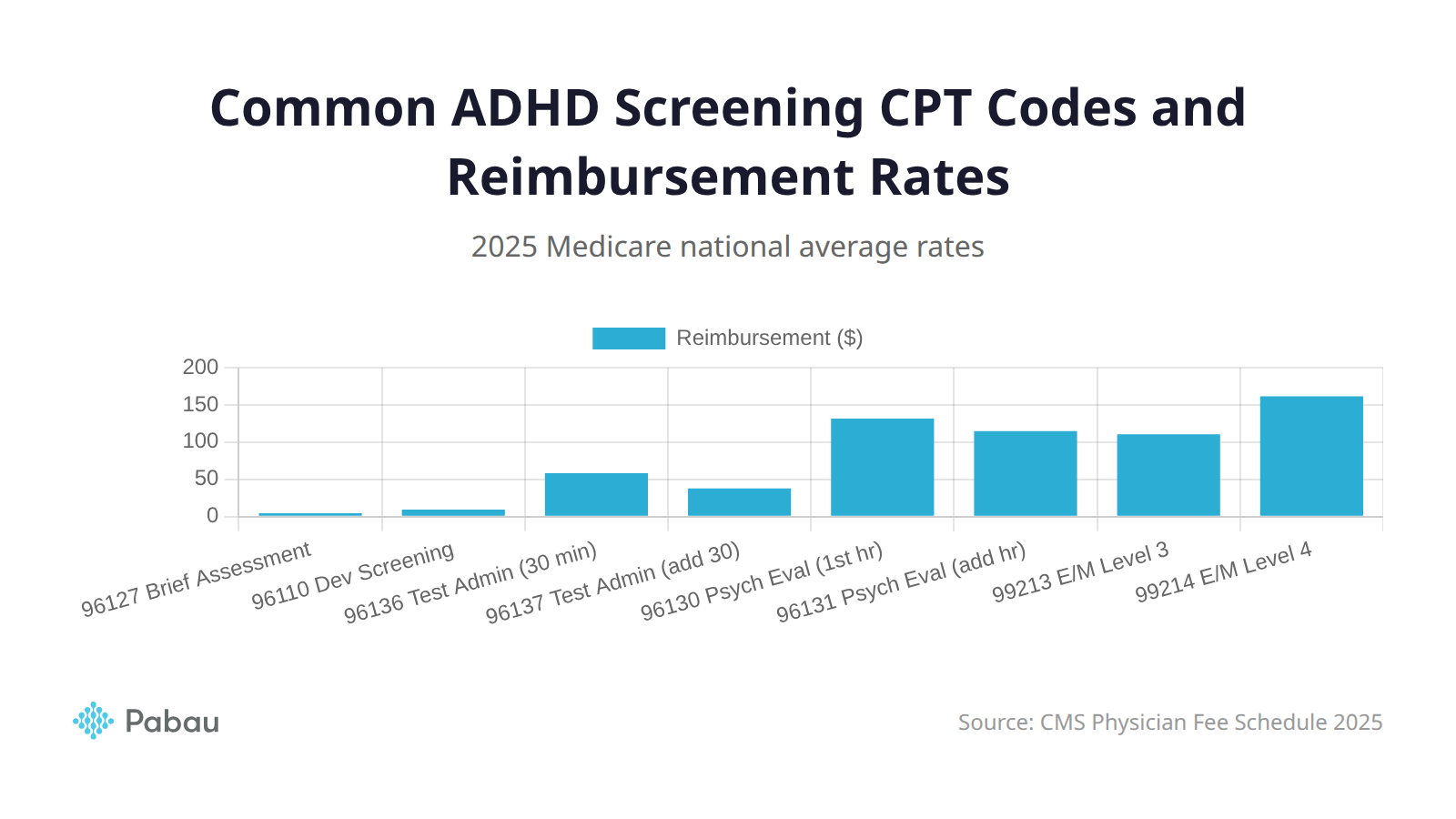
As the data shows, the ADHD screening CPT code 96127 reimburses at approximately $4.58 per instrument under Medicare. While this rate seems low, billing multiple units per encounter and pairing screening with E/M codes creates meaningful revenue. For instance, a 99214 ($161.59) plus two units of 96127 ($9.16) generates $170.75 for a single ADHD screening visit.
Commercial insurance rates typically exceed Medicare rates by 20-40%. As a result, your actual reimbursement may be significantly higher depending on your payer mix.
To maximise your ADHD screening revenue, consider these strategies:
A HIPAA-compliant billing workflow protects both your revenue and your patients’ data throughout this process.
“Since switching to Pabau, our ADHD screening documentation is far more structured. We can attach rating scales directly to patient records, and the billing codes are captured accurately every time. It has reduced our claim denials significantly.”

Dr Jonathan Garabette
Founder, London Psychiatry Clinic
Avoiding common mistakes protects your revenue and keeps your practice audit-ready. Here are the most frequent ADHD screening billing errors:
Using 96127 without a qualifying instrument. You cannot bill this code for informal observation or clinical interview alone. The AMA CPT guidelines require a validated, standardised instrument with documented scoring.
Failing to document scoring and interpretation. Simply noting that you administered a screening tool is insufficient. Your documentation must include the instrument name, the raw score, and your clinical interpretation of the results.
Incorrect modifier usage. Forgetting modifier 25 on the E/M code is the single most common reason for ADHD screening claim denials. Similarly, using modifier 59 instead of 25 can trigger audits.
Unbundling errors. Some payers bundle 96127 into the E/M service when the documentation does not clearly separate the two services. Therefore, your notes must demonstrate that the screening was a distinct clinical activity from the office visit assessment.
Billing 96127 for unscored instruments. If a patient takes home a questionnaire but does not return it, or if you collect the form but do not score it during the encounter, you cannot bill 96127 for that visit.
Clean claims start with thorough documentation. For the ADHD screening CPT code to pass payer review, your clinical notes must include specific elements.
Every note supporting a 96127 claim should contain:
For testing codes (96136-96139), you must additionally document start and stop times for each testing session. The CMS guidelines on psychological testing specify that time-based codes require contemporaneous time documentation.
Create a structured ADHD screening note template in your EHR that prompts you to record instrument name, score, interpretation, and clinical decision. This approach eliminates documentation gaps and speeds up your workflow.
Using practice management software with built-in clinical templates ensures your team captures every required data point. Furthermore, linking screening results directly to the patient’s ADHD ICD-10 codes in their record creates a complete clinical picture.
For practices looking to streamline their EHR workflows, exploring the best primary care EHR options can make a significant difference in documentation efficiency.
The primary ADHD screening CPT code is 96127, which covers brief emotional and behavioural assessment using a standardised instrument. You bill one unit per validated screening tool administered and scored during the encounter.
Can I bill 96127 and 99214 on the same day?Yes, you can bill 96127 alongside an E/M code like 99214 on the same day. However, you must append modifier 25 to the E/M code to indicate it was a significant, separately identifiable service from the screening.
How many times can I bill 96127 per visit?Most payers allow up to four units of 96127 per encounter. Each unit represents one standardised instrument administered and scored. For example, billing two units for a parent Vanderbilt and a teacher Vanderbilt is appropriate.
What is the reimbursement for ADHD screening CPT code 96127?The 2025 Medicare national average reimbursement for CPT code 96127 is approximately $4.58 per unit. Commercial insurance rates are typically higher, ranging from $5 to $20 per assessment depending on the payer and geographic location.
Do I need a specific diagnosis code to bill 96127?You do not need a confirmed ADHD diagnosis to bill 96127. You can use symptom-based ICD-10 codes such as R41.840 (attention and concentration deficit) or F90.9 (ADHD, unspecified type) when screening for suspected ADHD. The screening itself justifies the billing code.
Can non-physician providers bill ADHD screening codes?Yes, nurse practitioners, physician assistants, clinical social workers, and other qualified healthcare professionals can bill 96127 for ADHD screening. The code is not restricted to physicians. However, scope-of-practice rules vary by state, so verify your local regulations.