Primary & Preventive Care
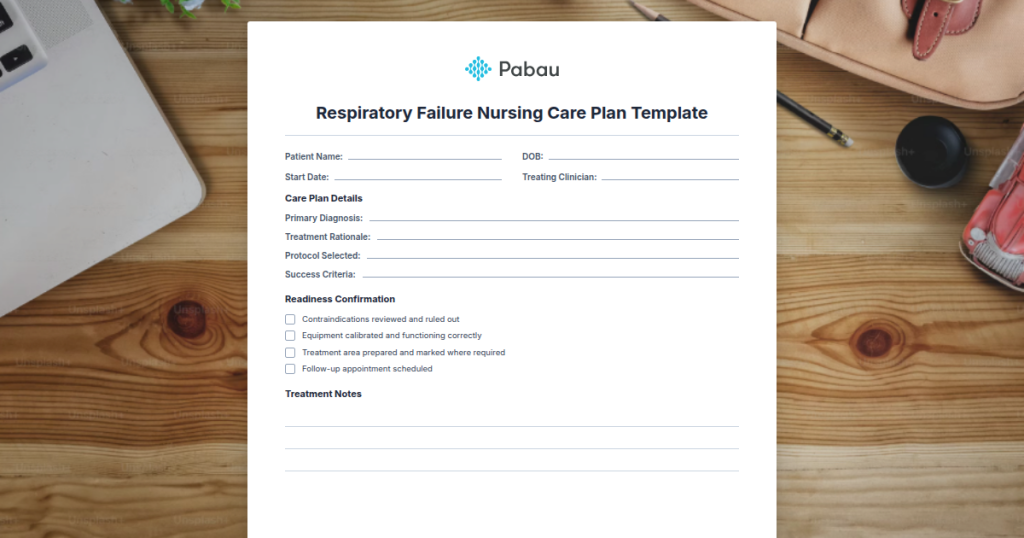
Respiratory Failure Nursing Care Plan Template
A Respiratory Failure Nursing Care Plan Template provides clinicians with a syst...

March 17, 2026


Buy now, pay later is now available in Pabau

A doctor’s note template ensures consistency, compliance, and legal protection.
Doctor’s notes must include provider name, credentials, date, and medical necessity statement.
HIPAA and GDPR compliance requires careful handling of patient information.
Digital templates streamline note creation and reduce documentation errors.
Different jurisdictions (UK fit notes vs. US medical notes) have distinct requirements.
A doctor’s note template is a critical tool for healthcare practitioners issuing medical documentation to patients for work, school, or employer requirements. Whether you’re providing a statement of fitness for work in the UK or a medical excuse letter in the US, a well-structured doctor’s note template ensures you capture all necessary clinical information whilst maintaining regulatory compliance and patient confidentiality. This guide covers what belongs in a professional doctor’s note, key compliance considerations across jurisdictions, and how digital solutions can streamline the documentation process for busy clinics.
A professional medical documentation template for healthcare practitioners to provide official medical assessments, treatment recommendations, and fitness-for-duty evaluations whilst maintaining compliance with healthcare standards and documentation requirements.
Download templateA doctor’s note template is a standardised form that healthcare practitioners use to document clinical encounters, assessments, and recommendations for patients requiring medical evidence for workplace or educational absences. Unlike traditional clinical progress notes (SOAP notes), a doctor’s note template focuses on three key purposes: confirming a patient received care, explaining medical necessity for time away, and protecting both the clinician and patient through documented evidence.
In the UK, the equivalent is the NHS fit note (officially the Statement of Fitness for Work), which replaced the older “sick note” in 2010, as detailed in the NHS fit note guidance. In the United States, practitioners issue medical excuse letters or medical notes to satisfy employer and FMLA (Family and Medical Leave Act) requirements. Both formats serve a legal function: they provide evidence of medical incapacity and protect the healthcare provider by documenting the clinical basis for recommendations.
The template should remain concise whilst including essential elements: clinician credentials, date of assessment, patient identifier, clinical findings, and a clear statement of medical status (e.g., “unfit for work until [date]” or “medically necessary to miss school on [dates]”). These templates must comply with regulatory frameworks like HIPAA in the US and GDPR in the UK/EU, ensuring patient confidentiality whilst providing employers and educational institutions with necessary information. Using a secure patient portal to issue and store notes adds another layer of compliance protection.
Using a doctor’s note template efficiently requires a structured approach. The template guides clinicians through each essential field, reducing the risk of omitting critical information whilst maintaining a consistent format across all notes issued by your practice. Below are the five operational steps to complete and issue a professional doctor’s note.
Using digital forms templates within your practice management system ensures every note follows the same structure, timestamps automatically, and integrates into the patient record without manual filing. This reduces transcription errors and creates an audit trail for compliance verification.

Automate note generation, reduce errors, and maintain compliance across your clinic team. See how Pabau integrates medical documentation into your workflow.

A doctor’s note template is essential for any healthcare practice that issues medical evidence for absences. Mental health practitioners, GPs, physiotherapists, occupational therapists, and specialist clinicians routinely need professional templates to support patients requesting time away from work or school due to medical necessity.
Mental health and therapy practitioners benefit significantly from standardised doctor’s note templates when patients require documentation for ADHD assessments, anxiety, depression, or other psychiatric conditions affecting work capability. Clinicians using mental health practice management systems can integrate doctor’s note templates into their patient workflows, ensuring consistent documentation across all providers. A structured template reduces the risk of inadvertently disclosing sensitive mental health information beyond what’s necessary for the employer.
General practitioners and private GPs use doctor’s notes daily to support patients’ absence requests for acute illness, chronic condition flare-ups, or post-operative recovery. In the UK, GPs complete the official NHS fit note; in the US, private practices issue medical excuse letters that must satisfy HIPAA documentation standards.
Allied health practitioners-physiotherapists, occupational therapists, and chiropractors-issue doctor’s notes to confirm a patient’s functional limitations and unsuitability for certain work tasks. These notes often include rehabilitation timelines and activity restrictions that support workers’ compensation or workplace accommodation requests. NICE provides occupational health fitness for work guidance that practitioners can reference when determining appropriate activity restrictions and return-to-work timelines.
School-based health professionals and occupational health nurses use doctor’s note templates to manage student and employee absences. Educational institutions and large employers require consistent documentation formats that comply with attendance policies and safeguarding requirements.
Ensures legal compliance. A well-designed template includes all elements required by HIPAA regulations (US) or GDPR (UK/EU), reducing the risk of data breaches or inadequate documentation during compliance audits. A consistent structure demonstrates professional oversight and supports your defence if a note’s validity is later questioned.
Protects patient confidentiality. Templates guide practitioners to include only clinically relevant information, avoiding the temptation to disclose unnecessary details (e.g., specific diagnoses or treatment details) that employers are not entitled to know. This principle of minimum necessary disclosure is central to both HIPAA and GDPR compliance.
Reduces documentation errors. A structured template with clear fields eliminates ambiguity and missing information. Automated templates within clinical documentation systems further reduce transcription errors and ensure consistency across all notes issued by your practice.
Improves workflow efficiency. Instead of composing each note from scratch, practitioners complete a template in minutes. This is especially valuable during peak demand periods (winter illness surges, post-operative periods) when multiple notes may be requested daily. Templates integrate seamlessly into electronic health records, eliminating manual filing and reducing administrative burden on support staff.
Demonstrates professional oversight. Standardised templates show regulators (CQC, GMC, professional bodies) that your practice has governance structures in place. The GMC good medical practice standards explicitly require that clinical records are clear, accurate, and legible, making templated documentation a direct compliance asset. During inspections or complaints investigations, consistent, templated notes are easier to defend than ad hoc handwritten notes prone to omissions or ambiguities.
Supports audit and record-keeping. Templates with embedded timestamps and digital signatures create an immutable audit trail. This is invaluable if a note’s authenticity is ever challenged or if legal action requires proof of when the note was issued and by whom.
Verify employer legitimacy before issuing a note. A small number of patients attempt to obtain notes fraudulently (e.g., by calling from a spoofed employer number or requesting backdated notes). Always confirm the request directly with the patient’s official employer HR contact or educational institution. Document the verification method in your patient record.
An effective doctor’s note template must contain seven essential elements to be legally valid and clinically sound. Omitting any one of these elements undermines the note’s credibility and may result in employer rejection or questions about its authenticity.
1. Provider credentials and contact details. Your full name, professional title, medical registration number (GMC/GDC/etc.), practice name, address, and phone number. Employers need this information to verify the note’s authenticity. Provide your registration number-it’s a marker of professional accountability.
2. Date of assessment. The date you examined the patient. If you’re issuing a note on behalf of a colleague or based on a previous appointment, clearly state the assessment date. Backdating notes is unethical and potentially illegal; employers will verify the date against your appointment records.
3. Patient identification. The patient’s full name and date of birth (at minimum). Some templates include NHS number (UK) or patient ID for additional verification. Do not include sensitive diagnoses in this section-keep it factual and minimal.
4. Clinical findings relevant to fitness for work. A brief, professional summary of the patient’s presenting complaint and relevant clinical examination or investigation findings. For example: “Patient reports acute lower back pain following lifting injury. Examination reveals restricted lumbar flexion and pain on movement. Imaging confirms acute muscle strain with no fracture.” Avoid unnecessary detail; focus on functional impact.
5. Medical statement or fitness-for-duty declaration. This is the core of the note. Use clear language: “Patient is unfit for work from [date] to [date]” or “Patient is medically unfit to attend school on [dates].” Some jurisdictions allow practitioners to indicate fitness with restrictions (e.g., “Unfit for work involving manual labour; suitable for office duties from [date]”). Follow local guidance-in the UK, the fit note has specific boxes for this statement.
6. Signature and date of issue. Your handwritten signature or digital signature (depending on your practice’s policy). Sign the same day the note is issued. Include your name typed below, professional registration number, and the date. Digital signatures should be compliant with your local standards (e.g., advanced electronic signature under eIDAS in the EU). The European Commission’s eIDAS electronic signature regulation outlines the legal framework governing qualified and advanced electronic signatures across member states.
7. Privacy statement (optional but recommended). A brief note that the information is confidential and intended for the named recipient only. Example: “This document is confidential and intended for [employer/school] only. Unauthorised disclosure may breach confidentiality and data protection regulations.” This reinforces the minimum necessary disclosure principle and supports compliance management across your practice.
The structure and legal requirements for doctor’s notes differ significantly between the UK and US, reflecting different healthcare systems and employment law frameworks. Understanding these distinctions is critical if your practice serves patients across jurisdictions.
UK Fit Notes (Statement of Fitness for Work). Introduced in 2010 to replace the traditional “sick note,” the NHS fit note is a standardised form issued by GPs and nurses. It includes three specific boxes: (1) “I am not fit for work until [date],” (2) “I may be fit for work taking into account the following advice,” or (3) “I am treating the patient as a private patient.” The employer cannot ask for specific diagnoses; the form focuses on functional incapacity. Statutory Sick Pay eligibility rules allow SSP for up to 28 weeks if a valid fit note is provided. The form is standardised across the NHS and is the only format employers can legally request for absences exceeding 7 days.
US Medical Excuse Letters. In the US, employers may request a doctor’s note, but there is no standardised format. Instead, practitioners issue custom medical excuse letters or medical notes. These must comply with HIPAA privacy rules, which prohibit employers from requesting detailed diagnoses. The Family and Medical Leave Act (FMLA) establishes employment protection for qualifying medical absences; notes must confirm medical necessity but need not reveal diagnosis. Employers may ask for “certification of health care provider” (FMLA certification form WH-380-E for FMLA eligibility), which uses a specific USDOL template.
Practical implications. If you practise in the UK, use the official NHS fit note template exclusively. If you serve US-based patients, create a flexible template that complies with HIPAA minimum necessary disclosure principles. If your practice is international, maintain two versions: one for UK fit notes and one for US medical excuse letters. Digital practice management systems should support both templates and flag which version applies based on patient location or employer jurisdiction.

Need to understand digital form workflows in your clinic? Digital Forms provides a platform to create, distribute, and store patient-completed forms electronically, reducing paper and automating data capture into your EHR.
Want to streamline clinical documentation across your team? Echo AI assists practitioners in generating structured clinical notes automatically, saving time on note entry and ensuring consistency.
Looking for guidance on compliant medical documentation? Safer Clinical Notes explains best practices for writing clinical notes that protect patient confidentiality and support audit readiness.
A professional doctor’s note template is non-negotiable for any healthcare practice issuing medical evidence for patient absences. By standardising the format, ensuring compliance with HIPAA and GDPR, and including all essential clinical and administrative elements, you protect both your practice and your patients. Whether you’re issuing a UK fit note or a US medical excuse letter, a well-structured template reduces errors, accelerates documentation, and demonstrates professional governance to regulators and employers alike. Implementing digital templates within your clinic’s electronic health record system transforms note-issuing from a time-consuming manual task into a streamlined, compliant workflow.
A doctor’s note must include your name and credentials, the date of assessment, the patient’s identification, clinical findings, the medical statement (e.g., “unfit for work until [date]”), your signature, and the date issued. Avoid unnecessary diagnoses; include only clinically relevant information for the employer or educational institution.
In the UK, employers can legally request a fit note only after 7 consecutive days of absence. In the US, employers may request a medical note for any absence, though some companies have internal policies permitting shorter absences without documentation. Check local employment law and your employer’s policy.
Both are acceptable. Typed notes are becoming standard, especially in practices using electronic health records. If handwritten, ensure legibility and apply a clear signature. Digital signatures are valid if your practice uses compliant e-signature software. Some institutions may request a scanned copy; check with the employer or school.
In the UK, a “fit note” (Statement of Fitness for Work) is the standardised NHS form for work absence documentation. In other contexts, “doctor’s note” is a broader term for any medical documentation confirming absence from work or school. The UK fit note is a specific legal document; a doctor’s note is a general medical document.
A doctor’s note is valid for the period specified (e.g., “unfit until [date]”). Once that date passes, a new note is required if the patient remains unfit. Employers typically accept notes issued within a reasonable timeframe of the absence request. Check your local employment law for specific retention and validity periods.
No. Issuing a backdated note is unethical and potentially fraudulent. Always date the note the day you issue it. If a patient requests a note for a past absence, issue a new note dated today but clearly indicating the assessment date and absence period in the clinical summary. This maintains audit integrity and professional accountability. Learn more about HIPAA compliance to understand documentation audit requirements.