WhatsApp group chats get the message across just fine. Need quick updates? Shift swaps?
Done.
But while that works great in retail, hospitality, or entertainment, healthcare is a different story.
When staff in a medical practice communicate, they’re often sharing sensitive info, such as details on patient care, clinical updates, and a person’s condition. And outdated or fragmented messaging methods often lead to:
Miscommunication
Privacy breaches
Costly inefficiencies
But when patient care is on the line, there’s no room for error. The info has to stay secure.
That’s why practices need a secure, purpose-built staff messaging platform. One that keeps communication compliant and helps protect the trust patients place in you.
In this guide, we’ll share how to evaluate, choose, and implement a staff messaging platform that improves your operations, patient safety, and team collaboration.
Understanding the need for staff messaging platforms in healthcare
Effective communication among healthcare professionals is crucial for seamless operations and excellent patient care.
But in many healthcare settings, this is what the reality looks like:
Phone calls go unanswered
Critical messages get lost among personal notifications
Pagers have limited reach
Paper notes get misplaced
Unsecured text messages risk privacy breaches
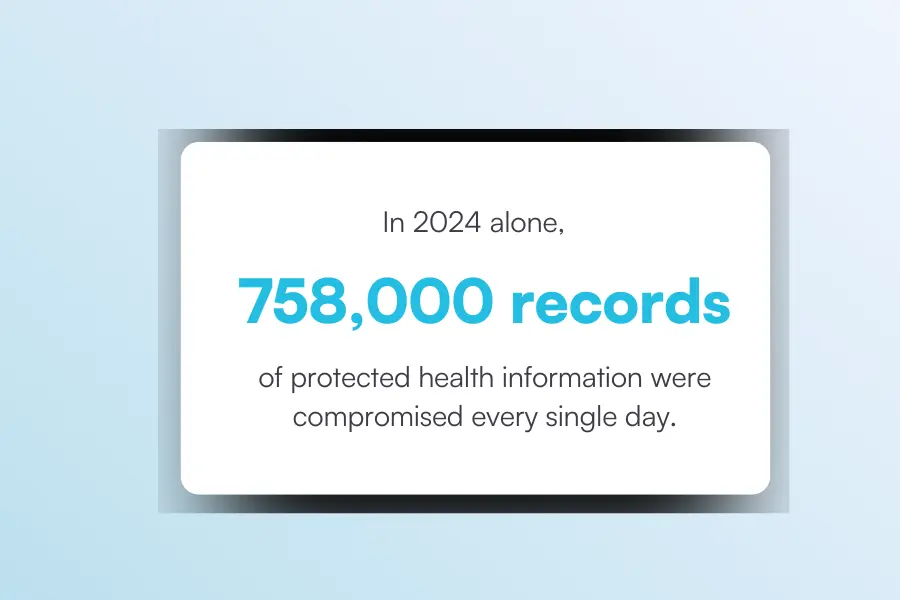
In 2024 alone, for instance, 276,775,457 individuals had their protected health information exposed or stolen, according to The HIPAA Journal. That’s an average of over 758,000 records compromised every single day.
All these problems are proof that centralized, secure communication for healthcare organizations is a must.
There are many situations where nurses need to quickly clarify a medication dose or alert a physician to a sudden patient’s allergic reaction, and delays or missed messages can have serious consequences.
A dedicated staff messaging platform ensures that communication is instant, reliable, and secure, helping care teams respond quickly and work together to provide the best care possible.
Key features to look for in a staff messaging platform
Staff communication platforms are not one-size-fits-all. You need to look for a platform that’s purposely built for the healthcare industry.
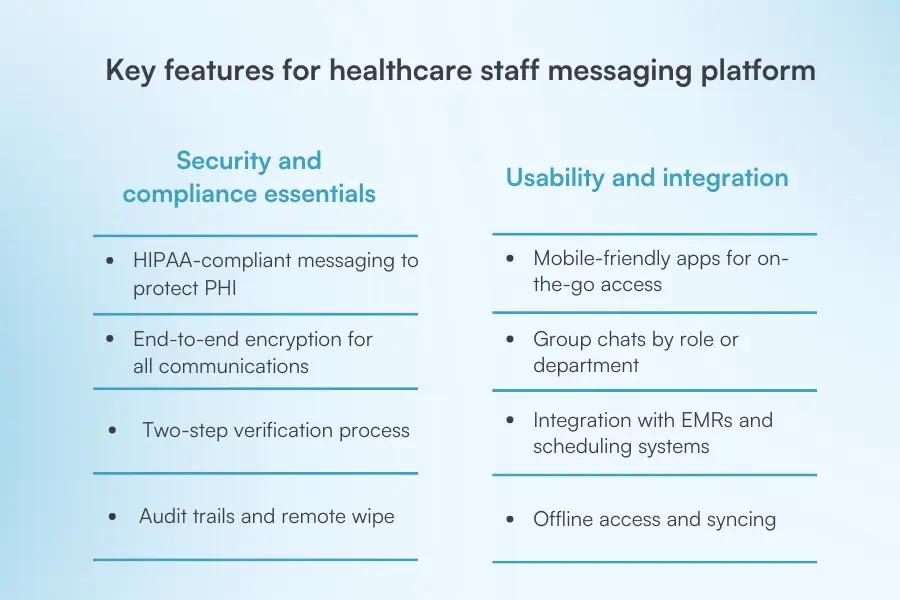
At the core, the platform must offer secure, HIPAA-compliant (Health Insurance Portability and Accountability Act) messaging to protect patient health information (PHI). Also, features like role-based access, audit trails, two-step verification process, end-to-end encryption, and the ability to remotely wipe data help maintain privacy, security, and control.
However, the platform should also be user-friendly and support group messaging. And as healthcare providers are always on the go, you should look for mobile-friendly apps that keep staff connected wherever they are.
What’s also important is that the staff messaging platform should easily integrate with your EMR or staff scheduling system to streamline workflows and provide offline access that automates syncing for reliability and uninterrupted workflows.
💡 Before making a decision, create a checklist of must-have and good-to-have features to ensure the platform supports both compliance and daily efficiency.
Benefits of using a staff messaging platform for clinics
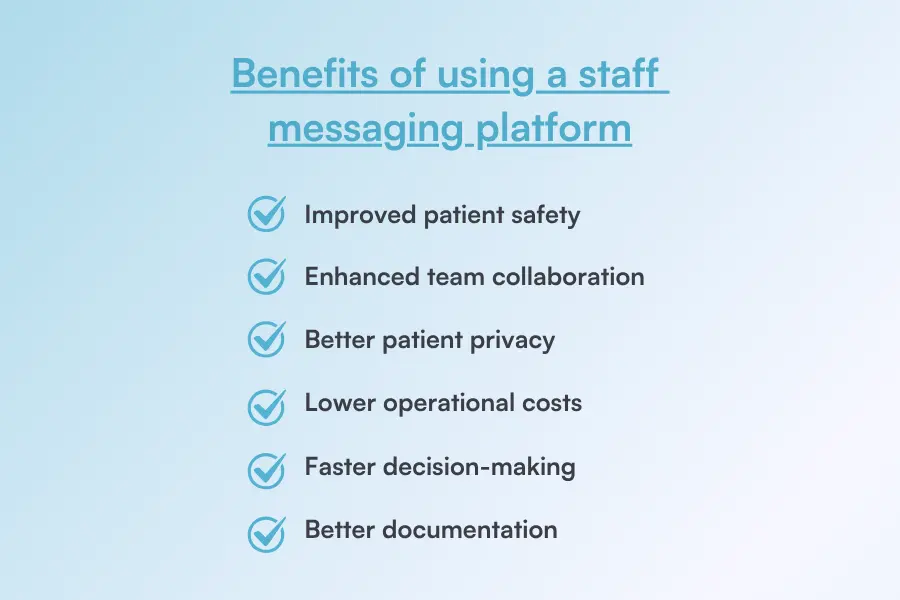
Implementing a dedicated staff messaging platform purpose-built for clinics can offer a wide range of benefits that directly improve both clinical and operational performance.
Here’s a quick overview of how it can help your practice:
🏥Faster, clearer, and more contextual communication between staff members
This leads to quicker decision-making and reduces the likelihood of misinterpretations that can lead to medical errors.
🤝 Real-time collaborationamong different team members
From nurses and doctors to administrative staff. This is particularly crucial in multi-disciplinary care, where coordinated efforts directly impact patient outcomes.
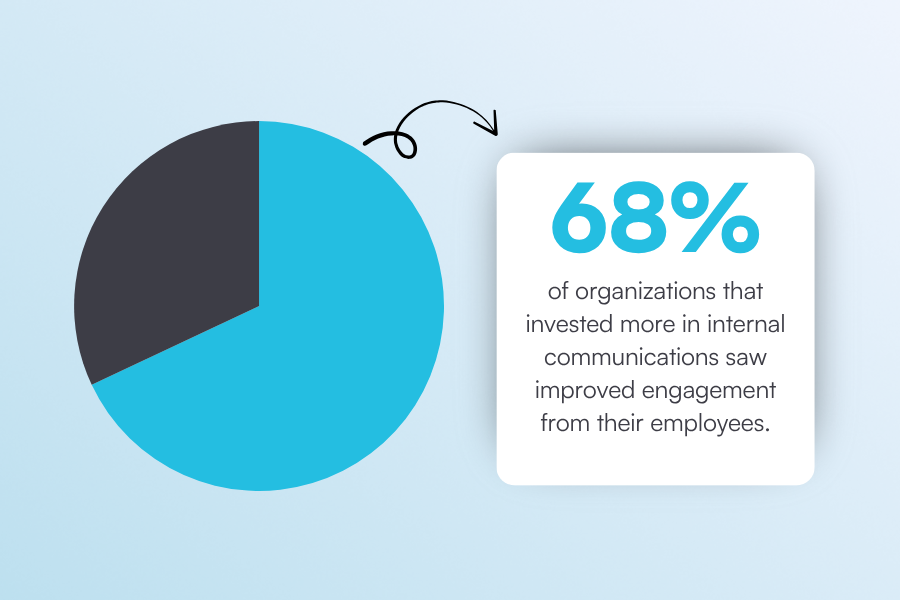
In fact, according to a statistical report by Axios HQ, 68% of organizations that invested more in internal communications saw improved engagement from their employees, compared to 32% that didn’t or even reduced communication investment.
🔒 A HIPAA-compliant platform
HIPAA compliance allows clinics to significantly enhance patient privacy and reduce the risk of costly data breaches. It builds patient trust and ensures adherence to strict regulatory requirements.
💸 Lower operational costs
As you move away from paper-based systems, faxes, and inefficient phone calls, costs for supplies, equipment, and staff time decrease. Streamlined IT management is also a benefit, as a centralized platform reduces the need to manage separate communication tools.
By adopting a secure, purpose-built staff messaging platform, practices can strengthen their staff management approach while creating a more connected and compliant environment.
How to choose the right platform for your practice
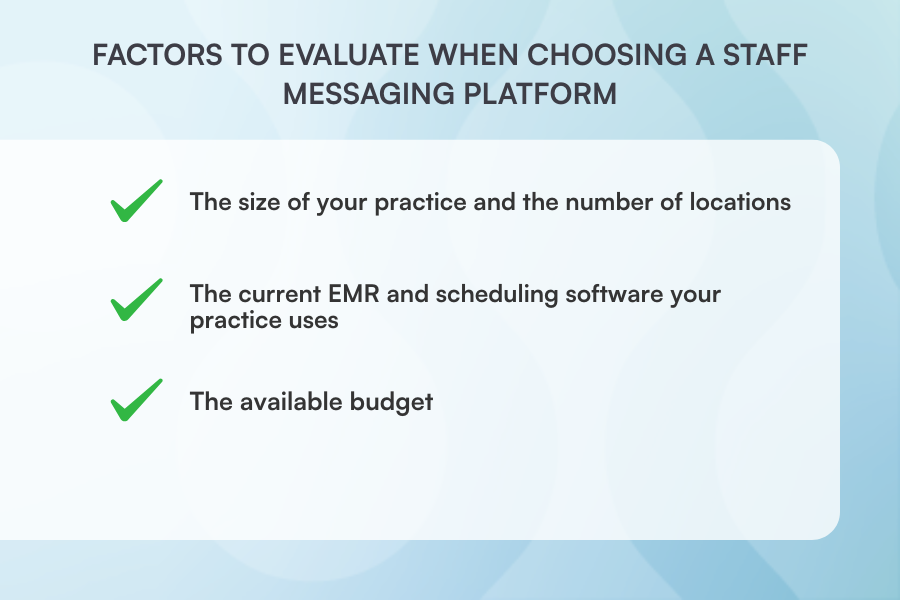
Choosing the right staff messaging platform starts with understanding your practice’s specific needs.
Practice size and multi-location needs: A small, single-location clinic will have different requirements than a large multi-location practice.
Your existing systems –EMR (electronic medical records) or EHR (electronic health records), scheduling: Make sure the messaging platform is compatible with your current EMR, scheduling software, and other essential tools.
Budget and pricing tiers: Messaging platforms often offer various pricing models based on features, number of users, and storage.
Switching to an all-in-one platform: If your current tools don’t support integrations, or if managing multiple disconnected systems is straining your budget, it may be time to switch to an all-in-one practice management solution with built-in staff messaging. This can streamline operations and reduce costs.
Additionally, to ensure the platform works for everyone, involve your team in the decision-making process:
Ask clinicians for feedback on usability, since they’ll use it daily
Get admin staff input on how it fits into existing workflows
Consult your IT team to assess ease of implementation and security
Staff feedback is important. And not just for initial buy-in, but for long-term success.
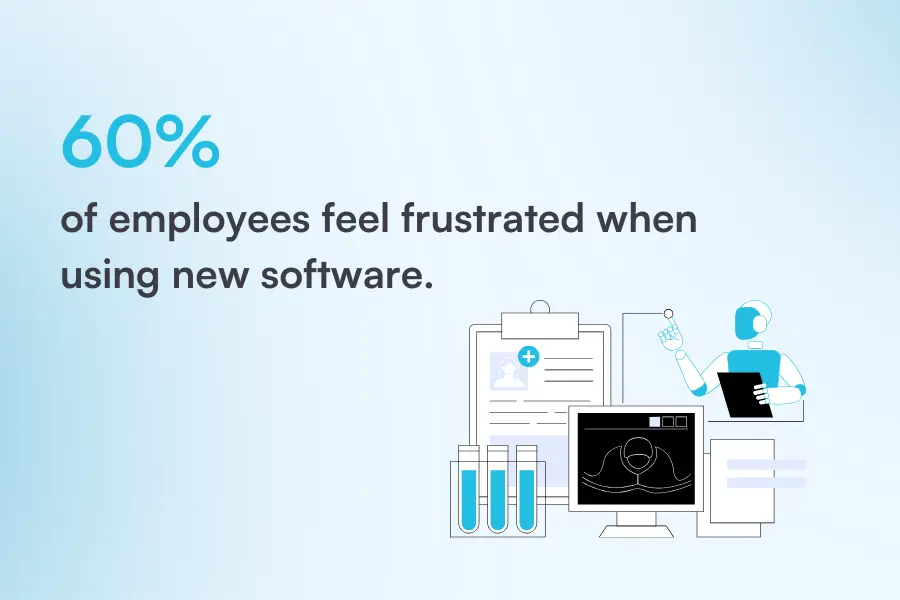
According to a Gartner survey, 60% of employees feel frustrated when using new software. And after a negative experience, 40% of users resist adoption by limiting how they use the tool, delaying engagement, or avoiding it altogether.
So, involving your clinicians, admin staff, and IT team early in the selection process helps ensure you choose a platform that fits their needs, reduces frustration, and leads to a smoother rollout with stronger, more consistent adoption.
Once you’ve gathered feedback, the next step is to:
Shortlist 3–5 staff messaging platforms (or all-in-one systems with built-in messaging)
Schedule demos to see how each one fits your clinic’s real-world needs
💡 Remember the importance of considering scalability for growing healthcare practices. Choose a platform that can easily expand with your practice’s future needs, accommodating more users, additional features, and increased data volume without requiring a complete system overhaul.
Any staff messaging platform you choose must be fully HIPAA and SOC 2 (System and Organization Controls 2) compliant for US clinics to safeguard patient information and protect your practice from legal and financial risks, and GDPR (General Data Protection Regulation) compliant for UK clinics.
The platform you choose must have these security features:
End-to-end encryption: Messages and data are encrypted from the sender’s device to the recipient’s, making them unreadable to anyone else.
Role-based access controls: Limit access to PHI based on a user’s role and responsibilities, ensuring only authorized staff view sensitive information.
Audit logs and user authentication: Comprehensive logs track all user activity, providing a clear record of who accessed what and when. Robust user authentication, including multi-factor authentication (MFA), prevents unauthorized access.
Remote wipe capability: In case a device is lost or stolen, this feature allows administrators to remotely erase all sensitive data and prevent breaches.
Business associate agreements (BAAs): Ensure that any third-party vendor handling PHI signs a BAA, outlining their responsibilities for safeguarding the data according to HIPAA.
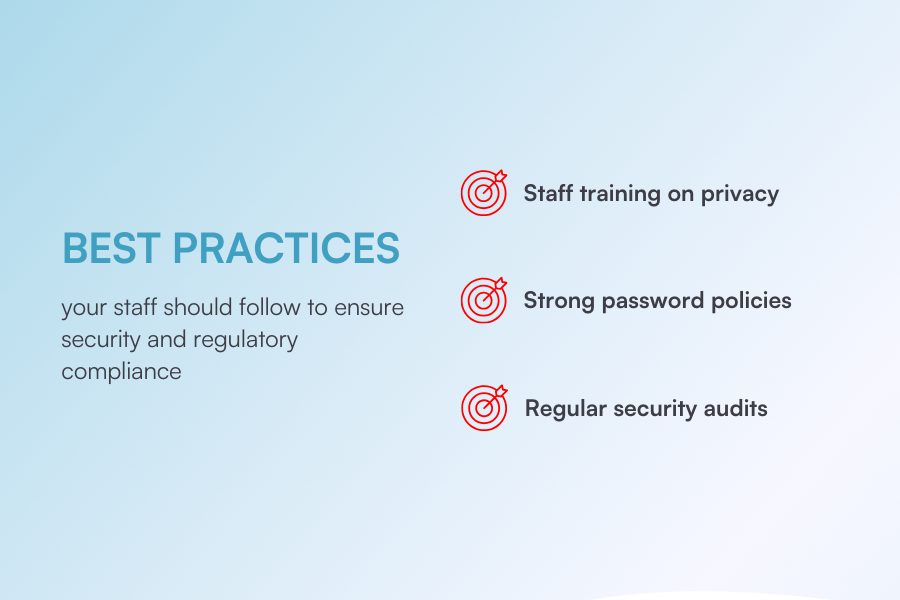
While built-in security features are essential, getting the full benefit from your staff messaging platform also depends on how your team uses it. To ensure compliance and protect patient data, it’s important to follow a few key best practices.
Start by regularly training all staff on HIPAA guidelines, your clinic’s privacy policies, and how to use the messaging platform securely. Enforce strong password policies that require complex, unique passwords and encourage staff to update them regularly.
Finally, conduct routine security audits to spot potential vulnerabilities early and confirm that your clinic remains compliant with all relevant regulations. These practices help build a culture of security and keep sensitive information safe.
Future trends in healthcare communication tools
The future of clinical communication is fast, flexible, and fully integrated.
And with the ongoing advancements in technology, clinics can boost efficiency without compromising patient-centered care.
Here are a few key trends to follow:
📱 Mobile-first design for always-on, anywhere access 🔌 Seamless integration with EMRs, scheduling, and billing systems ⏱️ Faster response times, helping reduce preventable delays in care 📈 Regulatory-driven adoption, especially around secure texting standards
By embracing these trends, your practice can stay efficient, adaptable, and ahead of the curve.
How Pabau supports better communication in clinics
To run a smooth and efficient clinic process, clear communication between staff is key, but not the only thing that’s important. That’s why you need a system that can seamlessly handle all the processes in your practice without having to juggle millions of tools.
That’s why our all-in-one practice management system, Pabau, is designed to streamline communication and reduce the friction that often comes with juggling multiple tools.
The Pabau Vision (that’s coming soon) feature will keep your team connected ⬇️
Internal chat: Instantly message team members to stay in sync, eliminating the need for fragmented conversations across multiple platforms.
Secure file sharing: Share sensitive files with end-to-end encryption for ultimate peace of mind, ensuring patient records remain confidential and compliant.
Create channels: Organize team discussions by department, specific teams, or patient topics for seamless collaboration, ensuring the right information reaches the right people.
Track all client communications from one place: Pabau’s existing capabilities allow you to centralize and track all client communications, whether via WhatsApp, SMS, calls, email, or social channels, providing a comprehensive communication history directly linked to the client’s file.
You can check out other Pabau features, which will help your team to contribute to a more efficient and collaborative environment.
Make communication your clinic’s competitive advantage with Pabau
Investing in a dedicated staff messaging platform is a smart move for clinics that want to stay ahead.
Why?
Because strong internal communication improves:
Care quality
Builds patient trust
Reduces liability
Boosts staff efficiency
With the right practice management software in place, your practice can stand out through better service, fewer errors, and a stronger reputation.