Musculoskeletal & Pain Management Physical Therapy
Cluster of Laslett Template
Download Your Free Cluster of Laslett Assessment Template Cluster of Laslett A s...

May 5, 2026


Buy now, pay later is now available in Pabau

The Cluster of Laslett is a 4-test assessment tool with 88% sensitivity and 78% specificity for identifying sacroiliac joint pain when 2+ tests are positive.
Two positive tests from the Thigh Thrust and Distraction tests alone are sufficient for SIJ pain diagnosis without additional testing.
Standardised documentation using a structured cluster of laslett template reduces assessment inconsistency and supports clinical decision-making across your team.
Pabau’s digital forms and automated workflows integrate template completion directly into patient records for seamless clinic documentation.
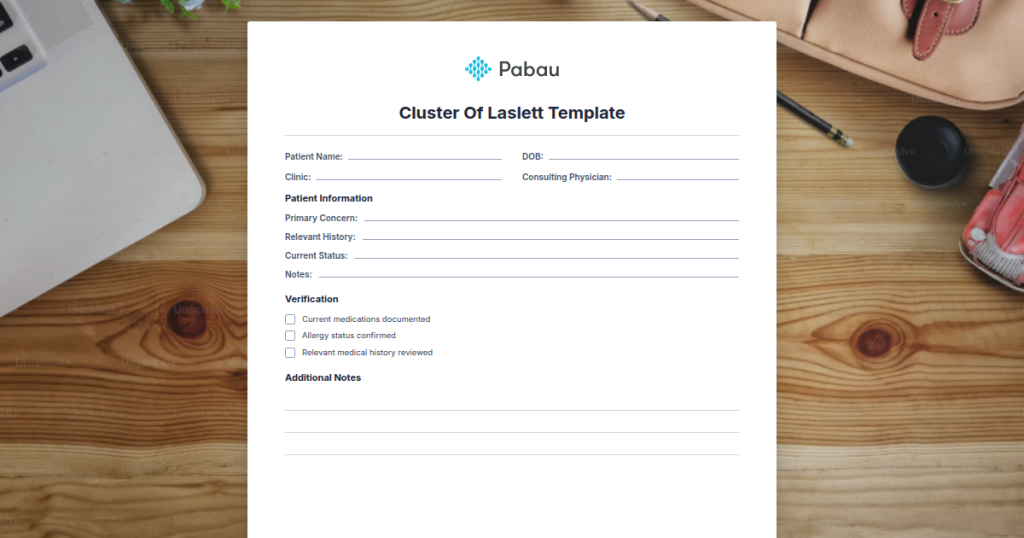
A structured assessment form for evaluating sacroiliac joint dysfunction. Includes patient details, test result fields with pain reproduction checkboxes, and a clinical decision algorithm to determine SIJ involvement.
Download templateThe Cluster of Laslett is a standardised assessment framework designed to identify sacroiliac joint (SIJ) pain as the source of a patient’s mechanical low back or buttock pain. Sacroiliac joint dysfunction accounts for 10-25% of patients presenting with mechanical low back pain or posterior pelvic pain, making accurate diagnosis clinically important for appropriate treatment planning.
Named after researcher Mark Laslett, the cluster uses four provocative tests that stress the sacroiliac joint and ligaments. When two or more tests reproduce the patient’s familiar pain, the probability of SIJ involvement is high-a finding supported by peer-reviewed research. The cluster of laslett template standardises this assessment across your clinic team, ensuring consistent documentation and reducing diagnostic variability.
From a regulatory and clinical governance perspective, using a structured assessment template aligns with American Physical Therapy Association (APTA) standards for evidence-based clinical decision-making. The template supports informed documentation for patient records, audit trails, and compliance with healthcare data protection requirements.
The cluster of laslett template guides clinicians through a systematic assessment workflow. Follow these five operational steps to complete the assessment and document results accurately.
Integration with Pabau’s automated clinical documentation streamlines this workflow by auto-generating assessment summaries after you enter test results, saving time during note-taking.
This template is designed for physiotherapists, sports medicine clinicians, chiropractors, and osteopaths who evaluate patients with mechanical low back pain or posterior pelvic pain. The assessment is particularly valuable in the following clinical settings:
Any clinic using physical therapy EMR software can immediately embed this template into patient workflows for consistent documentation across multiple clinicians.
Diagnostic consistency: A standardised template ensures every clinician in your practice applies the same testing protocol and scoring rules. This reduces inter-clinician variability and supports reliable diagnosis tracking over time.
Compliance and documentation clarity: Structured fields for test results, pain reproduction, and clinical decisions create clear audit trails required by regulatory bodies such as the Chartered Society of Physiotherapy (CSP). The template supports GDPR-compliant patient record-keeping and demonstrates evidence-based clinical reasoning.
Workflow efficiency: Printed or digital templates guide clinicians through the assessment step-by-step, reducing documentation time and the risk of missing critical test results. When integrated with digital forms software, the template auto-populates patient records and triggers clinical alerts if SIJ pain is confirmed.
Patient communication and consent: A professional assessment document reassures patients that their pain evaluation follows an established clinical protocol. It supports informed consent conversations about treatment options based on SIJ involvement.
Team training and continuity of care: When new clinicians join your practice, a standardised cluster of laslett template accelerates their onboarding. Team management features ensure all staff complete training on the assessment protocol before working with patients.
The Cluster of Laslett operates on a sequential testing algorithm. Begin with the Thigh Thrust and Distraction tests, which are the most sensitive for SIJ pain. If both are positive, diagnosis is confirmed without additional tests-this decision-making efficiency is why the cluster is widely considered the gold-standard non-invasive clinical screening tool for SIJ pain, second only to fluoroscopy-guided diagnostic anaesthetic block which remains the diagnostic reference standard.
If only one of the first two tests is positive, proceed to the Compression test and Sacral Thrust test. A total of two or more positive tests across all four tests indicates SIJ pain involvement. If fewer than two tests are positive, SIJ pain is considered unlikely, and assessment should focus on alternative pain sources such as lumbar spine dysfunction or hip pathology.
Research supporting this algorithm demonstrates sensitivity of 88% and specificity of 78% when two or more tests reproduce familiar pain. These diagnostic accuracy metrics make the cluster of laslett template one of the most reliable non-invasive tools for identifying sacroiliac joint as a pain source. Documentation of individual test results within your template provides evidence for treatment planning and outcome tracking.
Postpartum patients experience elevated SIJ pain risk due to pregnancy-related ligamentous laxity and pelvic biomechanical changes. The cluster of laslett template remains valid for this population, though careful interpretation is essential-positive test results may reflect hormonal-mediated hypermobility rather than pathological joint dysfunction.
Patients with prior SIJ fusion, hip replacement, or lumbar spine surgery require modified testing due to altered joint mechanics. Document any surgical history in the template’s contraindication field to flag when standard test interpretation may not apply. Patient record management in Pabau maintains this surgical history across all assessments for continuity of care.
Athletes and high-demand sports participants often develop SIJ dysfunction secondary to core weakness or movement pattern abnormality. The cluster of laslett template provides the objective assessment needed to confirm SIJ involvement before prescribing sport-specific rehabilitation or return-to-play protocols.
Most clinics implement the cluster of laslett template at the assessment phase-during the initial evaluation when the clinician performs special tests to confirm or rule out SIJ involvement. Designate a specific time in your intake process (typically 10-15 minutes) for the four-test cluster. Automated workflow systems can trigger the template form at the correct assessment stage, ensuring no patients are missed.
Train all physios, chiropractors, and osteopaths on the correct test execution and pain reproduction criteria. Use the template as a teaching tool during staff onboarding. Store completed assessments in your patient management system alongside clinical notes so that results inform treatment planning decisions and outcome measurement over the course of care.
The Cluster of Laslett is a clinically proven assessment tool that combines evidence-based testing with practical workflow efficiency. Using a structured cluster of laslett template ensures your team applies consistent diagnostic criteria, documents findings clearly, and supports confident treatment planning for patients with sacroiliac joint pain.
Download the free template above to integrate SIJ assessment into your clinic’s standard evaluation process. Whether you print copies for each patient file or embed the form in your digital patient records system, this tool becomes the foundation of reliable, defensible clinical documentation. See how Pabau’s digital forms and clinical documentation features connect assessment templates to patient records in real-time, allowing your entire team to build a comprehensive clinical picture without duplication or delays.
The Cluster of Laslett includes Thigh Thrust, Distraction (gapping), Compression, and Sacral Thrust tests. Thigh Thrust and Distraction are the primary screening tests, while Compression and Sacral Thrust are used if only one of the first two is positive. The goal is to reproduce the patient’s familiar pain to confirm sacroiliac joint involvement.
The Cluster of Laslett demonstrates sensitivity of 88% and specificity of 78% when two or more tests reproduce familiar pain. This diagnostic accuracy makes it one of the most reliable non-invasive clinical tools for identifying sacroiliac joint as a source of low back or buttock pain.
Two or more positive tests (reproducing familiar pain) across the four-test cluster indicate sacroiliac joint pain involvement. If both Thigh Thrust and Distraction are positive, diagnosis is confirmed without additional testing. If only one is positive, the Compression and Sacral Thrust tests are performed to reach a total of two positive results.
Yes, the cluster of laslett template is valid for postpartum patients, though pregnancy-related hormonal laxity may increase pain sensitivity. Document the postpartum timeline and any red flags (severe pain, instability) in your assessment notes. Consider referral to a pelvic health specialist if symptoms are severe or persistent.
If fewer than two tests reproduce familiar pain, sacroiliac joint pain is considered unlikely. Focus assessment on alternative pain sources such as lumbar spine dysfunction, hip joint pathology, or muscular strain. A negative cluster of laslett result does not rule out SIJ involvement entirely, but it lowers clinical suspicion and guides treatment planning toward other potential drivers.