Mental Health & Therapy Psychology
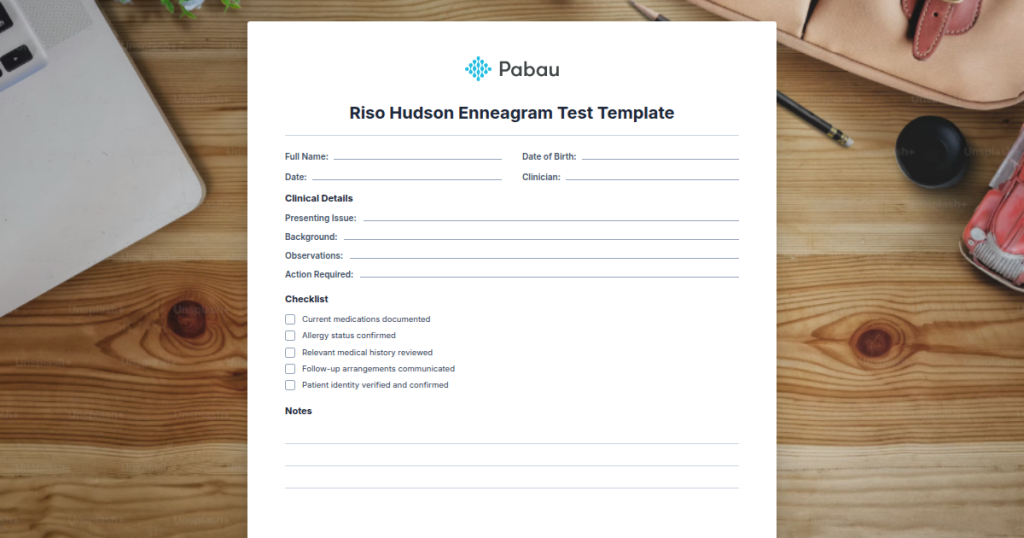
Riso Hudson Enneagram Test Template
Download Your Free Riso Hudson Enneagram Test (Sampler) Riso Hudson Enneagram Te...

April 23, 2026


Buy now, pay later is now available in Pabau

The Riso Hudson Enneagram Test Sampler is a 36-question personality assessment measuring nine core personality types and their behavioral patterns.
The sampler provides a low-cost introduction to personality profiling before investing in the full 144-question assessment ($20 per test).
Practitioners should use the RHETI as one tool within a comprehensive assessment, not as the sole determinant of personality type.
Pabau’s digital forms and intake workflows streamline enneagram assessment administration and automatically score client responses.
A 36-question personality assessment tool designed for therapists, coaches, and mental health practitioners to explore client personality patterns, motivational drivers, and growth areas during therapeutic interventions and coaching sessions.
Download templateMost therapists and coaches lack a structured, evidence-based tool to understand their clients’ personality patterns during the first session. Personality typing can feel vague or based on casual observation. The Riso Hudson Enneagram Test template fills this gap by providing a scientifically grounded assessment that identifies core personality motivations, fears, and growth areas. This guide explains what the riso hudson enneagram test template is, how practitioners use it in clinical workflows, and how to interpret results to inform treatment planning and coaching interventions.
The riso hudson enneagram test template is a forced-choice personality assessment developed by Don Richard Riso and Russ Hudson. The sampler version contains 36 paired statements; respondents select which statement resonates more with them. This reveals which of the nine enneagram personality types best describes their core motivations, fears, and behavioral patterns.
The enneagram framework divides human personality into nine types, each with distinct motivational drivers. Type One seeks perfectionism and integrity. Type Two craves connection and helpfulness. Type Three pursues achievement and recognition. Type Four values authenticity and depth. Type Five seeks knowledge and understanding. Type Six needs security and loyalty. Type Seven chases novelty and stimulation. Type Eight desires control and strength. Type Nine wants peace and harmony. Understanding which type applies to a client provides clinicians with a language for discussing personality patterns and relational tendencies.
The test is proprietary and owned by the Enneagram Institute. It is not a clinical diagnostic tool equivalent to DSM-based assessments, but rather a personality profiling instrument used in coaching, therapy, team development, and personal growth contexts. The full RHETI (144 questions) is the most comprehensive version and takes approximately 40 minutes to complete, costing $20 per test. The sampler serves as an accessible introduction.
Practitioners administer the riso hudson enneagram test template in five operational steps within a therapy, coaching, or team development session.
Using digital forms software to administer the enneagram test streamlines client workflows. Clients complete the assessment via a secure portal before or during the first session. The system automatically calculates scores, reducing manual tallying and human error. Results populate the client record, creating a permanent reference point for future sessions.
Therapists specializing in psychotherapy, counseling, and talk therapy use the enneagram to deepen client self-awareness and inform treatment planning. Mental health coaches in private practice often integrate the RHETI into their intake process to establish a shared language about personality patterns and growth edges.
Life coaches and wellness practitioners use the enneagram in one-on-one coaching relationships and group workshops to facilitate personal development. Leadership coaches apply enneagram type knowledge to improve executive self-awareness and interpersonal effectiveness. HR and organizational development teams use group enneagram assessments to improve team communication and reduce conflict.
Administering a structured personality assessment during intake establishes a shared language between practitioner and client about personality patterns, fears, and motivations. Clients often report that accurate enneagram typing creates an “aha” moment-a feeling of being seen and understood. This alliance-building function accelerates therapeutic or coaching progress.
The sampler’s 36-question format is brief enough to fit into a standard intake appointment without disrupting workflow. Costs are minimal compared to other personality assessments. The automated clinical documentation tools in modern practice management software allow practitioners to capture enneagram results directly in the client record, ensuring the data is preserved for continuity of care.
Understanding your clients’ personality types through the riso hudson enneagram test template deepens therapeutic alliance and accelerates progress toward treatment goals. Use it as one tool within a comprehensive intake and assessment process, and always ground results in clinical observation and client feedback.
Book a demo to see how Pabau’s digital forms and client records streamline personality assessment administration and clinical documentation for your practice.
The sampler contains 36 paired statements and takes 5-10 minutes. The full RHETI Version 2.5 contains 144 paired statements and takes approximately 40 minutes, providing a more detailed personality profile and cost $20 per test. The sampler serves as a low-cost introduction; many practitioners use it for initial screening and recommend the full assessment only for clients seeking deeper understanding.
Yes. Therapists and psychologists use it to deepen client self-awareness. Coaches use it to accelerate personal development work. HR teams use group enneagram assessments for team building and leadership development. However, avoid using the enneagram as a hiring or personnel evaluation tool unless explicitly approved by legal counsel and fully disclosed to candidates, as personality typing in employment carries legal and ethical risks.
The RHETI has peer-reviewed reliability and validity data (Newgent et al., 2004, published in academic journals). However, it has known limitations. As Ferris State University’s educational resource notes, enneagram tests are “notoriously unreliable” as sole determinants of type. Use the results as a framework for discussion and self-reflection, not as a final diagnosis or truth.
Yes, the enneagram is not a substitute for diagnostic assessment but complements it. A Type Two client experiencing depression might explore how their helper orientation and people-pleasing contribute to stress and burnout. A Type Six client managing anxiety can examine how their hypervigilance and loyalty-seeking shape their relationships. Keep the enneagram secondary to evidence-based diagnosis and treatment.
Store results in your secure client record alongside other intake assessments. Use HIPAA-compliant practice management software to ensure assessment data is encrypted and access-restricted. Document administration, scoring, and clinical interpretation in clinical notes just as you would any other assessment.