Chiropractic Musculoskeletal & Pain Management
SOAP Notes For Chiropractic Template
What Is a SOAP Notes for Chiropractic Template? A SOAP notes for chiropractic te...

April 22, 2026


Buy now, pay later is now available in Pabau

The MRC scale grades muscle strength on a 0-5 scale, from no visible contraction (0) to normal power (5).
The MRC Sum-Score evaluates six bilateral muscle groups and ranges from 0 to 60, enabling longitudinal tracking.
Clinicians must document findings with anatomical precision using gravity-eliminated positions for grades 0-2 and resisted testing for grades 3-5.
Pabau’s digital forms streamline MRC scale documentation into structured patient records with automated follow-up tracking.
Muscle weakness signals neurological, musculoskeletal, or systemic disease. The Medical Research Council (MRC) scale is the gold standard tool for grading muscle strength in clinical practice, widely used across physiotherapy, neurology, and rehabilitation settings. The MRC scale for muscle strength template provides a standardised, printable assessment form that clinicians use to document and track muscle power across six key bilateral muscle groups using a simple 0-5 grading system.
Unlike informal strength estimates, the MRC scale for muscle strength template offers reproducible, inter-rater reliable data. Research shows inter-rater weighted kappa values of 0.77-0.78 for key muscles, making it ideal for physiotherapy clinics tracking patient progress from initial assessment through discharge. The template captures grading decisions, muscle group results, and Sum-Score totals in a single clinical document.
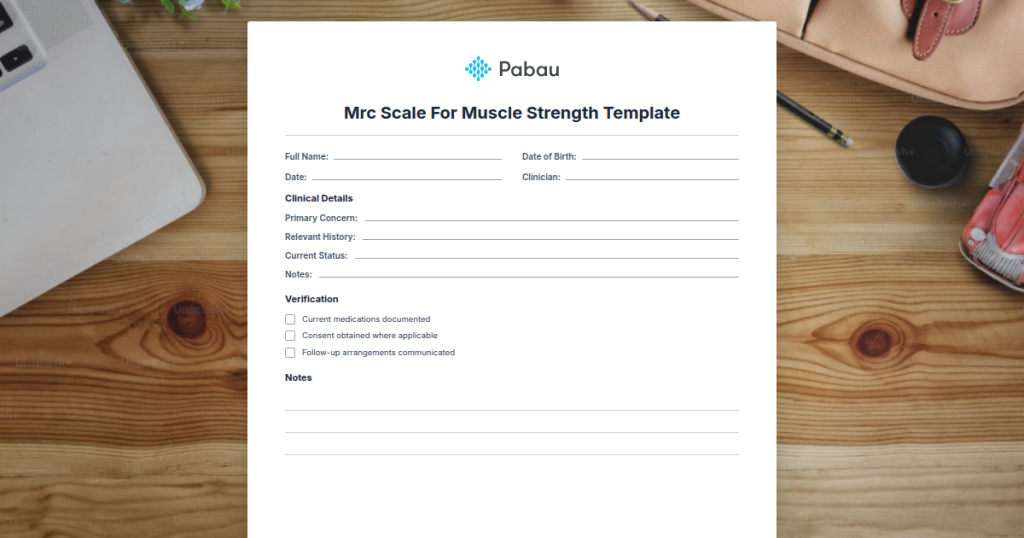
A standardised assessment form documenting muscle power using the 0-5 grading scale across bilateral muscle groups, including shoulder abduction, elbow flexion, wrist extension, hip flexion, knee extension, and ankle dorsiflexion.
Download templateThe MRC scale for muscle strength uses a consistent grading framework across all muscle groups. Understanding each grade ensures accurate assessment and reliable documentation of muscle power changes over time.
Grades 0-2 reflect severe weakness requiring testing in gravity-eliminated positions. Grades 3-5 use gravity and applied resistance. This structured approach makes the MRC scale for muscle strength template reproducible across clinicians and clinic visits, supporting evidence-based decision-making in stroke recovery, spinal cord injury assessment, and post-intensive care syndrome screening.
The five operational steps below guide clinicians through a complete MRC assessment using the MRC scale for muscle strength template.
AI-powered clinical documentation can auto-populate narrative findings from your grading entries, reducing administrative burden while you focus on hands-on assessment.
The MRC scale for muscle strength template is essential in multiple clinical contexts. Physiotherapists use it to track recovery after stroke, spinal cord injury, or nerve damage. Neurologists use it during cranial nerve and motor examination. Rehabilitation teams rely on MRC Sum-Score trends to justify continued therapy or discharge planning.
Post-intensive care syndrome screening commonly uses the MRC-SS as an objective weakness marker. Research published in Springer Critical Care (2020) demonstrates that an MRC Sum-Score below 48 (out of 60) indicates clinically significant critical illness weakness requiring intensive rehabilitation. Recovery protocols integrate baseline MRC grades to stratify exercise intensity and progression.
Accurate documentation makes or breaks the clinical utility of the MRC scale for muscle strength template. Record grades within moments of testing to avoid memory drift. Note any pain, fatigue, or patient effort that affects performance. If grades fluctuate across repeated tests, document the range.
Include narrative context: “Right shoulder abduction Grade 4, consistent effort, post-stroke Day 14 of rehabilitation.” This level of detail supports clinical reasoning and helps reviewers understand whether weakness reflects motor recovery or compliance barriers. Safer clinical note practices emphasise objective measurement paired with relevant clinical context, not vague assessments like “patient weak.”
Store the completed MRC scale for muscle strength template in your practice management system alongside imaging and other assessments. Longitudinal comparisons require consistent documentation intervals-weekly for acute stroke, bi-weekly for outpatient physiotherapy.
The MRC scale competes with the Oxford scale and analogue rating systems. Research from UK Research and Innovation (UKRI) shows the MRC scale is more reliable and accurate for grades 0-3 (weak muscles). An analogue scale performs better for grades 4-5 (near-normal strength) where discrete categories underestimate subtle power differences.
For most clinical workflows-stroke, spinal cord injury, post-ICU assessment-the MRC scale for muscle strength template offers sufficient discrimination and is faster to administer than analogue scales. The simplicity makes it ideal for busy physiotherapy clinics tracking multiple patients.
The MRC Sum-Score (MRC-SS) aggregates all 12 bilateral grades (0-60 range) into a single metric. Clinically meaningful improvement is 5-10 points. An MRC-SS below 48 signals weakness severe enough to delay mobilisation or discharge in critical care populations.
Using the MRC scale for muscle strength template repeatedly over time-weekly, bi-weekly, or monthly-demonstrates objective functional change to patients, payers, and your clinic’s clinical audit. This data supports evidence-based practice and outcomes reporting that attracts referrals from physicians who value quantified results.
Standardised assessment tools like the Ottawa rules follow the same principle of reproducible measurement. Building a culture of objective assessment across your physiotherapy clinic elevates credibility and patient outcomes tracking.
Manual paper templates introduce transcription errors and delay reporting. Structured clinical consultations benefit from digital MRC forms that auto-calculate Sum-Scores, flag concerning trends, and populate assessment summary fields. Your practice management system should link each MRC assessment to the patient’s treatment plan and discharge outcomes.
Request the downloadable MRC scale for muscle strength template above and integrate it into your digital forms library. Train all physiotherapists on consistent positioning, grading criteria, and documentation timing. Consistency across staff ensures valid longitudinal comparisons that support patient confidence in your clinical processes.

Track MRC scale results alongside treatment plans, automated follow-ups, and patient outcome dashboards in one integrated system.

The MRC Scale For Muscle Strength Template transforms subjective strength estimates into objective, reproducible data that clinicians and patients both understand. From stroke recovery to post-ICU rehabilitation, MRC grades inform treatment decisions and quantify functional progress. Download the free template above, integrate it into your digital forms, and start tracking MRC-SS trends across your patient population. Standardised measurement elevates your clinical practice and patient confidence in your physiotherapy outcomes.
The MRC scale is a standardised 0-5 grading system that clinicians use to assess and document muscle power during neurological examination. Grade 0 is complete paralysis; Grade 5 is normal strength. It is the most widely accepted clinical muscle strength assessment tool globally.
The MRC Sum-Score sums all 12 bilateral muscle grades (six muscle groups, left and right sides). Maximum is 60. Clinically significant weakness in critical care is an MRC-SS below 48. Compare baseline and follow-up scores to quantify patient progress.
Shoulder abduction, elbow flexion, wrist extension, hip flexion, knee extension, and ankle dorsiflexion. Each is tested bilaterally (left and right) and graded 0-5. The selection covers upper and lower limb proximal and distal muscles for comprehensive assessment.
The MRC scale is most reliable for grades 0-3 (weak muscles), with inter-rater weighted kappa around 0.77-0.78. For grades 4-5 (near-normal strength), analogue scales offer better discrimination. Use MRC for detecting weakness; consider analogue scales if fine-tuning near-normal strength is clinically important.
In-person assessment is standard because manual resistance testing requires hands-on examination. However, you can document historical MRC grades or perform gross visual screening remotely, then follow up with in-person testing for accurate baseline or discharge data.
Frequency depends on clinical context. Acute stroke: weekly. Outpatient physiotherapy: bi-weekly or monthly. Post-intensive care: baseline and weekly until discharge. Use consistent intervals so MRC Sum-Score trends are meaningful for clinical decision-making.