Mental Health Mental Health & Therapy
Acute Confusion Nursing Care Plan
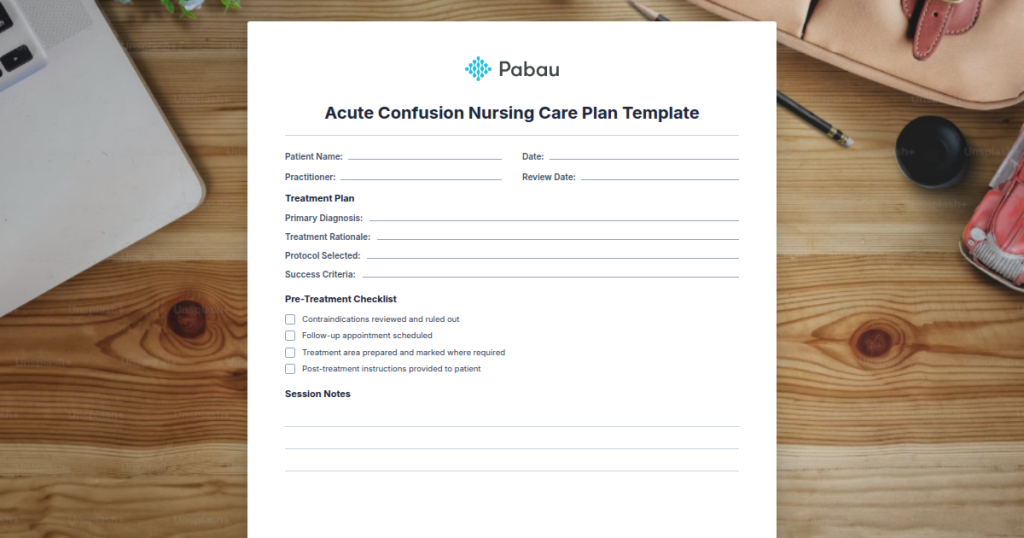
What is an Acute Confusion Nursing Care Plan Template? An acute confusion nursin...

April 20, 2026


Buy now, pay later is now available in Pabau

Acute confusion (delirium) is characterized by abrupt onset of disorientation, inattention, and altered consciousness-and differs from chronic confusion (dementia) in its sudden presentation and potential reversibility.
NANDA-I nursing diagnosis labels for acute confusion include ‘Acute Confusion’ and ‘Risk for Acute Confusion’, each with distinct defining characteristics and related factors requiring targeted interventions.
Common contributing factors include UTI, sepsis, electrolyte imbalance, hypoxia, medication changes, and sleep disruption-systematic assessment using tools like the Confusion Assessment Method (CAM) identifies these triggers.
Pabau’s digital forms and automated clinical documentation features streamline assessment completion, intervention tracking, and outcome evaluation, reducing manual charting time while maintaining NANDA-I compliance.
An acute confusion nursing care plan template is a structured clinical document that guides nurses through the systematic assessment, diagnosis, planning, intervention, and evaluation of patients experiencing sudden-onset confusion or delirium. The acute confusion nursing care plan template aligns with NANDA-I (North American Nursing Diagnosis Association International) diagnostic criteria and integrates evidence-based nursing interventions grounded in clinical research and professional standards.
Acute confusion-also called delirium-differs fundamentally from chronic confusion (dementia). It develops suddenly over hours to days, involves global disruption of attention and cognition, and is often reversible when underlying causes are addressed. According to the American Nurses Association (ANA) and The Joint Commission standards, systematic documentation of acute confusion through a care plan framework is essential for patient safety, regulatory compliance, and coordinated team care.
This template provides a ready-to-use framework that nurses and interdisciplinary teams can adapt to individual patient presentations. It captures assessment data, nursing diagnoses derived from NANDA-I taxonomy, specific patient goals and measurable outcomes, prioritized nursing interventions with clinical rationales, and evaluation criteria to determine care plan effectiveness.
A ready-to-use nursing care plan template for acute confusion and delirium, covering patient assessment, NANDA-I nursing diagnoses, evidence-based interventions with clinical rationales, patient goals and expected outcomes, and evaluation frameworks aligned with contemporary nursing practice standards.
Download templateImplementing an acute confusion nursing care plan follows the standard nursing process (ADPIE: Assessment, Diagnosis, Planning, Intervention, Evaluation). Here are the five operational steps:
Using a structured template ensures all team members-nurses, physicians, therapists, and care coordinators-work from a unified care plan. Digital forms integrated into your clinic’s practice management system allow real-time documentation, automatic timestamp tracking, and seamless communication across shifts and disciplines.
This template serves nurses across multiple healthcare settings and specialties:
Nurses working with older adults, post-operative patients, those with infection or metabolic disturbance, and individuals on complex medication regimens will find this template most applicable. Psychiatry and mental health clinics using EHR systems can embed the template within patient records for continuity of care across inpatient and outpatient transitions.
Standardized assessment and diagnosis: A template ensures every patient with acute confusion receives consistent, comprehensive assessment aligned with NANDA-I criteria. This reduces diagnostic variability and improves handoff communication between shifts.
Evidence-based interventions: Pre-populated intervention suggestions grounded in clinical research accelerate care planning while supporting best-practice standards. Nurses can customise interventions to individual patient needs rather than starting from a blank page.
Regulatory and compliance alignment: Documentation structured according to NANDA-I, ANA, and The Joint Commission standards supports audit readiness, reduces compliance risk, and demonstrates adherence to professional nursing practice standards during CQC inspections or quality reviews.
Improved patient safety: Systematic monitoring of mental status, early detection of delirium triggers, and coordinated interventions reduce falls, medication errors, and adverse outcomes associated with acute confusion.
Workflow efficiency: Pre-structured templates reduce documentation time, allowing nurses to spend more time on direct patient care. Templates also serve as communication tools, ensuring all team members understand the care plan and their specific responsibilities.
Flag contributing factors systematically: Create a checklist of common causes (UTI, sepsis, medication changes, hypoxia, electrolyte imbalance, sleep deprivation) and document which have been ruled in or out for your patient. This prevents missed diagnoses and supports team discussion of root causes rather than symptom management alone.
Effective assessment underpins accurate acute confusion diagnosis and care planning. The Confusion Assessment Method (CAM) is the gold-standard tool recommended by gerontology and critical care literature. CAM identifies four key features: acute onset, inattention, disorganized thinking, and altered level of consciousness. If acute onset AND inattention are present, plus either disorganized thinking or altered consciousness, CAM criteria for delirium are met.
Complementary tools include the Glasgow Coma Scale (GCS)-which measures eye opening, verbal response, and motor response-and the Mini-Mental State Examination (MMSE) for cognitive detail. Document the specific assessment findings, the tool used, timing of assessment, and baseline mental status (pre-confusion state) as reported by family or prior records. Best practices for clinical documentation emphasize objective, observable findings rather than vague descriptors (“confused” vs. “disoriented to time and place, thought process slow and tangential, unable to follow complex commands”).
ICD-10-CM codes relevant to acute confusion documentation include: F05 (Delirium due to known physiological condition) and R41.0 (Disorientation, unspecified). Accurate coding supports billing, research, and quality reporting for delirium prevention and management initiatives.
A key clinical decision is distinguishing acute confusion from chronic confusion (dementia). Acute confusion has sudden onset (hours to days), fluctuates throughout the day, involves inattention and disorganized thinking, and is potentially reversible. Chronic confusion develops gradually (months to years), remains relatively stable, and is typically progressive and irreversible. Many patients have BOTH: an underlying dementia plus superimposed acute delirium triggered by infection, medication, or metabolic derangement. Your care plan should address the reversible acute component while acknowledging baseline cognition.
Family input is invaluable: “Is this confusion new compared to their normal?” If yes, acute confusion is likely. If the family reports years of gradual cognitive decline, dementia is the primary diagnosis, though acute worsening may still indicate superimposed delirium. Psychiatric evaluation templates provide frameworks for cognitive history and baseline function documentation.

Need a mental health intake framework aligned with NANDA? Mental Health Intake Workflows guide collection of historical and symptom data that feeds into care plan development.
Want to streamline assessment documentation? Echo AI automated clinical notes can accelerate assessment charting, freeing nursing time for direct patient engagement during the confused patient’s critical early hours.
Looking for compliance guardrails? Psychiatry EMR software with built-in care plan templates ensures NANDA-I and regulatory alignment across your facility.
An acute confusion nursing care plan template standardizes assessment, diagnosis, and intervention for one of the most common and serious acute changes in hospitalized and aged patients. By following NANDA-I criteria and documenting systematically, nurses identify reversible causes, implement evidence-based care, and improve patient outcomes. The template transforms acute confusion from a vague description into a precise, actionable diagnosis with measurable goals. Pabau’s integrated clinical documentation tools make it easy to implement and track care plans in real time, keeping your whole team aligned.
“Acute Confusion” is used when the patient currently exhibits disorientation, inattention, and other defining characteristics of delirium. “Risk for Acute Confusion” is applied when risk factors are present (e.g., advanced age, multiple medications, recent surgery) but acute symptoms have not yet appeared. Use the risk diagnosis for prevention-focused interventions.
In acute hospital settings, reassess mental status every 4-8 hours or with each shift change. In aged care, daily reassessment is standard. Document changes in orientation, behavior, and response to interventions. If acute confusion resolves, discontinue the diagnosis and update goals. If it persists or worsens, investigate new contributing factors and revise interventions.
Common causes include urinary tract infection (UTI), sepsis, electrolyte imbalance (hyponatremia, hyperglycemia), hypoxia, dehydration, medication side effects or overdose, sleep deprivation, pain, and recent surgery. Always investigate medication reconciliation: new drugs, dose changes, or drug interactions frequently trigger delirium in older adults.
Both prevention and management are critical. Prevention focuses on “Risk for Acute Confusion” diagnosis: ensure adequate hydration, promote sleep, manage pain, review medications, maintain familiar environment cues, and engage family support. Once delirium occurs, the care plan addresses the acute diagnosis with interventions targeting identified causes and symptom management.
NANDA International provides the standardized diagnostic language and criteria. The American Nurses Association (ANA) publishes practice standards for nursing care. The Joint Commission requires documentation of delirium assessment and management in accredited facilities. The American Geriatrics Society has published clinical guidance on delirium management in older adults. Follow these sources for evidence-based practice benchmarks.