Mental Health Mental Health & Therapy
Gender Dysphoria Quiz Template
Consumer-facing online gender dysphoria quizzes flood search results. Most clini...

April 20, 2026


Buy now, pay later is now available in Pabau

The BSRI measures psychological androgyny across three subscales: masculinity, femininity, and neutral traits using a 7-point Likert scale.
Both 60-item long form and 30-item short form are validated; the short form shows equal or better psychometric properties in many populations.
Scoring requires calculating mean subscale scores and using classification methods (median split or t-test approach) to assign androgyny categories.
Pabau’s digital forms streamline BSRI administration, automated scoring calculations, and secure storage of assessment results for clinicians.
The Bem Sex-Role Inventory (BSRI) is one of psychology’s most widely used tools for measuring gender role orientation and psychological androgyny. Developed by Sandra Bem in 1974, the Bem Sex Role Inventory form has guided clinical assessment, research, and therapeutic practice for five decades. This guide provides a free, downloadable version and explains how to administer, score, and interpret results in clinical and research contexts.
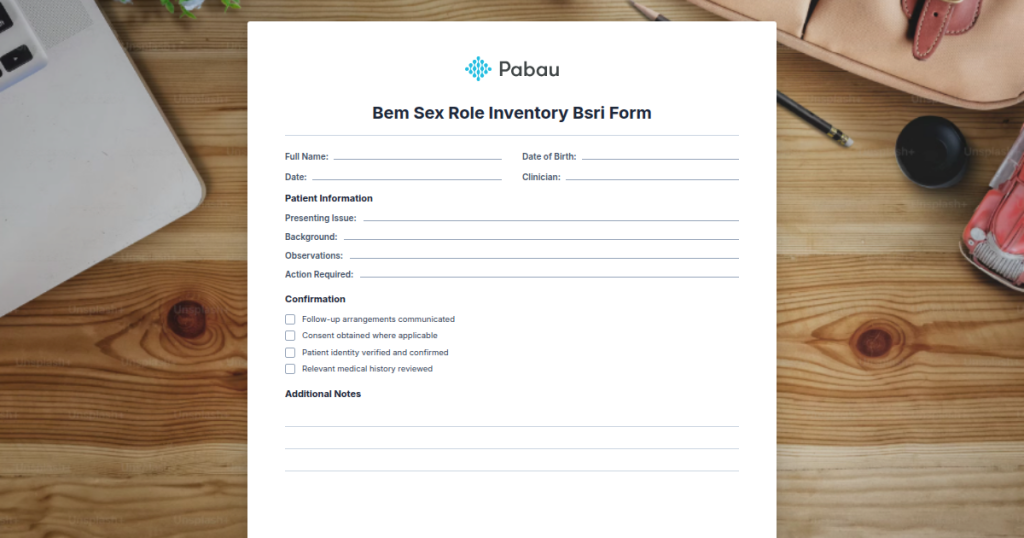
A ready-to-use psychological assessment tool covering the 60-item long form with instructions, response scale, scoring sheet, and interpretation guidelines for measuring masculinity, femininity, and androgyny in clinical and research settings.
Download templateThe Bem Sex-Role Inventory is a self-report questionnaire that measures how individuals perceive themselves in relation to traditionally masculine and feminine personality traits. Rather than classifying people into binary gender categories, the BSRI assesses psychological androgyny: the degree to which someone exhibits both masculine (e.g. assertiveness, independence) and feminine (e.g. warmth, compassion) characteristics.
The tool uses a 7-point Likert scale from “Never or almost never true” to “Always or almost always true” for each item. The long form contains 60 items split into three subscales: 20 masculine traits, 20 feminine traits, and 20 neutral/filler items. Clinicians and researchers use BSRI results to understand gender role orientation, identify areas of psychological flexibility, and inform treatment planning in therapeutic contexts.
Legally, the BSRI is protected by copyright held by Mind Garden Inc., the official publisher. Practitioners may administer the form for clinical or educational use; commercial licensing applies for published research or large-scale screening programs. Psychology practices routinely integrate the BSRI into their intake and assessment workflows for comprehensive client profiling.
Administering and scoring the BSRI follows a straightforward five-step workflow. Whether using the physical PDF or digital form, each step builds toward a clear gender role profile that informs your clinical or research narrative.
Mental health practitioners use the BSRI to assess gender role flexibility and identify how masculine/feminine trait expression affects identity, relationships, and self-esteem. Particularly useful in gender-affirming therapy and working with clients exploring non-binary identity.
Clinical researchers studying gender, personality, leadership, relationships, and coping mechanisms routinely include the BSRI in their protocols. Its 50-year track record and peer-reviewed validation make it a standard comparison tool in psychology and social science studies.
Coaching and organizational development professionals leverage the BSRI to help clients understand their interpersonal style and leadership approach. Understanding where you sit on the androgyny spectrum informs communication strategies and team dynamics.
Educational settings use the BSRI to teach students about gender theory, stereotype measurement, and psychological assessment design. Psychology and gender studies programs frequently assign the tool as both a self-report and methodological learning exercise.

Automate BSRI scoring, securely store assessment results, and integrate gender role insights directly into your clinical workflow with Pabau's practice management platform.

Gender role rigidity often contributes to psychological distress, relationship conflict, and limited coping options. When a client presents with anxiety around expressing needs, struggling with assertiveness, or feeling pressure to conform to stereotypical roles, the BSRI provides concrete data to explore these patterns.
A masculine-typed client may excel at task completion but struggle with emotional expression or asking for support. A feminine-typed profile might predispose someone to prioritize others’ needs over boundaries. An androgynous profile suggests greater flexibility and psychological well-being. Using BSRI results, clinicians collaboratively develop interventions to expand the client’s range of available responses.
Documentation of BSRI results in clinical notes ensures continuity and supports outcome tracking. Safer clinical note practices recommend noting subscale scores, classification category, client reaction to results, and how gender role flexibility connects to presenting concerns. This groundwork strengthens treatment goals and helps measure progress over time.
The BSRI was developed in the 1970s using predominantly White, university-educated American samples. Cross-cultural validation studies in Brazil, the UK, Spain, and other nations have revealed important nuances. Gender role expectations vary significantly by culture, socioeconomic background, generation, and geography. A high masculinity score in one context may reflect socially adaptive assertiveness; in another, it may signal deviation from collective values.
Contemporary clinicians recognize that BSRI interpretation must account for sociocultural context. A client from a background emphasizing family interdependence may score lower on autonomy-related masculine traits not due to psychological limitation but cultural fit. Non-binary and gender-diverse clients may find binary masculinity/femininity language limiting. Use BSRI data as one input alongside qualitative exploration of the client’s lived experience and gender identity.
Scoring methods also vary. Research supports both Bem’s original t-test median split and continuous subscale analysis. Some clinicians report raw subscale scores; others use percentile ranks. Report your chosen method in documentation so future providers understand your interpretive approach. Psychiatric evaluation templates offer standardized formatting to ensure consistency across assessments.

Exploring psychological assessment best practices in therapy? Psychiatric Evaluation Template provides a comprehensive assessment framework for documenting client presentations, diagnostic impressions, and treatment planning in a structured format.
Want to deepen your understanding of gender-affirming assessment? Safer Clinical Notes covers trauma-informed and identity-conscious documentation practices that respect client autonomy and protect sensitive information.
Looking to integrate assessments into your workflow seamlessly? Sensory Profile 2 Scoring and Interpretation demonstrates how to organize multi-dimensional assessment data for clear clinical communication and outcome monitoring.
The Bem Sex Role Inventory Form remains an essential tool for clinicians and researchers seeking to understand psychological androgyny and gender role flexibility. Whether you use the downloadable 60-item version, the shorter 30-item form, or integrate BSRI administration into digital intake processes, the inventory’s simplicity and validity make it a cornerstone of comprehensive assessment. For psychology practices ready to streamline assessment workflows and secure clinical data, book a demo with Pabau to see how digital forms automate BSRI scoring and integrate results seamlessly into client records.
The long form contains 60 items (20 masculine, 20 feminine, 20 neutral). The short form has 30 items (10 masculine, 10 feminine, 10 neutral). Both produce comparable subscale scores and classifications. The short form is faster to administer and shows equal or superior psychometric properties in many studies, making it practical for high-volume clinical settings.
No. The BSRI measures trait expression and psychological androgyny, not gender identity or clinical diagnosis. It is a research and assessment tool, not a diagnostic instrument. Gender identity assessment requires comprehensive qualitative exploration, clinical interview, and collaboration with specialists in gender-affirming care.
Ideally, all 60 items should be completed. If one or two items are missing per subscale, substitute the midpoint value (4 on the 7-point scale). If more than two items are missing per subscale, consider the inventory incomplete and readminister. Always document any substitutions or deviations in your clinical notes.
Subscale means range from 1-7. Scores above the median indicate higher endorsement of that trait cluster; scores below indicate lower endorsement. High androgynous profiles (high masculinity + high femininity) typically correlate with better psychological adjustment, coping flexibility, and relationship satisfaction in Western samples. Interpretation always accounts for cultural context and individual client meaning-making.
The BSRI measures trait expression, not identity. Non-binary and transgender clients can complete it meaningfully; however, they may find the binary framing of “masculinity” and “femininity” limiting. Use clinical judgment, offer optional completion, and contextualize results within broader identity-affirming assessment. Consider supplementing with open-ended gender questions that honor non-binary identities.
Clinical and educational use is generally permitted under copyright fair use. Published research or commercial licensing (e.g. online administration at scale) requires permission from Mind Garden Inc., the official publisher. Check their website for licensing terms. When in doubt, contact Mind Garden directly for clarification specific to your use case.