Mental Health & Therapy Therapy & Counseling
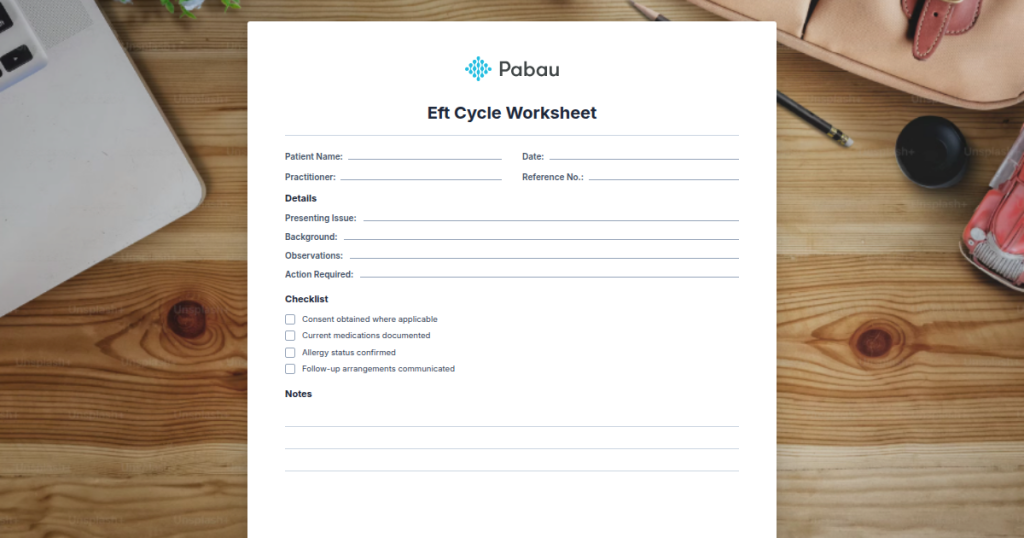
EFT Cycle Worksheet
Download Your Free EFT Cycle Worksheet EFT Cycle Worksheet A structured assessme...

April 14, 2026


Buy now, pay later is now available in Pabau

An EFT cycle worksheet maps the recurring negative interaction patterns couples experience during conflict
The worksheet identifies primary emotions (hurt, fear, loneliness) beneath secondary reactive emotions (anger, defensiveness)
Therapists use the tool to track attachment needs and help couples move from defensive cycles to secure connection
Pabau’s digital forms feature allows you to deliver worksheets electronically and track completion in real time
A structured assessment tool that helps therapists map the emotional cycles couples experience during conflict, identify primary and secondary emotions, and track attachment needs. This free downloadable resource supports the core principles of emotionally focused therapy in clinical practice.
Download templateAn EFT cycle worksheet is a clinical assessment tool that visualises the negative interactional patterns couples fall into during moments of conflict. Emotionally Focused Therapy, developed by Sue Johnson and Les Greenberg in the 1980s, operates on the principle that relationship distress stems from insecure attachment and reactive emotional cycles. This worksheet makes those cycles visible and tangible.
The tool identifies the sequence of events: one partner’s action triggers the other’s defensive response, which in turn escalates the first partner’s protective behaviour, creating a repeating loop. Most couples trapped in these cycles cannot see the pattern themselves. The worksheet breaks down this sequence into observable steps, revealing the attachment fears beneath surface-level anger or withdrawal.
The worksheet operates within EFT’s three-stage model: Stage 1 (De-escalation) uses cycle awareness to help couples step back from reactive patterns. The tool is particularly valuable in this phase because it externalises the problem, shifting focus from blame (“You always criticise me”) to pattern recognition (“We’re both stuck in a cycle where criticism triggers withdrawal, which triggers more criticism”).
Effective use of the eft cycle worksheet requires structured facilitation. The worksheet functions best when introduced after initial rapport-building but before deeper emotional work, typically in sessions 2-4 of an EFT treatment course.
Document the completed worksheet in your clinical notes using Pabau’s AI-assisted documentation to capture session summaries and therapy outcomes automatically. This reduces administrative burden and ensures consistent record-keeping.
The worksheet serves therapists and counselors working across multiple practice settings. Marriage and family therapists certified in EFT use it as a core intervention. Couples therapists without formal EFT training find it valuable for normalising relationship conflict and introducing the concept of reactive patterns.
Mental health counselors working with individuals often adapt the worksheet to explore relational patterns with one partner present. The tool is particularly useful when clients struggle to articulate emotional dynamics or when blame cycles prevent progress.
The worksheet delivers measurable benefits for both therapists and couples. It creates a shared language for describing relationship patterns, reducing defensiveness and blame. Couples often experience relief when they recognise their conflict as a predictable, solvable cycle rather than evidence of incompatibility.
From a clinical perspective, the tool accelerates the therapeutic process. Instead of spending weeks helping couples develop awareness of their patterns through conversation alone, the worksheet structures that awareness work into one or two focused sessions. This efficiency supports faster movement into Stage 2 (Restructuring), where emotional vulnerability and responsive connection become possible.
Documentation clarity improves as well. Treatment plans anchored to specific cycle components-trigger identification, emotional sequencing, attachment needs-demonstrate clinical reasoning to insurance reviewers and supervisors. The worksheet provides objective evidence of progress as couples report fewer cycle activations or shorter cycle duration across sessions.
Understanding the distinction between primary and secondary emotions is fundamental to using the worksheet effectively. Secondary emotions are reactive and visible. They include anger, frustration, criticism, sarcasm, contempt, or withdrawal. Couples typically focus on these emotions because they feel most intense and occur in response to perceived threat or injustice.
Primary emotions lie beneath the secondary response. They emerge from deeper attachment fears and vulnerabilities. When a partner criticises, the secondary emotion might be anger (“You’re so ungrateful for what I do”), but the primary emotion underneath is often fear of being unvalued or inadequate. When a partner withdraws, the secondary emotion is defensive shutdown, but the primary emotion is hurt or fear of rejection.
The worksheet’s power lies in this distinction. Therapists help couples recognise that fighting over the secondary emotion (the criticism or withdrawal) keeps the cycle spinning. Connecting to the primary emotion (the vulnerability and need) opens the door to empathy, understanding, and secure connection. Therapy practices using this framework report faster resolution of presenting complaints and stronger therapeutic alliances.

Pabau's digital intake forms and clinical note templates help you deliver worksheets like the EFT Cycle Worksheet electronically and track client progress in real time.

The EFT cycle worksheet is distinct from the EFT Infinity Loop diagram, also called the negative cycle diagram. The Infinity Loop is an educational visual showing couples how their reactive patterns create a closed loop with no exit. The cycle worksheet is the clinician’s assessment tool-more detailed and structured for therapeutic exploration during sessions.
The worksheet is a supervision-friendly tool. Trainees can bring completed worksheets to supervision, and experienced clinicians can assess the quality of cycle identification and emotional naming. Supervisors look for evidence that primary emotions were identified rather than overlooked, and that attachment needs were explicitly stated.
Introduce the worksheet after initial rapport-building and psychoeducation about attachment and cycles, typically in sessions 2-4. Couples need basic understanding of how EFT works before diving into cycle mapping. Premature introduction before safety is established may feel confrontational.
Yes. Therapists working with individuals can use a modified version to explore relational patterns with one partner present, exploring how the individual’s primary emotions and attachment needs influence their reactive behaviour.
This is common in early sessions. Use gentle, exploratory questions (“What did you feel under the anger?”) rather than pushing. If primary emotions remain elusive, pause the worksheet and address emotional awareness directly through other interventions before returning to cycle mapping.
Summarise the identified cycle, specific emotions, and attachment needs in your session note. Reference the worksheet as supporting assessment data. Include observable changes in cycle awareness or reduced cycle activation as measurable treatment progress indicators.
The worksheet is contraindicated in high-conflict situations involving domestic violence, active substance abuse, or untreated severe mental illness. In these cases, safety and stabilisation take priority. Consult clinical supervision and evidence-based guidelines for appropriate treatment sequencing.