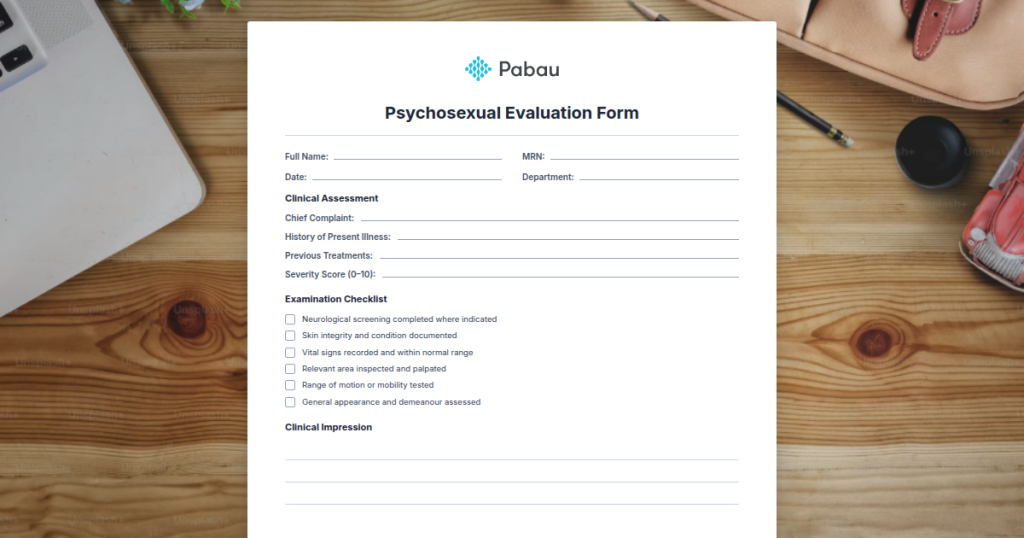
Psychosexual Evaluation Form
What is a Psychosexual Evaluation Form? A psychosexual evaluation form is a stan...

April 22, 2026


Buy now, pay later is now available in Pabau

The DBT STOP skill – Stop, Take a step back, Observe, Proceed mindfully – is a distress tolerance technique from Marsha Linehan’s Dialectical Behaviour Therapy framework.
Clinicians use the DBT STOP skill to interrupt impulsive reactions during emotional crises before clients act in ways they later regret.
NICE guideline CG78 recommends DBT as a treatment for borderline personality disorder, making the STOP skill a clinically validated intervention.
The STOP skill complements other DBT distress tolerance tools such as TIPP and ACCEPTS, and sits within the broader crisis survival module.
Accurate session documentation of the DBT STOP skill supports clinical audits, supervision, and continuity of care across multi-disciplinary teams.
Most emotional crises do not arrive slowly. A client receives a difficult message, a conflict escalates without warning, or an internal trigger fires before the conscious mind has time to respond. The gap between stimulus and reaction – measured in seconds – is where the DBT STOP skill is designed to operate. Developed as part of Marsha Linehan’s Dialectical Behaviour Therapy framework at the University of Washington, the DBT STOP skill gives clients a structured pause between feeling and acting.
This guide is written for mental health practitioners – therapists, psychologists, and clinical team leads – who teach and apply the DBT STOP skill with clients. It covers the clinical rationale, step-by-step application, how the skill relates to other distress tolerance techniques, and practical guidance for documenting its use within therapy sessions. For practitioners working within NHS mental health services or private psychology practices, understanding precisely how to introduce and reinforce the DBT STOP skill is as important as understanding the technique itself.
The DBT STOP skill is a four-step distress tolerance technique designed to help individuals pause and regulate their response during moments of acute emotional distress. It belongs to the crisis survival skills module within DBT’s distress tolerance component – one of four core skill modules that Linehan originally developed and codified in the DBT Skills Training Manual (Guilford Press). The other modules are mindfulness, emotion regulation, and interpersonal effectiveness.
The skill’s primary function is to interrupt the impulsive action urge that arises during emotional flooding. When a client’s nervous system is activated – whether through interpersonal conflict, perceived rejection, or internal triggers – the cognitive pathways associated with measured decision-making are typically compromised. The DBT STOP skill creates a structured interruption before that compromised state produces behaviour the client will later regret.
According to the National Institute for Health and Care Excellence (NICE) guideline CG78 on borderline personality disorder, DBT is the recommended psychological treatment for women with BPD who have a recent history of recurrent self-harm. The distress tolerance module – and the DBT STOP skill within it – is a direct clinical response to the impulsive crisis behaviours that characterise BPD presentations. That said, practitioners apply the skill across a wide range of presentations, including DBT adaptation for PTSD presentations, eating disorders, and generalised emotional dysregulation, where impulsivity and crisis reactivity are clinically relevant. Published research supports DBT evidence base for BPD and its adaptation to related conditions.
The skill is intentionally brief. It does not require extended practice time to teach, and clients can deploy it independently in daily situations. This accessibility makes it particularly valuable in community mental health settings, outpatient DBT programmes, and private psychology practices where between-session skill use is a core treatment goal.
Each letter in the DBT STOP skill acronym corresponds to a specific action. The sequence is cumulative – skipping or rushing through a step reduces the skill’s effectiveness. The following breakdown reflects the framing used in Linehan’s DBT Skills Training Handouts and Worksheets, the DBT Skills Training Handouts worksheets, the standard reference for certified DBT practitioners.
The client physically stops whatever they are doing. This is not a metaphor. If they are mid-sentence in an argument, they stop speaking. If they have picked up their phone to send an impulsive message, they put it down. The instruction is literal and immediate. Therapists often compare this to freezing in place – a full pause before any further action. For clients with high impulsivity, even this first step can require deliberate practice over multiple sessions before it becomes habitual.
Taking a step back refers to creating physical or psychological distance from the situation. This might mean leaving the room, taking a short walk, or simply sitting down if the client was standing. The purpose is to interrupt the environmental cue that is sustaining emotional activation. Breathing is often incorporated here – slow, diaphragmatic breaths that begin to reduce the physiological arousal associated with distress. Importantly, this step is not about avoidance. The client is not escaping the situation permanently; they are creating space to re-engage more effectively.
With some distance established, the client observes what is happening – internally and externally – without immediately judging or acting on those observations. What are they feeling in their body? What thoughts are present? What is the other person actually saying or doing? This step draws directly on DBT’s mindfulness module, specifically the concept of Wise Mind and non-judgemental stance. Practitioners who have introduced mindfulness skills earlier in treatment will find this step easier to coach, because clients already have a framework for observing experience without fusing with it. Evidence on Wise Mind observing experience research confirms that prior mindfulness training improves clients’ capacity to engage non-reactively during distress.
Proceeding mindfully means returning to the situation with intention rather than reaction. The client asks themselves: what response is consistent with my values and my goals in this situation? This is where the DBT STOP skill connects to the broader interpersonal effectiveness module – the capacity to engage in ways that preserve relationships and self-respect, rather than damage both. Some clients benefit from briefly consulting their list of personal values before this step, particularly early in treatment when Wise Mind is not yet well-established.

Pabau supports mental health practitioners with integrated session documentation, digital consent forms, and automated workflows – so you can focus on the clinical work rather than the admin.

The DBT STOP skill is specifically designed for moments of high emotional arousal – what DBT terminology calls a crisis state. However, practitioners need to be clear with clients about what qualifies as a crisis in this context. The skill is not reserved for acute psychiatric emergencies. It applies to any situation where a client’s emotional intensity is high enough that their usual problem-solving capacity is compromised.
Common clinical presentations where the DBT STOP skill is particularly relevant include interpersonal conflicts where the client feels rejected or invalidated, situations triggering shame responses, moments preceding impulsive self-harm urges, and scenarios involving substance use cravings. Clients who meet criteria for emotional dysregulation across multiple life domains tend to use the skill most frequently – often multiple times per day during periods of acute stress.
Timing the introduction of the DBT STOP skill within the treatment sequence matters. In standard comprehensive DBT, distress tolerance skills are typically introduced after mindfulness – not because distress tolerance is less important, but because mindfulness provides the observational platform the STOP skill depends on. A client who cannot yet observe their internal experience without immediately reacting to it will struggle with the “Observe” step. Introducing the skills in the correct sequence improves uptake and reduces client frustration.
In group DBT skills training contexts, the DBT STOP skill is often role-played using real scenarios clients have encountered during the week. This approach – drawing directly from the DBT group skills training model – allows the practitioner to coach the skill in vivo rather than in the abstract. The skill generalises more quickly when clients can connect it to actual recent experiences rather than hypothetical situations. Mental health teams using therapy practice management software with session note templates can embed STOP skill practice logs directly into their standard clinical documentation workflow.
When introducing the DBT STOP skill to a new client, ask them to identify one specific high-risk situation from the past month where they acted impulsively. Build the role-play around that exact scenario rather than a generic example. Clients retain the skill more durably when they can visualise applying it to a situation they recognise as genuinely threatening.
The DBT STOP skill sits within a broader toolkit of distress tolerance techniques, and practitioners frequently encounter questions about when to use which skill. Understanding how the STOP skill differs from adjacent techniques helps therapists provide clearer guidance and avoid presenting the skills as interchangeable.
The TIPP skill – Temperature, Intense exercise, Paced breathing, Paired muscle relaxation – addresses the physiological dimension of emotional crisis more directly than the STOP skill. Where the DBT STOP skill primarily targets the behavioural impulse (the action urge), TIPP targets the nervous system activation itself. A client experiencing intense physiological arousal. Research on TIPP skill paced breathing evidence supports its role in reducing acute physiological arousal prior to cognitive re-engagement. – racing heart, shallow breathing, physical agitation – may find TIPP more immediately effective as a first response, with the STOP skill applied once some physiological regulation has occurred. The two skills are complementary rather than competing. The Linehan Institute’s training organisation provides further guidance on TIPP skill physiological regulation within the full DBT framework.
The ACCEPTS skill (Activities, Contributing, Comparisons, Emotions, Pushing away, Thoughts, Sensations) is a distraction-based technique suited to longer-duration distress – the kind that persists over hours or days rather than minutes. The DBT STOP skill, by contrast, is suited to acute, moment-by-moment interruption of impulsive action. Therapists working with clients who experience prolonged emotional states may find they need to sequence both: STOP to interrupt the immediate action urge, then ACCEPTS to manage the extended distress that follows.
Compared to mindfulness-based approaches, the DBT STOP skill is more directive. Mindfulness invites the client to observe experience with curiosity and non-judgement; the STOP skill prescribes a specific behavioural sequence. For clients in acute crisis, the structured nature of the STOP skill can feel more manageable than open-ended mindfulness practice, which some individuals find difficult to access when distress is high. The mental health EMR documentation a practitioner completes after a session should reflect which skill was prioritised and why – this supports supervision and longitudinal review of skill effectiveness for individual clients.
The American Psychological Association (APA) recognises DBT as a well-established treatment with strong evidence for reducing self-harm and suicidal behaviour, particularly in BPD. Within that evidence base, distress tolerance skills – including the DBT STOP skill – play a specific role in the acute phase of crisis management. Practitioners should familiarise themselves with the research underpinning each module to communicate evidence clearly to clients, referrers, and commissioning bodies.

Need structured tools for mental health session documentation? Mental Health EMR covers how Pabau supports clinical notes, consent management, and session tracking for therapy practices.
Looking for a clinical guide to crisis intervention strategies? Crisis Intervention Strategies for Clinicians provides a practical framework for managing acute distress presentations in therapy settings.
Want to understand how therapy practice management software can reduce admin? Therapy Practice Management outlines the workflow tools available to therapists running private or group DBT programmes.
Supporting clients experiencing burnout alongside emotional dysregulation? Therapist Burnout Signs, Causes and Prevention explores the intersection of practitioner wellbeing and sustainable clinical practice.
Clinical documentation of the DBT STOP skill sits at the intersection of clinical accuracy and regulatory compliance. For practitioners registered with the Health and Care Professions Council (HCPC) or working in settings subject to Care Quality Commission (CQC) oversight, session notes must reflect not just what intervention was delivered. The CQC mental health records standards set out specific expectations for the accuracy and completeness of clinical records in regulated settings., but the clinical rationale, client response, and next steps.
A minimum viable note for a session where the DBT STOP skill was introduced or reviewed should include: the specific situation the client identified as a practice target, which steps they found most challenging, any barriers to implementing the skill between sessions, and agreed homework for the coming week. This level of specificity supports meaningful clinical supervision and ensures that if a client transfers to a different clinician, the receiving therapist understands exactly where the client is in their skill acquisition journey.
Group DBT programmes present additional documentation considerations. Where the DBT STOP skill is taught as part of a structured skills training group, practitioners should record attendance, the specific skill module covered, any in-session practice exercises, and any client disclosures relevant to risk management. Consent documentation for group participation – covering confidentiality expectations and the structure of the group – should be recorded before the programme begins and accessible within each client’s record. Digital consent and intake forms streamline this process considerably in multi-practitioner settings.
Practices delivering telehealth-based DBT sessions should ensure their documentation workflow captures the same clinical detail as face-to-face sessions. The method of delivery does not reduce the documentation standard – The HCPC record-keeping standards guidance applies equally regardless of whether sessions are conducted in person or via video platform. Building structured note templates for DBT skill sessions into practice management software reduces inconsistency across practitioners and supports audit readiness.
Reviewed against current NICE guidelines (CG78) and BABCP competencies for DBT practitioners for DBT documentation in clinical settings.
The DBT STOP skill is one of the most transferable tools in the distress tolerance module – compact enough to teach in a single session, durable enough to support clients through years of ongoing emotional challenges. Its value lies not in complexity but in reliability: a client who truly internalises the Stop, Take a step back, Observe, Proceed mindfully sequence has a portable intervention they can access in the moments that matter most.
For practitioners, the clinical task is not simply to deliver the skill but to sequence it correctly within treatment, adapt it to individual presentation, and document its use with sufficient specificity to support ongoing clinical review. Whether you are delivering individual DBT, running a group skills training programme, or integrating distress tolerance techniques into a broader psychology practice, the DBT STOP skill remains a foundational starting point for clients learning to navigate emotional crises without acting in ways that compound the original problem.
Mental health practices that invest in robust documentation systems, structured session templates, and integrated clinical workflows are better positioned to demonstrate the quality of DBT delivery – to clients, to referrers, and to regulatory bodies alike.
STOP stands for Stop, Take a step back, Observe, and Proceed mindfully. It is a four-step distress tolerance technique from Marsha Linehan’s Dialectical Behaviour Therapy framework, designed to interrupt impulsive reactions during moments of acute emotional distress. Each step builds on the previous, creating a structured pause between emotional trigger and behavioural response.
Most practitioners introduce the DBT STOP skill by first explaining the acronym, then role-playing a specific real-life scenario the client has encountered recently. Connecting each step to the client’s actual experience improves retention significantly compared to using generic examples. Homework between sessions – tracking situations where the skill was used or could have been used – reinforces learning.
The DBT STOP skill belongs to the distress tolerance module, specifically within the crisis survival skills cluster. Distress tolerance focuses on getting through a crisis without making things worse, whereas emotion regulation addresses changing emotional states over time. The STOP skill’s function – interrupting an impulsive action urge in the moment – places it firmly in the distress tolerance category.
Mindfulness in DBT invites clients to observe experience with curiosity and non-judgement, without necessarily prescribing a specific action sequence. The DBT STOP skill is more directive – it provides a structured four-step protocol for crisis moments. The Observe step within STOP draws on mindfulness principles, but the skill as a whole is more action-oriented and better suited to acute crisis states where open-ended mindfulness practice may be difficult to access.
The DBT STOP skill is most effective when used at the onset of high emotional arousal – before the client has acted on an impulse rather than after. Typical situations include escalating interpersonal conflicts, moments of intense shame or rejection, and experiences that trigger self-harm urges. Practitioners should help clients identify their personal high-risk situations in advance so the skill can be deployed proactively.
Emotional dysregulation often results in impulsive behaviours that worsen the original situation – a conflict that escalates, a relationship that is damaged, or a self-harm episode that follows intense distress. The DBT STOP skill addresses this by creating a structured pause that preserves the client’s ability to make deliberate, values-consistent choices even when emotional arousal is high. Over time, repeated use of the skill helps build the self-regulatory capacity that reduces crisis frequency.