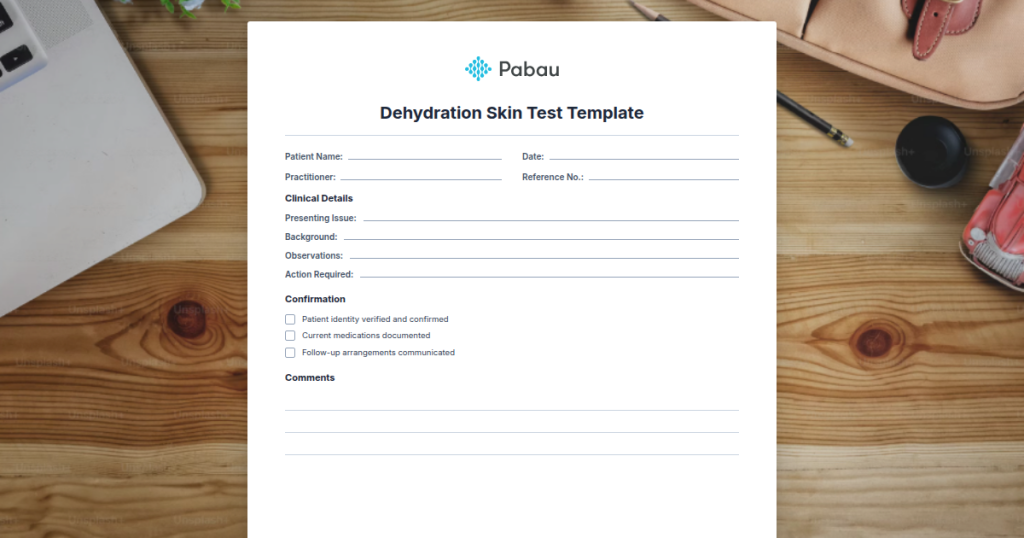
Dehydration Skin Test Template
Download Your Free Dehydration Skin Test Template Dehydration Skin Test Template...

April 22, 2026


Buy now, pay later is now available in Pabau

SOAP charting structures clinical notes into four sections: Subjective, Objective, Assessment, and Plan.
Dr. Lawrence Weed introduced the SOAP format in the 1960s as part of the Problem-Oriented Medical Record system.
CQC Regulation 17 and GMC Good Medical Practice guidance both require accurate, contemporaneous clinical records.
SOAP notes are used across physiotherapy, mental health, aesthetics, and general practice – each specialty adapts the format to its workflow.
AI-assisted documentation tools can help clinicians complete SOAP notes faster, though clinical judgment remains the practitioner’s responsibility.
SOAP charting is the most widely used clinical documentation format in private practice. It gives clinicians a consistent structure for recording patient encounters – from the patient’s own account of their symptoms through to the treatment plan – in a way that supports continuity of care, medico-legal protection, and regulatory compliance. For clinic owners and practice managers, understanding how SOAP charting works is inseparable from understanding how safe, efficient clinical documentation works. This guide covers the structure, purpose, regulatory context, specialty adaptations, and practical strategies for effective SOAP charting in private healthcare settings.
SOAP charting was developed by Dr. Lawrence Weed at the University of Vermont in the 1960s, as part of his Problem-Oriented Medical Record (POMR) system. His intention was straightforward: give clinicians a repeatable framework that anyone – a colleague covering a shift, a specialist reviewing referral notes, or a regulator conducting an audit – could read and immediately understand. That logic has held up for six decades across nearly every clinical discipline.
The format divides every clinical note into four sections. Subjective: what the patient reports. Objective: what the clinician observes and measures. Assessment: the clinical interpretation of those findings. Plan: the agreed course of action. Each section has a defined scope, which is precisely what makes SOAP charting so useful in busy clinic environments – there is no ambiguity about what belongs where.
In the UK private sector, the Care Quality Commission (CQC) expects registered providers to maintain accurate, contemporaneous clinical records under Regulation 17 of the Fundamental Standards. The General Medical Council’s Good Medical Practice guidance is equally explicit: doctors must keep clear, accurate, legible records of their clinical findings, decisions, and the information given to patients. SOAP charting, used consistently, supports compliance with both frameworks.
Each section of a SOAP note carries distinct clinical and medico-legal weight. Treating them as tick-box formalities rather than structured clinical reasoning is one of the most common documentation errors in private practice.
The Subjective section captures what the patient tells you – their chief complaint, symptom history, current medications, relevant medical history, and any concerns they raise. This is not the clinician’s interpretation; it is the patient’s voice in the record. Experienced practitioners use direct quotes sparingly but deliberately: “Patient reports pain as 7/10, worse on waking” is more defensible than “patient in significant pain.”
For intake-heavy practices, digital intake forms can pre-populate the Subjective section before the clinician sees the patient, reducing consultation time while improving data completeness.
Objective data is what the clinician directly observes, measures, or tests – vital signs, range of movement, skin condition, postural assessment, lab results, or standardised scoring tools. The key discipline here is specificity. “Reduced range of motion in left shoulder” is insufficient. “Left shoulder abduction limited to 70° (normal 180°), with pain on resisted external rotation” creates an auditable baseline for tracking treatment progress.
This section should also reference any standardised assessment tools used, particularly relevant for physiotherapy, mental health, and occupational therapy where validated scales carry evidential weight. The Nursing and Midwifery Council (NMC) and Health and Care Professions Council (HCPC) both emphasise the importance of evidence-based assessment frameworks in clinical records.
The Assessment section is where clinical reasoning is documented. For medical practitioners, this typically includes a working diagnosis or differential diagnosis. For allied health professionals, it may focus on functional limitations, treatment response, or risk stratification. Whatever the discipline, this section must reflect the clinician’s analytical process – not just a label, but the reasoning behind it.
Practices that document the Assessment thoroughly are considerably better positioned during complaint investigations or indemnity queries. A note that reads “improving, continue treatment” is far weaker than “patient reports 40% reduction in reported pain (baseline 7/10, now 4/10); response consistent with expected trajectory for presenting complaint; no red flags identified at this stage.”
The Plan section covers everything agreed for the patient’s ongoing care: treatment administered, prescriptions issued, referrals made, follow-up scheduling, and any self-management advice given. It should be specific enough that a different clinician – covering an absence, for example – can pick up the care without needing to contact the treating practitioner.
Clear Plan documentation also supports pre- and post-care communication workflows. When a clinic automates pre- and post-care instructions based on treatment records, the Plan section becomes the trigger for those workflows – but only if it is documented consistently and completely.

Pabau helps clinic teams build consistent SOAP charting workflows with customisable clinical note templates, digital intake forms, and AI-assisted documentation – so nothing gets missed between appointments.

The four-section structure is universal. How each section is populated varies considerably between disciplines – and understanding those variations is important for multi-specialty practices or clinics building standardised documentation templates.
Physiotherapy SOAP notes emphasise objective functional measurement. The Objective section typically includes range of motion data, muscle strength grades, neurological screening findings, and the results of specific orthopaedic tests (Lachman, SLR, Hawkins-Kennedy, and similar). The Plan section maps directly to a rehabilitation programme, with session-by-session goals and discharge criteria.
For clinics providing physiotherapy services, having a physical therapy EMR that structures note-taking around these discipline-specific requirements reduces the cognitive load on clinicians and improves note consistency across a team. The American Physical Therapy Association (APTA) supports structured documentation as a core component of evidence-based practice.
Mental health SOAP notes require particular care in the Subjective and Assessment sections. The Subjective section may include direct quotes, mood ratings, and the patient’s account of recent events or distress. The Assessment section must reflect clinical formulation – not just a diagnosis code, but a considered interpretation of presenting symptoms in context. Risk assessment (self-harm, harm to others, vulnerability) should appear explicitly when relevant.
Therapists and counsellors sometimes prefer alternative formats such as DAP notes (Data, Assessment, Plan) or BIRP notes (Behaviour, Intervention, Response, Plan). Both are structurally similar to SOAP charting but reorganise the sections to better fit talk therapy workflows. The choice between them usually reflects practice policy or supervisor preference rather than any clinical superiority of one format over another.
Practices supporting mental health services can explore documentation workflows through a mental health EMR designed around the specific confidentiality, risk documentation, and session note requirements of the discipline.
Aesthetic practitioners face a documentation challenge that general medical SOAP charting does not fully address out of the box: the highly visual nature of treatment assessment. The Objective section in aesthetic practice typically includes baseline photographs, skin condition scoring, anatomical measurements, and product and volume records. Some practices integrate injection plotting diagrams directly into the clinical note – a capability that materially supports the ability to reproduce or review a previous treatment.
The Plan section in aesthetic SOAP notes should document consent confirmation, the specific product and dosage administered, and any complications or patient concerns raised during the procedure. Given the regulatory scrutiny now applied to non-surgical cosmetic procedures in the UK – including CQC oversight and the requirements introduced by the Health and Care (Staffing) Act – thorough SOAP charting is a risk management tool as much as a clinical one. Clinics can explore skin clinic software with built-in consent and photo documentation workflows to support these requirements.
Audit your SOAP note templates quarterly. Check whether the Objective section prompts for the specific measurements your team needs for each treatment type – a physiotherapy note requires different objective fields than an aesthetic consultation. Generic templates save time initially but often create documentation gaps that are expensive to fix retroactively.
Consistent SOAP charting is harder to maintain in practice than in principle. Most documentation failures in private clinics are not the result of negligence – they result from time pressure, generic templates, and the absence of a structured review process.
The most common SOAP charting error is recording observations in qualitative terms when quantitative data is available. “Patient appears uncomfortable” is not equivalent to “patient rates pain 6/10 on numeric rating scale, unable to complete full range of motion assessment.” When the Objective section lacks measurable data, the Assessment becomes harder to justify and the Plan harder to defend.
Mixing patient-reported symptoms into the Objective section – or recording clinical observations under Subjective – is a persistent habit, particularly among clinicians new to structured documentation. It matters because insurers, solicitors, and CQC inspectors read SOAP notes with the assumption that Subjective content reflects the patient’s account and Objective content reflects verifiable clinical findings. Conflated notes create doubt about which is which.
A Plan section that simply reads “review in two weeks” misses the clinical reasoning that justifies the interval, any treatment administered in the current session, advice given, and patient response to that advice. Complete SOAP charting in the Plan section is especially important for multi-session treatment courses, where the note serves as the handover document for the next appointment – whether with the same clinician or a colleague.
Practices with high appointment volumes can reduce incomplete documentation by building required fields into their client record templates – so clinicians are prompted to complete each SOAP section before saving the note rather than after the fact.
Clinical notes, including SOAP notes, are special category data under UK GDPR and the Data Protection Act 2018. The Information Commissioner’s Office (ICO) expects healthcare providers to implement appropriate technical and organisational measures to protect health records – including access controls, audit trails, and secure storage. Paper-based SOAP charting creates compliance risks that electronic records systems are designed to address.
Electronic SOAP notes maintained within a clinical management system provide several compliance advantages: timestamped entries that demonstrate contemporaneous documentation, role-based access controls that limit who can view sensitive records, and audit logs that record every access or amendment. For UK private practices subject to CQC inspection, these features directly support compliance with Regulation 17 governance requirements.
Data residency is also a consideration for UK-based clinics. Patient records – including SOAP notes – should be stored on servers located within the UK or EEA, or subject to appropriate transfer safeguards. Practices reviewing their GDPR compliance should confirm that their clinical documentation software meets these requirements explicitly, rather than assuming default compliance.
AI-assisted documentation tools are increasingly used to support SOAP note generation. These tools can help clinicians capture notes faster, particularly in high-volume settings. The important caveat is that AI supports documentation – it does not replace clinical reasoning. The clinician remains responsible for reviewing, editing, and signing off every note. Pabau’s Echo AI is one example of how AI-assisted documentation may support SOAP charting workflows, though clinicians should always verify AI-generated content against their own clinical assessment.

Need a detailed SOAP note guide for social work settings? SOAP Notes for Social Work provides a complete walkthrough of effective clinical note writing in social care contexts.
Looking for safer, more legally defensible clinical note practices? Safer Clinical Notes covers the documentation standards that protect both clinicians and patients.
Want to explore AI-assisted documentation for your clinic? Pabau Echo AI explains how AI-powered clinical documentation tools work in a practice management context.
Building a more efficient clinical records workflow? Why You Should Keep Client Records Up to Date outlines the operational and compliance case for consistent record-keeping in private practice.
SOAP charting has remained the dominant clinical documentation format for over 60 years because it works. The four-section structure – Subjective, Objective, Assessment, Plan – gives clinicians a framework that supports clinical reasoning, protects against medico-legal risk, and satisfies the record-keeping standards expected by the CQC, GMC, NMC, and HCPC.
The challenge for most private practices is not understanding the format – it is maintaining consistent, complete SOAP charting under real-world clinical pressures. That is where documentation systems, structured templates, and AI-assisted tools make a meaningful operational difference. Practices that treat SOAP charting as a workflow discipline rather than an administrative obligation tend to produce better records, handle complaints more effectively, and demonstrate stronger governance during regulatory inspections.
Reviewed against current GMC Good Medical Practice guidance, CQC Fundamental Standards (Regulation 17), and HCPC Standards of Conduct, Performance and Ethics for allied health professionals.
SOAP charting is a structured clinical documentation format that divides each patient encounter note into four sections: Subjective (what the patient reports), Objective (what the clinician observes and measures), Assessment (the clinical interpretation), and Plan (the agreed next steps). It is used across virtually every healthcare discipline to support continuity of care and regulatory compliance.
SOAP stands for Subjective, Objective, Assessment, and Plan. In nursing, the format is the same as in other disciplines, though the Objective section typically includes vital signs, nursing observations, and assessment tool scores rather than diagnostic findings. The NMC’s documentation standards support the use of structured formats like SOAP charting for clear, contemporaneous records.
DAP notes (Data, Assessment, Plan) combine Subjective and Objective information into a single Data section, making them slightly faster to complete. SOAP charting separates patient-reported and clinician-observed data, which provides a clearer distinction between the two sources of information. Many therapists prefer DAP notes for talk therapy settings, while SOAP charting remains the standard in medical and allied health documentation.
SOAP notes provide a consistent structure that supports clinical reasoning, continuity of care, and regulatory compliance. In the UK, the CQC expects healthcare providers to maintain accurate, contemporaneous records under Regulation 17. Well-written SOAP notes also protect clinicians during complaint investigations by providing a clear, contemporaneous account of every clinical decision made.
AI-assisted documentation tools can help clinicians capture and structure SOAP notes more efficiently, particularly in high-volume practices. These tools support note completion – they do not replace clinical judgment. The clinician remains responsible for reviewing and signing off every entry. Some practice management platforms now integrate AI documentation support directly into their clinical record workflows.
SOAP charting is not mandated by statute, but the record-keeping obligations it supports are. The CQC Fundamental Standards, GMC Good Medical Practice guidance, NMC Code, and HCPC Standards all require practitioners to maintain clear, accurate, contemporaneous clinical records. SOAP charting is one widely accepted framework for meeting those requirements, though other structured formats may be equally appropriate in specific disciplines.