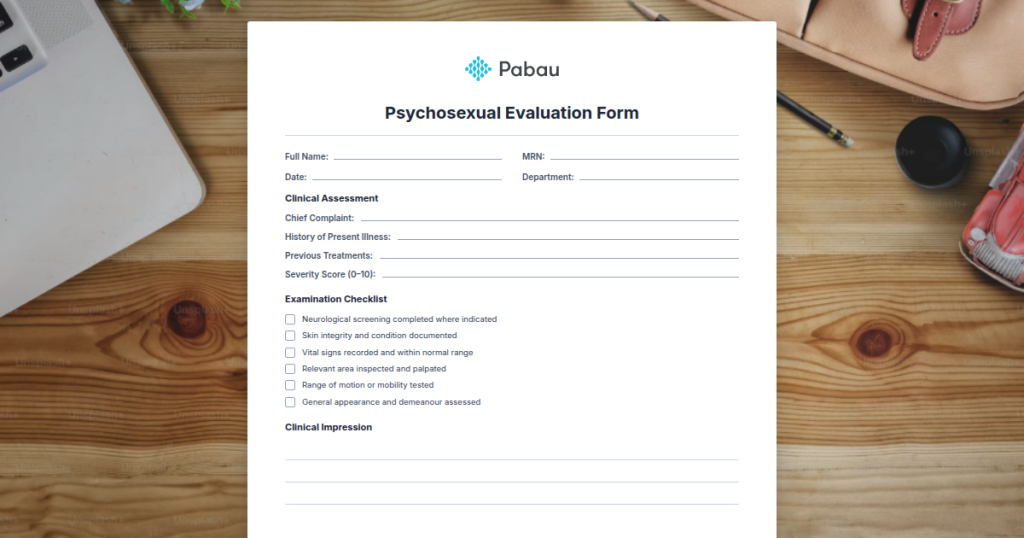
Psychosexual Evaluation Form
What is a Psychosexual Evaluation Form? A psychosexual evaluation form is a stan...

April 22, 2026


Buy now, pay later is now available in Pabau

The MoCA assessment is a 30-point cognitive screening tool, not a diagnostic instrument.
Scores of 26 or above are generally considered normal, with education-level adjustments applied.
MoCA detects mild cognitive impairment more sensitively than the MMSE in most populations.
Clinicians must complete certification via mocatest.org before using MoCA in clinical practice.
Longitudinal tracking of MoCA scores across visits is essential for monitoring cognitive decline.
The MoCA assessment – short for the Montreal Cognitive Assessment – is one of the most widely used cognitive screening instruments in clinical practice today. Developed by Dr Ziad Nasreddine in 1996, it assesses six cognitive domains in approximately 10-15 minutes, giving clinicians a structured, validated starting point for identifying patients who may need further neurological evaluation. For mental health and neurology-focused practices, understanding how to administer, score, and interpret the MoCA assessment is essential for delivering consistent, defensible patient care.
This guide covers everything practising clinicians and practice managers need to know: how the MoCA assessment works, how scores are interpreted across different patient populations, how it compares to the MMSE, and how healthcare practices can integrate MoCA tracking into their patient management workflows.
The MoCA assessment was designed specifically to address a gap that older screening tools could not fill: the reliable detection of mild cognitive impairment (MCI). MCI sits in a clinically significant space – beyond normal age-related memory changes, but not yet meeting criteria for dementia. Early identification changes the trajectory of care.
The tool comprises 30 points distributed across six cognitive domains: visuospatial and executive function, naming, memory, attention, language, and orientation. Each domain targets a distinct neurological pathway, which is why the MoCA assessment catches patterns of decline that more general questionnaires tend to miss. According to the National Institute on Aging, brief cognitive screening tools like the MoCA are now recommended for routine use in primary care and specialist settings.
The assessment takes approximately 10-15 minutes to administer, making it practical for busy outpatient settings. It can be used with patients presenting concerns related to memory loss, Alzheimer’s disease, Parkinson’s disease, vascular dementia, and other conditions affecting cognitive function. Clinicians should be clear with patients from the outset: the MoCA assessment screens for cognitive changes – it does not diagnose any specific condition. A below-threshold score indicates a need for further evaluation, not a confirmed diagnosis.
One aspect clinicians sometimes overlook: the MoCA is copyrighted. Free use requires completing training certification through mocatest.org. Commercial use of the tool – for example, in a private clinical setting operating for profit – requires a separate licence. This requirement was formalised in 2021 and catches some practices off guard.
Administration follows a structured, standardised sequence. The clinician works through each cognitive domain in order, recording scores on the official MoCA form. Certification from mocatest.org is required before using the assessment clinically – this ensures consistent administration and scoring across practitioners.
This section uses the Trail Making Test and the Clock Drawing Test – two subtests with strong sensitivity to frontal lobe and parietal function changes. The Trail Making component asks patients to connect numbered and lettered circles in an alternating sequence. The Clock Drawing Test requires the patient to draw a clock face showing a specific time. Both tasks reveal difficulties with planning, sequencing, and spatial organisation that patients may not consciously notice.
The memory component involves a short-term recall task administered at the start and scored at the end of the assessment – making the delay intentional and clinically meaningful. Naming requires the patient to identify three animal drawings, while attention tasks include Digit Span (forward and backward sequences) and a vigilance task requiring response to a specific auditory target. A serial subtraction task (counting down from 100 by sevens) rounds out this section. These tasks together probe working memory, sustained attention, and processing speed – areas that often decline early in neurodegenerative conditions.
Language tasks include sentence repetition and verbal fluency – specifically, generating as many words beginning with the letter “F” as possible within one minute. Abstraction requires the patient to explain how two items are conceptually similar. Orientation asks for the current date, month, year, day, place, and city. A full score on orientation is six points, and partial losses here often reflect the kind of disorientation that family members notice before clinicians do.
Practices using digital clinical forms can attach a standardised MoCA administration checklist to patient records, ensuring every clinician follows the same protocol and that no subtest is inadvertently skipped during a busy clinic day.
The MoCA assessment produces a total score out of 30. According to the original Nasreddine et al. 2005 validation study, a score of 26 or above is generally considered within the normal range. Scores between 18-25 may indicate mild cognitive impairment. Scores below 18 suggest moderate to severe impairment, though interpretation always requires clinical context.
There is one education-level correction clinicians must apply: if a patient has 12 or fewer years of formal education, one point is added to the total MoCA score. This adjustment accounts for the documented relationship between educational attainment and baseline cognitive performance on paper-based tasks. Without it, lower-education patients may be incorrectly flagged as impaired.
Age-adjusted normative data also exists. Published normative datasets – available through peer-reviewed sources including NCBI’s published MoCA validation studies – provide age- and education-stratified cutoffs that improve clinical accuracy, particularly in older adult populations. Clinicians working with patients over 75, or those from non-English-speaking backgrounds, should apply these adjustments rather than relying solely on the standard 26-point threshold.
A single score is rarely sufficient for clinical decision-making. Longitudinal tracking – comparing a patient’s MoCA score across visits over months or years – provides far more actionable data than a one-time reading. A patient with a score of 24 who declines to 19 over 18 months tells a clinically different story than a patient who has been stable at 23 for three years. Measurement tracking tools built into a practice management system make this kind of longitudinal monitoring operationally straightforward for clinics running high volumes of cognitive assessments.
Audit your MoCA documentation workflow before adding the tool to regular use. Each administration should capture the date, total score, education correction applied (yes or no), language version used, and the administering clinician’s name. Tracking these fields consistently from the first assessment means meaningful longitudinal data is available when patients return for follow-up – not reconstructed from incomplete notes.
Both the MoCA assessment and the Mini-Mental State Examination (MMSE) score out of 30 points, take a similar amount of time to administer, and aim to screen for cognitive impairment. The similarity ends there.
The critical difference is sensitivity to mild cognitive impairment. Research published in peer-reviewed neurology literature – including the original Nasreddine et al. validation study – demonstrates that the MoCA assessment identifies MCI in approximately 90% of cases, compared to roughly 18% for the MMSE at standard cutoffs. The MMSE was developed to detect moderate-to-severe dementia and performs well in that context. For earlier-stage decline, it frequently misses patients who the MoCA assessment would flag.
There are practical differences too. The MMSE does not include a Trail Making Test component or a verbal fluency task, both of which have good sensitivity to frontal and executive dysfunction – the kind of decline common in Parkinson’s disease-related cognitive impairment and vascular dementia. The MoCA assessment’s five-word delayed recall task is also more demanding than the MMSE’s equivalent, making it better at revealing subtle memory deficits.
NICE dementia guidelines (NG97) recommend using validated cognitive assessment tools in diagnostic pathways. The psychiatry and neurology clinics most likely to encounter borderline presentations are generally better served by the MoCA assessment for initial screening, reserving the MMSE for settings where the simpler, faster format is a practical necessity. For most clinical scenarios involving suspected MCI or early dementia, the MoCA assessment is the more defensible choice.

Pabau helps clinics document, track, and monitor MoCA assessment results within structured patient records – giving your team a clear longitudinal view of each patient's cognitive health over time.

The MoCA assessment was originally validated for use by trained neurologists and psychiatrists. Its clinical reach has expanded considerably since then. NHS memory clinics, GPs, geriatricians, neuropsychologists, and occupational therapists now routinely administer the tool – provided they hold current certification from mocatest.org.
In primary care, the MoCA assessment fits naturally into the annual wellness visit framework. In the United States, the Centers for Medicare and Medicaid Services (CMS) accepts validated cognitive assessment tools – including the MoCA – as components of Medicare Annual Wellness Visits, making it billable within that context. UK practices operating under GP clinic workflows similarly incorporate it into dementia case-finding pathways aligned with NICE guidance.
Specialist settings where the MoCA assessment is particularly useful include:
In each of these contexts, the MoCA assessment provides a structured, documented baseline that supports clinical decision-making, referral decisions, and – critically – longitudinal monitoring. A practice seeing patients across any of these specialties that is not yet using a validated cognitive screening tool is operating without a systematic approach to cognitive risk identification.
The biggest operational gap in most clinics that use the MoCA assessment is not the assessment itself – it is what happens to the score afterwards. A single result recorded in free-text notes is difficult to retrieve, impossible to trend, and entirely dependent on the next clinician finding and reading it before the patient’s follow-up appointment.
Structured patient records change this. When MoCA assessment results are recorded in a consistent, searchable format – capturing score, date, education correction, administering clinician, and any clinical notes – the data becomes usable. Clinicians can filter their patient list by last MoCA score, identify who is overdue for a repeat assessment, and pull up a score history at the point of care rather than reconstructing it from narrative notes.
For practices managing cognitive health pathways at scale, structured patient record tools and longitudinal measurement tracking make this operationally achievable without adding significant administrative burden. The American Academy of Neurology (AAN) recommends systematic cognitive monitoring for at-risk populations – a recommendation that presupposes the kind of consistent, retrievable documentation that structured software supports.
Remote administration deserves a note here. Standard MoCA administration requires physical paper materials and in-person interaction. For telehealth settings, validated alternatives exist: MoCA-Blind (suitable for telephone administration) and the MoCA Cognitive Assessment via Telephone (MoCA-T). Neither is a direct substitute for the standard tool – validation profiles differ – but they represent clinically appropriate options when in-person administration is not possible. Practices using integrated telehealth software should document which MoCA version was administered alongside the score.
Flag patients with a MoCA assessment score below 26 for a scheduled follow-up at 6 or 12 months rather than leaving recall to chance. Build the follow-up as a specific appointment type in your scheduling system so it appears in recall reports. Clinics that systematise this step catch meaningful cognitive decline far earlier than those relying on patient-initiated reattendance.
The MoCA assessment is a robust and well-validated screening tool. It is not, however, appropriate for every patient or every clinical context without modification.
Language and cultural factors are the most frequently underestimated limitation. The original English version was validated primarily in English-speaking, Western populations. Translated versions exist for dozens of languages, but validation quality varies – some adapted versions have strong local normative data, others do not. Using an unvalidated translation introduces scoring error that may lead to incorrect flagging or missed impairment. Clinicians working with non-English-speaking patient populations should confirm that the translation they use has been validated in the relevant population before interpreting results against the standard 26-point threshold.
Education effects extend beyond the one-point correction. The correction adjusts for patients with 12 or fewer years of education, but this is a blunt instrument. Patients with very low literacy, or those who completed education in systems structured differently from Western models, may score lower on language and abstraction tasks for reasons unrelated to cognitive impairment. In these cases, clinical judgement, collateral history, and functional assessment carry more weight than the raw score.
Practice effects – improved performance on a retest due to familiarity with the format – are documented with the MoCA assessment. For this reason, clinicians typically use different parallel versions when re-testing within short intervals. Mocatest.org provides alternate forms for this purpose. Using the same form repeatedly with a patient over a short period inflates scores and obscures genuine change.
Finally, the MoCA assessment screens for the presence of cognitive difficulty – it does not identify the cause. A score below 26 might reflect early Alzheimer’s disease, post-stroke cognitive impairment, a mood disorder affecting concentration, medication side effects, or sleep deprivation. The assessment result is the beginning of a clinical workup, not its conclusion. Comprehensive psychiatric evaluation and neurological referral remain essential next steps for patients with concerning scores.

Need a structured framework for cognitive and psychiatric assessment? Psychiatric Evaluation Template provides a step-by-step guide for comprehensive mental health assessments alongside cognitive screening.
Looking for clinical assessment scoring guides for your practice? Beery VMI Scoring and Interpretation Guide covers another validated neurodevelopmental assessment tool used across clinical settings.
Want to improve how your practice tracks patient measurements over time? Measurement Tracking Software supports longitudinal data capture for cognitive and clinical scores across patient visits.
Exploring digital forms for standardised clinical workflows? Digital Forms allows clinics to attach assessment checklists and structured documentation to patient records for consistent administration.
The MoCA assessment occupies a well-established position in clinical practice because it does something no purely subjective assessment can: it gives a structured, reproducible, 30-point picture of a patient’s cognitive function across six distinct domains in under 15 minutes. For clinics managing patients at risk of mild cognitive impairment, Alzheimer’s disease, Parkinson’s disease-related decline, or post-stroke cognitive change, it is one of the most practical tools available.
Getting the most from the MoCA assessment requires more than correct administration and scoring. It requires certification (via mocatest.org), careful application of normative adjustments, and – critically – a documentation and follow-up system that turns individual scores into longitudinal data. Practices that embed the MoCA assessment into structured patient records and systematic recall workflows generate clinical insight that episodic, paper-based use simply cannot match. Reviewed against current American Academy of Neurology and NICE cognitive assessment guidance.
The MoCA assessment screens for cognitive impairment across six domains: visuospatial and executive function, naming, memory, attention, language and abstraction, and orientation. It is designed to detect mild cognitive impairment – decline beyond normal ageing but not yet meeting dementia criteria. It is a screening tool, not a diagnostic instrument, and a below-threshold score indicates that further clinical evaluation is warranted.
A score of 26 or above out of 30 is generally considered within the normal range, based on the original Nasreddine et al. 2005 validation study. One point is added for patients with 12 or fewer years of education. Age-adjusted normative data exists for older populations and should be applied when clinically relevant, as standard cutoffs may not be appropriate for all patient groups.
Both tools score out of 30 points and take similar time to administer, but the MoCA assessment is substantially more sensitive to mild cognitive impairment – detecting MCI in approximately 90% of cases versus around 18% for the MMSE at standard thresholds. The MoCA includes Trail Making, verbal fluency, and abstraction tasks not present in the MMSE, giving it a broader assessment of executive and frontal function.
Any trained healthcare professional can administer the MoCA assessment, provided they hold current certification from mocatest.org. This includes GPs, neurologists, psychiatrists, psychologists, geriatricians, and occupational therapists. Certification has been mandatory for clinical use since 2021. Commercial use of the tool in a private practice setting also requires a separate licence from the copyright holder.
Repeat interval depends on the clinical context. Patients with a below-threshold score are commonly reassessed at 6 or 12 months to monitor for meaningful change. Parallel forms of the MoCA should be used for retesting within shorter intervals to avoid practice effects – score inflation caused by familiarity with the format. Stable, borderline patients may be monitored annually; those with rapidly progressing symptoms may need more frequent reassessment.
Free access to the MoCA assessment requires completing training and certification through mocatest.org. Clinical use without certification is not permitted under the tool’s copyright terms. Commercial use – for example, in a private clinic operating for profit – requires a separate paid licence. This licensing requirement was formalised in 2021 and applies internationally.