Occupational Therapy Primary & Preventive Care
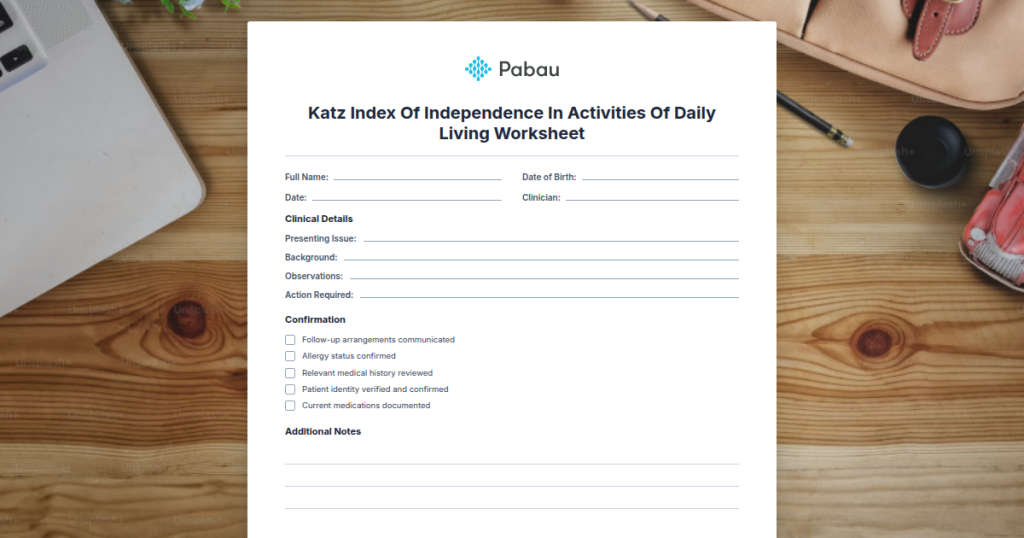
Katz Index of Independence in Activities of Daily Living Worksheet
Download Your Free Katz Index of Independence in Activities of Daily Living Work...

April 9, 2026


Buy now, pay later is now available in Pabau

A temperament test template assesses personality traits and emotional patterns using the four classical temperament types (Sanguine, Choleric, Melancholic, Phlegmatic).
The four temperaments model is rooted in ancient medicine and remains a clinically useful framework for understanding client behaviour and therapeutic planning.
Proper administration and scoring of a temperament test template reduces diagnostic misinterpretation and supports informed treatment planning decisions.
Pabau’s digital forms feature enables secure, HIPAA-compliant administration of temperament assessments within integrated patient records.
Most therapists and counsellors struggle to efficiently assess client personality traits during intake. A temperament test template streamlines this process by providing a structured, evidence-grounded tool that captures behavioural patterns in minutes rather than hours of clinical observation. This article guides you through selecting, administering, and scoring a temperament test template for your practice, plus how to integrate results into treatment planning.
A comprehensive assessment tool evaluating natural behavioural tendencies, emotional responses, and personality characteristics. Includes scoring instructions and clinical interpretation guidance for therapists, counsellors, and mental health professionals.
Download templateA temperament test template is a structured assessment tool that measures an individual’s innate personality traits and emotional response patterns. The instrument classifies responses into four classical temperament types: Sanguine (optimistic, social), Choleric (assertive, goal-driven), Melancholic (reflective, conscientious), and Phlegmatic (calm, adaptable). Unlike formal diagnostic instruments, a temperament test template serves as a therapeutic aid to identify behavioural patterns and inform client self-awareness.
The four temperaments model originates from ancient Greek medicine, documented by Hippocrates and Galen. Modern psychology recognizes it as a useful supplementary assessment framework, particularly when integrated with digital forms for secure clinical administration. This model is not a DSM diagnostic tool. Rather, it helps therapists understand clients’ natural strengths, potential stressors, and communication preferences-critical information for treatment planning and therapeutic rapport.
Administering a temperament test template follows a five-step clinical workflow:
Always include a clinical disclaimer in client-facing materials clarifying that temperament assessment is a reflective tool, not a diagnostic instrument. Pair results with other intake data (presenting problems, medical history, psychosocial factors) to build a comprehensive clinical picture.

Pabau's digital forms feature allows you to administer temperament tests and other assessments securely within your EHR, auto-populating results into client records and treatment plans.

A temperament test template is valuable across multiple clinical disciplines. Mental health therapists and counsellors use it during initial intake to understand clients’ coping styles and emotional regulation tendencies. Psychiatrists incorporate temperament findings to contextualize medication response and treatment preferences. Coaching professionals leverage temperament insights for personal development work. Occupational therapists reference temperament patterns when designing adaptive strategies for ADHD or neurodivergent clients. Even primary care providers use simplified temperament screening to anticipate patient communication needs and appointment adherence.
The template is particularly useful for practices serving adolescents and young adults, where understanding innate personality helps differentiate temperament traits from symptoms of anxiety, depression, or behavioural disorders. It also supports family therapy by revealing how different family members’ temperaments may clash or complement, informing systemic interventions.
Faster client understanding: Rather than relying on weeks of observation, a structured temperament test gives you immediate insight into how clients naturally respond to stress, process emotions, and interact with others.
Improved treatment adherence: Clients who understand their temperament are more likely to engage with treatment plans tailored to their natural strengths. A Phlegmatic client, for instance, benefits from gentle pacing; a Choleric client responds better to clearly defined goals.
Enhanced clinical documentation: Temperament data enriches clinical notes and supports outcome tracking. When paired with therapy practice management systems, temperament results become part of an integrated client profile accessible across your team.
Reduced diagnostic error: Temperament traits can mimic or mask psychiatric symptoms. Identifying a client’s baseline personality style helps clinicians avoid over-pathologizing normal variance or missing genuine disorder.
Team communication: Sharing temperament insights with colleagues, supervisors, or family members (with consent) accelerates coordination of care and reduces conflict rooted in personality mismatch.
Administer temperament assessments during the first or second session to establish baseline understanding before presenting problems obscure personality patterns. Revisit temperament findings at treatment milestones to track how clients’ self-awareness and coping strategies evolve.
Effective use of temperament data requires deliberate clinical integration. After scoring, conduct a collaborative interpretation session with your client. Ask open-ended questions: “Which temperament traits feel accurate to you? Which surprise you?” This validates their self-perception and builds therapeutic alliance.
Next, explicitly link temperament findings to their presenting concern. If a Melancholic client presents with depression, explore whether rumination and perfectionism (Melancholic strengths taken to extremes) are maintaining their mood symptoms. If a Sanguine client struggles with relationship conflict, examine whether their tendency toward spontaneity and conflict avoidance is preventing resolution of deeper relational issues. This bridges assessment into intervention.
Document your interpretation in clinical notes following safer clinical notes practices. Use language like “Client’s temperament profile suggests a primary Sanguine style with secondary Choleric traits, characterized by social orientation and task-focus. This may inform their preference for group therapy and goal-oriented interventions.” This grounding helps justify treatment choices to insurers and supervisors and ensures continuity if another clinician assumes care.
Most temperament test templates use a straightforward scoring method. Clients respond to 40-60 items on a Likert scale (typically 1-5 or agree/disagree), with items grouped by temperament category. Raw scores are summed by temperament, then plotted on a visual profile showing the client’s score across all four types.
Interpretation focuses on the client’s dominant temperament and secondary blend. Someone with high Sanguine and moderate Phlegmatic scores exhibits outgoing, steady-paced traits. A person with high Choleric and moderate Melancholic scores is decisive but detail-oriented. Most people are blends, not pure types, so avoid labeling clients rigidly.
Be cautious about over-interpreting scores. Clients under stress may respond defensively or inconsistently. Cultural background, language barriers, and reading level affect responses. Always contextualize scores within the client’s lived experience and other clinical data.

Need structured client assessment tools? Psychiatric Evaluation Template provides a comprehensive framework for documenting mental status and treatment planning.
Looking for intake workflow guidance? Group Therapy Informed Consent outlines clinical and ethical considerations for group-based temperament work.
Want to track outcomes over time? Pabau’s measurements tracking feature lets you re-administer temperament assessments at treatment milestones to measure client insight and coping growth.
A temperament test template is an efficient, clinically sound tool for understanding client personality and informing treatment decisions. By assessing the four classical temperament types during intake, you gain immediate insight into clients’ natural strengths, stress responses, and communication preferences. Paired with secure digital administration through Pabau’s integrated forms and documentation features, a temperament test becomes part of a comprehensive clinical workflow that improves outcomes and reduces diagnostic error. Book a demo today to see how Pabau helps you administer and track temperament assessments within your practice management system.
The four classical temperaments are Sanguine (optimistic, social, spontaneous), Choleric (assertive, goal-driven, ambitious), Melancholic (thoughtful, conscientious, analytical), and Phlegmatic (calm, cooperative, steady). Most people exhibit a blend of two or three temperament types rather than a single pure type.
Temperament and personality overlap but differ. Temperament refers to inborn, stable behavioural and emotional patterns. Personality includes temperament plus learned behaviours, values, and environmental influences. A temperament test focuses on innate traits; broader personality tests (like the Big Five or MBTI) assess a wider range of characteristics.
Yes, when used appropriately. Administer temperament tests during intake or early sessions for assessment and treatment planning. Use results collaboratively with clients to enhance self-awareness and tailor interventions. Do not use temperament labels as limiting diagnoses or to excuse harmful behaviour. Always pair results with other clinical data.
Most temperament test templates take 15-20 minutes to complete. Clients with reading difficulties, cognitive impairment, or language barriers may require additional time or verbal administration. Digital versions with progress tracking can be paused and resumed across sessions if needed.
Temperament is inborn and relatively stable across the lifespan-your natural emotional and behavioural baseline. Personality develops through temperament plus learning, experiences, and environmental factors. Understanding this distinction prevents clinicians from misattributing learned maladaptive patterns to immutable traits.