ADHD Assessment Mental Health & Therapy
Neurodivergent Test Template
A neurodivergent test template is a clinician-facing screening form that healthc...

April 3, 2026


Buy now, pay later is now available in Pabau

SDQ is a validated screening tool for ages 2-17 across clinical and educational settings
The 25-item questionnaire assesses five key dimensions of child behaviour and wellbeing
Available in parent, teacher, and self-report versions for comprehensive assessment
Free to use for clinical, educational, and research purposes with standardised scoring
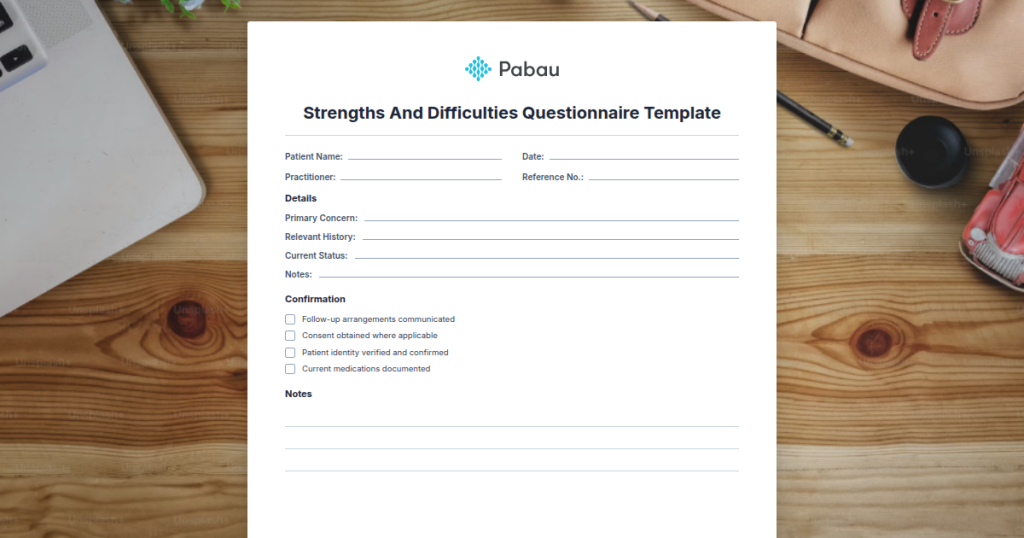
The Strengths and Difficulties Questionnaire template is a brief, evidence-based screening tool that helps clinicians identify emotional and behavioural concerns in children and young people aged 2-17. Widely used across mental health services, schools, and paediatric clinics, the SDQ template captures key dimensions of child development in just 5-10 minutes of completion time. This guide explains what the Strengths and Difficulties Questionnaire template is, how to use it in your practice, and why it has become an essential part of childhood mental health assessment.
A standardised 25-item behavioural screening questionnaire covering emotional symptoms, conduct problems, hyperactivity, peer relationships, and prosocial behaviour, with versions for parents, teachers, and young people themselves.
Download templateThe Strengths and Difficulties Questionnaire (SDQ) is a validated behavioural screening instrument designed to identify emotional and behavioural difficulties in children and adolescents. Developed by researchers at the University of London, the Strengths and Difficulties Questionnaire template measures five key dimensions: emotional symptoms, conduct problems, hyperactivity-inattention, peer relationship problems, and prosocial behaviour. The tool generates both a total difficulties score and an impact supplement that assesses functional impairment across home, school, and peer contexts.
Youth in Mind, the official SDQ copyright holder, permits free use of the questionnaire for clinical, educational, and research purposes. The Strengths and Difficulties Questionnaire template is available in multiple versions: parent-report (ages 2-17), teacher-report (ages 3-16), and self-report (ages 11-17). This multi-informant design enables clinicians to gather perspectives from different caregivers and environments, improving the accuracy of behavioural assessment. Comprehensive patient record systems support storing and tracking SDQ assessments alongside other clinical data for longitudinal comparison.
The National Institute for Health and Care Excellence (NICE) recognises the SDQ as a useful screening tool for identifying children at risk of developing mental health difficulties. In the UK, Child and Adolescent Mental Health Services (CAMHS) commonly use the Strengths and Difficulties Questionnaire template as part of initial assessment protocols, while in the US, the tool appears in SAMHSA guidance for pediatric mental health screening.
Administering the Strengths and Difficulties Questionnaire template involves five straightforward steps that ensure consistent, clinically valid assessment across your practice.
Store completed Strengths and Difficulties Questionnaire templates securely within your patient management system. Digital forms workflows help standardise administration and automatically calculate subscale scores, reducing manual calculation errors and improving efficiency.

Digital intake forms and automated clinical documentation help clinics administer assessment tools like the SDQ faster while maintaining clinical accuracy.

The Strengths and Difficulties Questionnaire template is relevant across multiple healthcare and educational settings. Child and adolescent mental health clinicians use the SDQ template during initial assessment to establish baseline emotional and behavioural functioning before diagnosis or treatment planning. School psychologists and educational psychologists use it to identify children needing additional support or intervention within school settings. Paediatric primary care practitioners administer the Strengths and Difficulties Questionnaire template during routine developmental screening to flag early mental health concerns. Occupational therapists and speech-language pathologists incorporate the SDQ template into comprehensive assessments of children with neurodevelopmental differences.
The template also supports ADHD assessment pathways. Clinical teams evaluating suspected ADHD use the Strengths and Difficulties Questionnaire template’s hyperactivity subscale alongside specialist ADHD rating scales to gather multi-informant data. Child protection and social work teams use the Strengths and Difficulties Questionnaire template to assess emotional wellbeing in at-risk children and monitor protective factors during intervention. Any practice working with children aged 2-17 can benefit from having a standardised, validated screening tool readily available during clinical consultations.
Standardised assessment framework. The Strengths and Difficulties Questionnaire template provides a consistent, validated measurement tool that reduces subjective clinical judgment. Clinicians across your practice administer the same items using the same scoring criteria, supporting reliable comparison of children’s responses over time and between practitioners. Published normative data enables interpretation in the context of age and gender-matched peers.
Quick administration and scoring. The 25-item format completes in 5-10 minutes, respecting the time constraints of busy clinics and schools. Fast scoring enables clinicians to discuss results with patients and parents during the same visit, supporting collaborative discussion of findings and next steps. This efficiency reduces administrative burden while maintaining clinical rigour.
Multi-informant perspective. By collecting parent, teacher, and self-report data, the Strengths and Difficulties Questionnaire template captures how the child functions across different environments. Discrepancies between informants (e.g., high symptoms at home but not in school) point to context-specific factors and help clinicians tailor interventions appropriately.
Regulatory alignment. NICE guidance, CAMHS protocols, and SAMHSA recommendations reference the SDQ as an evidence-supported screening tool. Using the Strengths and Difficulties Questionnaire template supports compliance with best-practice guidelines and strengthens documentation during clinical audits or regulator inspections. The tool’s international validation status protects against accusations of non-validated assessment methods.
Cost-effectiveness. The Strengths and Difficulties Questionnaire template is free for clinical and research use, eliminating licensing fees associated with proprietary assessment tools. This cost advantage makes universal screening accessible to all clinics, regardless of budget constraints. Free use encourages uptake across education and primary care settings, benefiting the broader child mental health pathway.
Track SDQ scores longitudinally in your patient management system. Repeat administration every 3-6 months during treatment enables clinicians to quantify response to intervention objectively. Trends in subscale scores (e.g., declining hyperactivity following ADHD medication) validate treatment effectiveness and inform shared decision-making with families about continuing, adjusting, or stopping interventions.
Each Strengths and Difficulties Questionnaire subscale measures a distinct dimension of child development and psychopathology. Emotional Symptoms (5 items) assess anxiety, depression, and mood regulation-core features of internalising disorders. Conduct Problems (5 items) measure oppositional and antisocial behaviour, including arguing, lying, and rule-breaking. Hyperactivity (5 items) screen for inattention, impulsivity, and restlessness characteristic of ADHD. Peer Relationship Problems (5 items) assess bullying, loneliness, and social competence.
Prosocial Behaviour (5 items) reflects the child’s strengths-helpfulness, sharing, and empathy. Unlike the other subscales, higher prosocial scores are protective. A child may have elevated difficulties on three subscales but strong prosocial behaviour, indicating resources and protective factors that clinicians should leverage during treatment planning. The Strengths and Difficulties Questionnaire template’s inclusion of both difficulties and strengths supports a balanced, respectful, child-centred approach to assessment.
The Strengths and Difficulties Questionnaire has been validated in over 100 countries and translated into more than 80 languages, making it applicable across diverse cultural contexts. However, clinicians must interpret scores with cultural sensitivity. Parental expectations about children’s behaviour, emotional expressiveness, and peer relationships vary across cultures. A behaviour rated as “difficult” in one cultural context may be normative in another.
Threshold scores for the “normal,” “borderline,” and “abnormal” ranges are published separately for boys and girls, acknowledging sex-based differences in symptom presentation. Girls often internalise difficulties (higher emotional symptoms), while boys externalise (higher conduct and hyperactivity scores). Use gender-specific norms when interpreting the Strengths and Difficulties Questionnaire template to avoid misclassifying typical sex-based variation as pathology. Clinicians following evidence-based psychology assessment protocols rely on the Youth in Mind official SDQ website for international normative data by age, gender, and country.

Want to standardise mental health screening across your entire clinic? Mental Health EMR Software helps integrate validated screening tools like the SDQ into intake workflows, automatically scoring results and flagging clinical risks.
Looking to document SDQ results and treatment response in one system? Echo AI automated clinical documentation captures SDQ findings and generates structured clinical notes, reducing manual paperwork while improving record consistency.
Need to track child and adolescent outcomes across multiple appointments? Psychiatric Evaluation Template complements the SDQ by providing a framework for comprehensive mental health assessment and ongoing outcome measurement.
The Strengths and Difficulties Questionnaire template is a validated, cost-effective screening tool that deepens understanding of children’s emotional and behavioural functioning. By using the SDQ template systematically-gathering multi-informant data, scoring consistently, and tracking changes over time-clinicians strengthen assessment accuracy and support evidence-based treatment planning. The template’s inclusion of both difficulties and prosocial strengths ensures a balanced perspective that supports child-centred, collaborative clinical practice.
Download the free Strengths and Difficulties Questionnaire template above and begin integrating it into your assessment routine. Whether you’re screening for mental health concerns, monitoring treatment response, or conducting research, the SDQ template provides a reliable foundation for understanding child development and identifying who needs support most urgently.
The SDQ is validated for ages 2-17 years. Parent-report versions assess children ages 2-17, teacher-report ages 3-16, and self-report versions ages 11-17. Using age-appropriate norms ensures accurate interpretation of scores.
Yes, Youth in Mind permits free use of the Strengths and Difficulties Questionnaire template for clinical, educational, and research purposes, without licensing fees or copyright restrictions for non-commercial use.
The standard Strengths and Difficulties Questionnaire template takes approximately 5-10 minutes to complete. The optional Impact Supplement adds a few minutes and assesses functional impairment across life domains.
The SDQ template is a screening tool, not a diagnostic instrument. Elevated scores indicate the need for further assessment using specialist tools (e.g., ADHD rating scales, anxiety measures) and clinical interview, but the SDQ alone cannot diagnose conditions like ADHD, anxiety, or conduct disorder.
Each subscale (Emotional, Conduct, Hyperactivity, Peer, Prosocial) is scored 0-10. Published norms categorise raw scores as “normal,” “borderline,” or “abnormal” based on age and gender. Use the official SDQ website’s scoring guidance and normative tables to interpret results in clinical context.