

ADHD Assessment Mental Health & Therapy
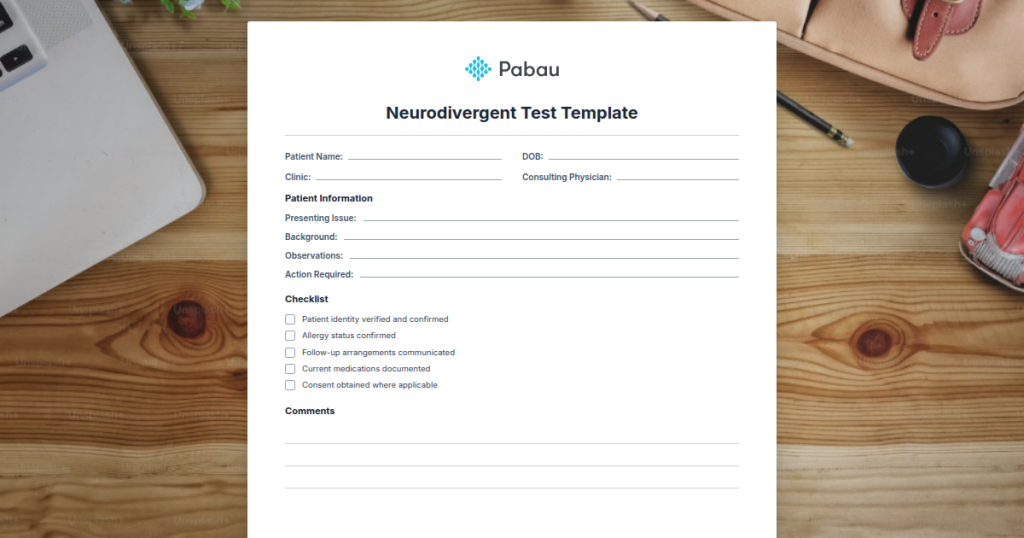
Neurodivergent Test Template
A neurodivergent test template is a clinician-facing screening form that healthc...

April 3, 2026


Buy now, pay later is now available in Pabau

The RAADS-R consists of 80 items across four clinical subscales measuring autism traits
Cutoff score of 65 or above indicates likelihood of autism spectrum disorder
Takes 15-30 minutes to complete; suitable for adult ages 18 and over
RAADS-R results require interpretation by a qualified clinician, not a standalone diagnosis
Digital assessment administration improves clinic workflow efficiency and data accuracy
The RAADS-R test is a validated screening tool clinicians use to evaluate autism spectrum traits in adults. Unlike brief questionnaires, the RAADS-R test provides comprehensive assessment across sensory, social, and interest-based domains, offering structured data for diagnostic evaluation and treatment planning. This guide explains how to administer, score, and interpret the RAADS-R test in your clinical practice, plus how practice management systems can streamline the assessment workflow.
A comprehensive 80-item assessment form for evaluating autism spectrum traits across four clinical subscales. Includes scoring guidance, interpretation thresholds, and clinical documentation sections for structured patient evaluation.
Download templateThe RAADS-R test (Ritvo Autism Asperger Diagnostic Scale-Revised) is a 80-item self-report questionnaire designed to identify autism spectrum traits in adults aged 18 and over. Published by Ritvo et al. 2011 validation study, the assessment evaluates autism characteristics across four distinct subscales: sensory motor responses, circumscribed interests, language characteristics, and social relatedness. The RAADS-R test is grounded in peer-reviewed research and reflects current autism diagnostic criteria in the DSM-5 autism diagnostic criteria and ICD-11.
Clinically, the RAADS-R test serves as a structured screening tool that standardises the evaluation process. It captures specific behavioural and sensory patterns often missed in unstructured interviews, particularly for adults whose autism presentation differs from stereotyped perceptions. The tool supports clinical decision-making but is not diagnostic by itself – results require interpretation by a qualified mental health professional, psychologist, psychiatrist, or physician.
From a regulatory perspective, the RAADS-R test aligns with NICE Guideline NG142 (Autism in Adults-Diagnosis and Management), which recommends validated screening tools as part of a comprehensive diagnostic pathway. Patient assessment data collected via the RAADS-R test is subject to UK GDPR and NHS information governance requirements, making secure digital storage and access control essential for compliance.
Administering the RAADS-R test in clinical practice follows a structured five-step workflow that ensures consistency and captures complete assessment data. Each step builds on the previous to create a comprehensive evaluation record that supports diagnostic decision-making and treatment planning.
Many clinics use digital intake forms to distribute assessment questionnaires to patients before appointments, reducing in-clinic time and ensuring legible responses. AI-powered clinical documentation can summarise assessment results and flag key findings for the clinician’s review, supporting faster interpretation workflows.

Send assessments to patients before appointments and receive structured data ready for clinical review. Automate scoring workflows and securely store results in patient records.

The RAADS-R test is designed for clinicians and healthcare practitioners assessing autism spectrum traits in adult populations. It serves several key practice types and clinical scenarios.
Psychiatry and psychology practices frequently use the RAADS-R test as part of comprehensive diagnostic evaluation for adult patients presenting with social difficulties, communication challenges, or sensory sensitivities. The structured format standardises assessment across multiple patients, improving diagnostic consistency and supporting differential diagnosis from conditions like social anxiety, ADHD, or personality traits.
Occupational therapy clinics administer the RAADS-R test to understand sensory and behavioural profiles before recommending environmental modifications or sensory integration interventions. Occupational therapists often use RAADS-R test results to identify specific sensory sensitivities requiring targeted management strategies within daily routines and work environments.
Primary care and integrated mental health services use the RAADS-R test as a screening tool in patients presenting with mental health concerns-such as anxiety or depression-that may co-occur with undiagnosed autism. Early identification supports appropriate referral pathways and prevents misdiagnosis as purely mood-based disorders.
NHS autism diagnostic pathways incorporate the RAADS-R test into structured assessment protocols. NHS England’s autism diagnosis pathway emphasises validated screening tools as essential components of specialist assessment. Private practitioners often align with these guidelines to support patients seeking diagnostic clarity or transitioning between NHS and private care. The RAADS-R maps to the ICD-11 autism spectrum disorder classification, ensuring assessment findings translate across international diagnostic frameworks.
The RAADS-R test is not appropriate for children under 18 or for clinicians without training in autism assessment; interpretation requires clinical expertise and understanding of differential diagnosis.
Standardised evaluation reduces diagnostic variability. The RAADS-R test provides objective scoring across consistent domains, ensuring every patient receives comparable assessment depth. This eliminates reliance on clinician intuition alone and creates quantifiable data suitable for clinical records, treatment planning, and peer review or audit.
Structured data supports diagnostic accuracy. By systematically exploring sensory, social, interest, and language domains across 80 items, the RAADS-R test captures subtle traits easily missed in brief interviews. The four-point Likert scale captures frequency and intensity, not just presence or absence, helping clinicians distinguish true autism traits from single quirks.
Results align with DSM-5 and ICD-11 diagnostic criteria. The RAADS-R test maps directly to current diagnostic frameworks, making interpretation consistent with regulatory and clinical guidelines. This alignment is particularly important for NHS referrals or when seeking clinical consensus among specialists.
Compliant documentation satisfies regulatory requirements. Documented RAADS-R test results form part of the clinical record required by CQC and NICE standards. For time-limited settings, the RAADS-14 shortened screening tool validation provides evidence for using the abbreviated version as an initial filter before full RAADS-R administration. Secure digital storage meets UK GDPR expectations for patient data management, reducing compliance risk in audits or inspections.
Early identification supports timely intervention. Positive RAADS-R test results trigger appropriate referrals for specialist assessment or therapeutic support (occupational therapy, communication coaching, sensory management). Earlier identification-particularly in adults who masked autism traits-enables tailored support and reduces long-term psychological burden from undiagnosed condition.
Track RAADS-R test administration time and completion rates across your clinic. If patients consistently report feeling overwhelmed by the 80-item format, consider using the validated RAADS-14 (14-item shortened version) as an initial screening tool. RAADS-14 results can guide whether a full RAADS-R test is clinically justified, reducing patient fatigue while maintaining diagnostic accuracy.
Understanding RAADS-R test scoring thresholds is essential for accurate clinical interpretation. The original validation study by Ritvo and colleagues (2011) established that a total score of 65 or above strongly indicates likelihood of autism spectrum disorder in adults. Scores between 41 and 64 suggest possible autism traits warranting further evaluation; scores below 41 are less suggestive of autism but do not completely exclude it, particularly in individuals with significant masking or atypical presentations.
Subscale analysis provides clinical nuance beyond the total score. A clinician may observe, for example, very high sensory motor scores (indicating significant sensory sensitivities) paired with moderate social relatedness scores, suggesting autism presentation focused on sensory and regulatory challenges rather than social difficulty. This profile-level understanding helps tailor treatment recommendations-such as occupational therapy for sensory regulation rather than social skills coaching as the primary intervention.
Interpretation must always integrate RAADS-R test findings with comprehensive clinical assessment. Developmental history, observed behaviour during the appointment, collateral information from family or long-term contacts, and screening for co-occurring conditions (ADHD, anxiety, depression) all inform whether RAADS-R test results support an autism diagnosis or suggest alternative explanations. The RAADS-R test is a standardised tool, not a diagnostic instrument in isolation.
Managing RAADS-R test administration and results digitally improves clinic efficiency and reduces data entry errors. Many practices now send the RAADS-R test questionnaire to patients via a secure patient portal before their appointment, allowing self-completion at home where patients may feel less pressure and more able to answer thoughtfully about lifelong patterns.
Once completed, digital forms auto-populate clinic records, eliminating manual transcription and ensuring response consistency. Clinicians can review subscale totals and identify response patterns before the appointment, tailoring their clinical interview to explore areas of highest concern. This pre-appointment review significantly shortens in-clinic assessment time.
Secure digital storage of RAADS-R test results within patient records satisfies UK GDPR health data requirements for data protection and audit trails. Psychiatry EMR systems designed for compliance automatically segment sensitive assessment data, control clinician access, and maintain version histories-critical for high-risk assessments like autism diagnosis where documentation accuracy affects treatment pathways and patient safety.

Need detailed guidance on autism diagnostic pathways? Psychiatric Evaluation Template provides a framework for comprehensive assessment that complements RAADS-R test findings with clinical interview structure.
Looking to improve your clinic’s digital assessment workflow? Capture Forms Software enables you to deploy RAADS-R test questionnaires digitally and auto-score responses directly into patient records.
Want to ensure compliant data handling for sensitive assessments? GDPR Compliance Checklist for Healthcare outlines best practices for securing assessment data and managing patient privacy in diagnostic workflows.
The RAADS-R test is a clinically validated tool that brings structure and objectivity to adult autism assessment. By systematically evaluating sensory, social, interest, and language domains across 80 items, clinicians capture comprehensive trait profiles that inform diagnostic decision-making and treatment planning. The assessment works best as part of a broader diagnostic pathway that integrates clinical interview, developmental history, and observation-never as a standalone diagnostic instrument.
Using the RAADS-R test digitally streamlines administration, reduces data entry errors, and ensures secure compliance with GDPR and professional audit standards. Early adoption of digital assessment workflows supports faster diagnosis and earlier intervention for adults with undiagnosed autism, particularly those whose traits were historically masked or dismissed as personality characteristics rather than diagnostic features.
A total RAADS-R test score of 65 or above indicates likelihood of autism spectrum disorder in adults, according to the original validation study by Ritvo and colleagues (2011). Scores between 41-64 suggest possible autism traits; scores below 41 are less suggestive of autism but do not completely exclude it. Clinical interpretation always requires integration with comprehensive assessment.
The RAADS-R test typically takes 15-30 minutes for adults to complete. Completion time varies based on reading speed, attention capacity, and familiarity with self-report questionnaires. Allowing extra time in clinical settings for patients with processing differences or anxiety is good practice.
Yes. The RAADS-R test is a validated assessment tool available for use by qualified mental health professionals in private practice, NHS settings, and specialist clinics. Users should have training in psychological assessment and autism diagnosis to ensure appropriate administration and interpretation.
RAADS-R contains 80 items across four subscales; RAADS-14 is a validated shortened version with 14 items. RAADS-14 is suitable for time-limited clinical settings or initial screening. If RAADS-14 results suggest autism traits, the full RAADS-R test provides greater diagnostic precision and subscale breakdown for treatment planning.
Yes. The RAADS-R test has strong psychometric properties (internal consistency and test-retest reliability) for adults aged 18 and over. It was specifically designed and validated in adult populations and is recommended by clinical guidelines including NICE NG142 (Autism in Adults-Diagnosis and Management).
Each of the 80 items is scored on a four-point Likert scale: Never (0), Sometimes (1), Often (2), Always (3). Raw subscale scores are summed from their respective items, then total score is calculated by adding all four subscale totals. A total score of 65 or above indicates likely autism spectrum disorder.