Pelvic Health Reproductive & Sexual Health
Pelvic Floor Therapy Pricing: Package vs Per-Session
Pelvic floor therapy pricing shapes more than how much patients pay per visit. I...

February 22, 2026


Buy now, pay later is now available in Pabau

PFDI-20: validated 20-question outcome measure across 3 symptom domains
Measures pelvic floor dysfunction severity and quality-of-life impact over 3 months
Digital forms enable auto-scoring, trend tracking, and secure patient data storage
Essential standardised assessment tool for pelvic health physiotherapy and gynaecology clinics
The pelvic floor distress inventory template is a clinician-administered assessment tool that systematically measures how pelvic floor dysfunction affects a patient’s quality of life. Used across pelvic health physiotherapy, gynaecology, and urogynecology, the PFDI-20 provides a standardised way to quantify symptom burden and monitor treatment response over time.
This guide covers what the pelvic floor distress inventory template is, how to use it in clinical practice, and how digital forms integrated with your clinic software can streamline assessment workflows whilst maintaining HIPAA and GDPR compliance. Whether you manage a single pelvic health clinic or a multi-location practice, implementing this template improves documentation consistency and patient outcome tracking.
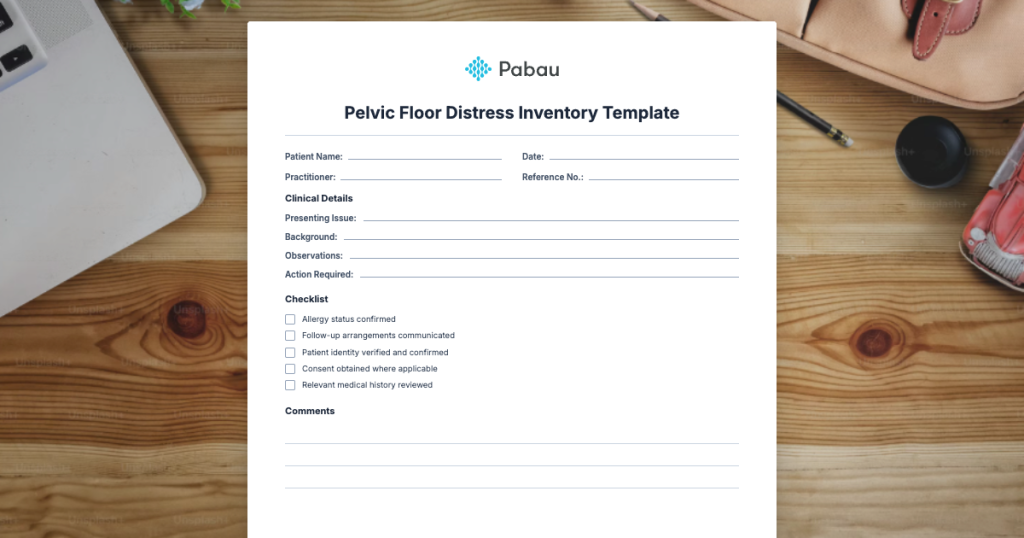
A ready-to-use assessment form with 20 standardised questions divided into three validated subscales: Urinary Distress Inventory (6 questions), Colorectal-Anal Distress Inventory (8 questions), and Pelvic Organ Prolapse Distress Inventory (6 questions). Includes scoring guidance and quality-of-life interpretation thresholds for clinical decision-making.
Download template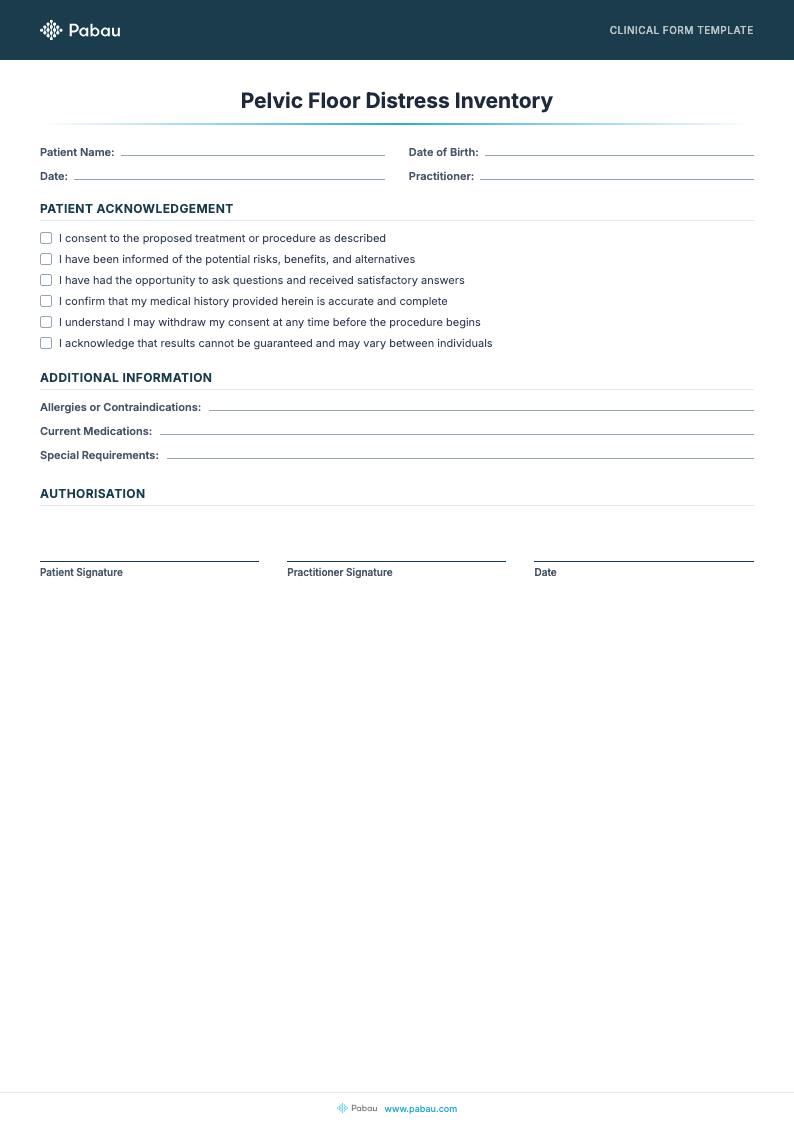
The Pelvic Floor Distress Inventory (PFDI-20) is a patient-reported outcome measure (PROM) that evaluates the symptom impact of pelvic floor disorders on health-related quality of life. Unlike symptom checklists, the PFDI-20 captures both the presence and the distress level of symptoms, making it sensitive to clinical change and treatment response.
The tool comprises three validated subscales: the Urinary Distress Inventory (UDI-6) measuring urinary incontinence impact, the Colorectal-Anal Distress Inventory (CRADI-8) measuring faecal incontinence and bowel dysfunction impact, and the Pelvic Organ Prolapse Distress Inventory (POPDI-6) measuring prolapse-related symptoms. Each question uses a 5-point Likert scale (-4), with higher scores indicating greater symptom distress.
Clinically, the PFDI-20 serves as a baseline assessment tool, progress monitor during treatment, and outcome documentation for audit and research purposes. It is particularly valuable in pelvic health physiotherapy where objective measurement of functional improvement is essential for demonstrating treatment efficacy and informing discharge decisions.
From a regulatory perspective, using a validated PROM like the PFDI-20 demonstrates evidence-based practice aligned with CQC (Care Quality Commission) inspection requirements and professional standards set by the RCCP (Royal College of Physiotherapists) and APTA. Pelvic health practices using specialised clinic software can integrate the PFDI-20 as a digital form, automating scoring and enabling compliance documentation audit-ready.
Implementing the PFDI-20 in clinical practice requires a structured workflow. The following five steps guide clinicians from initial administration through scoring and clinical interpretation.

Automate questionnaire administration, scoring, and outcome tracking in one integrated platform. Reduce manual data entry, improve compliance, and gain real-time visibility into patient progress.

The PFDI-20 is essential for any healthcare practice treating pelvic floor dysfunction across multiple specialties and care settings.
Pelvic health physiotherapy clinics use the PFDI-20 as their primary baseline and progress assessment tool. Physiotherapists treating urinary incontinence, faecal incontinence, or pelvic organ prolapse require standardised measurement to justify ongoing treatment and demonstrate discharge readiness to referring GPs and insurance providers.
Gynaecology and urogynecology practices implement the PFDI-20 pre-operatively for surgical candidates with prolapse or incontinence, and post-operatively to assess functional recovery. A significant reduction in PFDI-20 score validates surgical intervention efficacy and documents improvement for patient satisfaction and medico-legal records.
Women’s health and continence clinics in primary care and integrated care systems (ICS) use the PFDI-20 to screen for pelvic floor dysfunction severity, stratify risk, and triage referrals to specialist physiotherapy. The tool helps GPs and practice nurses identify patients requiring urgent gynaecology input versus conservative management.
Multi-disciplinary pelvic health teams benefit from the PFDI-20’s ability to harmonise assessment across physiotherapy, nursing, and medical domains. A single outcome measure enables shared care planning, reduces duplication, and creates continuity when patients transfer between providers.
Healthcare settings pursuing HIPAA, GDPR, and CQC compliance require PROMs as part of quality assurance frameworks. The PFDI-20’s validated psychometric properties and widespread adoption in compliance audit registries and clinical governance systems make it an ideal choice for demonstrating evidence-based practice during regulatory inspections.
Standardised symptom documentation. The PFDI-20’s validated 20-question structure ensures consistent data capture across all patients and clinicians. Rather than relying on subjective notes, the tool quantifies symptom burden in a format recognised by fellow healthcare professionals, payers, and audit bodies. This standardisation reduces documentation variability and improves care handover quality.
Objective progress measurement. Numeric scores enable clinicians to demonstrate treatment efficacy to patients, referring physicians, and insurance companies. A patient seeing a 40-point improvement in PFDI-20 score over 8 weeks of physiotherapy proves functional benefit objectively, justifying continued treatment or discharge with confidence.
Compliance and audit readiness. CQC inspectors expect practices to use validated PROMs as part of quality improvement frameworks. The PFDI-20’s international validation and presence in the Rehabilitation Measures Database (Shirley Ryan AbilityLab) establishes it as a defensible, evidence-based tool. Pabau’s pelvic health software module includes automated PROM scoring, further strengthening audit trails and compliance documentation.
Targeted treatment planning. By measuring three distinct symptom domains (urinary, bowel, prolapse), the PFDI-20 reveals the patient’s dominant dysfunction. A physiotherapist seeing a high POPDI-6 score but low UDI-6 can prioritise prolapse-specific exercises, reducing unnecessary treatment of minor symptoms and improving efficiency.
Patient engagement and motivation. Shared outcome scores help patients visualise their improvement trajectory, increasing adherence to home exercise programmes. Monthly reductions in PFDI-20 scores provide tangible motivation, especially important in conditions like chronic pelvic pain where improvement is often gradual.
Data security and regulatory alignment. Implementing the PFDI-20 as a digital form within clinic management software ensures GDPR-compliant patient consent, encrypted data storage via the secure patient record module, and audit-ready record-keeping. Patients control their portal access, reducing paper wastage and improving data accuracy compared to manual transcription.
Track PFDI-20 scores over 12 months and stratify patients by responders versus non-responders. Flag patients with <10% improvement at 8 weeks for clinical review - they may benefit from treatment modification, referral to specialist pelvic pain services, or imaging investigation. Automated alerts in your clinic software reduce manual oversight burden.
The PFDI-20’s power lies in its three-domain structure, each targeting a distinct pelvic floor dysfunction type. Understanding subscale interpretation guides differential treatment.
The Urinary Distress Inventory (UDI-6) measures urinary incontinence symptom impact using 6 items covering stress incontinence, urgency incontinence, and nocturia. Scores range 0-100. A UDI-6 score >50 indicates moderate-to-severe urinary symptom distress requiring pelvic floor muscle training, bladder retraining, or specialist urology/urogynecology referral. Patients with UDI-6 dominance often report leakage with coughing, sneezing, or exercise, signalling stress incontinence physiology.
The Colorectal-Anal Distress Inventory (CRADI-8) measures bowel dysfunction symptom impact using 8 items covering faecal incontinence, urgency, and defaecatory straining. Scores range 0-100. A CRADI-8 score >50 indicates significant bowel distress often linked to pelvic floor hypertonicity, paradoxical pelvic floor contraction during defaecation, or anal sphincter weakness. These patients benefit from defaecation retraining, manual therapy to relax pelvic floor muscles, and dietary modification addressing constipation.
The Pelvic Organ Prolapse Distress Inventory (POPDI-6) measures prolapse-related symptom impact using 6 items covering sensation of bulging, heaviness, and vaginal pressure. Scores range 0-100. A POPDI-6 score >40 typically indicates anatomically evident prolapse (grade 2 or higher on pelvic floor examination) requiring assessment for pessary fit, pelvic floor rehabilitation intensification, or referral for surgical candidacy evaluation if conservative options fail.
In clinical practice, tracking PFDI-20 scores over time reveals whether a balanced profile (roughly equal contributions from all three subscales) suggests multi-factorial pelvic floor dysfunction requiring comprehensive pelvic floor rehabilitation. An imbalanced profile (one subscale much higher than others) guides specialised intervention – for instance, directing a patient with POPDI-6 > 150 towards prolapse-specific pelvic floor support strategies rather than incontinence-focused exercises.
Implementing the PFDI-20 as a paper form introduces transcription risk, incomplete data, and lost appointment time. Digital implementation via patient portal forms eliminates these barriers whilst improving data integrity and compliance.
Pre-appointment portal access. Patients receive the PFDI-20 via email or SMS reminder 24-48 hours before their appointment. They complete it on their phone or home computer, eliminating clinic waiting-room delays. The system auto-validates responses, preventing missing data and prompting patients to confirm answers before submission.
Automatic score calculation and outcome flagging. Upon submission, the system instantly calculates UDI-6, CRADI-8, POPDI-6, and total PFDI-20 scores. Using automated workflow logic, clinicians view colour-coded severity flags during the appointment: green (minimal distress), amber (moderate), red (severe). This visual prompt accelerates clinical decision-making and ensures treatment intensity matches symptom burden.
Longitudinal trend visualisation. Digital systems display PFDI-20 scores as graphs across visits, clearly showing improvement trajectories. A patient and clinician can jointly review a 12-week graph showing PFDI-20 decline from 180 to 110 points, validating treatment efficacy and supporting discharge planning or treatment intensification discussions.
GDPR-compliant audit trails. Every form completion, edit, and deletion is logged with timestamp and user identification. Patients consent to specific data uses (clinical care, research, audit) with granular permission settings. Data encryption, secure backup, and role-based access control ensure confidentiality and regulatory compliance without manual administration overhead.

Want to verify PFDI-20 validity and scoring rules? Rehabilitation Measures Database (Shirley Ryan AbilityLab) provides the official instrument manual, scoring spreadsheets, and links to peer-reviewed validation studies demonstrating psychometric reliability across diverse populations.
Need pelvic health clinical guidance aligned with APTA standards? APTA’s Pelvic Floor Distress Inventory resource page links evidence-based practice guidelines, measurement properties, and clinical interpretation frameworks used by physiotherapists across the USA and internationally.
Looking for integration examples of PROMs in clinic software? Pabau’s dedicated pelvic health software page demonstrates how digital forms with automated scoring, patient portal delivery, and outcome dashboards streamline PFDI-20 administration in busy multi-practitioner clinics.
The pelvic floor distress inventory template provides a clinically validated, internationally recognised framework for measuring pelvic floor dysfunction symptom burden and treatment response. Whether you manage a single-clinician pelvic health practice or a multi-location gynaecology clinic, implementing the PFDI-20 elevates assessment rigour, improves compliance documentation, and demonstrates patient progress objectively.
Digital implementation via integrated clinic software removes administrative friction, accelerates score calculations, and enables real-time patient engagement. Combined with robust data governance and GDPR compliance built into your system, the PFDI-20 becomes a core component of evidence-based pelvic health care that satisfies clinician, patient, and regulatory requirements alike. Reviewed for alignment with APTA pelvic health standards and Rehabilitation Measures Database validation criteria.
The PFDI-20 (Pelvic Floor Distress Inventory-20) is a validated patient-reported outcome measure (PROM) that quantifies both the presence and the distress level of pelvic floor symptoms, rather than simply checking symptom presence. Its three subscales (UDI-6, CRADI-8, POPDI-6) provide domain-specific scores enabling targeted treatment planning, unlike generic checklists that only list symptoms.
Patients typically complete the PFDI-20 in 5-10 minutes. It should be administered at baseline assessment, then repeated at 4-week intervals during active treatment, at discharge, and at 6-12 month follow-up to monitor long-term outcomes. Digital forms reduce completion time and improve compliance with retest scheduling.
A reduction of 10-15 points in total PFDI-20 score is considered clinically meaningful improvement. Improvements in individual subscales (e.g., UDI-6 reduction of 10+ points) also indicate significant symptom change. Scores stable within ±5 points suggest no meaningful change; increases >10 points suggest deterioration requiring treatment review.
The PFDI-20 has been validated in diverse age groups (adult women aged 18+) and multiple ethnic populations, including Iranian, Chinese, and UK cohorts. Translated versions exist in multiple languages. Validity has been confirmed across studies of over 2,000 participants, making it internationally robust. Always use validated language translations if available.
Digital clinic software with HIPAA/GDPR compliance encrypts data at rest and in transit, maintains audit logs, and enables granular patient consent. Ensure your system has documented data processing agreements, regular security audits, and staff GDPR training. Paper forms should be archived in locked cabinets with restricted access and destroyed after retention periods.
Yes. The PFDI-20 is registered in the Rehabilitation Measures Database, endorsed by APTA, and widely published in peer-reviewed literature. It satisfies CQC expectations for evidence-based outcome measurement and is recognised by many private health insurers and NHS commissioners as a standard pelvic floor assessment tool.