

Musculoskeletal & Pain Management Physical Therapy
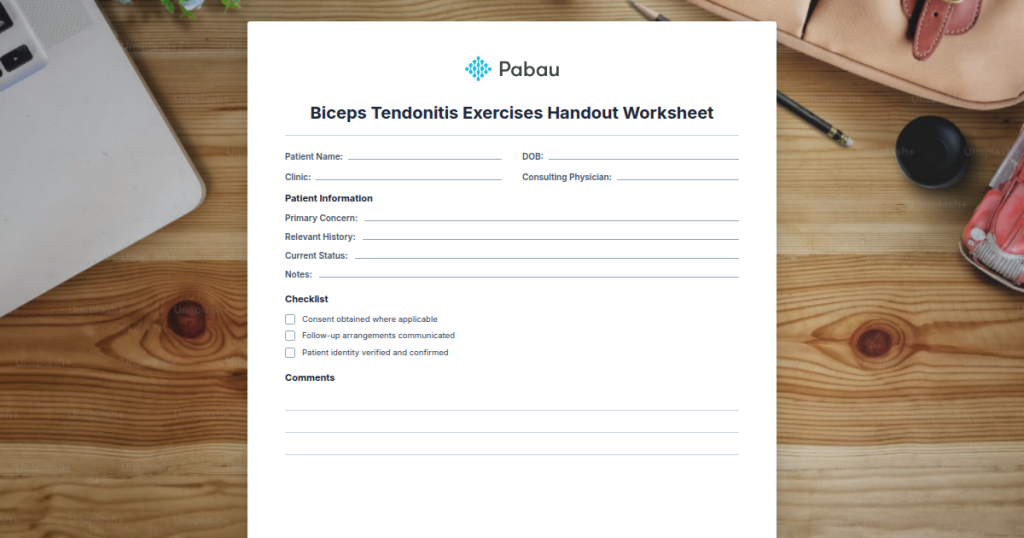
Biceps Tendonitis Exercises Handout Worksheet
Biceps Tendonitis Exercises Handout: Printable Rehabilitation Guide for Patients...

April 7, 2026


Buy now, pay later is now available in Pabau

Pain assessment intake forms establish baseline pain severity, location, and functional impact for tailored treatment planning.
Validated scales (VAS, NRS, McGill Pain Questionnaire) standardise pain documentation across clinical visits.
Structured forms reduce clinical documentation time and improve compliance with Joint Commission and CMS requirements.
Longitudinal pain tracking enables clinicians to measure treatment response and adjust interventions objectively.
Digital pain assessment forms integrate seamlessly into EHR workflows, improving care coordination in multidisciplinary teams.
A pain assessment intake form is the clinical foundation for effective pain management. It captures patient demographics, pain history, location mapping, symptom descriptors, functional limitations, and treatment response-all essential data points for developing targeted care plans.
For practitioners in physical therapy, chiropractic, sports medicine, and primary care, a structured pain assessment intake form transforms unstructured patient narratives into standardised, objective data. This standardisation enables better treatment tracking, improves compliance with regulatory requirements, and facilitates communication across multidisciplinary teams.
This guide covers the clinical components of a comprehensive pain assessment intake form, how to implement it in your practice workflow, and why validated pain scales matter for clinical decision-making and documentation.
A comprehensive clinical intake form covering patient demographics, pain history, location mapping, intensity assessment using validated scales, functional limitations, medication history, and treatment response documentation for multidisciplinary pain management settings.
Download templateA pain assessment intake form is a structured clinical questionnaire designed to gather comprehensive information about a patient’s pain experience at the point of initial contact. Rather than relying on brief verbal reports, the form captures detailed pain history, severity, location, quality, temporal patterns, functional impact, and response to previous treatments.
The pain assessment intake form serves multiple clinical purposes. It establishes a baseline pain level against which future interventions are measured. It identifies potential pain generators and contributing factors (postural habits, injury history, psychological stressors). It documents informed consent by ensuring patients understand the assessment process.
From a regulatory standpoint, Joint Commission standards require pain assessment as a vital sign in healthcare settings. CMS documentation guidelines mandate that pain severity and functional impact be recorded in clinical records to justify medical necessity for treatment. A formalised intake form ensures compliance with these standards and strengthens clinical and legal defensibility of treatment decisions.
Effective implementation of a pain assessment intake form follows a structured five-step workflow that integrates seamlessly into your existing intake process.
Store completed forms in the patient’s digital record alongside clinical notes. Reference pain scores in every treatment note to demonstrate objective progress. Use longitudinal pain tracking to support clinical decision-making: if pain remains unchanged after 4 weeks of treatment, modify your intervention rather than continuing the same approach indefinitely.

Digital pain assessment forms auto-populate clinical notes, track outcomes across visits, and integrate with treatment planning. See how Pabau simplifies intake workflows.

Pain assessment intake forms are essential for any clinical setting where pain is a presenting complaint or treatment target. Physical therapy clinics managing musculoskeletal pain (back pain, shoulder impingement, knee osteoarthritis) rely on structured pain assessment to track rehabilitation progress. Chiropractic practices use pain intake forms to quantify spinal pain severity and demonstrate treatment efficacy to patients and insurers.
Sports medicine practitioners administer pain forms to differentiate acute injury pain from chronic overuse patterns. Occupational therapy clinics assess pain related to functional limitations in activities of daily living. Primary care practices and private GPs document baseline pain as a vital sign to inform referral decisions and justify specialist treatment.
Pain clinics and multidisciplinary pain management programmes use comprehensive pain assessment forms to screen for neuropathic vs. nociceptive pain, psychological factors affecting pain perception, and medication-seeking behaviour. Functional medicine and integrative medicine practitioners use pain assessment to track patient-reported outcomes before and after dietary, supplement, or lifestyle interventions.
A structured pain assessment intake form delivers measurable clinical and operational benefits. Clinical benefit: Standardised pain documentation enables objective treatment tracking. When you record NRS scores of 8/10 at week 1 and 4/10 at week 6, you have evidence of clinical improvement to share with the patient, reinforcing treatment compliance and justifying continued care.
Regulatory compliance: Joint Commission requires pain assessment; CMS requires pain severity and functional impact documentation for medical necessity justification. A formalised intake form demonstrates compliance during audits and protects your practice against claims that treatment lacked clinical justification.
Insurance and billing support: Many insurers require evidence of baseline pain severity and functional limitation to authorise ongoing treatment episodes. Pain assessment forms provide this documentation, reducing claim denials and improving reimbursement rates.
Care coordination: When patients see multiple providers (physiotherapist, GP, pain specialist), shared pain assessment data improves communication. A unified pain score ensures all team members understand baseline severity and treatment response, preventing contradictory advice or redundant interventions.
Audit your pain assessment form completion rate quarterly. Aim for 95%+ of new patients completing the form at initial visit. If completion rates drop below 90%, analyse barriers: unclear instructions, form length, timing in intake flow. Streamline the form or integrate it into your digital intake portal to remove friction.
The pain scale you select shapes how you communicate with patients and measure treatment response. The Numeric Rating Scale (NRS 0-10) is the most commonly used. Patients rate pain from ” = no pain” to “10 = worst pain imaginable.” NRS is rapid (5 seconds), cognitively accessible to most patients, and sensitive to small changes in pain (clinically meaningful change is often 2 points).
The Visual Analog Scale (VAS) presents a 10-centimetre unmarked line with anchors at each end. Patients mark where their pain falls on the continuum. VAS is highly sensitive to pain changes and preferred by research studies, but requires slightly more cognitive effort than NRS. It suits patients who struggle with number-based rating systems.
The McGill Pain Questionnaire extends beyond severity to capture pain quality (burning, throbbing, sharp, aching). It categorises pain into sensory, affective, and evaluative dimensions. McGill is more time-consuming (10-15 minutes) but provides richer clinical information about pain character. Use it for initial comprehensive assessment; use NRS for routine follow-up visits.
The Brief Pain Inventory (BPI) combines pain severity with functional impact questions: “How much has pain interfered with walking?” and “How much has pain interfered with sleep?” BPI bridges pain measurement and functional outcome assessment, making it ideal for demonstrating treatment impact to patients and insurers.
Pain severity alone does not determine treatment urgency or outcomes. Two patients with identical pain scores may have vastly different functional limitations. One might have 7/10 pain but continue walking 5 kilometres daily; the other might have 6/10 pain but be unable to walk more than 100 metres. A functional pain assessment captures this distinction.
Comprehensive pain intake forms include functional limitation questions: distance walked before pain limits activity, ability to perform work tasks, impact on sleep quality, social participation restrictions. Link these to your treatment plan explicitly. If a patient reports “unable to sit for more than 30 minutes,” your first intervention targets sitting tolerance through postural coaching and frequent position changes. If pain-free walking distance is 200 metres, your initial goal becomes 300 metres-quantifiable, patient-centred, and achievable.
Review functional outcomes at each visit, not just pain scores. Declining pain without improving function suggests patients are protecting movement patterns; continuing the same treatment risks chronicity. Conversely, improving function despite unchanged pain perception indicates successful pain coping strategy adoption. Functional assessment data informs clinical documentation and supports narrative-based justification for ongoing treatment episodes.

Need a comprehensive intake form builder? Pabau’s Digital Forms feature lets you create custom pain assessment forms with conditional logic, pain scale graphics, and auto-population into clinical notes.
Looking to track pain outcomes across visits? Measurement Tracking visualises pain score trends, functional milestone progress, and treatment response patterns to guide clinical decision-making.
Want to streamline patient intake workflows? Pabau Capture Forms delivers pre-visit completion via patient portal, reducing appointment time spent on paperwork and improving data quality.
A pain assessment documents pain location (using body diagrams), intensity (using a validated scale like NRS or VAS), quality (descriptors: sharp, burning, aching), temporal pattern (constant vs. intermittent, time of day variation), aggravating and relieving factors, functional impact, and treatment history. Structure the assessment chronologically: when did pain start, how has it changed, what treatments have been tried, and what limitations does it create today.
Core components include: (1) pain history (onset, duration, mechanism of injury), (2) location mapping using body diagrams, (3) pain intensity using a validated scale (NRS, VAS, or McGill), (4) pain quality descriptors (sharp, throbbing, burning), (5) temporal patterns (constant, intermittent, time of day variation), (6) aggravating and relieving factors, (7) functional limitations (walking, sitting, work capacity), (8) medication and treatment history, (9) psychological factors (mood, sleep disruption, anxiety), and (10) impact on activities of daily living and social participation.
The five key components distilled to essentials are: (1) pain location and distribution, (2) pain intensity using a standardised scale, (3) pain quality and character, (4) temporal pattern and triggers, and (5) functional impact on daily activities. These five elements provide sufficient baseline data for treatment planning, even when time constraints prevent a comprehensive multi-dimensional assessment.
No single tool is universally “best”-the ideal tool depends on patient population and clinical context. For rapid screening in busy clinics, the Numeric Rating Scale (NRS 0-10) is most practical. For research and sensitivity to small changes, the Visual Analog Scale (VAS) is preferred. For capturing pain quality and psychological dimensions, the McGill Pain Questionnaire provides richer data. For linking pain severity to functional impact, the Brief Pain Inventory combines both. Most practices use NRS for routine visits and McGill or BPI for initial comprehensive assessments.
Pain assessment establishes baseline severity and functional limitation, enabling objective measurement of treatment response across visits. It satisfies regulatory requirements (Joint Commission standards, CMS documentation mandates). It supports insurance authorisation by documenting medical necessity. It improves care coordination across multidisciplinary teams by providing shared baseline data. Most importantly, it demonstrates clinical progress to patients, reinforcing treatment compliance and satisfaction.
A structured pain assessment intake form is not administrative overhead-it is the clinical foundation for effective pain management. It transforms subjective patient narratives into objective, quantifiable baseline data. It enables longitudinal tracking of treatment response. It ensures compliance with regulatory standards and supports insurance authorisation.
Whether you work in physical therapy, chiropractic, sports medicine, occupational therapy, or primary care, a validated pain assessment form elevates your clinical documentation, improves patient outcomes, and strengthens the defensibility of your treatment decisions. Download the free template above and integrate it into your intake workflow today.