Musculoskeletal & Pain Management Sports Medicine
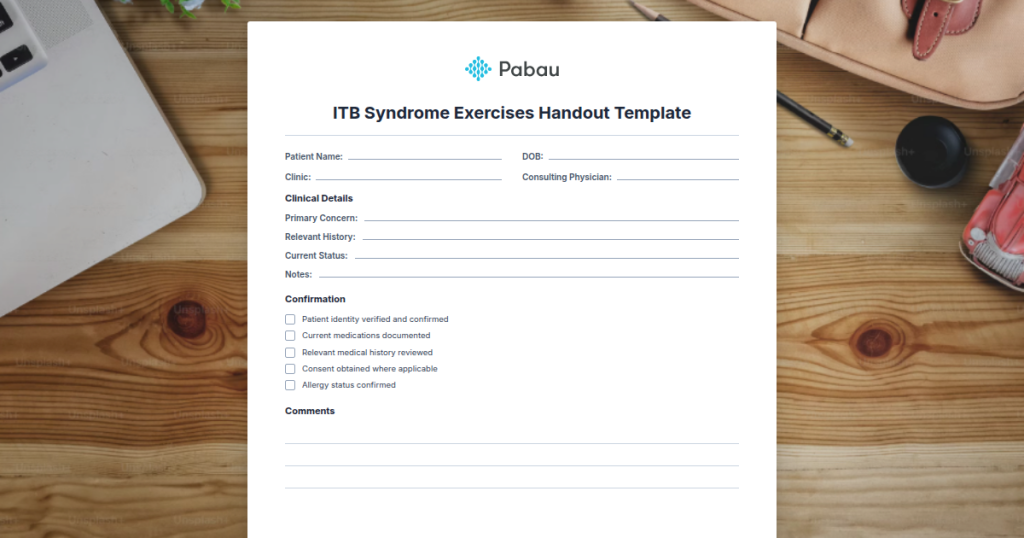
ITB Syndrome Exercises Handout Template
What Is an ITB Syndrome Exercises Handout Template? The iliotibial band is a thi...

March 17, 2026


Buy now, pay later is now available in Pabau

Mini Balance Evaluation Systems Test (Mini BESTest) Template assesses four balance systems in 10-15 minutes
Scoring ranges from 0-28, with lower scores indicating greater fall risk
Standardised assessment enables objective documentation and outcome tracking
Downloadable template integrates seamlessly with physical therapy clinic workflows
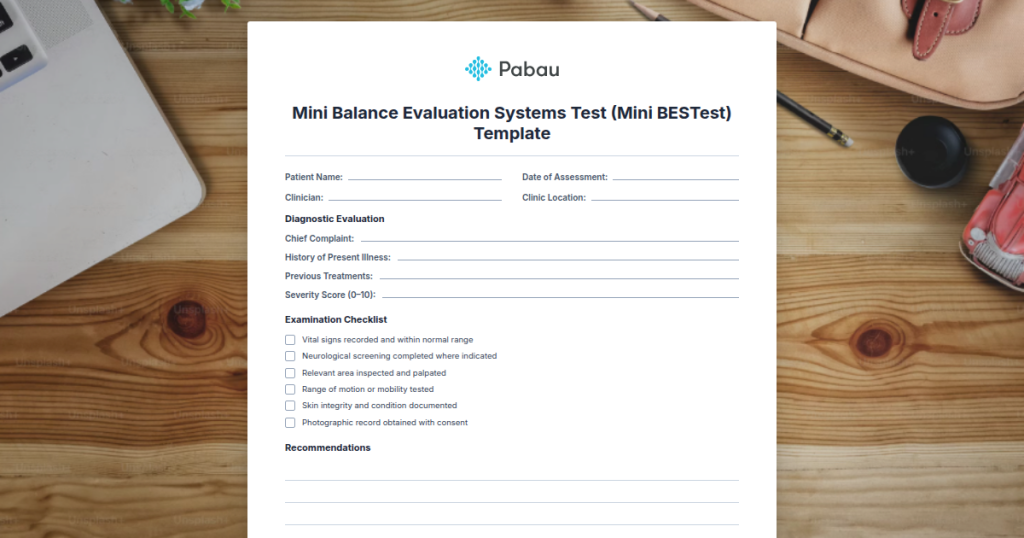
A ready-to-use clinical assessment form covering 14 standardised balance test items, scoring instructions, fall risk interpretation, and space for clinician notes. Scores across four balance systems: anticipatory postural adjustments, reactive postural control, sensory orientation, and stability limits.
Download templateThe Mini Balance Evaluation Systems Test (Mini BESTest) is a clinically validated assessment tool designed to measure static and dynamic balance impairments and predict fall risk in patients. Developed as a shorter alternative to the full Balance Evaluation Systems Test (BESTest), this standardised form contains 14 items clustered across four distinct balance systems: anticipatory postural adjustments, reactive postural control, sensory orientation, and stability limits.
Each item scores between 0 and 2, with a maximum total score of 28 points. Clinicians administer the assessment over approximately 10-15 minutes, observing performance during tasks ranging from sit-to-stand transitions to walking with head turns. The Mini BESTest framework reflects current understanding of the neurophysiological systems underlying balance control.
This assessment holds particular relevance within physiotherapy, sports medicine, and geriatric rehabilitation settings. The American Physical Therapy Association (APTA) recognises the Mini-BESTest as a validated outcome measure for documenting balance function and tracking progress in rehabilitation programmes. In the UK, the Chartered Society of Physiotherapy (CSP) supports its use within clinical assessment protocols.
From a regulatory perspective, standardised assessment tools like the Mini BESTest support compliance with quality standards. CQC (Care Quality Commission) guidance emphasises the importance of objective, documented assessments in demonstrating safe, effective care. Using a structured template ensures all clinicians within your practice administer and interpret the assessment consistently, reducing variability and supporting audit readiness.
The downloadable Mini Balance Evaluation Systems Test (Mini BESTest) template streamlines clinical administration. Follow these five operational steps to integrate the assessment into your practice workflow.
The template’s structure mirrors the assessment logic, making completion intuitive for new clinicians and efficient for experienced practitioners. Digital intake forms can automate score calculation and progress tracking over time, reducing administrative burden and strengthening clinical documentation.
The Mini Balance Evaluation Systems Test (Mini BESTest) is essential for physiotherapy clinics, musculoskeletal practices, sports medicine clinics, and geriatric rehabilitation settings. Physical therapists administering fall risk screening, balance retraining, or vestibular rehabilitation programmes depend on this assessment. Chiropractors evaluating postural stability and sports medicine practitioners monitoring proprioceptive recovery benefit from the template’s structured scoring.
Neurological rehabilitation teams working with stroke survivors, Parkinson’s disease patients, or individuals recovering from traumatic brain injury use the Mini-BESTest to document baseline balance function and measure treatment effectiveness objectively. Occupational therapists assessing functional mobility and fall risk in community-dwelling older adults find the assessment valuable for informing home safety recommendations.
Practices operating multi-disciplinary teams benefit especially from a standardised template. When physiotherapists, occupational therapists, and nurses all use the same assessment form, patient progress is transparent across the care team. This integration supports seamless handover between practitioners and aligns documentation with clinical guidelines from professional bodies like the Health and Care Professions Council (HCPC).
Standardised assessment across your practice. All clinicians follow the same administration and scoring protocol, eliminating inconsistency. This consistency strengthens legal defensibility during complaints or audits.
Objective outcome measurement. Quantified scores (0-28 scale) provide concrete evidence of patient progress, satisfying insurance documentation requirements and supporting shared decision-making with patients. Rather than subjective notes like “patient improved balance,” you document specific score changes: “Mini-BESTest improved from 14 to 19 over 6 weeks.”
Fall risk stratification. The template guides interpretation of scores against established cutoff values, enabling clinicians to categorise patients into risk tiers. This informs discharge planning and safety guidance recommendations.
Regulatory and compliance alignment. Using a validated, nationally recognised assessment demonstrates adherence to professional standards and CQC expectations for evidence-based practice. Audit teams recognise the Mini-BESTest as a gold-standard outcome measure.
Clinical decision-making clarity. Structured subscale scoring reveals which balance systems are impaired. Anticipatory deficits suggest one treatment focus; reactive deficits suggest another. This systems-based approach sharpens your intervention strategy.
The Mini Balance Evaluation Systems Test (Mini BESTest) template grounds balance assessment in neuroscience. Balance control depends on integration across four systems: the nervous system’s ability to generate postural adjustments before movement (anticipatory control), response speed to external perturbations (reactive control), sensory integration of visual, vestibular, and proprioceptive input (sensory orientation), and the stability limits within which the body can recover balance (stability limits).
Understanding this framework informs your treatment strategy. A patient with poor anticipatory scores might benefit from task-specific training (sit-to-stand practice, step-up progressions). Poor reactive scores suggest balance perturbation training or controlled treadmill-based interventions. Sensory deficits point toward proprioceptive work and vestibular retraining. This systems-based approach to physical therapy assessment aligns clinicians around a shared conceptual model.
Related assessment tools-the Berg Balance Scale, Timed Up and Go Test, and Functional Gait Assessment-measure balance from different angles. The Mini-BESTest’s four-system framework offers diagnostic specificity that broader tools lack. AI-powered clinical documentation can now assist in structured note generation following standardised assessments, reducing administrative time and improving consistency.
The Mini Balance Evaluation Systems Test (Mini BESTest) template includes interpretation guidance aligned with published research cutoff values. Scores below 21 are associated with significantly elevated fall risk in community-dwelling older adults. Scores between 14 and 20 indicate moderate risk; below 14, high risk. These thresholds guide your safety recommendations and discharge planning.
Documentation should link assessment findings to functional implications. Instead of recording a raw score in isolation, note: “Mini-BESTest score 16 (moderate-high fall risk). Specific deficits: reactive postural control (subscale 2 = 3/8) and stability during dynamic walking (subscale 4 = 2/8). Recommend home safety assessment, balance-specific training programme, and family education on fall prevention strategies.”
Re-administer the Mini-BESTest at regular intervals-typically every 4-6 weeks during active rehabilitation. Track score trends to quantify progress. This objective measurement approach strengthens outcome reporting to insurers and referring physicians.
Explore CDC fall prevention resources for context: the CDC Falls Prevention Programme provides epidemiological data and clinical guidance supporting your assessment and intervention choices.
Standardised assessment templates like the Mini Balance Evaluation Systems Test (Mini BESTest) are most effective when integrated into clinic software. Automated scoring, progress graphs, and built-in interpretation guidance reduce clinician burden and strengthen outcome documentation. Discover how practice management platforms streamline assessment workflows.

Want to standardise assessments across your team? Digital forms software enables all clinicians to administer the Mini BESTest consistently and track scores over time.
Need structured clinical documentation? AI-powered clinical notes generate summary narratives from assessment findings, saving time on documentation.
Looking for outcome measurement integration? Centralised patient records store all Mini-BESTest administrations and progress graphs in one searchable location.
The Mini Balance Evaluation Systems Test (Mini BESTest) template provides a clinically validated, standardised framework for assessing balance impairment and fall risk. Its four-system approach-anticipatory, reactive, sensory, and stability-delivers diagnostic specificity that informs targeted treatment planning. Downloading and implementing this template ensures consistent assessment across your team, strengthens regulatory compliance, and delivers objective outcome data your patients and referrers value. Integration with digital clinic management systems amplifies these benefits, automating scoring and enabling longitudinal progress tracking.
The Mini Balance Evaluation Systems Test (Mini BESTest) typically requires 10-15 minutes to complete, making it practical for busy clinic schedules. The full BESTest takes 30-40 minutes, making the Mini version ideal for screening and outcome tracking.
Scores below 14 on the Mini Balance Evaluation Systems Test (Mini BESTest) are associated with high fall risk. Scores between 14-20 indicate moderate risk; above 21, low risk. However, clinical judgment should always supplement standardised scores.
Yes. The Mini Balance Evaluation Systems Test (Mini BESTest) template is valid for stroke survivors, patients with vestibular disorders, those recovering from traumatic brain injury, and individuals with neurological conditions. Cutoff values for fall risk interpretation may differ by population.
The Mini Balance Evaluation Systems Test (Mini BESTest) requires basic training in administration and scoring. Most physiotherapists and occupational therapists learn administration within a few supervised attempts. The template includes step-by-step instructions to support consistent practice.
The Mini Balance Evaluation Systems Test (Mini BESTest) is shorter (14 items vs 14 items for Berg, but takes less time) and uses a systems-based framework, identifying which balance systems are impaired. The Berg Balance Scale provides a single global balance score. The Mini-BESTest offers greater diagnostic detail.