

Mental Health Mental Health & Therapy
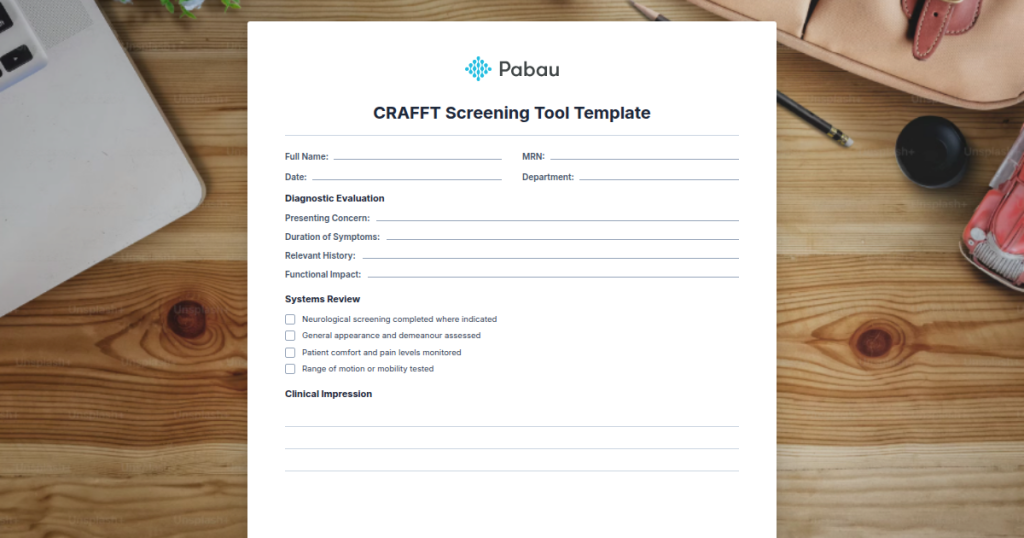
CRAFFT Screening Tool Template
The CRAFFT Screening Tool Template is a clinically validated instrument designed...

March 17, 2026


Buy now, pay later is now available in Pabau

Mental status exam templates standardise psychiatric assessment across clinicians and settings
MSE documentation supports accurate diagnosis, treatment planning, and legal compliance
Structured templates reduce documentation time while improving clinical safety
Digital mental status exam forms streamline data capture and EHR integration
A mental status exam template is a structured clinical assessment tool that helps practitioners systematically evaluate a patient’s psychological and cognitive functioning during a psychiatric or psychological evaluation. Rather than relying on informal observation, this mental status exam template provides a standardised framework covering appearance, behaviour, speech patterns, mood, affect, thought processes, perceptual experiences, cognitive abilities, insight, and judgment.
Mental health professionals across psychiatry, psychology, counselling, and nursing rely on the mental status exam template to document clinical findings in a consistent format. This approach ensures no key assessment area is overlooked and creates a permanent, legally defensible record of the evaluation. According to the American Psychiatric Association (APA), structured clinical documentation using standardised formats improves diagnostic accuracy and supports evidence-based treatment planning.
The mental status exam template captures data essential for diagnosis codes, insurance documentation, regulatory compliance, and continuity of care. In both inpatient and outpatient settings, a properly completed template protects clinicians against liability claims and audit findings by demonstrating adherence to clinical standards of care.
A structured mental status examination template covering cognitive assessment, emotional presentation, risk assessment, and behavioural observations for comprehensive psychiatric and psychological evaluations.
Download templateA comprehensive mental status exam template divides assessment into distinct domains, each capturing specific clinical observations. The opening section documents patient identifying information, visit date, and clinician credentials-essential for legal and billing purposes. Appearance and behaviour sections record observable presentation: posture, grooming, eye contact, psychomotor activity, and any unusual movements or mannerisms.
Speech evaluation captures rate, volume, quality, and coherence. Mood and affect sections document the patient’s reported emotional state versus observable emotional expression, helping identify incongruence that may signal clinical significance. Thought process and content sections explore organisation, flow, and the presence of delusions, obsessions, or suicidal/homicidal ideation-critical safety considerations.
The perceptual experiences domain addresses hallucinations across sensory modalities. Cognitive function assessment evaluates orientation, attention, memory, abstract reasoning, and language. Insight and judgment sections assess the patient’s awareness of illness and ability to make sound decisions. This structured mental status exam template approach ensures clinicians document findings consistently, supporting accurate diagnosis and treatment safety.
Completing a mental status exam template requires systematic observation and careful documentation during the clinical interview. Begin by establishing rapport with the patient, explaining that you’ll be taking structured notes to ensure comprehensive assessment. Observe presentation from the moment the patient enters: posture, gait, grooming, clothing appropriateness, and eye contact all inform the appearance and behaviour section.
During conversation, actively listen to speech patterns-note the pace (pressured, slow, normal), volume, articulation quality, and whether thoughts flow logically or jump between topics. Document the patient’s stated mood in their own words whenever possible: “How have you been feeling?” Simultaneously observe whether facial expression and body language match the reported mood. Incongruence between verbal report and observable affect signals important clinical information.
As the interview progresses, explore thought content carefully. Ask direct, non-judgmental questions about current worries, fears, or unusual beliefs. Assess safety by asking about suicidal and homicidal ideation with appropriate specificity. Evaluate cognitive function through brief formal testing: orientation to person, place, time, and date; attention via serial sevens or digit span; memory through immediate and delayed recall. Use the mental status exam template sections to guide these observations, documenting specific examples rather than general impressions.
Close by assessing insight (“Do you think there might be something going on that needs attention?”) and judgment (“If you were feeling this way, what would you do?”). Complete the template immediately after the interview while observations are fresh. Accurate documentation protects patient care quality and establishes a clear clinical record for continuity, consultation, and legal defensibility.
Psychiatrists and psychiatric nurse practitioners use the mental status exam template as the foundation of every psychiatric evaluation. Clinical psychologists and counsellors completing comprehensive assessments rely on structured templates to ensure diagnostic accuracy. Community mental health clinicians, school psychologists, and occupational therapists benefit from standardised documentation when working with individuals experiencing cognitive or emotional difficulties.
Primary care physicians evaluating patients presenting with mood or behavioural concerns use simplified mental status exam templates during brief office visits. Neuropsychologists employ detailed versions when assessing cognitive decline or acquired brain injuries. Addiction specialists integrate mental status assessment with substance use history to identify co-occurring psychiatric conditions. Crisis intervention teams and emergency departments use rapid mental status exam templates to assess safety and disposition decisions.
Any practitioner completing mental health documentation-whether in private practice, hospital, clinic, or telehealth setting-benefits from the consistency and completeness a mental status exam template provides. Using a template ensures regulatory compliance, supports accurate diagnosis coding, and demonstrates adherence to clinical standards across diverse healthcare settings.
Standardisation is the core value of a mental status exam template. When all clinicians use the same assessment framework, patient records become consistent and transferable across settings. A psychiatrist reviewing a patient’s prior evaluation can quickly locate relevant findings because the template structure is familiar. This consistency improves continuity of care and reduces the risk of overlooked clinical information.
Structured templates significantly reduce documentation time. Rather than writing narrative paragraphs, clinicians select from predefined domains and add targeted observations. This efficiency frees time for direct patient care while ensuring completeness. Templates also support accurate diagnostic coding: ICD-10 diagnoses depend on documented evidence of specific symptoms, and a thorough mental status exam template creates the clinical foundation for justified coding.
From a compliance perspective, mental health documentation using standardised templates demonstrates that assessment meets clinical and regulatory standards. CQC inspections, insurance audits, and potential legal proceedings all favour practices using evidence-based, systematic documentation. A well-completed mental status exam template protects clinicians by showing they conducted a thorough, professional evaluation aligned with accepted standards of care.
Digital mental status exam templates integrated with digital forms systems streamline data entry and automatically populate EHR records, reducing transcription errors and improving accessibility. AI-powered clinical documentation can assist in generating summary notes from structured template data, further supporting clinician efficiency without compromising accuracy.
Visit the mental health EMR resource centre to explore how integrated practice management supports comprehensive clinical documentation workflows.
Best practice mental status exam documentation uses descriptive, objective language. Rather than labelling a patient as “depressed” in the affect section, describe what you observed: “Flat affect; slow speech; minimal eye contact; tearful when discussing family losses.” Specific examples provide the clinical detail needed for diagnosis and create a more compelling legal record if questioned.
Include both positive and negative findings. Documenting that a patient denies suicidal ideation is as important as noting it is present. Use direct quotes when patients express concerns in their own words-these details strengthen clinical credibility and support treatment planning. Flag safety concerns immediately, using clear language such as “Patient endorses passive suicidal ideation with no current plan, intent, or access to means.”
Complete the mental status exam template contemporaneously (at the time of the visit) rather than retroactively. Timely documentation ensures accuracy and demonstrates diligence in clinical practice. If you cannot complete the template immediately, note the delay on the form. Maintain confidentiality throughout: never include unnecessary identifiers in sections that might be shared or printed outside a secure system.
Inpatient psychiatric units use comprehensive mental status exam templates daily, often incorporating them into shift handoffs and treatment rounds. These detailed assessments track changes in mental state, inform medication adjustments, and document progress toward discharge readiness. Outpatient mental health practices adapt the template to fit appointment length and focus: a follow-up psychotherapy session may use an abbreviated version, while intake evaluations require full assessment.
Primary care practices often use shortened mental status screening templates when patients present with mood or cognitive concerns but do not require full psychiatric evaluation. Emergency departments employ rapid assessment versions to determine safety and appropriate disposition. Telehealth mental health providers document mental status observations based on video interaction, adapting the template to address the limitations and strengths of remote assessment-noting any areas where in-person evaluation would add clarity.
Educational settings, forensic evaluations, and workplace wellness programmes each adapt the mental status exam template to their specific context while maintaining core assessment domains. Consistency in template use across settings ensures patients receive thorough, comparable evaluations regardless of where they seek care.

Need to structure psychiatric assessments comprehensively? Psychiatric Evaluation Template provides a complete framework for intake assessments that includes mental status examination as one essential component.
Looking to streamline clinical documentation workflows? SOAP Notes Writing Guide explains how mental status findings fit into broader clinical note structure for continuity and compliance.
The mental status exam template represents a fundamental tool in mental health practice, transforming clinical assessment from impressionistic to systematic and standardised. By providing a structured framework for documenting appearance, behaviour, speech, mood, thought processes, perception, cognition, and insight, the template ensures comprehensive evaluation while reducing documentation burden. Whether working in psychiatry, psychology, primary care, or crisis assessment, practitioners who adopt a quality mental status exam template improve diagnostic accuracy, support regulatory compliance, and create defensible clinical records that prioritise patient safety. Download the free template above and integrate it into your practice workflow today.
A psychiatric evaluation is a comprehensive assessment that includes history, physical examination, diagnostic testing, and treatment planning. The mental status exam is one essential component of the full evaluation, focusing specifically on observations of current mental state and cognitive functioning during the clinical interview.
A thorough mental status exam typically takes 15-30 minutes as part of a broader clinical interview. Using a structured template actually reduces time by guiding clinicians through each domain systematically rather than relying on narrative free-form notes.
Yes. Clinicians adapt the template to account for remote assessment limitations-for example, observing facial expression and speech clearly via video but noting that physical coordination cannot be directly assessed. Document what can and cannot be evaluated in a telehealth setting.
Document the refusal objectively: “Patient declined cognitive testing” or “Patient declined to answer questions about suicidal ideation.” Explain any clinical reasoning for proceeding without that information, and note whether you assessed safety through alternative means.
Yes. Use a full template at intake; for follow-ups, many practices use an abbreviated version focusing on areas of clinical concern or change since the last visit. This tracks progress while maintaining efficiency in ongoing care.