ADHD Assessment Mental Health & Therapy
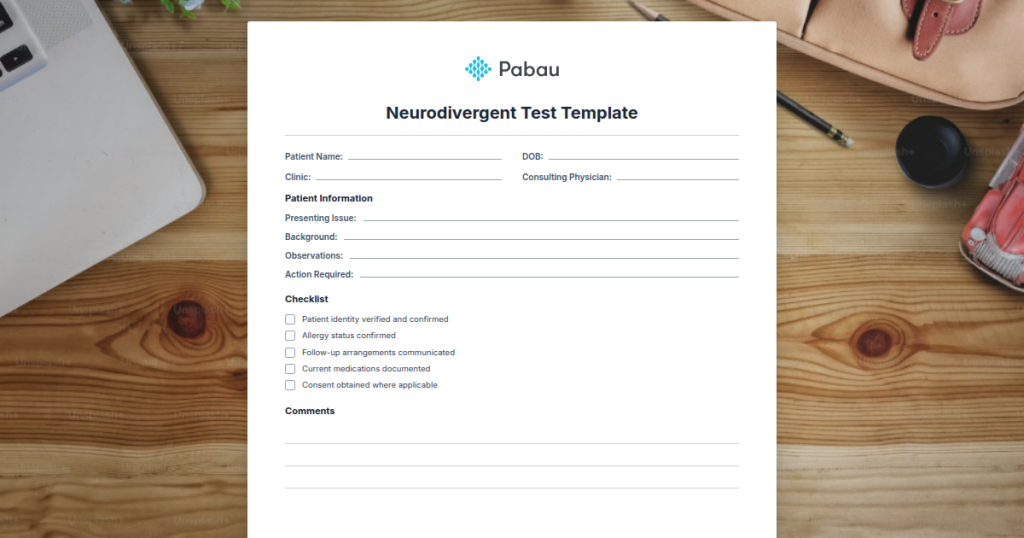
Neurodivergent Test Template
A neurodivergent test template is a clinician-facing screening form that healthc...

April 3, 2026


Buy now, pay later is now available in Pabau

A structured healthy boundaries worksheet helps clients identify personal limits and communicate them effectively
Boundary-setting is grounded in DBT and CBT frameworks, proven therapeutic approaches for interpersonal effectiveness
Digital worksheets integrate seamlessly into client records, supporting continuity of care across sessions
Use this resource as homework or an in-session tool to support boundary establishment and maintenance
A healthy boundaries worksheet is a structured therapeutic tool that helps clients identify, articulate, and establish limits in their relationships and daily life. The resource guides practitioners and patients through the process of recognising unhealthy boundary patterns, clarifying personal values, and developing assertive communication strategies grounded in evidence-based frameworks.
The digital form workflow makes worksheets particularly valuable in modern therapy practice. Rather than relying on handwritten notes or separate PDF files, clinicians can assign the worksheet directly through their practice management system, track client completion, and attach responses to the permanent clinical record. This integration reduces administrative burden and ensures boundary-work is documented as part of the therapeutic journey.
Clinically, boundary-setting interventions are rooted in dialectical behaviour therapy (DBT) and cognitive-behavioural therapy (CBT), therapeutic models that emphasise DBT interpersonal effectiveness skills and assertiveness skills. The worksheet operationalises these frameworks into practical, client-friendly language, making abstract boundary concepts concrete and actionable. For mental health professionals, the worksheet becomes both a clinical tool and a documentation artefact that supports compliance and continuity of care.
Under regulations like GDPR and HIPAA, storing completed worksheets securely within a practice management system (rather than as loose PDFs or email attachments) strengthens data protection compliance. The resource signals that boundary-work is a legitimate, evidence-based intervention-not a self-help suggestion-which increases therapeutic credibility and client buy-in.
A structured therapeutic tool for identifying personal boundaries, recognising unhealthy patterns, and developing assertive communication strategies. Includes boundary type frameworks (physical, emotional, professional, digital, sexual, time), self-assessment questions, and practical scripts grounded in DBT and CBT principles.
Download templateThe healthy boundaries worksheet works as both an in-session exploration tool and as therapeutic homework assigned between sessions. The structured five-step approach mirrors how clinicians guide clients through boundary identification and maintenance work.
In practice management platforms with AI-powered clinical documentation, you can generate session notes that reference the boundary-work completed in the worksheet, creating a seamless clinical record. The worksheet becomes part of the documented treatment plan, supporting audit readiness and demonstrating that boundary-setting is a core therapeutic intervention.

Assign worksheets, track client progress, and store completed resources securely within your practice management system. Digital integration means less admin, more clinical focus.

Mental health professionals across multiple specialities use this worksheet as a core therapeutic resource. Therapists treating anxiety, depression, and relationship issues regularly discover that boundary-setting deficits underlie client presentations. A client with generalised anxiety often carries exhaustion from over-commitment-poor boundaries compound the anxiety cycle. A therapist skilled in boundary work addresses the root driver, not just the symptom.
Psychology and counselling practices integrate the worksheet into routine intake and ongoing treatment. Psychologists conducting trauma-informed therapy find boundary-setting essential; many trauma survivors struggle with boundary assertion due to disrupted autonomy. Counsellors specialising in relationship therapy use the worksheet to help couples establish healthier relational limits.
Occupational therapy and holistic wellness practitioners use boundary worksheets to address work-life balance and occupational wellbeing. When clients feel their personal time is invaded by work demands or family obligations, an occupational therapist might assign this worksheet to clarify what “self-care time” means and how to protect it.
Coaching practices-particularly executive and life coaches-employ the worksheet when clients report relationship challenges, perfectionism, or difficulty saying no. Coaches use the resource to help clients align their boundaries with their stated goals and values.
Adolescent and family therapy practices adapt the worksheet for teens and families, using age-appropriate language to explore healthy boundaries between parent and child, peer relationships, and digital boundaries. Families often come to therapy because boundary violations are creating conflict; the worksheet provides a structured way to open conversation.
Clinical effectiveness grounded in evidence. Boundary-setting is a core skill in DBT, originally developed by Marsha Linehan for treating borderline personality disorder. DBT borderline personality disorder outcomes have been validated in randomised controlled trials demonstrating significant reductions in self-harm and interpersonal dysregulation. Research by the British Association for Counselling and Psychotherapy (BACP) shows that clients who develop assertive boundary skills experience improved relationship satisfaction, reduced anxiety, and better emotional regulation. Using a structured worksheet operationalises these research-backed interventions into clinical practice.
Reduces therapy session time while deepening client insight. When clients complete the worksheet before a session (or during the session with guidance), they’ve already done the self-awareness work. Sessions shift from “what boundaries do you have?” to “how will you communicate this boundary?” Clinicians save time on psychoeducation and spend more time on skill-building and problem-solving.
Creates portable, reusable documentation. A completed healthy boundaries worksheet becomes part of the permanent clinical record. If a client returns to therapy years later or transfers to a new provider, the boundary-work is documented. This supports continuity of care and prevents starting from zero.
Supports compliance and audit readiness. CQC mental health record standards require review of clinical records for evidence of evidence-based interventions. A documented boundary-setting worksheet using DBT or CBT frameworks demonstrates that your practice is delivering structured, theoretically grounded care-not ad hoc advice.
Increases client accountability and follow-through. When clients put pen to paper (or complete a digital form), they commit more fully to boundary-work. Written goals and action plans have higher completion rates than verbal discussion alone. The worksheet becomes a contract between therapist and client about what boundaries matter and how they’ll be maintained.
Easily adapted across client populations. The worksheet’s language is accessible to adults while still being clinically sophisticated. Practitioners can adapt language for adolescents, modify examples for specific cultural contexts, or emphasise particular boundary domains (e.g., digital boundaries for tech-heavy clients, work boundaries for overextended professionals).
Assign the healthy boundaries worksheet as homework at the end of a session, then review completed responses in the next session. This two-session approach allows clients time to reflect between appointments and gives them a chance to practise boundary-setting in real life before discussing it with you. The review conversation often surfaces unexpected obstacles-a client discovers communicating a boundary is harder than anticipated-which becomes the focus of the next intervention.
The worksheet guides clients through six core boundary types, each tied to different life domains and grounded in evidence-based understanding of psychological wellness.
Physical boundaries involve bodily autonomy-consent to touch, personal space, and physical safety. Therapy clients with histories of abuse or assault often need explicit work around physical boundaries. Trauma and boundary assertion research demonstrates that survivors frequently experience disrupted autonomy, making structured boundary-work a key component of trauma-informed treatment. A client might learn to say “I’m not ready for hugs” or “I need my own space at home” without guilt or over-explanation.
Emotional boundaries refer to limits around taking responsibility for others’ feelings. Many therapy clients struggle with emotional enmeshment-feeling responsible for a parent’s mood, a partner’s happiness, or a friend’s crisis. The worksheet helps clients distinguish between empathy (understanding another’s emotion) and over-responsibility (managing their emotional state for them). Therapists working with anxious clients and those in codependent dynamics find this distinction transformative.
Time boundaries protect personal time and prevent chronic over-commitment. Clients say yes to every request, work through lunch, skip self-care, or stay late to help others. Time boundaries connect to occupational wellbeing and burnout prevention. The worksheet helps clients identify their “yes capacity” and protect time for rest, relationships, and personal interests.
Professional boundaries maintain appropriate separation between work and personal life, and between clinician and client. For practitioners, this worksheet supports reflection on their own boundaries-an important aspect of clinical self-care and HCPC standards of conduct and ethics. For clients in demanding careers, professional boundaries prevent work from consuming all other life domains.
Digital boundaries address social media, email, messaging, and phone access. Modern therapy increasingly tackles digital boundary challenges-clients feel obligated to respond immediately to texts, scroll social media instead of sleeping, or feel invaded by work notifications after hours. The worksheet helps clients set intentional limits (e.g., “Phone down after 9pm,” “Email check only at 10am and 3pm”) that align with their values.
Sexual boundaries protect consent and bodily autonomy in intimate relationships. Therapists working with couples, trauma survivors, and clients navigating desire discrepancies use the worksheet to help clients articulate what they do and don’t want sexually. Sexual boundaries are often the hardest to assert due to cultural messaging and relational power dynamics-the worksheet normalises this work as legitimate therapy.
Effective boundary-setting doesn’t happen in isolation. The worksheet works best when embedded in a broader therapeutic approach. NICE guidance on mental health treatment recommends psychoeducation and structured skills training as core components of evidence-based care. The healthy boundaries worksheet delivers both-it educates clients about boundary types and gives them a structured framework to practise skills.
For CBT practitioners: The worksheet aligns with cognitive-behavioural approaches to assertiveness. Clients identify the thought (“If I say no, they’ll reject me”) that prevents boundary assertion, examine evidence for and against it, and practise assertive communication to test the thought. The worksheet’s script section becomes a behavioural experiment. CBT assertiveness training evidence base supports this approach, showing that structured rehearsal of assertive communication reduces anxiety and improves interpersonal outcomes.
For DBT-trained therapists: Boundary-setting falls squarely within the interpersonal effectiveness module. The GIVE, DEAR MAN, and TIPP skills (from DBT skills training) support effective boundary communication. Use the worksheet in conjunction with DBT coaching to help clients apply these skills to real-world boundary scenarios.
For trauma-informed practitioners: Boundary work is central to healing from relational trauma. Many trauma survivors have learned that their boundaries don’t matter or that asserting limits leads to punishment. Healing involves gradually reclaiming the belief that their boundaries are valid and safe to maintain. Use the worksheet as a gentle, paced way to rebuild boundary confidence.
For systemic and couples therapists: Unhealthy boundary dynamics are often embedded in relationship patterns. One partner over-functions while the other under-functions. Enmeshed families have blurred boundaries that prevent individual development. Assign the worksheet to explore individual boundary needs, then use the insights in couples or family sessions to renegotiate relational boundaries together.

Looking for guidance on documenting boundary-work in clinical notes? SOAP Notes for Social Work: A Complete Guide to Writing Effective Clinical Notes explains how to structure session notes that capture psychoeducation, client insight, and skills practised.
Want to support clients in managing anxiety that underlies boundary struggles? Crisis Intervention Strategies for Clinicians provides frameworks for helping clients navigate emotional activation when boundaries are challenged.
Need a complementary tool for assessing interpersonal patterns? Psychiatric Evaluation Template includes structured prompts for exploring relationship history and relational functioning alongside boundary assessment.
A healthy boundaries worksheet is a structured therapeutic tool that helps clients identify personal limits, recognise unhealthy boundary patterns, and develop assertive communication strategies. It’s grounded in evidence-based frameworks like DBT and CBT and designed for use by mental health professionals (therapists, counsellors, psychologists) in individual sessions or as homework.
Setting healthy boundaries involves identifying your limits, clarifying your values, and communicating those limits assertively to others. The worksheet guides you through self-reflection (what boundaries matter to you?), psychoeducation (six types of boundaries), and skill-building (scripts for communicating boundaries). It’s a graduated process-start with lower-stakes boundaries and build confidence before addressing more emotionally charged situations.
The worksheet covers six types: physical (bodily autonomy and personal space), emotional (responsibility for others’ feelings), time (personal time and availability), professional (work-life separation), digital (communication and social media access), and sexual (consent and intimacy). Different clients prioritise different boundary types based on their lived experience and current relational challenges.
Therapists assign the worksheet as in-session exploration or homework. It works best as a two-step process: clients complete the self-assessment and reflect on boundaries outside session, then return to the next session to discuss barriers to boundary-setting and practise assertive communication. The completed worksheet becomes part of the clinical record and supports documentation of evidence-based intervention.
A healthy boundary is clear, consistent, and grounded in your values. It’s communicated assertively (directly and respectfully) without apologising or over-explaining. Examples: “I don’t answer work calls after 6pm,” “I’m not available to bail people out financially,” “I need consent before being touched,” “I check email twice daily, not constantly.” Healthy boundaries protect your wellbeing while respecting others’ autonomy.
Start with psychoeducation: explain that boundaries are limits you set to protect your wellbeing and values. Use relatable examples relevant to the client’s situation. Normalise boundary struggles-many people grow up in environments where boundaries weren’t modelled or respected. Then guide the client through self-reflection using the worksheet to identify which boundaries matter most to them, and practise assertive communication through role-play or written scripts.
The healthy boundaries worksheet is a practical, evidence-based resource that transforms boundary-setting from abstract conversation into structured skill-building. Whether you’re a therapist guiding clients through relationship healing, a counsellor supporting clients with anxiety rooted in over-commitment, or a coach helping professionals establish work-life boundaries, the worksheet operationalises DBT and CBT principles into actionable steps.
Completed worksheets become part of the clinical record, supporting audit readiness and demonstrating that your practice delivers structured, theoretically grounded interventions. When integrated into a practice management platform with digital form capture, the worksheet workflow reduces administrative burden and ensures boundary-work is documented as a core therapeutic intervention. Download the resource, adapt it to your client population, and use it to help clients reclaim the assertiveness and autonomy that healthy boundaries protect.