Musculoskeletal & Pain Management Physical Therapy
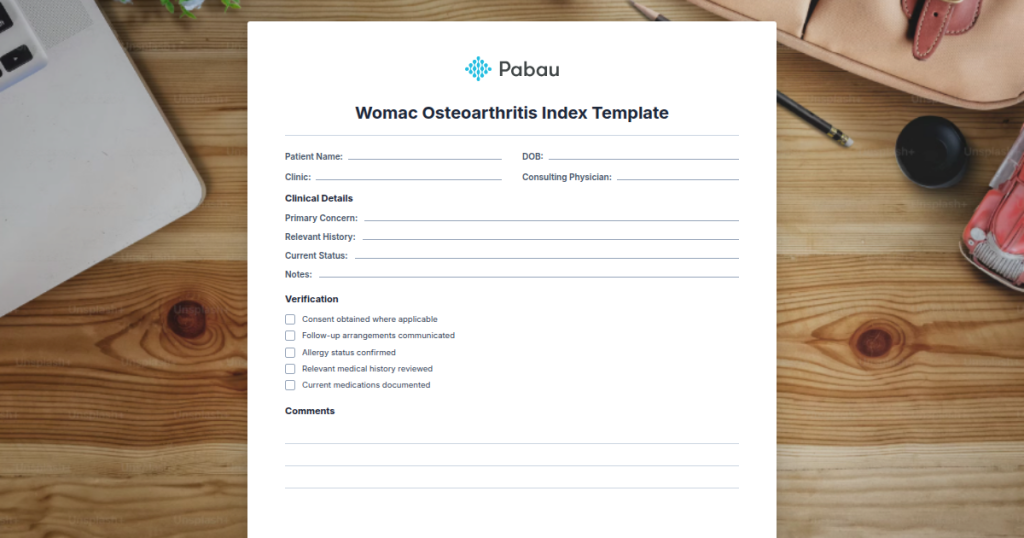
WOMAC Osteoarthritis Index Template
Download Your Free WOMAC Osteoarthritis Index Template The Western Ontario and M...

April 9, 2026


Buy now, pay later is now available in Pabau

An edema nursing care plan template provides structured assessment, NANDA-I diagnosis, and intervention protocols for managing fluid volume excess across all clinical settings
The edema grading scale (1+ to 4+) is the standardised assessment tool for pitting edema documentation and monitoring response to interventions
Common nursing diagnoses for edema include Excess Fluid Volume and Risk for Skin Breakdown, each requiring specific measurable outcomes and evidence-based interventions
Digital care plan templates streamline documentation workflows while supporting compliance with clinical standards and patient safety requirements
An edema nursing care plan template is a structured clinical document that guides systematic assessment and management of patients with fluid retention. The template provides a framework for identifying underlying causes of edema, documenting patient presentation, and implementing evidence-based digital forms to capture assessment data efficiently.
This edema nursing care plan template aligns with NANDA-I nursing diagnosis taxonomy, ensuring standardised language across care teams. Nurses use it to move beyond general observations into precise, measurable clinical findings. The template captures patient information, relevant medical history, allergies, medications, subjective and objective assessment data, duration and location of edema, and aggravating or relieving factors.
Legally and clinically, an edema care plan template documents informed clinical decision-making. It demonstrates that the nursing team has systematically assessed the patient, identified specific problems, set realistic goals, and selected appropriate interventions. This documentation protects both the patient and the practice by creating an auditable record of care delivery aligned with professional nursing standards.
A ready-to-use care plan template covering patient assessment, NANDA-I nursing diagnoses, goals and expected outcomes, evidence-based interventions with rationales, and evaluation protocols for systematic edema management.
Download templateThe edema nursing care plan template is designed for rapid integration into your clinical workflow. Follow these five operational steps to complete the plan effectively.
This template applies across multiple healthcare settings and nursing roles. Acute care nurses on medical-surgical units use it for post-operative patients, heart failure admissions, and renal disease management. Community health nurses implement it for home-based monitoring of chronic edema in elderly or diabetic populations. Occupational and physical therapy clinics use the template to document fluid management as part of rehabilitation protocols. Long-term care facilities apply it to prevent skin breakdown in immobilised residents. Private practice nurses managing IV therapy, lymphedema, or post-surgical care benefit from structured assessment and goal-tracking frameworks the template provides.
A structured care plan template transforms edema management from reactive observation into proactive, evidence-based practice. Standardised documentation reduces gaps in clinical communication. When a nurse documents using NANDA-I language and the 1+ to 4+ grading scale, the next shift immediately understands severity and trend. This clarity accelerates intervention adjustments and prevents complications like deep vein thrombosis (DVT) or skin ulceration.
Compliance and audit readiness improve significantly. Regulatory bodies like The Joint Commission and CMS expect care plans to demonstrate assessment, diagnosis, goal-setting, and intervention selection. A completed template serves as proof of systematic clinical reasoning. Liability risk decreases because the plan documents why specific interventions were chosen and what outcomes were monitored.
Documentation clarity also supports patient education. When nurses reference the care plan during patient rounds, patients understand what symptoms to report, why daily weights matter, and what dietary changes support fluid balance. This transparency improves treatment adherence and patient engagement.
The type of edema directly influences intervention selection and prognosis, so the care plan template requires accurate differentiation. Pitting edema (associated with fluid volume excess, cardiac or renal failure, venous insufficiency) leaves a visible indentation when finger pressure is applied. Non-pitting edema (linked to lymphatic obstruction, inflammation, or lipedema) does not leave an indentation and typically requires different management strategies like compression garments, manual lymphatic drainage, or elevation.
Document the type explicitly in your assessment section. If pitting, record the grading. If non-pitting, note the texture (brawny, firm, boggy) and distribution pattern. This distinction ensures your nursing interventions align with underlying pathophysiology rather than treating all swelling identically.
The most frequently applied NANDA-I diagnosis is Excess Fluid Volume, defined as an isotonic fluid retention exceeding the body’s physiological needs. Expected outcomes include weight reduction toward baseline (typically 0.5-1 kg per day during diuretic therapy), gradual resolution of pitting edema (measurable by grading scale reduction), and maintenance of respiratory rate between 12-20 breaths per minute (indicating absence of pulmonary edema). A secondary diagnosis often includes Risk for Skin Breakdown, with outcomes focused on maintaining intact skin without erythema or ulceration despite ongoing edema. Interventions for this diagnosis include positioning changes every 2 hours, moisture barriers for skin folds, and daily assessment.
Use AI-assisted documentation tools to capture assessment findings quickly, ensuring that outcome statements remain specific and measurable rather than vague. This supports real-time evaluation of whether interventions are working.
Integrating the edema nursing care plan template into daily clinical practice requires team training and systems support. Nurses must understand when to complete the template (admission for acute edema, initial assessment for chronic management), how to gather objective data consistently (circumference measurements using the same landmarks and tape measure), and how to evaluate whether interventions are achieving measurable outcomes by discharge or at specified review intervals.
Electronic systems that embed this template into patient records reduce transcription errors and ensure data persists across shifts. When multiple nurses reference the same documented assessment and interventions, patient safety improves because changes in condition are detected against a clear baseline rather than from memory.
Many nurses complete the template as a documentation task rather than a clinical reasoning tool. Avoid copying outcomes from textbooks without making them patient-specific. Instead of “Patient will have reduced edema,” specify “Patient will demonstrate 2 cm reduction in bilateral ankle circumference by day 3 post-operatively.” Generic goals provide no measurable benchmark for evaluating care effectiveness.
A second common error is selecting interventions without documenting the rationale. If the plan states “Elevate extremities,” add why: “Elevation above heart level promotes venous return and counteracts hydrostatic pressure driving fluid into interstitial spaces.” Rationales guide nursing students, support handoffs, and justify care decisions during audits. They also signal professional clinical thinking rather than rote task completion.
Systematic edema assessment and management rely on structured documentation. The edema nursing care plan template transforms fluid retention from a general observation into a precise clinical problem with measurable outcomes and evidence-based interventions. By using NANDA-I diagnoses, pitting edema grading, and outcome-focused planning, nurses deliver safer care and prevent complications like skin breakdown or undetected pulmonary edema. Book a demo to see how digital practice management systems embed care plan templates directly into patient workflows, reducing time spent on documentation while improving clinical quality and compliance.
Reassess daily in acute settings. Measure circumference at the same time each day (morning before activity), use identical anatomical landmarks, and update the grading scale. In chronic care, reassess weekly unless condition changes. Document any trend (improving, stable, worsening) and adjust interventions accordingly. If edema worsens despite interventions, escalate to the clinical team for diagnostic review.
Peripheral edema (limbs, sacral area) uses the 1+ to 4+ grading scale and focus on skin integrity and mobility. Pulmonary edema is a medical emergency requiring immediate respiratory assessment, oxygen saturation monitoring, and orthopneic positioning. Care plans for pulmonary edema prioritise airway clearance and breathing effectiveness, not limb measurement. Both stem from fluid volume excess but require distinct interventions.
Use the template as a framework but customise diagnoses, outcomes, and interventions to each patient. Heart failure edema may require strict I&O monitoring and diuretics. Post-operative edema may focus on early mobility and compression. Renal or hepatic edema may include dietary sodium and protein considerations. The template structure remains consistent, but content reflects the underlying cause and patient goals.
Document the specific intervention refused, the reason given (if stated), education provided about consequences, and the patient’s understanding. Example: “Patient refuses elevation due to discomfort. Educated regarding venous return benefits. Patient states preference to remain flat. Nursing plan continues monitoring and reassessment.” This protects both patient autonomy and the clinical record. Reassess readiness to accept interventions at the next encounter.