Mental Health Mental Health & Therapy
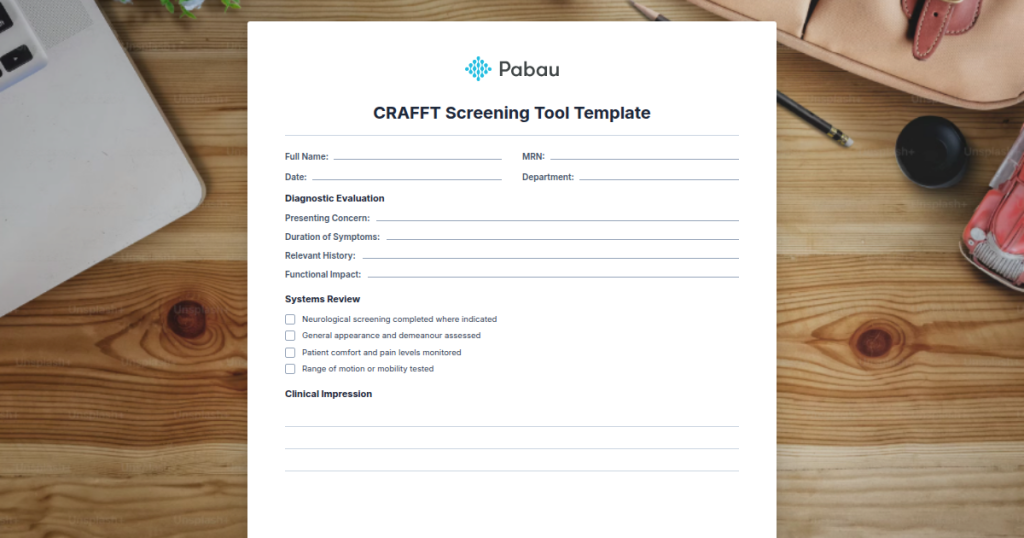
CRAFFT Screening Tool Template
The CRAFFT Screening Tool Template is a clinically validated instrument designed...

March 17, 2026


Buy now, pay later is now available in Pabau

Systematically screen for GAD using all DSM-5 diagnostic criteria
Track worry duration, triggers, and functional impact in one structured form
Reduce assessment time while strengthening compliance documentation
The DSM-5 Generalized Anxiety Disorder Checklist Template is a clinician-focused assessment form designed to systematise the screening and diagnostic evaluation of generalised anxiety disorder in clinical practice. This template aligns directly with diagnostic criteria from the Diagnostic and Statistical Manual of Mental Disorders, Fifth Edition, ensuring your assessments meet current clinical standards. For practitioners across mental health clinics, therapy practices, psychiatry offices, and counselling services, a structured checklist removes guesswork from GAD screening and creates audit-ready documentation. This article explains what the template covers, how to implement it in your clinical workflow, and why systematic assessment improves both patient outcomes and regulatory compliance.
The DSM-5 Generalized Anxiety Disorder Checklist is ready to download and deploy in your clinic today. This ready-to-use assessment form captures all essential diagnostic information: patient worry patterns over the past six months, physical symptoms experienced (muscle tension, sleep disturbance, restlessness, fatigue, difficulty concentrating, irritability), impact on work and social functioning, and screening for differential diagnoses. Use this template at the first appointment or during follow-up reviews to document structured mental health assessment aligned with clinical guidelines.
A comprehensive, clinician-ready assessment form that structures GAD screening across all DSM-5 diagnostic criteria. Includes worry duration tracking, physical symptom assessment, functional impairment evaluation, and differential diagnosis support.
Download templateGeneralised Anxiety Disorder is defined by persistent, excessive worry lasting six months or more. The DSM-5 criteria require that patients experience worry they cannot control, affecting multiple life areas, accompanied by at least three physical or cognitive symptoms. A structured checklist template transforms this diagnostic framework into a systematic clinical tool.
Rather than relying on open-ended notes or memory-based recall, clinicians complete a form that methodically documents each diagnostic criterion. This approach reduces the risk of missing criteria, accelerates the diagnostic process, and creates consistent records suitable for regulatory review or treatment planning handover. The American Psychiatric Association (APA) publishes the DSM-5 diagnostic standard; a good checklist template operationalises those criteria into actionable clinical steps.
Mental health clinics, therapy practices, psychiatric offices, psychology clinics, and counselling services all benefit from structured GAD assessment. Individual therapists running solo practices use the checklist to differentiate GAD from other anxiety presentations-social anxiety, panic disorder, phobias-and to track treatment response over time.
Multi-therapist clinics deploy the template across all clinicians to ensure consistent diagnostic standards, reducing variability and supporting supervision. Primary care practitioners and general practice teams screen for GAD in routine consultations, using the checklist to determine when specialist referral is indicated. Occupational therapists and speech pathologists working with patients who present with anxiety-driven communication or functional challenges use the form to document the underlying anxiety diagnosis.
Structured assessment templates deliver operational and regulatory advantages. Diagnostic accuracy improves when all DSM-5 criteria are systematically evaluated rather than based on clinical impression alone. Assessment time decreases; clinicians complete the checklist methodically in 10-15 minutes rather than crafting custom notes.
Documentation consistency strengthens across your team when every clinician captures the same information, supporting supervision and reducing gaps. Regulatory compliance is auditable; the CQC and NHS England expect evidence of standardised assessment tools in mental health services. A completed checklist demonstrates diagnostic rigour during inspections. Treatment planning becomes more precise when the baseline assessment captures functional impairment and symptom severity; clinicians measure progress against this documented baseline.
Billing and coding accuracy improves when the checklist maps to ICD-10 F41.1 (Generalised Anxiety Disorder) with supporting documentation of the six-month duration criterion and functional impact.
Combine your DSM-5 checklist with AI-powered clinical documentation to automatically draft a summary note from completed form data. This eliminates manual transcription, reduces clinician fatigue, and accelerates the documentation workflow without sacrificing diagnostic detail.
Intake Workflow: Deploy the checklist at the first appointment or as a pre-appointment form. Patients or clinicians complete it before the consultation, allowing the appointment to focus on treatment planning rather than diagnostic exploration.
Follow-Up Assessment: Repeat the checklist at intervals-monthly, quarterly, or before treatment reviews-to measure symptom change and functional improvement. Track worry scores, symptom counts, and impairment ratings over time to demonstrate treatment efficacy.
Handover and Referral: When transferring care to a specialist or secondary service, include the completed checklist as part of the referral documentation. It communicates the baseline diagnostic picture and supports clinical continuity. Mental health EMR systems designed for therapy practices store completed checklists securely and flag high-risk patients for immediate review.
Many mental health practices struggle to balance thorough assessment with time constraints. Pabau’s integrated clinic management system embeds assessment templates directly into your workflow, reducing paperwork and accelerating diagnosis. Book a demo to see how structured forms streamline both clinical documentation and patient experience.
GAD shares symptoms with other anxiety disorders and medical conditions. A comprehensive checklist distinguishes GAD from Panic Disorder (which centres on acute panic attacks rather than persistent worry), Social Anxiety Disorder (where worry focuses on social judgment), Specific Phobias (worry tied to one object or situation), and Post-Traumatic Stress Disorder (linked to trauma history).
The DSM-5 Generalized Anxiety Disorder Checklist Template includes screening questions to rule out these presentations and clarify diagnosis. Medical causes like hyperthyroidism, caffeine sensitivity, or medication side effects can mimic GAD; the template prompts clinicians to review medical history and current medications. Including these screening elements in your assessment supports diagnostic confidence and prevents misdiagnosis. NICE clinical guidelines recommend this level of differential diagnostic assessment for all anxiety presentations.

Need to automate clinical note generation from assessment forms? Echo AI generates structured clinical summaries from completed checklists, eliminating manual documentation time.
Looking to store and manage templates across your entire team? Digital Forms deploys assessment templates to all clinicians, tracks completion rates, and integrates responses into client records.
Want to benchmark your clinic’s GAD assessment practices? Mental Health EMR Software provides dashboards showing assessment completion, diagnostic distribution, and treatment outcomes across your practice.
The DSM-5 Generalized Anxiety Disorder Checklist Template transforms diagnostic assessment from an art into a science. By systematically evaluating all DSM-5 criteria-worry duration, uncontrollability, physical symptoms, and functional impairment-clinicians reduce diagnostic uncertainty and create audit-ready documentation.
Whether you operate a solo therapy practice or a multi-site mental health clinic, deploying a structured template improves diagnostic accuracy, accelerates assessment, and strengthens regulatory compliance. Download the template today and integrate it into your intake process. Your patients benefit from faster diagnosis, and your practice gains documentation that demonstrates clinical rigour during regulatory review.
No. The checklist is a screening and diagnostic assessment tool, not a substitute for comprehensive psychiatric evaluation when indicated. Use it to systematise GAD assessment; refer to psychiatry or higher-care services when complex presentations, safety concerns, or comorbidity require specialist input.
Many clinics re-administer the checklist monthly or quarterly to track symptom change and treatment response. At minimum, repeat it at key points-before significant treatment changes, at mid-treatment review, and at discharge. Tracking change over time provides objective evidence of progress.
Yes. Many practices deploy the checklist as a self-report form prior to appointment or during virtual pre-assessment. Clinician review and clarification during the appointment ensures accuracy and allows exploration of ambiguous responses.
The DSM-5 diagnosis of Generalised Anxiety Disorder aligns with ICD-10-CM code F41.1 (Generalised Anxiety Disorder). The checklist documents the criteria required to justify this coding for billing and compliance purposes.
NICE guidelines for anxiety disorder assessment recommend structured, criterion-based tools. The CQC expects evidence of standardised assessment in mental health services. A completed checklist demonstrates both diagnostic rigour and regulatory compliance.
Most clinics can use the standard template as-is. If you need customisation-additional screening items, clinic-specific consent language, or integration with your electronic health record system-consult your Pabau implementation specialist or contact support.