ADHD Assessment Mental Health & Therapy
Neurodivergent Test Template
A neurodivergent test template is a clinician-facing screening form that healthc...

April 3, 2026


Buy now, pay later is now available in Pabau

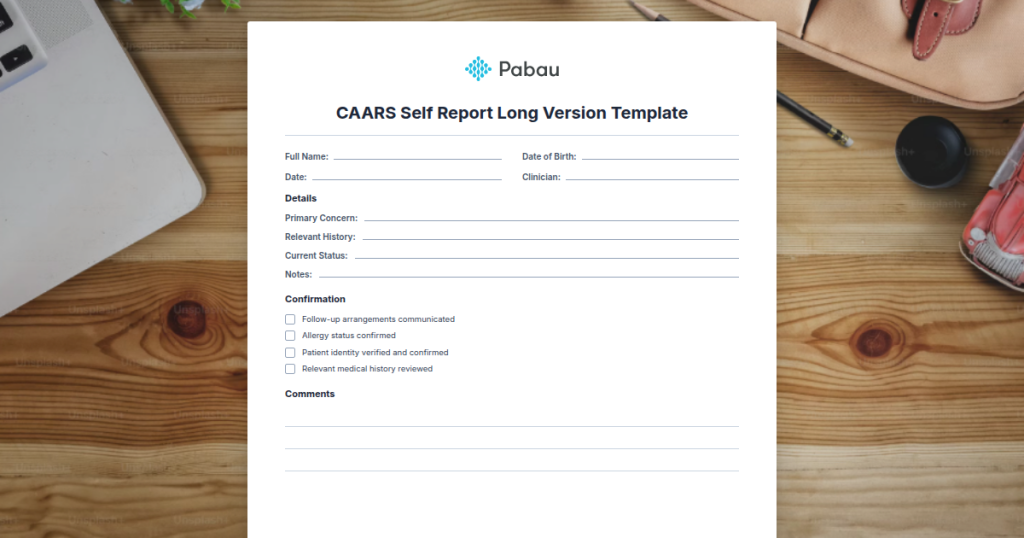
The CAARS Self Report Long Version is a 66-item assessment tool designed to evaluate ADHD symptoms in adults using DSM-5 aligned criteria.
Clinical interpretation requires understanding score ranges, subscale profiles, and integration with comprehensive diagnostic evaluation.
Digital administration through structured forms improves consistency, reduces documentation burden, and enables automated score calculation.
Standardised assessment supports differential diagnosis, treatment planning, and longitudinal progress monitoring in mental health practices.
Adult ADHD assessment requires systematic evaluation of inattention, hyperactivity-impulsivity, and executive dysfunction across multiple life domains. The CAARS Self Report Long Version Template provides a standardised framework for gathering this information directly from patients. This comprehensive questionnaire, containing 66 structured items, enables mental health clinicians to conduct thorough symptom screening and generate reliable baseline data for diagnosis and treatment monitoring.
A standardised 66-item self-report questionnaire for comprehensive ADHD assessment in adults. Covers inattention, hyperactivity-impulsivity, and executive function domains aligned with DSM-5 diagnostic criteria. Includes scoring interpretation guidance and clinical applications.
Download templateThe CAARS (Conners Adult ADHD Rating Scale) Self Report Long Version is a diagnostic assessment tool designed by Multi-Health Systems (MHS) to evaluate attention-deficit/hyperactivity disorder symptoms in adults aged 18 years and older. The tool measures persistent patterns of inattention, hyperactivity-impulsivity, and related executive function difficulties using 66 items rated on a 4-point scale ( = not at all, 1 = just a little, 2 = pretty much, 3 = very much).
This assessment aligns with DSM-5 diagnostic criteria for ADHD, enabling clinicians to document symptom severity across inattention and hyperactivity-impulsivity domains. The long-form design captures comprehensive behavioural and cognitive symptoms, making it suitable for initial diagnostic evaluation rather than screening alone. Results are reported as raw scores, T-scores, and percentile ranks for clinical interpretation.
Clinically, the CAARS Self Report Long Version serves multiple purposes: differential diagnosis to rule out other conditions presenting with similar symptoms, baseline establishment before treatment initiation, and progress monitoring during pharmacological or psychological interventions. The assessment framework supports informed decision-making about whether further evaluation, medication trial, or psychotherapy is warranted.
Administering the CAARS Self Report Long Version requires structured workflow management and careful documentation. Here are the five operational steps clinicians follow when implementing this assessment in practice:
The CAARS Self Report Long Version template works best when integrated into your clinic’s broader assessment workflow. Automated clinical documentation tools can generate interpretation summaries after scoring, reducing clinician documentation time while ensuring consistency across all ADHD assessments.
The CAARS Self Report Long Version serves multiple clinical practice types and professional settings where ADHD assessment is a routine or emerging service line.
The CAARS Self Report Long Version is particularly valuable for adult-focused practices where baseline ADHD symptomatology establishes treatment eligibility, informs medication selection, or documents disability for workplace accommodation requests. The standardised format supports medical necessity documentation and regulatory compliance across all these settings.
Standardised assessment framework. The CAARS Long Version uses validated, normed items aligned with DSM-5 ADHD criteria. This standardisation enables comparison across patients, over time, and against published population norms. Clinicians can defend assessment decisions and treatment recommendations with reference to evidence-based metrics rather than subjective impression alone.
Comprehensive symptom coverage. Sixty-six items capture inattention, hyperactivity-impulsivity, and executive function dimensions across work, home, and social domains. This breadth reduces risk of symptom underrecognition, particularly in high-functioning adults who mask ADHD in some settings while struggling in others. The long-form design supports differential diagnosis by distinguishing ADHD from anxiety, mood disorders, or situational stress.
Regulatory and insurance compliance. Standardised assessment documentation strengthens claims for ADHD diagnosis, supports medical necessity arguments for treatment authorisation, and provides defensible records during audits or complaints. The CAARS is widely recognised by insurers and regulatory bodies, reducing claim denials based on diagnostic sufficiency concerns.
Treatment monitoring and adjustment. Repeat CAARS administrations at regular intervals (6-8 weeks) quantify treatment response. Clinicians can objectively demonstrate whether medication dosing is effective, whether psychotherapy is producing change, or whether alternative approaches are warranted. This data-driven approach improves clinical decision-making and patient engagement in treatment planning.
Workplace accommodation documentation. Objective CAARS scores support workplace accommodation requests, disability determinations, and reasonable adjustment applications. Employers and disability assessors value standardised quantitative evidence; raw clinical opinions carry less weight in formal proceedings.
Ready to streamline ADHD assessment in your clinic? Pabau’s digital forms and clinical documentation tools integrate CAARS administration, automated scoring, and clinical interpretation into a single workflow. Book a demo to see how practices reduce assessment time while improving diagnostic accuracy and patient engagement.

Automate ADHD assessment workflows with digital forms, automated scoring, and AI-powered documentation summaries.

Accurate CAARS scoring requires methodical item summation and normative comparison. Raw scores are converted to T-scores (mean 50, standard deviation 10) and percentile ranks based on the respondent’s age and gender. A T-score of 60 or above generally indicates clinically elevated symptoms; 65+ suggests marked impairment warranting intervention.
Inattention subscale elevation (particularly ≥ 65) suggests difficulties with focus, organisation, and task completion. Hyperactivity-impulsivity elevation reflects restlessness, rushed decision-making, or interrupt patterns. Clinically, inattention-elevated profiles are associated with procrastination and underperformance; hyperactivity-elevated profiles with relationship friction and occupational volatility.
Interpretation must account for setting-specific symptom expression. Many adults show ADHD symptoms primarily in unstructured environments or monotonous tasks; structured work may mask symptoms. Distinguish ADHD from anxiety-driven restlessness, mood disorder-related concentration loss, or substance use effects. Consulting normative data for the patient’s specific age group ensures developmentally informed interpretation.
Modern mental health practices increasingly use electronic health records and digital assessment platforms to reduce administrative burden and improve data consistency. The CAARS Self Report Long Version integrates seamlessly into digital workflows when administered through structured online forms that enforce consistent item presentation and auto-calculate scores.
Key integration points include: pre-appointment digital administration (reducing in-session time), automatic score calculation (eliminating manual arithmetic errors), EHR embedded storage (supporting audit trails and continuity), and longitudinal tracking (enabling visual trend graphs for patient engagement). Practices using integrated systems report 30-40% reduction in assessment documentation time and higher patient completion rates due to convenient online access.
Digital administration also supports automated clinical workflows – for instance, flagging scores above threshold for clinician review, automatically scheduling follow-up assessments, or triggering referral prompts when indicated. These efficiencies allow clinicians to focus on interpretation and treatment planning rather than administrative logistics.

Need a structured framework for ADHD diagnostic interviews? Psychiatric Evaluation Template provides a comprehensive intake structure that complements CAARS assessment with developmental history and functional impact narratives.
Looking for resources on clinical documentation best practices? Safer Clinical Notes outlines documentation standards that protect practices during regulatory reviews and support diagnostic clarity in medical records.
Want to explore how other mental health practices manage ADHD assessments? ADHD Clinic Software shows how practices streamline assessment workflows and improve patient outcomes through integrated assessment tools.
The CAARS Self Report Long Version Template provides a standardised, evidence-based foundation for adult ADHD assessment. By using a comprehensive 66-item questionnaire aligned with DSM-5 criteria, clinicians gather objective symptom data that informs diagnostic decisions, treatment planning, and progress monitoring. Digital integration reduces administrative friction while improving consistency and compliance documentation. Whether you’re initiating ADHD assessment services or refining existing protocols, the CAARS Long Version offers the clinical depth and regulatory defensibility that modern mental health practices require.
Most adults complete the questionnaire in 15-20 minutes. Digital administration using online forms may be slightly faster (15-18 minutes) compared to paper-based completion due to reduced navigation friction. Patients with ADHD-related reading difficulties or comorbid anxiety may require additional time; allow 25-30 minutes in appointment scheduling.
No. The CAARS provides quantified symptom data but must be integrated with developmental history, functional impairment assessment, ruling out medical/psychiatric mimics, and collateral information (e.g., school records, family interviews) for confident ADHD diagnosis. Use the CAARS as one component of comprehensive evaluation, not as a standalone diagnostic test.
Yes. Repeat administration at 6-8 week intervals quantifies symptom change during medication trials or psychotherapy. T-score reductions of 10+ points indicate clinically meaningful improvement. This objective tracking supports medication adjustment decisions and patient engagement in treatment planning.
The CAARS is proprietary to Multi-Health Systems (MHS). Clinical use within licensed healthcare settings is permitted under standard assessment licensing agreements. Digital administration may require additional licensing; contact MHS for current licensing terms if using assessment software or online administration platforms.
The long form provides comprehensive symptom coverage across inattention, hyperactivity-impulsivity, and executive function. The short form is quicker but less sensitive for diagnostic refinement. Use the long form for initial diagnosis; the short form suits screening or progress monitoring once diagnosis is established.