Hormone Replacement Therapy (HRT) Reproductive & Sexual Health
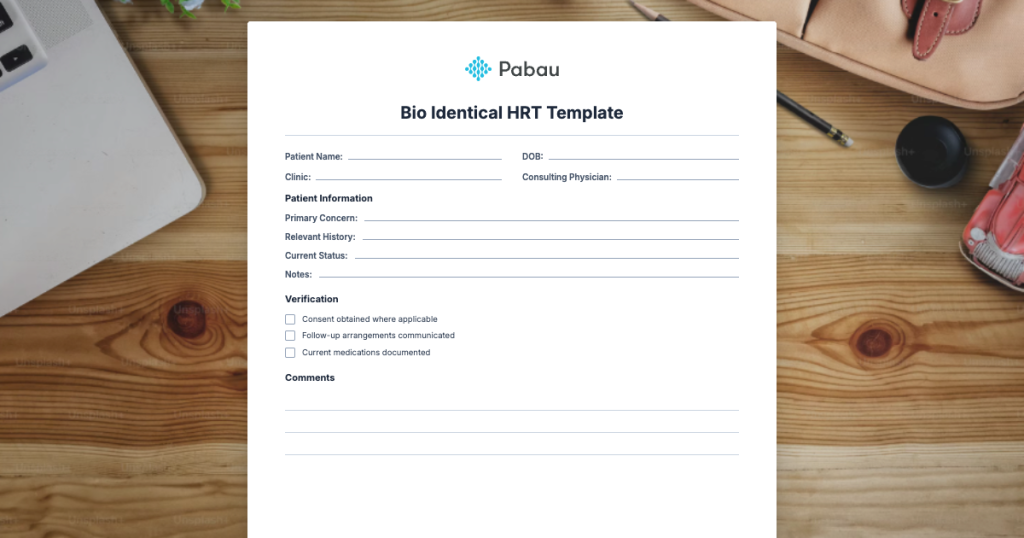
Bio Identical HRT Template
Bioidentical hormone replacement therapy (BHRT) offers a personalised approach t...

February 26, 2026


Buy now, pay later is now available in Pabau

Standardises patient assessment across bioidentical HRT protocols
Documents medical history and symptom baselines comprehensively
Ensures informed consent and treatment safety
Integrates with compounding pharmacy workflows seamlessly
Supports regulatory compliance and audit readiness
Bioidentical hormone replacement therapy (BHRT) offers a personalised approach to managing hormonal imbalance, using hormones chemically identical to those naturally produced by the human body. Because each patient’s needs differ significantly-based on age, symptom severity, medical history, and blood test results-clinics need a structured framework to document assessments and treatment plans consistently. A well-designed bioidentical hrt template provides exactly this: a comprehensive patient intake and consultation form that captures essential clinical data while ensuring informed consent and compliance.
This downloadable form addresses a key operational challenge for HRT clinics: streamlining patient intake without sacrificing clinical detail. Rather than relying on generic medical forms, a BHRT-specific template guides clinicians through symptom assessment, medical history review, blood test documentation, and contraindication screening-all in a sequence that supports safe, evidence-informed treatment planning. Using this template in your practice standardises the consultation process, reduces administrative burden, and strengthens your clinic’s compliance posture.
A comprehensive patient intake and consultation form for bioidentical hormone replacement therapy, covering medical history, symptom screening, blood test documentation, treatment consent, and personalised hormone protocol planning.
Download templateA bioidentical HRT template is a clinical documentation form used by healthcare practitioners to systematically assess patients considering or undergoing hormone replacement therapy with body-identical hormones. Unlike synthetic hormones (derived from pregnant mare urine) or semi-synthetic alternatives, bioidentical hormones are molecularly identical to those naturally produced by the human body-oestrogen, progesterone, and testosterone. This distinction matters clinically and legally: practitioners must document that they’ve discussed the evidence, risks, and alternatives with each patient before initiating treatment.
The template serves several essential functions. First, it standardises patient assessment, ensuring clinicians consistently evaluate medical history, current symptoms, and baseline blood hormone levels before prescribing. Second, it documents informed consent-a legal and ethical requirement acknowledging that the patient understands the treatment rationale, potential benefits, known risks (including cardiovascular and cancer risk considerations), and any absolute or relative contraindications. Third, it creates an audit trail that demonstrates compliance with professional standards and regulatory expectations.
Regulatory context varies by jurisdiction. In the UK and Europe, the American College of Obstetricians and Gynaecologists (ACOG) and the International Menopause Society both emphasise individualised assessment and informed consent for any HRT. The FDA regulates compounded bioidentical hormones under specific guidelines, and clinics must ensure their documentation reflects awareness of regulatory standards for compounding pharmacies. Patient consent forms should reference screening for absolute contraindications (active or recent hormone-sensitive cancer, uncontrolled hypertension, active venous thromboembolism) and discussion of relative contraindications (family history of thrombosis, migraine with aura, smoking status).
A well-designed template reduces clinical risk by embedding these requirements directly into the patient intake workflow, making compliance automatic rather than aspirational.
This bioidentical HRT template guides clinicians through a structured five-step intake and assessment workflow. Digital form completion supports this process by automating template distribution and integrating patient responses directly into clinical notes. Follow these steps during the patient’s initial consultation to capture complete information and ensure informed consent documentation.
This structured sequence ensures no clinical information is missed while creating a defensible audit trail.

Streamline bioidentical HRT patient intake and follow-up documentation with Pabau's integrated digital forms and clinical workflow tools. Automate template completion, link assessment data directly to treatment planning, and centralise hormone protocol management-all from one platform.

This bioidentical HRT template is designed for any healthcare practice offering hormone replacement therapy with body-identical hormones. Several clinic types benefit most directly:
Specialist HRT clinics rely on standardised intake processes to manage high patient volumes efficiently. The template ensures consistent symptom assessment and informed consent documentation across multiple practitioners and locations-critical for multi-site HRT services.
Functional medicine practitioners often treat hormonal imbalance as part of whole-system optimisation. This template supports their workflow by capturing detailed baseline data (medical history, current symptoms, lab results) that informs individualised treatment planning and allows practitioners to track improvements over time.
Menopause-focused practices see women across perimenopause and postmenopause stages. The template’s menstrual history and symptom assessment sections are purpose-built for this population, ensuring clinicians gather the information needed to prescribe appropriately and monitor treatment efficacy.
While dermatology clinics typically focus on skin health, many cosmetic and aesthetic practitioners manage hormone-related skin conditions (acne, rosacea exacerbation, collagen loss). Some offer adjunctive HRT services for clients seeking comprehensive anti-ageing protocols. This template supports that integration.
Mood symptoms-depression, anxiety, irritability-are common presentations of hormonal imbalance, especially perimenopause. Mental health practitioners treating women in this age group benefit from BHRT assessment and treatment literacy. The template documents the hormone-mood connection explicitly.
Testosterone replacement therapy (TRT) follows similar assessment and informed consent principles as BHRT for women. Men’s health and longevity clinics use this template to standardise testosterone assessment, contraindication screening, and treatment planning.
Using a standardised bioidentical HRT template delivers concrete operational and clinical benefits:
The template embeds systematic contraindication screening directly into the intake workflow. By documenting absolute contraindications (active hormone-sensitive cancer, uncontrolled hypertension, recent venous thromboembolism) and relative contraindications upfront, clinicians reduce the risk of inappropriate prescribing. This structured approach supports evidence-based decision-making and defensible clinical judgment.
A documented template that includes patient consent signatures, risk acknowledgment, and discussion of alternatives creates an audit trail demonstrating your clinic met informed consent standards. This is invaluable in regulatory reviews, complaints investigations, or litigation scenarios. Rather than relying on memory or informal notes, a signed template provides objective proof of patient education and agreement.
Multi-practitioner clinics often struggle with inconsistent patient assessment. A template standardises which questions are asked, in what order, and how results are recorded. This consistency improves data quality, makes it easier to compare baseline and follow-up assessments, and reduces the risk of missing critical information.
Pre-printed or digital templates eliminate the need for clinicians to invent assessment questions during consultations. Patients can complete demographic and symptom sections before the appointment, freeing clinical time for face-to-face discussion of findings and treatment planning. Digital form completion further streamlines this process and integrates data directly into your clinical records.
A comprehensive intake template captures baseline data (symptoms, lab values, medication list) that informs initial dosing and individualisation. At follow-up appointments, clinicians can reference the same questions to measure symptom changes objectively, validating treatment efficacy and supporting dose adjustments.
Regulatory bodies (CQC in the UK, state medical boards in the US) expect clinics to demonstrate structured assessment and informed consent. A standardised template shows you follow best practices and maintain consistent standards-exactly what auditors and inspectors look for.
Tailor the template to your specific clinical population. If your clinic treats primarily menopausal women, emphasise the menstrual history and hot flash severity scale. If you manage men’s testosterone replacement, modify symptom sections to include energy, libido, and mood symptoms relevant to male andropause. Customisation increases relevance and completion rates without losing the standardisation benefits.
Contraindication screening is the single most important safety step in bioidentical HRT assessment. A well-designed template separates absolute contraindications (conditions that preclude treatment entirely) from relative contraindications (conditions requiring modified dosing, closer monitoring, or specialist input).
These are conditions where HRT-regardless of formulation-carries unacceptable risk. They include active or recent (within 5 years) hormone-sensitive cancer (breast, endometrial, ovarian); uncontrolled or severe hypertension; active venous thromboembolism or unprovoked thrombosis within the past 3 months; and serious liver disease. Patients with any absolute contraindication should not receive HRT and should be counselled on alternative symptom management strategies.
These warrant careful evaluation, shared decision-making, and closer monitoring during treatment. Examples include family history of breast cancer (increased risk but not a prohibition), migraine with aura (associated with higher stroke risk, especially if combined with smoking or age >35), current smoking, uncontrolled diabetes, and personal history of thrombosis >3 months ago. Patients with relative contraindications may proceed with HRT after informed discussion of risk-benefit. Research shows micronized progesterone produces better outcomes with fewer side effects compared to synthetic progestins when prescribing for patients requiring careful risk management.
, often with adjustments to hormone type, dose, or delivery route (transdermal preferred over oral to reduce thrombotic risk).
Your template should ask about all major medical and surgical history, current medications (including herbal supplements), family history of cancer and thrombosis, and lifestyle factors (smoking, alcohol use). Document the patient’s responses explicitly. If any absolute contraindication is identified, document that you’ve discussed why HRT is not appropriate and explored alternatives. If a relative contraindication exists, document that you’ve reviewed the specific risks, discussed how monitoring will happen (blood pressure checks, lab reviews, symptom tracking), and obtained the patient’s informed consent to proceed.
This structure protects both patient safety and your clinic’s liability.
One of the greatest advantages of a structured bioidentical HRT template is its compatibility with compounding pharmacy systems. When your patient intake template captures specific data points-blood hormone levels, patient symptoms, medical history, preferred delivery routes-you create a seamless handoff to the compounding pharmacy preparing personalised hormone formulations.
Compounding pharmacists need precise information to prepare individualised bioidentical hormone combinations. Your template should document baseline hormone levels (oestrogen, progesterone, testosterone, and any other measured hormones), the lab that performed the testing, reference ranges used, and the date of testing. When this data flows directly from your template to the pharmacy-either via fax, email, or integrated digital system-there’s no ambiguity about which tests were done or what the results were. This reduces errors and speeds compounding.
Your template should include space for the practitioner’s prescribed hormone combination (e.g., “oestradiol 2 mg, progesterone 100 mg, testosterone 0.5 mg daily”), delivery route (oral, transdermal patch, cream, pellet implant), and any special instructions (timing relative to food, application sites, monitoring intervals). This becomes the prescription specification that the compounding pharmacy uses. If treatment needs adjustment, the follow-up template documents changes clearly, creating an audit trail.
Many clinics see patients 6-8 weeks after starting therapy to assess symptom response and tolerability, then annually thereafter. Your template should include sections for follow-up visits that mirror the initial assessment-same symptom scales, same contraindication checks, repeat blood work if indicated. This consistency allows you to compare baseline to follow-up objectively, document treatment efficacy, and adjust prescriptions with confidence.
Some patients work with multiple practitioners or switch compounding pharmacies. A portable, standardised template ensures all parties-your clinic, the patient, and any compounding pharmacy-operate from the same clinical baseline. This reduces duplication and ensures continuity of care.

Need to convert your BHRT template into a digital form? Digital Intake Forms & Patient Data Capture shows how to transform paper templates into interactive digital forms that feed directly into your patient records system.
Want to automate template distribution and completion tracking? Digital Forms for Healthcare Practices guides teams through setting up digital form workflows that save time and reduce manual data entry.
Looking to improve clinical documentation quality? Echo AI: Clinic Note Generation Software demonstrates how AI-assisted clinical note writing can streamline documentation of BHRT consultations and assessments, capturing key details automatically.
A well-structured bioidentical HRT template is foundational to safe, compliant, and efficient hormone replacement therapy practice. Whether you’re a specialist HRT clinic, a functional medicine practice offering hormonal support, or a women’s health provider expanding into BHRT, having a standardised intake and assessment form elevates your clinical standards while reducing administrative burden.
Download the free template above and customise it to match your practice setting, patient population, and specific clinical focus. If your patients are primarily menopausal women, emphasise menstrual history and hot flash assessment. If you treat men’s testosterone replacement, adjust symptom sections accordingly. The core structure-medical history, symptom assessment, lab documentation, contraindication screening, and informed consent-remains constant.
Once you’ve implemented the template, consider whether a digital version might further streamline your workflow. HRT clinic management software platforms can automate form distribution, track completion, and integrate patient responses directly into clinical notes and treatment planning. This progression from paper template to digital workflow represents the operational evolution that supports growing HRT practices.
Your patients deserve structured, thoughtful assessment. Your clinic deserves efficient, defensible documentation. This template delivers both.
Patients with active or recent hormone-sensitive cancer (breast, endometrial, ovarian), uncontrolled hypertension, active venous thromboembolism, or serious liver disease should not receive HRT. Patients with migraine with aura, smoking history, personal history of blood clots, or uncontrolled diabetes require specialist evaluation and may need modified treatment approaches.
Excessive progesterone can cause sedation, mood depression, bloating, breast tenderness, and irregular bleeding. Some patients report brain fog or reduced motivation. If a patient reports these symptoms, blood work to measure progesterone levels helps guide dose adjustment downward. This is why baseline and follow-up assessment is essential.
Many clinics import the PDF template into their practice management software as a digital form. When patients complete the form digitally, responses populate directly into the patient record, eliminating manual data entry. Some systems allow conditional logic, further streamlining the process.
Yes. The template’s core structure should remain constant for safety and compliance. However, you can modify symptom lists, add clinic-specific questions, adjust branding, or remove sections not relevant to your patient population.
Best practice calls for follow-up at 6-8 weeks to assess initial symptom response and tolerability, then at 3, 6, and 12 months. After the first year, annual follow-up is standard unless symptoms warrant more frequent review.