

Mental Health & Therapy Speech Therapy
Penetration Aspiration Scale Template
Penetration Aspiration Scale Template Overview The Penetration Aspiration Scale ...

March 17, 2026


Buy now, pay later is now available in Pabau

The Yerkes-Dodson Law explains how moderate stress enhances performance while too little or too much impairs it.
Clinicians can use this principle to help patients recognize optimal arousal levels for focus and productivity.
Understanding the stress-performance curve is vital in treating anxiety-related disorders and burnout.
Monitoring stress responses with psychological tools helps maintain optimal therapeutic outcomes.
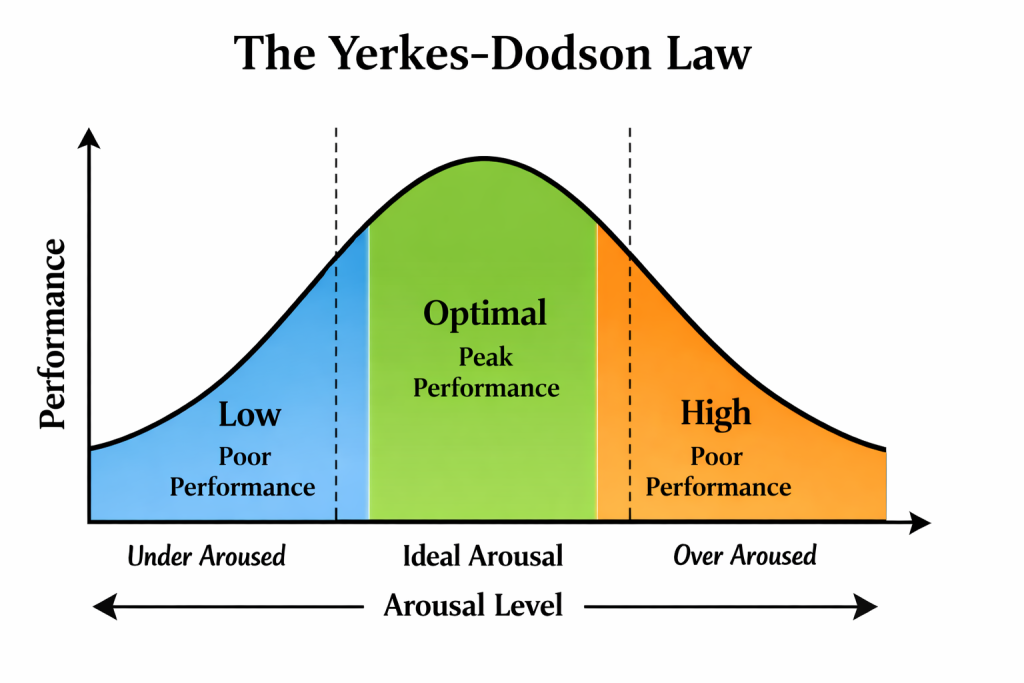
The Yerkes-Dodson Law is one of psychology’s foundational models describing the relationship between stress and performance.
Originally formulated by Robert Yerkes and John Dodson in 1908, it suggests that performance improves with physiological or mental arousal, but only up to a point.
In other words, while a certain amount of stress can be beneficial, beyond that threshold excessive stress or anxiety leads to a decline in performance.
As a result, this inverted U-shaped relationship underpins modern understanding of workplace efficiency, test performance, athletic output, and clinical anxiety management.
| Arousal Level | Typical Response | Performance Outcome |
|---|---|---|
| Low | Apathy, low motivation | Poor performance |
| Moderate | Focused, engaged, energetic | Optimal performance |
| High | Overwhelmed, anxious, fatigued | Performance declines |
Did You Know? Yerkes and Dodson’s 1908 experiments zapped mice with mild shocks to prove it: stress is like Goldilocks’ porridge—just right boosts your brainpower to peak performance, but too hot (or shocking) flips the switch to panic mode. Next time you’re cramming for a test, remember: optimal anxiety, not oblivion!
For mental health professionals, the Yerkes-Dodson Law provides a powerful model to explain to patients why some stress is not only inevitable but also necessary.
In many cases, patients who aim for a completely stress-free life often end up disengaged or unmotivated.
Conversely, those experiencing chronic anxiety may perform below their potential due to excessive arousal.
Therefore, helping clients find their ‘sweet spot’ of stress can improve productivity, emotional regulation, and resilience.

In practice, therapists and coaches can apply the Yerkes-Dodson principle in stress management and performance optimization programs.
For instance, by teaching patients to monitor physiological cues such as heart rate, muscle tension, and thought patterns, clinicians can help clients recognize when arousal is optimal versus excessive.
Additionally, cognitive-behavioral strategies, mindfulness, and biofeedback can support patients in maintaining balanced arousal levels that maximize concentration while simultaneously minimizing anxiety.
Importantly, not all clients have the same optimal stress threshold.
More specifically, personality, genetic predisposition, trauma history, and mental health conditions influence how stress affects performance.
For example, individuals with generalized anxiety disorder (GAD) or ADHD may reach their performance peak at lower stress levels.
As a result, clinicians should personalize interventions, ideally using assessment tools and validated psychometrics to identify a client’s ideal arousal zone.
The curve below shows how performance increases with stress up to an optimal point, after which it declines sharply due to excessive arousal or anxiety.
For clients struggling with chronic anxiety or burnout, clinicians can use structured interventions to realign stress levels:

Beyond therapy, the Yerkes-Dodson model is highly applicable to occupational and performance psychology.
For example, managers, HR specialists, and coaches can use the law to structure workloads, deadlines, and feedback systems that keep employees within their optimal stress range.
On the one hand, chronic under-stimulation can lead to disengagement; on the other hand, overpressure results in reduced creativity, decision fatigue, and absenteeism.
Digital platforms like Pabau’s client management tools can assist mental health professionals in tracking stress and performance metrics across sessions.
Anxiety scores, session outcomes, and client-reported data can be recorded securely in one central system, supporting GDPR-compliant data handling.
This approach simplifies progress tracking and encourages clearer collaboration between practitioner and client.

Clinicians can quantify arousal and performance levels through standardized psychological assessments, including:
By correlating assessment results with behavioral performance metrics, therapists can develop evidence-based stress optimization plans.
As stress monitoring becomes increasingly digitized, clinicians must ensure data privacy and ethical compliance.
Systems must follow global healthcare standards like GDPR in Europe and HIPAA in the United States.
Ensuring patient consent, maintaining transparency about data usage, and storing clinical information securely are non-negotiable aspects of digital practice management.
The Yerkes-Dodson Law highlights a fundamental truth for clinicians and clients alike: stress is not inherently negative. When managed properly, it becomes a catalyst for growth and achievement.
By understanding the physiological and psychological interplay between arousal and performance, mental health professionals can empower clients to harness stress constructively — enhancing productivity, emotional resilience, and overall wellbeing.