Primary & Preventive Care
Respiratory Failure Nursing Care Plan Template
A Respiratory Failure Nursing Care Plan Template provides clinicians with a syst...

March 17, 2026


Buy now, pay later is now available in Pabau

11-item standardised assessment measuring sitting balance in non-ambulatory patients
4-point Likert scale scoring system (0-3) quantifies balance deficits objectively
Free downloadable template integrates into clinic documentation workflows
Guides functional balance evaluation from static sitting to dynamic reaching tasks
Supports fall risk identification and rehabilitation progress monitoring
The sitting balance scale template is a standardised clinical assessment tool that enables physical therapy, occupational therapy, and rehabilitation clinics to evaluate sitting balance capacity in non-ambulatory and frail elderly patients. This proven assessment form measures postural control and dynamic balance through 11 functional items scored on a 4-point Likert scale, providing objective data to guide treatment planning, identify fall risk, and track rehabilitation outcomes over time.
A standardised 11-item clinical assessment tool that evaluates sitting balance and postural control in non-ambulatory and frail elderly patients using a 4-point Likert scale. The form guides clinicians through functional balance tasks including sitting unsupported, reaching, picking up objects, and dynamic weight shifting to assess balance deficits and monitor rehabilitation progress.
Download template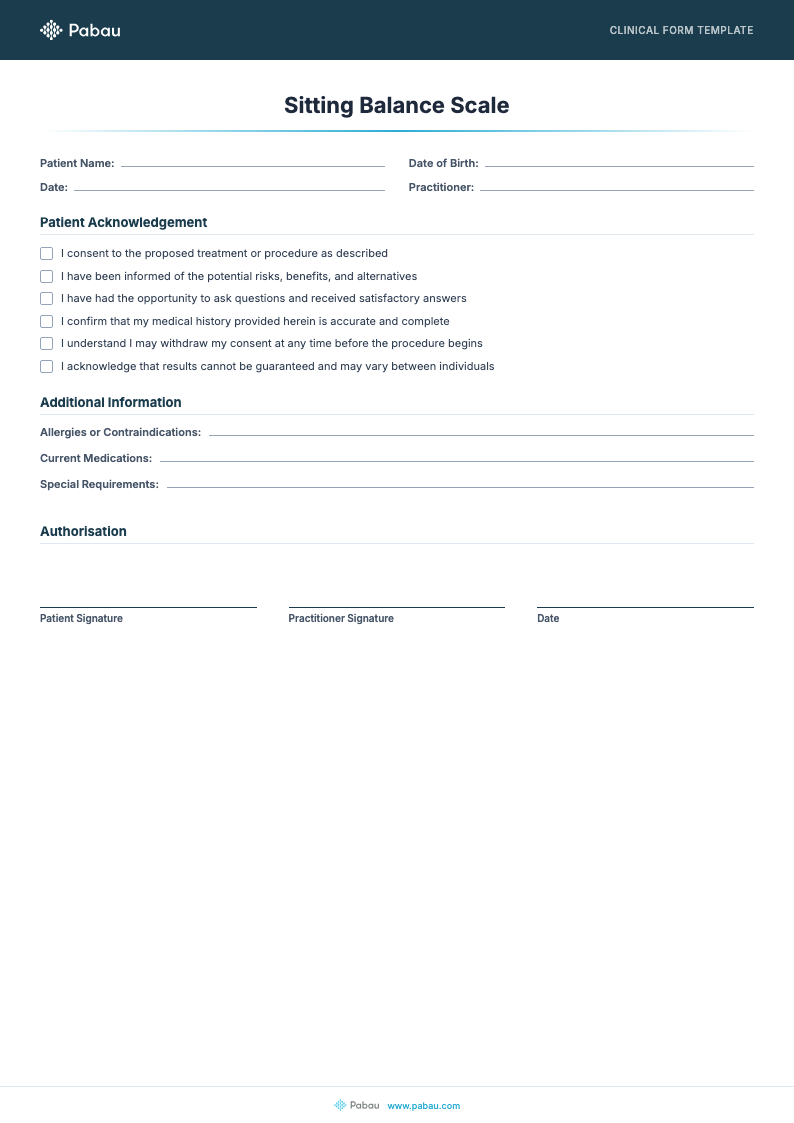
The Sitting Balance Scale (SBS) is a clinical measurement tool designed specifically for assessing balance capacity in older adults who are primarily non-ambulatory or have significant functional limitations. Unlike general balance assessments designed for standing patients, the sitting balance scale assessment evaluates postural control in seated positions-the functional context where many frail elderly patients spend the majority of their time.
The tool comprises 11 functional items, each scored on a 4-point Likert scale ranging from 0 (unable to perform task) to 3 (normal performance without loss of balance). Items progress in difficulty from static sitting unsupported on a hard surface through dynamic tasks including reaching to pick up objects from the floor, transferring between chairs, and maintaining balance against external perturbation. The total scale score ranges from 0 to 33, with higher scores indicating better sitting balance and postural control.
The sitting balance scale has strong clinical validity and is recognized by the American Physical Therapy Association (APTA) as an evidence-based measure for evaluating functional sitting balance. Rehabilitation clinics use this form to establish baseline balance capacity, set functional goals, and document progress during therapy for patients recovering from stroke, orthopaedic surgery, neurological conditions, and age-related functional decline.
Administering the sitting balance scale template requires a systematic, task-by-task approach to accurately assess each balance component. The following five-step process guides clinicians through the assessment workflow.
Complete documentation of item-level scores in the template allows clinicians to identify specific balance deficits (e.g., reactive balance loss vs. reaching difficulty) and target therapy accordingly. Repeat assessments at regular intervals-typically every 2-4 weeks during active rehabilitation-to objectively track functional progress and adjust treatment plans based on measurable change.

Pabau's digital forms integrate sitting balance scale templates directly into patient records with automated scoring and progress tracking. Reduce paperwork, link assessment results to treatment planning, and generate instant outcome reports.

The sitting balance scale template is essential for clinics serving populations with significant balance impairment and limited functional mobility. Physical therapy clinics working with stroke survivors, neurological rehabilitation programmes serving patients with Parkinson’s disease and multiple sclerosis, and occupational therapy teams supporting older adults in residential care settings all use this assessment to identify sitting balance deficits and guide functional recovery.
Geriatric rehabilitation practices rely on the sitting balance scale to screen for fall risk in frail elderly patients. Many older patients are primarily non-ambulatory due to arthritis, cardiorespiratory limitations, or deconditioning-populations where standing balance tests are neither feasible nor clinically relevant. The sitting balance scale evaluation captures the functional balance capacity that matters most: the ability to maintain upright posture and perform activities of daily living while seated or transitioning between seated and standing positions.
Orthopaedic post-operative teams use the sitting balance scale template during early rehabilitation phases when patients cannot yet tolerate standing balance assessment. Neurological programmes supporting patients with traumatic brain injury, spinal cord injury, or acquired brain injury use this form to document recovery of trunk stability and postural control. Pulmonary and cardiac rehabilitation units incorporate the sitting balance scale to assess balance capacity in deconditioned or medically complex patients where standing balance assessment poses safety risk.
Standardised Measurement: The 11-item structure and 4-point scoring system provide consistency across clinicians and appointments. This standardisation allows meaningful comparison between assessments over time and enables clinics to benchmark outcomes across similar patient populations.
Objective Fall Risk Identification: Rather than subjective clinical impression, the sitting balance scale template quantifies fall risk through measurable item scores. Clinics can apply evidence-based thresholds (SBS score <14 = high risk) to trigger specific safety protocols, increased supervision, or environmental modifications immediately.
Targeted Treatment Planning: Item-level scores reveal specific balance deficits-whether the patient loses balance with reaching, during transfers, or in response to external perturbation. This specificity guides therapy design: reaching difficulties warrant reaching and reaching coordination exercises, whilst reactive balance loss requires perturbation-based training.
Progress Documentation: Regular sitting balance scale assessments create an objective progress record. Clinics can demonstrate functional gains to patients, justify continued rehabilitation to insurance providers, and adjust treatment intensity based on quantified change rather than clinical assumption.
Clinical Communication: The standardised assessment score provides common language across the rehabilitation team-physical therapists, occupational therapists, nursing staff, and physicians all understand that an SBS score of 18 represents moderate sitting balance impairment. This clarity reduces miscommunication about patient functional status and safety risk.
Document the patient’s confidence in their own balance alongside the objective SBS score. Patients with low confidence despite adequate sitting balance capacity benefit from confidence-building exercises and reassurance; conversely, patients with overconfidence and poor balance scores require graded task progression with clear safety structure. This subjective-objective pairing personalises rehabilitation approach.
Interpreting the sitting balance scale template results requires understanding the relationship between score thresholds and functional risk. A patient scoring 10 on the SBS (markedly impaired sitting balance) faces substantial fall risk and likely requires one-on-one supervision during all transfers and reaching activities. This patient is appropriate for intensive inpatient or day rehabilitation with close monitoring. In contrast, a patient scoring 28 (near-normal sitting balance) can safely perform most seated and transitional activities independently with minimal intervention.
The midrange scores (14-24) are clinically critical: these patients require targeted therapy addressing specific impairments revealed by item-level analysis. A patient with normal static sitting (items 1-4) but impaired dynamic reaching (item 5) and poor reactive balance (items 10-11) needs reaching stability and perturbation response training, not general balance work. Digital documentation systems can automatically flag item patterns and suggest targeted intervention protocols based on the profile, reducing clinical decision time.
Seasonal and longitudinal tracking reveals meaningful patterns. Patients typically show measurable SBS improvement (2-5 point gains) within 4-6 weeks of targeted therapy. Plateau in scores despite continued intervention suggests need for therapy progression, additional modalities, or environmental modification rather than continuing unchanged protocols. The sitting balance assessment template thus becomes a dynamic clinical tool guiding ongoing decision-making, not a static one-time measurement.
Modern rehabilitation practice increasingly incorporates hybrid telehealth models where initial assessment occurs in-clinic and follow-up reassessment happens via secure video consultation. The sitting balance scale template adapts to this workflow: the initial SBS assessment requires in-person observation of balance responses and safety. However, follow-up assessments, provided the home environment is safe and the patient is medically stable, can be conducted via video with the patient performing the items at home and the clinician observing and scoring in real-time.
Digital form systems that integrate the sitting balance scale template with telehealth platforms allow clinicians to complete the assessment form during the video session, automatically timestamp the assessment, and link it to the patient’s treatment plan and progress notes. This integration reduces post-visit documentation burden and ensures the assessment data flows into the clinical record immediately for billing, outcome tracking, and care coordination purposes.

Looking to automate balance assessment scoring? Digital Forms with Capture enables clinics to build custom sitting balance scale templates with automatic point calculation and instant score interpretation.
Need to track balance progress across multiple patients? Measurements Tracking stores all sitting balance assessments in searchable, reportable format for outcome analysis and clinic-wide performance benchmarking.
Want to integrate assessments into treatment planning? Client Records link sitting balance scale scores directly to treatment goals and progress notes, creating a unified clinical documentation system.
The sitting balance scale template is a clinically validated, evidence-based tool that transforms subjective clinical impression into quantified, traceable balance assessment data. Physical therapy, occupational therapy, and rehabilitation clinics implementing the sitting balance scale gain immediate benefit: objective fall risk identification, targeted treatment direction, and clear progress documentation that satisfies clinical, financial, and patient communication requirements. Download this free template today to standardise balance assessment across your clinic team and improve functional outcomes for patients with sitting balance impairment.
The Berg Balance Scale (BBS) assesses standing balance through 14 functional tasks and is designed for ambulatory or near-ambulatory older adults. The Sitting Balance Scale (SBS) evaluates sitting balance in primarily non-ambulatory populations. The SBS is more appropriate for frail elderly, post-acute rehabilitation, and neurological populations where standing balance assessment is unsafe or not functionally relevant.
Administer the sitting balance scale template at initial evaluation, then re-assess every 2-4 weeks during active rehabilitation. More frequent assessment (weekly) may be appropriate in intensive inpatient programmes; less frequent assessment (every 6-8 weeks) suits maintenance or outpatient therapy settings. Reassess immediately if the patient experiences a fall or significant change in functional status.
An SBS score below 14 out of 33 indicates high fall risk and warrants close supervision and targeted intervention. Scores 14-20 represent moderate impairment; 21-28 indicate mild impairment; 29-33 represent normal sitting balance. Use these thresholds to guide safety precautions and therapy intensity rather than as absolute cut-offs.
Yes. The sitting balance scale assessment is profession-neutral and applicable to any clinician trained in assessment administration. Both physical therapists and occupational therapists use this form in rehabilitation settings. Ensure all team members receive training in standardised item administration and scoring to maintain consistency.
The sitting balance scale template is valuable in early post-operative rehabilitation phases when standing balance assessment is unsafe or not yet feasible. It provides objective baseline data on sitting balance capacity and guides progression to standing activities. Use in conjunction with medical precautions (weight-bearing status, healing timeline) for safe post-operative rehabilitation.