Musculoskeletal & Pain Management Physical Therapy
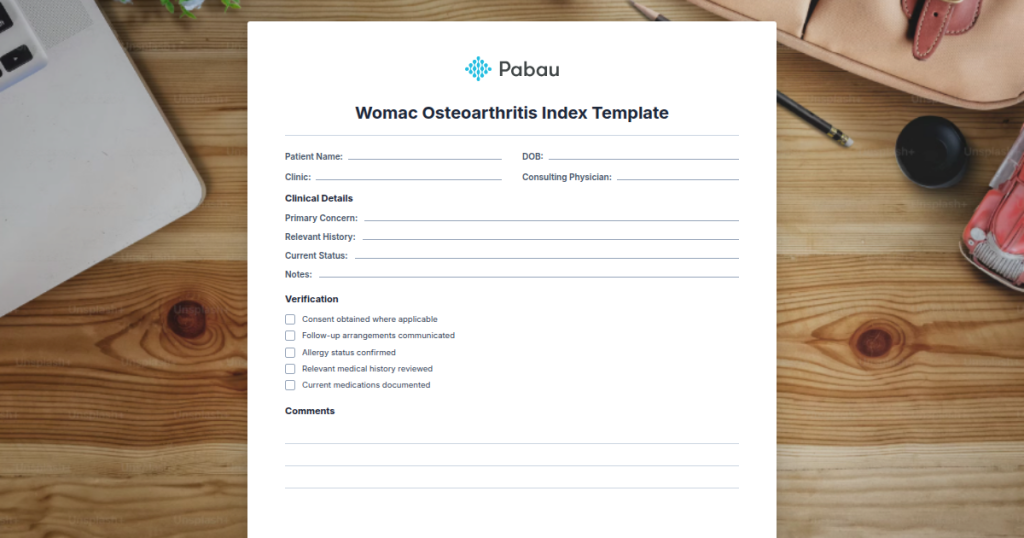
WOMAC Osteoarthritis Index Template
Download Your Free WOMAC Osteoarthritis Index Template The Western Ontario and M...

April 9, 2026


Buy now, pay later is now available in Pabau

The Katz Index assesses six core activities (bathing, dressing, toileting, transferring, continence, feeding) using a binary 0-1 scoring system per activity.
A score of 6 indicates full independence; 4 indicates moderate impairment; 2 or less indicates severe functional impairment requiring comprehensive support.
Effective across all care settings (community, home health, long-term care, skilled nursing facilities) for detecting functional decline and informing care planning.
Pabau’s digital forms and clinical documentation tools streamline Katz Index administration, scoring, and integration into patient records for continuity of care.
Functional assessment is a cornerstone of geriatric care and rehabilitation. Many clinicians struggle to standardise their evaluation approach, leading to inconsistent documentation and missed opportunities to adjust care plans. The Katz Index of Independence in Activities of Daily Living worksheet solves this by providing a validated, evidence-based framework that quantifies independence across the six most essential self-care activities. This guide includes a free downloadable template, scoring methodology, and clinical interpretation guidelines to help your team assess functional status efficiently and document findings with precision.
A standardised functional assessment tool evaluating independence in six basic self-care activities: bathing, dressing, toileting, transferring, continence, and feeding. Used across healthcare settings to detect functional decline and guide care planning.
Download templateThe Katz Index is a brief, validated instrument designed to measure functional independence in six basic self-care activities essential to daily living. Created by Katz and colleagues, it has become the gold standard in geriatric and rehabilitation settings worldwide. Purpose: The tool detects functional decline, quantifies disability levels, and informs care planning decisions across age groups and healthcare environments.
Each of the six activities is scored individually on a binary scale: 0 for dependent (requires assistance) or 1 for independent (requires no assistance). A total score of 6 indicates complete independence; lower scores reflect progressive impairment requiring intervention. This simple scoring system translates directly into care intensity assessments and digital documentation workflows that support compliance with CMS Minimum Data Set (MDS) requirements for Medicare-certified facilities.
Clinically, the Katz Index functions as both a screening tool and a baseline measurement. Healthcare professionals use it to detect problems in activities of daily living and to plan individualised care accordingly. The tool’s legal and regulatory context is significant: proper documentation of Katz Index findings supports informed consent, establishes the medical necessity for care intensity classification, and provides evidence of appropriate service levels for reimbursement audits.
Administration of the Katz Index of Independence in Activities of Daily Living worksheet follows five key operational steps that clinicians can integrate directly into their assessment workflow.
The Katz Index serves healthcare professionals across multiple specialties and practice settings. Primary users: geriatricians, occupational therapists, physical therapists, nurses (RN, LPN, CNA), social workers, case managers, and care coordinators in medical practices, rehabilitation facilities, home health agencies, and skilled nursing facilities. Industries: private practice primary care clinics, functional medicine practices, integrative medicine clinics, and specialised geriatric or rehabilitation centres all rely on this tool for standardised functional assessment.
The tool is particularly valuable for practitioners managing older adult populations, post-acute rehabilitation cases, and patients with chronic conditions affecting mobility or self-care capacity. Home health agencies and long-term care facilities use it as a mandated assessment component under CMS regulations. Any clinic documenting patient functional status for care planning, discharge disposition decisions, or reimbursement justification benefits from the Katz Index’s evidence base and regulatory alignment.
Compliance and legal protection: The Katz Index is recognised by CMS and geriatric care accreditation bodies as a valid assessment method. Documented use demonstrates adherence to best practice standards and supports defence against regulatory findings during inspections. Workflow efficiency: Standardised scoring eliminates interpretation ambiguity and reduces the time spent negotiating assessment findings with other team members.
Documentation clarity: A single composite score communicates functional status quickly and consistently across team members and across settings, reducing handoff errors when patients transition between care levels. Patient safety: Quantifying independence in essential self-care activities identifies high-risk transitions early. A decline from score 6 to 4 over one month signals a need for intervention before catastrophic events (falls, malnutrition, infection) develop.
Care planning precision: Katz scores map directly to care intensity classifications and service level recommendations. A patient scoring 2 or less requires comprehensive assistance; a patient scoring 6 may be appropriate for discharge or reduced monitoring. This linkage supports evidence-based discharge planning and resource allocation.
Each of the six core activities in the Katz Index represents a fundamental component of independent living. Understanding each activity’s clinical assessment criteria ensures consistent scoring and meaningful care planning.
All six activities must be assessed in context. Environmental factors (bathroom accessibility, furniture height, lighting) and health fluctuations (pain, fatigue, cognitive status on the day of assessment) influence scores. Best practice includes noting contextual factors in documentation alongside the numeric score.
Score interpretation directly informs care intensity decisions. A Hartford Institute for Geriatric Nursing study validated these clinical thresholds across community and facility settings.
Score 6 (Full Independence): Patient requires no assistance in any of the six activities. Suitable for independent living with minimal support. Reassessment frequency: annually or when acute changes occur. Scores 4-5 (Moderate Impairment): Patient requires assistance in 1-2 activities but maintains independence in core areas (continence, feeding). Appropriate for supported living arrangements or family caregiving with professional support. Reassessment frequency: quarterly or after hospitalisation. Scores 0-3 (Severe Impairment): Patient requires assistance in 3 or more activities or is fully dependent. Indicates need for skilled nursing care, 24-hour supervision, or facility placement. Reassessment frequency: monthly or bi-weekly during acute episodes.
Score trends matter as much as single-point values. A decline of 2 points within 3 months signals accelerating functional loss and should trigger comprehensive reassessment and potential care plan revision.
Pabau’s client record system tracks Katz scores over time, highlighting trends automatically. This longitudinal view supports proactive care planning and early intervention before crises develop.

Pabau's integrated forms and clinical documentation tools make Katz Index administration, scoring, and care plan linkage seamless. Reduce manual re-entry and ensure consistent, compliant documentation across your team.

Several functional assessment instruments exist; choosing the right one depends on the clinical context and patient population. The Katz Index is often compared to two alternatives: the Barthel Index and Instrumental Activities of Daily Living (IADL) scale.
Katz vs Barthel Index: The Barthel Index uses a weighted scoring system (0-15 points per activity) and includes additional items like stair climbing and personal hygiene items not in Katz. Barthel is more granular and sensitive to small changes; Katz is simpler and faster to administer. Choose Katz for rapid screening and baseline establishment; choose Barthel for detailed rehab progress tracking. Katz vs IADL Scale: IADL measures instrumental self-care (managing finances, medication, transportation, shopping). Katz measures basic self-care. IADL is more sensitive to early cognitive decline; Katz is more relevant to physical disability and care dependency. Use both together for comprehensive functional assessment.
Research shows adequate to excellent correlation between Katz ADL and IADL scales (r = 0.756 for men, r = 0.572 for women, Arik et al. 2015), confirming they measure related but distinct domains. Many clinics use Katz for basic self-care screening and IADL for comprehensive community-living readiness assessment.
Healthcare teams often face documentation consistency issues when scoring manually. Challenge: Different clinicians score the same patient differently, leading to conflicting care plans. Solution: Use standardised scoring criteria (the six-activity framework above) and digital forms that enforce consistent field definitions across staff.
Challenge: Reassessment schedules are missed because tracking intervals manually is error-prone. Solution: Pabau’s automated workflow features alert clinicians when reassessments are due, ensuring compliance with regulatory timelines and catching functional decline early.
Challenge: Katz scores sit isolated in charts; clinical teams don’t see how scores link to care intensity or discharge planning. Solution: Embed Katz results directly into care plan templates so scores automatically populate recommendations and ensure the entire team sees functional status in one place.

Need a comprehensive guide to geriatric functional assessment? Safer Clinical Notes provides structured documentation frameworks that align Katz Index findings with evidence-based care planning.
Want to automate care plan updates based on Katz scores? Pabau Automated Workflows trigger care plan reviews and team notifications when functional decline is documented.
Looking for templates that integrate Katz assessment with compliance tracking? Compliance Management links functional assessments to regulatory requirements and flags overdue reassessments automatically.
Functional assessment is non-negotiable in geriatric, rehabilitation, and home health practice. The Katz Index of Independence in Activities of Daily Living worksheet provides the evidence-based framework clinicians need to quantify independence, detect decline, and justify care intensity decisions with confidence. This guide has covered the six core activities, scoring methodology, interpretation thresholds, and practical administration tips. The downloadable template is ready to integrate into your workflow immediately. Yet tools alone are insufficient without reliable systems to track scores, link findings to care plans, and alert teams to reassessment deadlines. Pabau’s digital forms and integrated documentation eliminate manual entry errors, ensure compliance with CMS standards, and give your entire team a unified view of patient functional status. Book a demo today to see how Pabau transforms functional assessment from a compliance burden into a clinical asset that drives better patient outcomes.
The Katz Index is a brief, validated assessment tool that measures functional independence in six basic self-care activities: bathing, dressing, toileting, transferring, continence, and feeding. Each activity is scored 0 (dependent) or 1 (independent), with a total score ranging from 0-6. It is the gold standard functional assessment instrument used across geriatric, rehabilitation, and home health settings.
Each of the six activities is scored individually: 1 point if the patient performs the activity independently (without supervision, direction, or personal assistance), and 0 points if any assistance is required. Add all six scores to obtain the composite Katz Index score (range 0-6). Higher scores indicate greater independence.
A Katz score of 6 indicates full independence in all six self-care activities. The patient requires no assistance in bathing, dressing, toileting, transferring, continence, or feeding. This score is typically associated with independent living and minimal need for care support.
The six activities are: (1) bathing (washing and drying self), (2) dressing (selecting, putting on, fastening, and removing clothing), (3) toileting (going to/from toilet and managing personal hygiene), (4) transferring (moving to/from bed, chair, or standing position), (5) continence (voluntary bladder and bowel control), and (6) feeding (bringing food and drink to mouth independently).
ADL (Activities of Daily Living) scales like Katz measure basic self-care activities essential to survival (bathing, dressing, feeding, toileting, transferring, continence). IADL (Instrumental Activities of Daily Living) scales measure more complex tasks needed for independent community living (managing finances, medication, transportation, shopping). IADL assessments are typically more sensitive to early cognitive decline, while ADL assessments focus on physical dependency and care intensity.