Primary & Preventive Care
Respiratory Failure Nursing Care Plan Template
A Respiratory Failure Nursing Care Plan Template provides clinicians with a syst...

March 17, 2026


Buy now, pay later is now available in Pabau

Systematically document skin conditions before treatment
Protects clinicians through comprehensive informed consent
Identifies contraindications early in the assessment process
Improves treatment planning with baseline skin documentation
A skin assessment form is a clinical documentation tool that guides healthcare professionals through a systematic evaluation of a patient’s complete dermatological status. From initial medical history screening through detailed examination findings and risk identification, this form ensures no clinical factors are overlooked before treatment planning.
Skin assessment forms serve multiple purposes: they establish baseline documentation for legal and medical-legal protection, identify contraindications that might affect treatment suitability, and create a structured record that supports continuity of care across appointments. Whether in a medspa, dermatology clinic, or aesthetic practice, this foundational tool directly impacts patient safety, treatment outcomes, and regulatory compliance.
A comprehensive evaluation form designed to systematically document a patient’s dermatological history, current skin concerns, examination findings, and treatment goals for personalised skin care planning.
Download template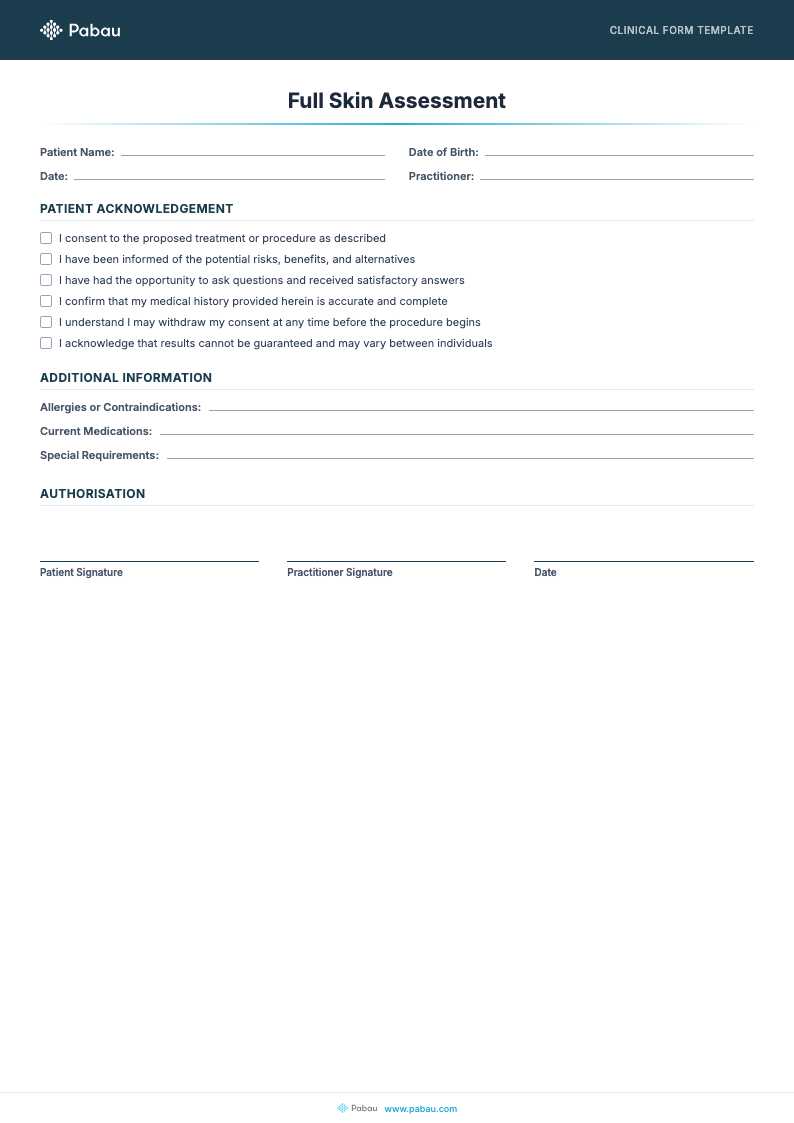
A skin assessment form is a structured clinical document that captures a patient’s complete skin history and current status in one comprehensive record. It functions as both a clinical tool and a legal document, systematically recording medical history, current concerns, examination findings, and risk factors relevant to skin-related treatments.
Unlike generic intake forms, a dedicated skin assessment template is specifically designed for practices that treat skin conditions, perform aesthetic procedures, or manage dermatological concerns. The form typically includes sections for constitutional history (allergies, medications, previous reactions), current skin concerns (location, duration, severity), and detailed examination findings (skin type, lesions, abnormalities, texture, hydration status).
The clinical purpose extends beyond documentation. A proper skin assessment identifies absolute contraindications (conditions that prohibit treatment) and relative contraindications (conditions requiring precautions or modifications). This risk-stratification process protects both patient safety and practitioner liability. From a regulatory perspective, comprehensive skin assessment documentation demonstrates due diligence when reviewed by healthcare authorities, insurance bodies, or in medical-legal proceedings. For clinics operating under professional licensing standards (CQC in the UK, state boards in the US, or equivalent bodies), systematic assessment forms are evidence that care meets recognised standards for patient safety and informed consent.
The Full Skin Assessment is completed in five operational steps that fit seamlessly into your clinic’s patient workflow:

Capture skin assessments digitally at bedside, in treatment rooms, or pre-appointment online. Automate follow-up scheduling based on assessment findings and access patient history across multiple locations from one secure platform.

A dedicated skin assessment form is essential for any healthcare practice that routinely evaluates or treats skin conditions. Dermatology clinics performing diagnostic skin assessments, biopsies, or topical treatments rely on systematic documentation to track changes over time and manage chronic skin disease. Aesthetic practices offering injectables, laser treatments, chemical peels, or other skin procedures use the form to identify contraindications, document baseline skin characteristics, and establish informed consent.
Medspa teams providing skincare treatments, facials, and skin rejuvenation services benefit from the structured approach to identifying skin type, sensitivity, and previous reactions. Beyond aesthetics, occupational health clinics assessing work-related skin exposure, primary care practices managing common skin conditions like eczema or psoriasis, and wound care specialists documenting pressure ulcer risk all use variations of systematic skin assessment.
Private practices in the UK regulated by CQC, US clinics licensed by state medical boards, and international practices operating under equivalent standards find that a documented skin assessment form satisfies regulatory expectations for patient safety and informed decision-making. For any practice where skin evaluation directly influences treatment planning or where treatment carries even minor skin-related risks, a standardised assessment form reduces documentation gaps, improves clinical consistency, and provides clear evidence of due diligence if patient outcomes are ever questioned.
Comprehensive baseline documentation. A structured form ensures every relevant skin characteristic is recorded consistently, creating a reliable baseline for measuring treatment response. Rather than relying on memory or casual notes, clinicians document skin type, texture, hydration, lesions, and abnormalities in a standardised way that allows meaningful comparison between visits.
Contraindication identification. Systematic screening of medical history and current skin status identifies absolute and relative contraindications before treatment begins. Patients with active infections, recent sun exposure, or certain medications may need postponement or modified protocols. Early identification prevents adverse outcomes and reduces emergency complications.
Legal and regulatory protection. Documented skin assessments demonstrate that your practice operates to professional standards recognised by regulators, insurers, and courts. If patient outcomes are ever questioned, a comprehensive assessment form shows you gathered necessary information and made informed clinical decisions. For CQC-regulated practices, systematic assessment documentation is expected; for US clinics, state boards expect evidence of informed consent; for international practices, equivalent standards apply.
Improved patient communication. Walking a patient through the assessment process with a visible form creates transparency. Patients see that you’re taking their concerns seriously, reviewing risk factors carefully, and making deliberate clinical decisions. This engagement improves patient confidence in treatment recommendations and reduces post-treatment disputes about expectations.
Workflow efficiency. Once a form template is embedded in your clinic system, completion becomes routine. Patients pre-complete medical history online, clinicians add examination findings during the appointment, and the form automatically links to treatment notes and follow-up scheduling. Over a year, this saves hours of documentation time while improving accuracy.
Treatment planning clarity. Detailed examination findings inform truly personalised treatment plans. Rather than generic protocols, clinicians tailor intensity, frequency, and product selection based on documented baseline characteristics. This specificity improves outcomes and creates clearer post-treatment expectations for the patient.
Screen contraindications in tiers. Use the form’s medical history section to identify absolute contraindications (stop treatment immediately) separately from relative contraindications (modify approach or add precautions). Document your reasoning for any precautions applied, then review these notes with the patient. This tiered approach speeds decision-making while keeping patients informed of your clinical reasoning.
Effective skin assessment goes beyond completing checkboxes. Clinicians who excel at assessment use the form as a thinking tool, not just a compliance checklist. Begin with constitutional and lifestyle questions that provide context: sleep quality, stress level, hydration habits, sun exposure patterns, and product sensitivities all influence current skin status and treatment tolerance.
Document examination findings using consistent terminology. Instead of vague notes like “good skin” or “some redness,” describe observable characteristics: “skin type: combination (oily T-zone, normal cheeks, dry lateral neck); turgor: normal with slight dehydration lines on forehead; erythema: mild follicular inflammation on chin; no active lesions or ecchymosis.” This precision allows future clinicians to compare baseline to follow-up visits objectively.
Include a treatment suitability assessment that explicitly documents why the proposed treatment is appropriate given the assessment findings. For example: “Skin assessment supports suitability for microneedling: adequate skin hydration, no active infection, no photosensitising medications, realistic expectations documented.” This brief statement ties the assessment to the treatment decision, reinforcing clinical reasoning and creates a clear record if outcomes are later questioned.
Encourage patients to report changes between visits. If a patient reports new lesions, increased sensitivity, or unexpected reactions since the last assessment, update the form and note the change. Over time, this creates a valuable longitudinal record showing how the patient’s skin responds to treatments and lifestyle factors.
For clinics serving populations at risk of pressure injury (long-term care facilities, rehabilitation centers, home health, or aging-focused practices), skin assessment includes specific attention to pressure ulcer risk. The Braden Scale, a validated tool for predicting pressure ulcer development, integrates into skin assessment by evaluating sensory perception, skin moisture, activity level, mobility, nutrition, and friction/shear.
Systematic skin assessment documents any areas of non-blanching erythema (redness that persists after pressure release), which signals skin damage and increased ulcer risk. Assessment findings guide prevention strategies: increased repositioning frequency for immobile patients, moisture management for incontinent patients, nutritional support for undernourished patients, and friction-reduction techniques for patients with high shear forces.
Even for aesthetic clinics not focused on pressure injury prevention, understanding skin integrity assessment principles is valuable. Recognising early signs of skin compromise-poor healing, unusual bruising, persistent inflammation-helps clinics identify when a patient is unsuitable for elective procedures and should be referred back to primary care or dermatology for underlying concerns.

Need structured guidance for clinical documentation? Safer Clinical Notes provides step-by-step principles for documenting assessment findings that stand up to regulatory review and medical-legal scrutiny.
Want to streamline patient consent workflows? Digital Forms enables you to build customised skin assessment templates within your practice management system, with automatic patient reminders and secure storage.
Looking for broader skin assessment context? Skin Assessment Tools explores specialised assessment instruments (Braden Scale, DLQI, SCORAD) and when to incorporate them into your clinical workflows.
A systematic skin assessment form is foundational to safe, effective skin care practice. From medical history screening through detailed examination documentation, this tool protects patient safety, supports clinical decision-making, and creates the regulatory and legal documentation that demonstrates your practice operates to recognised professional standards. Whether you’re launching a new aesthetic clinic, expanding dermatology services, or refining documentation in an established practice, a structured assessment form is a practical, evidence-aligned investment in clinical excellence.
A comprehensive form includes constitutional history (allergies, medications, systemic conditions), current skin concerns (location, duration, severity), examination findings (skin type, lesions, texture, hydration), contraindication screening, and consent declarations. The form should be specific enough to guide clinical decisions but simple enough to complete in 5-10 minutes.
Typically, the patient completes the medical history section before the appointment (either online or in the waiting room), and the clinician completes the examination findings section during the appointment. For digital forms, both can be done within the patient portal with appropriate digital signatures.
Ideally before any skin-related treatment or diagnosis. Pre-appointment completion captures baseline data and identifies red flags early. Reassessment at follow-up visits documents changes and guides treatment modifications. For chronic skin conditions, periodic reassessment (monthly or quarterly) supports monitoring.
Start with the core sections (history, examination, findings, risk assessment), then customise based on your clinic’s specific services. If you treat injectables, add injection location mapping; if you manage chronic skin disease, add severity scoring tools. Use terminology consistent with your industry standards (aesthetic, dermatology, wound care). Many practices use template libraries as starting points, then customise fields and consent language.
Digital forms designed for mobile use have responsive layouts that work on phones and tablets. Clinicians document examination findings by tapping checkboxes, selecting dropdowns, and typing free-text notes. Mobile forms sync to cloud storage and link automatically to patient records, enabling documentation from treatment rooms or bedside without paper-based entry.
Typically, attach photographs (before/after for treatment tracking), related pathology reports (if biopsies were taken), external specialist reports (if referred for dermatology evaluation), and relevant medication lists. Ensure all attachments are scanned or photographed clearly and stored securely per HIPAA, GDPR, or equivalent data protection standards.