How to Effectively Manage Your Dermatology Practice In 2026
Pabau helps dermatology and aesthetic clinics manage scheduling, payments, marke...

March 17, 2026
Discover free eBooks, guides and med spa templates on our new resources page

Buy now, pay later is now available in Pabau
You’ve worked hard, built up an incredible clinical skill set, earned a loyal client base, saved some money, and there’s no better time to open your own practice.
But while your clinical expertise is indispensable, it alone isn’t enough to guarantee success.
What really separates the practices that thrive from the ones that struggle (or even close their doors) comes down to one thing: a solid business plan.
A thoughtful business plan helps you secure funding, avoid common operational pitfalls, stay compliant, track progress, and scale.
A medical practice business plan is your operational and financial roadmap. It lays out who you’ll serve, how you’ll deliver care, what you’ll charge, how you’ll staff and run the clinic, and how you’ll measure success.
It’s a document that aligns the team, clarifies decision-making, and creates measurable milestones for growth.
Here’s why you need one:
In short, a business plan keeps you on course. It’s your compass, preventing you from wandering aimlessly and helping you make confident, informed decisions.
While U.S. labor statistics show that around 70–80% of new businesses survive their first year, a notable share still struggle to make it past the early stages.
Often, the culprits are poor planning, undercapitalization, and a lack of market research. A solid business plan helps reduce those risks by forcing you to confront cash requirements, regulatory obligations, and operational realities before you open your doors.
And those aren’t the only reasons you need one. You also need it for:
A well-crafted business plan helps you spot potential problems before they become real headaches. By analyzing your market, competition, and financial needs, you can uncover weaknesses early and address them before they turn into crises.
Clearly defining your standard operating procedures and staffing models keeps your team aligned and your operations smooth. That consistency reduces confusion, maintains efficiency, and ensures your patients receive the best care possible.
Think of your business plan as a framework that grows with you. If your practice succeeds and you decide to expand into multiple locations, you’ll already have a strong foundation.
Source: Pabau
So, whether you’re launching a solo micro-practice or managing a large, multi-location clinic, thoughtful planning is the foundation of long-term success.
It’s easy to think this step can wait until after the logistics are sorted. But that’s a mistake. Defining the why and how of your practice is the foundation of your entire business plan. It’s the root that everything else grows from, and it needs to be planted firmly.
Here’s how to do it:
A clear, well-defined vision keeps your practice focused, aligned, and true to its purpose, no matter how much it grows.
This step is all about making sure there are enough patients in your area who are willing and able to pay for your health services.
Here’s how to approach it:

Location plays a big role in whether patients choose your practice. In fact, a research report from Accenture found that around 70% of patients prioritize location access when choosing their healthcare provider, making it essential to select a site that is convenient, accessible, and easy to reach by car or public transport.
Setting up a medical practice in the UK is as much about strong administration as it is about clinical expertise. Getting your legal, compliance, and insurance foundations right from the start ensures you can focus on patient care without unnecessary risks or interruptions.
By establishing these foundations from the start, you’re not compromising the safety of your patients, your team, or the future of your practice.
This step of your business plan is critical and should never be taken lightly. If you’re unsure how to navigate it, hiring a professional can help ensure your practice is built on a solid, secure foundation.
Once you’ve clarified your vision and validated your market, the next step is to define exactly what services your practice will provide and how they will generate sustainable revenue.
So, start by building your service list around three things:
This will help you decide whether your focus will be on chronic disease management, specialist consultations, wellness and preventative care, or something more niche.
Next, decide how you’ll price and bill your services. Will you operate on:
In the UK, accurate coding is key to getting paid correctly and staying compliant. Procedures are usually recorded using OPCS-4 codes, and diagnoses with ICD-10 codes. Getting this right from the start saves endless headaches later.
Also, setting smart pricing strategies can help you set your service prices based on factors such as demand, seasonality, staff expertise, and client behavior.
Finally, take time to plan your appointment structure. Set clear appointment types and durations. For example, follow-ups will be 20 minutes, and 40 minutes for new patient consultations. This might seem like a small detail, but it has a big impact on patient flow, clinician workload, and your financial performance.
When you define your services and pricing clearly from the start, you’re setting up your practice to deliver care efficiently without compromising quality, staff wellbeing, or profitability.
This step is all about outlining the day-to-day reality of your practice, ensuring that everyone knows their role and that every process runs like clockwork.
So here’s how to get started:
When your operations are well-organised, you free yourself to focus on patient care, growth, and delivering the kind of experience that keeps patients coming back.
For practices, technology isn’t just a nice-to-have anymore.
Take it from me: two years ago, I used to book all my appointments over the phone. Now, I practically cringe at the thought of calling just to schedule something. Like many patients today, I prefer booking online, on my own time, usually after 9 p.m., once my kid’s asleep.
But not every system will do. If it’s clunky, confusing, or time-consuming, most patients will quickly lose patience. The right technology should make life easier for you, your team, and your clients.
So when choosing a platform for your medical practice, here’s what to look for:
That’s why it’s often best to choose an all-in-one practice management system rather than juggling multiple platforms.
A great example is Pabau, an all-in-one software designed specifically for medical practices. It includes everything above and more, like:

Source: Pabau
With the right system in place, your team stays organised, your patients enjoy a smoother experience, and your new practice runs like a well-oiled machine.
Before you open your doors, you need a clear forecast of how much it will cost to get started, how long your funds will last, and when your practice will start turning a profit. This means you should:
Finally, when all of this is calculated, you need to explore your funding options. You can consider a bank loan, equipment financing, investor backing, or your own capital. And lastly, you should plan how you’ll manage cash flow to stay secure and confident as your practice ramps up.
A medical practice that isn’t visible won’t attract any patients. And with a solid marketing plan, you can bring it closer to your future patients:
Here’s, for example, how one GP promoted its services for men’s health week:
By showing up consistently, educating patients, and building genuine relationships, you’ll attract patients who will help you get your business off the ground and start on the right foot.
A successful launch depends on a clear, structured timeline that shows you what to do and what to expect at each stage. Here’s an example of a simple way to map it out:
With a timeline like this, you’ll always know what steps to take next and can move forward confidently.
Launching your practice is just the beginning. To ensure long-term success, you need to track how well it’s performing and make adjustments along the way. Start by defining key performance indicators (KPIs) across three areas:
Regularly reviewing these KPIs allows you to spot trends and refine your processes before small issues turn into big problems.
Using practice management software with built-in KPI dashboards can make this even easier, giving you real-time visibility into your clinic’s performance, highlighting what’s working and what doesn’t.
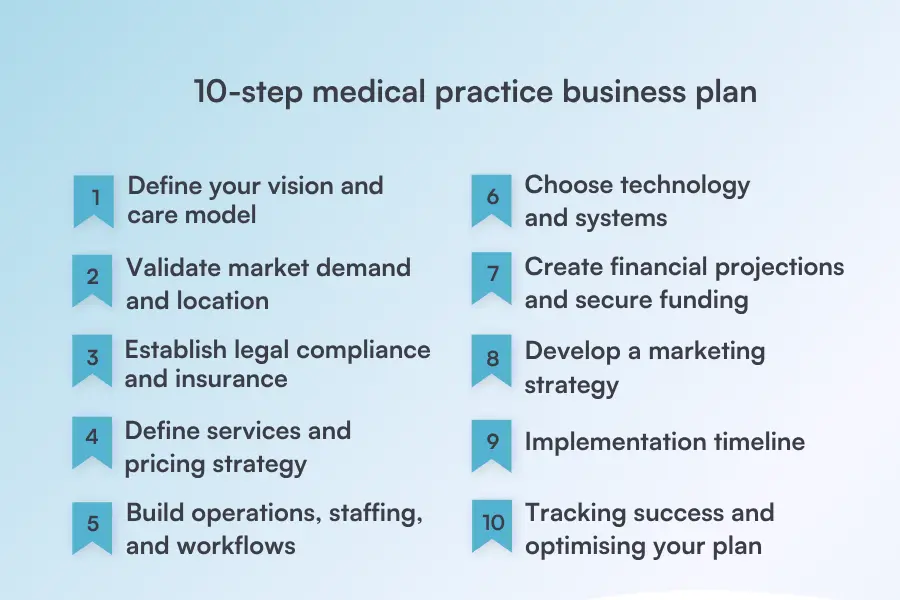
There you have it! Follow these 10 steps and you’ll be well on your way to not just opening your practice, but making it thrive for years to come. Using integrated, all-in-one tools like Pabau can make executing your business plan much easier by centralising all your essential functions:
With the right system in place, you can focus on providing excellent care while your practice runs smoothly behind the scenes. If you want to see Pabau in action, book a live demo with our team today.