Best Practice Management Software in Canada (2026 Guide)
Disclosure: Pabau is our product. We have included it alongside other platforms ...

March 16, 2026


Buy now, pay later is now available in Pabau

Read case studies from our satisfied clients

Compare Pabau with alternative systems
 Integrations
 Measure Pabau savings
  Our security commitment
  About us
Learn why this holistic care and aesthetic medicine clinic chose Pabau to power patient care and performance.
Read more

Pabau is the only platform in this comparison that combines multi-location operations with medical-grade clinical documentation in a single unified dashboard.
Zenoti suits large beauty and wellness chains; Mindbody fits fitness-first businesses – neither is built for clinical or CQC-regulated environments.
Jane App earns the highest user satisfaction ratings but is primarily oriented toward North American markets with limited UK and EU integration support.
SimplePractice and Carepatron are designed for solo or small-group practitioners and lack the consolidated multi-site reporting that growing clinic groups need.
Centralised reporting, granular staff permissions, and cross-branch inventory management are the three features most likely to determine which platform fits your group’s growth stage.
The best clinic management software for multi-location practices does far more than book appointments. It consolidates operations – scheduling, clinical documentation, staff permissions, stock levels, and revenue reporting – across every branch, from a single dashboard. Most platforms on the market handle one or two of those things well. Very few handle all of them without requiring separate tools, manual data exports, or account switching. For a clinic group running three, five, or ten locations, those gaps translate directly into administrative overhead, compliance risk, and revenue leakage.
This comparison evaluates six platforms against the specific demands of multi-location clinic operations: Pabau, Zenoti, Mindbody, Jane App, SimplePractice, and Carepatron. Each is assessed on multi-site management depth, clinical documentation capability, staff and permissions management, reporting, integrations, and pricing transparency. The goal is to help clinic owners, practice managers, and group operators identify the platform that fits their clinical environment, growth stage, and regulatory context.
Running multiple clinic locations surfaces a category of operational problems that solo-practice software simply was not built to solve. Appointment routing between branches, consolidated revenue visibility, GDPR-compliant data handling across jurisdictions, and staff role management at site level – these are not edge cases for a growing group. They are daily operational requirements.
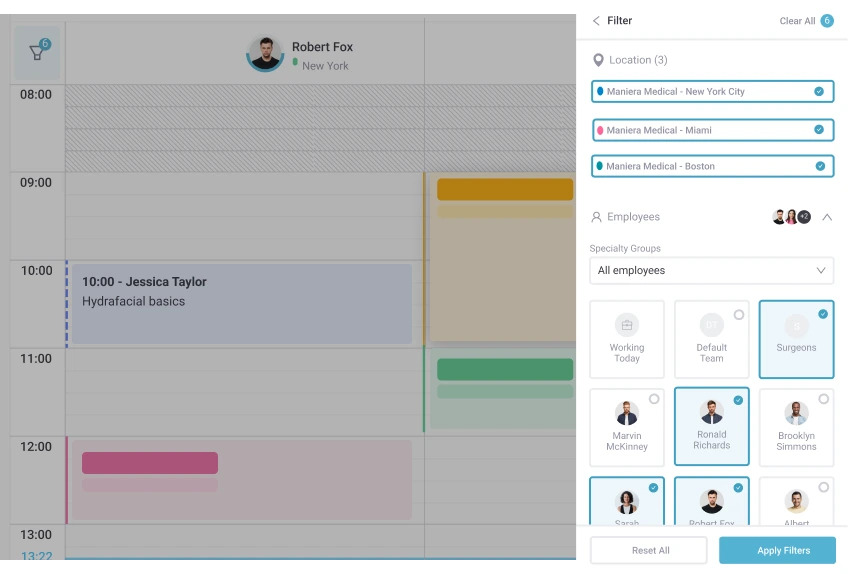
The six platforms in this comparison represent the most frequently evaluated options for healthcare and aesthetic clinic groups. Their architectural approaches differ significantly. Some are built enterprise-first, designed for chains with dozens of locations. Others started as tools for independent practitioners and have added multi-location features over time – a distinction that matters when your team is managing cross-branch inventory or running a group-level P&L review.
Three capabilities define whether a platform is genuinely suited to multi-location clinic management. First, a single sign-on that provides visibility across all branches without requiring staff to switch between separate accounts or logins. Second, role-based permissions granular enough to assign different access levels at location level – so a clinic manager in one branch cannot view financial data from another unless explicitly granted that access. Third, consolidated reporting that pulls appointment utilisation, revenue, stock levels, and staff performance into one view rather than requiring manual aggregation from per-location exports.
Platforms that meet all three criteria are rare. Most offer two of the three, leaving clinic groups to patch the gap with spreadsheets or additional software. The comparison below evaluates each platform against all three, alongside clinical capability, compliance positioning, and pricing model.
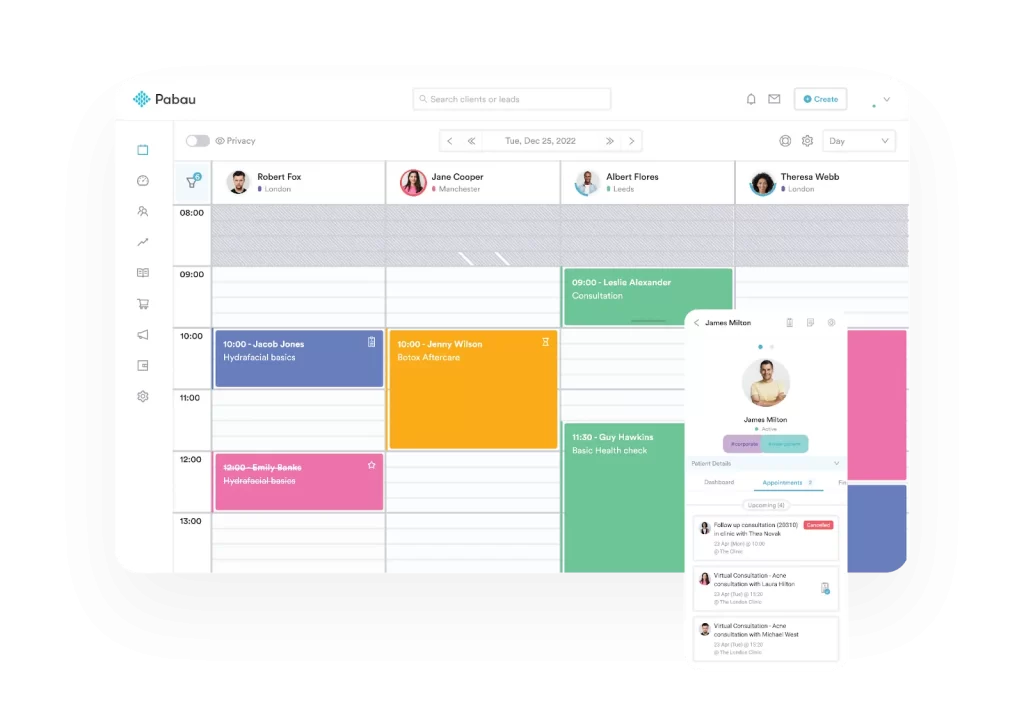
Pabau is purpose-built for multi-location clinic groups operating across aesthetic, medical, wellness, and hybrid clinical environments. Its architecture centres on a unified dashboard that consolidates scheduling, clinical documentation, staff management, inventory, and revenue reporting across all branches without account switching. For a clinic group owner who needs a real-time view of appointment utilisation across five locations at 9am on a Monday, that is not a minor convenience – it is the operational foundation everything else depends on.
The platform’s multi-location feature set includes per-branch and cross-branch scheduling, granular role-based permissions at location level, centralised client records accessible (with appropriate permissions) across all sites, and consolidated analytics that cover revenue, appointment volume, staff performance, and stock levels from a single reporting interface. Clinic groups that have migrated from per-location tools to Pabau consistently report the largest time saving in reporting and cross-branch client management – areas where manual reconciliation previously consumed significant administrative hours each week.
Where Pabau separates itself most clearly from wellness and booking-focused competitors is clinical documentation depth. The platform includes built-in digital consent forms, customisable treatment notes, before-and-after photo management, injection plotting, and prescribing tools – all designed for aesthetic and medical clinic workflows. These are not bolt-on additions. They are core features built into the same interface as scheduling and reporting, so clinical staff do not switch between systems to complete a client journey.
For clinic groups operating in CQC-regulated environments or managing complex treatment protocols across multiple sites, this integration matters considerably. A client who receives Botox at one branch and a skin treatment at another carries a single unified record across both interactions – accessible to the treating clinician at either location, subject to the permission structure the practice manager has configured. That is a meaningfully different operational reality from managing separate records per location.
Pabau also includes Echo AI for AI-assisted clinical note generation, prescription management, lab management tools, and automated pre- and post-care communications – features that reflect a platform designed for clinical environments rather than adapted from a booking or wellness tool. The platform supports multi-location med spa and clinic operations with workflows built for groups scaling beyond their first site.
Carepatron markets itself as a free-to-start practice management solution, which gives it strong appeal among solo practitioners and very small clinical teams. Its scheduling, billing, and clinical documentation tools cover the core requirements of an individual clinician running a single-location practice, with a clean interface and a self-serve onboarding model that minimises the time required to get started.
The freemium pricing model is Carepatron’s most distinctive advantage. For a solo practitioner or a two-person clinic evaluating options without a software budget, the ability to access scheduling and basic documentation without upfront cost is a genuine differentiator. The platform’s interface is clean and requires minimal training, which suits small teams where onboarding time is limited. According to Capterra reviewers, users frequently praise the ease of initial setup and the platform’s approachability for non-technical clinical staff.
Carepatron’s architecture is built for individual practitioners, not clinic groups. Multi-location management, consolidated cross-branch reporting, and granular role-based permissions at site level are not features Carepatron was designed to deliver. A practice manager trying to view appointment utilisation across three locations, or an owner reviewing stock levels across branches, will find the platform cannot support those workflows natively. The self-serve onboarding model – a strength for solo users – becomes a limitation for complex multi-location migrations where supported implementation is typically required. Carepatron is a credible choice for a solo practitioner or a very small single-location clinic. It is not suited to the operational demands of a clinic group.
Jane App has built a strong reputation among North American allied health practitioners, particularly in Canada and the US, where its charting tools, clean scheduling interface, and highly responsive support team have earned it consistently high satisfaction ratings. For a physiotherapy, chiropractic, or psychology clinic operating in those markets, Jane’s combination of clinical documentation and practice management is genuinely competitive.
Jane’s user experience is a genuine strength. The platform’s interface is consistently described by users as intuitive and well-designed, reducing the training burden for new clinical staff. Charting and clinical notes are a core feature rather than an afterthought, with customisable templates suited to a range of allied health disciplines. According to Capterra reviewers, Jane receives a rating of 4.8 out of 5 – one of the highest in the practice management category – driven largely by user experience quality and support responsiveness.
Jane’s multi-location capability is less mature than its single-location experience. Clinic groups managing multiple branches report that cross-location reporting and centralised client record management require more manual effort than equivalent functions in enterprise-first platforms. Jane’s integration ecosystem is also primarily built around North American billing and insurance workflows – Canadian provincial health billing, US insurance claims processing – with limited depth for UK and EU clinic groups operating under GDPR or NHS-adjacent data requirements. For an aesthetic or medical clinic group based in the UK or Europe, Jane’s geographic orientation is a meaningful practical constraint. According to G2 reviewers, Jane earns a 4.8 rating, though reviews focus predominantly on North American clinical contexts.
Mindbody is one of the most widely recognised names in wellness business management, with a large user base across fitness studios, yoga centres, spas, and beauty businesses. Its marketplace – the Mindbody app used by consumers to discover and book wellness services – gives member businesses meaningful client discovery potential, particularly in urban markets where the platform has strong consumer penetration.
Mindbody’s consumer-facing marketplace is a genuine differentiator for wellness businesses that benefit from organic discovery traffic. For a yoga studio chain or a day spa group, appearing in Mindbody’s app exposes the business to active searchers who may not otherwise find it. The platform also handles membership and package management well, with recurring billing, class passes, and promotional tools built into the core product. According to Capterra reviewers, Mindbody earns a 4.0 out of 5 rating, with positive themes around membership management and brand recognition in the wellness sector.
Mindbody does not include clinical documentation tools. Treatment notes, consent forms, before-and-after photo management, injection plotting, and prescribing workflows – the features that define clinical practice management – are absent from the platform. This is a structural limitation rather than a gap that updates are likely to close. Mindbody’s product strategy is oriented toward wellness and fitness, not medical or CQC-regulated clinical environments. For any clinic group operating aesthetic treatments, GP services, physiotherapy, or other regulated clinical disciplines, Mindbody is not suitable as a primary practice management system. User reviews on Trustpilot reflect a 2.9 rating, with frequent complaints about pricing increases and customer support responsiveness – concerns worth weighing for a long-term platform decision.
SimplePractice is a well-established platform for mental health practitioners, therapists, and solo clinicians in the US market. Its combination of scheduling, telehealth, billing, and clinical notes has made it a dominant choice for individual practitioners building private practices, with a clean interface and a strong focus on the therapist-client relationship.
For a solo therapist or a small group practice in the US, SimplePractice’s combination of telehealth integration, insurance billing tools, and clinical note templates covers most operational requirements without requiring additional software. The interface is clean and consistent, and the platform’s US insurance billing and superbill generation tools are well-developed for private pay and insurance-accepting practices. According to Capterra reviewers, SimplePractice earns 4.6 out of 5, with strong scores for ease of use and telehealth capability.
SimplePractice’s reporting and operational architecture is built for individual practitioners, not group practice operators. Consolidated reporting across multiple locations, cross-branch scheduling management, and site-level staff permissions are not native capabilities. A practice manager overseeing two or three therapy locations would need to manage each as effectively a separate entity within the platform, with manual reconciliation required for any group-level financial or operational view. The platform’s US-centric design – including its billing tools, insurance integrations, and regulatory framing – makes it a poor fit for UK and EU clinic groups, where GDPR compliance, NHS-adjacent workflows, and different billing frameworks apply. According to G2 reviewers, SimplePractice holds a 4.4 rating, with reviews primarily reflecting solo and small-group US mental health practice use cases.
Zenoti is an enterprise-grade platform built specifically for multi-location beauty, wellness, and medical spa chains. Its architecture is designed from the ground up for large-scale multi-site operations, with centralised reporting, loyalty programme management, and marketing automation tools suited to businesses running dozens or even hundreds of locations. For a large beauty chain or wellness franchise, Zenoti’s enterprise capabilities are substantial.
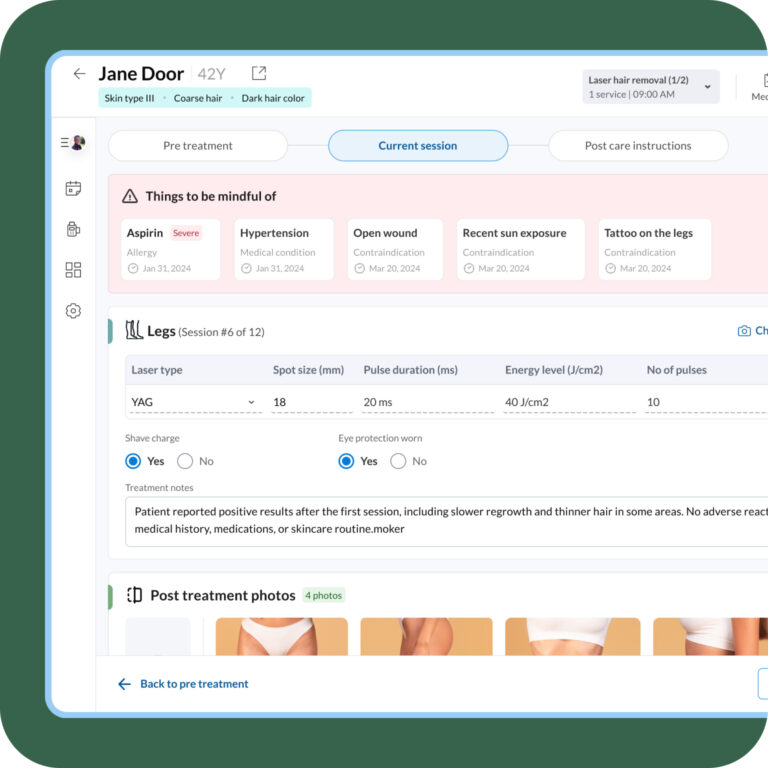
Zenoti’s multi-location operational infrastructure is genuinely strong. Centralised reporting, inventory management across branches, enterprise-level loyalty and marketing tools, and a scalable architecture designed for large chains give it a credible enterprise proposition. According to Capterra reviewers, Zenoti earns 4.3 out of 5, with positive themes around its analytics depth and suitability for large multi-location wellness and beauty operations. For a business running 20 or more locations across a beauty or spa brand, Zenoti’s enterprise feature set may justify the complexity of its onboarding process.
Zenoti’s strength is the beauty and wellness enterprise market – not medical or CQC-regulated clinical environments. Clinical documentation tools, treatment notes designed for medical practitioners, consent form workflows for aesthetic procedures, prescribing management, and the compliance infrastructure needed for regulated clinical practice are not Zenoti’s core product orientation. A clinic group offering injectable treatments, GP services, physiotherapy, or any regulated clinical discipline alongside wellness services would find Zenoti’s clinical toolset limited relative to platforms built for healthcare environments. Zenoti also requires custom enterprise pricing for multi-location setups, which can be cost-prohibitive for mid-market clinic groups operating 2-10 branches. According to G2 reviewers, Zenoti holds a 4.3 rating, with reviews noting complex setup and onboarding as common friction points.
Pabau’s core proposition for multi-location clinic groups is the combination of enterprise-grade operational management with medical-grade clinical tooling in a single platform. That combination – which no other platform in this comparison fully delivers – is what positions it as the primary recommendation for clinic groups operating across healthcare and aesthetic disciplines.
Multi-location management from a single dashboard is Pabau’s foundational strength. Clinic group owners can view appointment utilisation, revenue performance, staff schedules, and stock levels across all branches simultaneously, without switching accounts or pulling data manually. Insights Plus delivers consolidated analytics that give group operators a real-time operational view – the kind of visibility that typically requires dedicated business intelligence tooling in enterprise environments, here built natively into the platform.
Clinical documentation is the second major differentiator. Pabau’s built-in consent forms, customisable treatment notes, before-and-after photo management, injection plotting, and prescription management tools are designed for the full range of clinical and aesthetic practice disciplines – from medical spas and aesthetic clinics to physiotherapy, mental health, longevity, and multi-specialty group practices. The platform supports compliance management workflows designed with CQC and GDPR requirements in mind, giving clinical groups operating in regulated UK environments a meaningful compliance infrastructure.
According to Capterra reviewers, Pabau holds a 4.5 out of 5 rating based on over 370 verified reviews. Positive themes consistently reference the ease of multi-location setup, the comprehensiveness of clinical documentation, and the quality of customer support – three areas that directly affect the operational experience of a clinic group rolling out a new platform.
Pabau’s breadth of features creates a learning curve for new users, particularly those migrating from simpler tools or paper-based systems. The platform’s onboarding process is supported, which helps – but teams accustomed to minimal-feature tools may find the initial configuration period requires investment. Some reviews note occasional performance considerations when working with large datasets, and certain integrations require manual configuration rather than one-click setup. These are limitations worth factoring into an implementation timeline, though they reflect the complexity of the platform’s scope rather than fundamental product gaps.
Pricing transparency varies significantly across the six platforms, and for multi-location clinic groups, the difference between published tiered pricing and custom enterprise quotes has real operational implications – both for budget planning and for evaluating total cost of ownership across a clinic group’s growth trajectory.
Pabau offers tiered pricing with multi-location support available at higher tiers. Pricing is available via Pabau’s pricing page, with plan details accessible without requiring a sales call – a meaningful advantage for clinic groups in the early stages of evaluation. Contact Pabau directly for current pricing applicable to your group’s size and location count.
Carepatron uses a freemium model with paid tiers available for additional features. The free tier covers basic scheduling and documentation for solo practitioners; paid plans are available for teams requiring more functionality. Current pricing is available on Carepatron’s website.
Jane App offers published per-location pricing based on the number of practitioners at each site. The structure is transparent and predictable for clinic groups adding locations incrementally. Current pricing is available on Jane’s website.
Mindbody pricing for multi-location setups is not publicly transparent. User reviews consistently reference pricing increases as a pain point, and enterprise multi-location configurations typically require custom quotes. Verify current pricing directly with Mindbody before including it in any budget comparison.
SimplePractice offers published pricing tiers suited to solo and small-group practices in the US. Multi-location group pricing is not a core product scenario and is not clearly documented for non-US markets. Current pricing is available on SimplePractice’s website.
Zenoti requires custom enterprise pricing for all configurations, including multi-location setups. This approach suits large chains where per-location economics justify a dedicated sales process, but it creates friction for mid-market groups evaluating options. Contact Zenoti directly for a quote applicable to your location count and operational requirements.
Audit your current platform costs across all tools – scheduling, clinical notes, marketing, billing, and reporting – before comparing against an all-in-one platform price. Clinic groups running four or more separate tools frequently find that consolidating onto a single platform reduces total software spend while eliminating the manual reconciliation work that separate tools require.

Clinic groups across aesthetic, medical, and wellness disciplines use Pabau to consolidate scheduling, clinical documentation, staff management, and reporting across all their branches – without switching between accounts or exporting data manually.

Integration depth and compliance positioning are two of the most underdiscussed factors in multi-location clinic software selection – and two of the most consequential. A platform that handles scheduling and billing well but cannot connect to your accounting system, payment processor, or marketing tools will create friction points that grow proportionally with your location count.
Pabau’s integration ecosystem covers payment processors, accounting tools (including Xero), marketing platforms, and an open API for bespoke workflow connections. For UK and EU clinic groups, the integration set is built around the operational tools most commonly used in those markets – an important distinction from platforms whose integrations are primarily configured for North American billing and insurance systems. Jane App’s integration depth in UK and EU markets is limited compared to its North American configuration, where Canadian provincial insurance billing and US claims processing integrations are mature and well-maintained. For a UK aesthetic clinic group, Jane’s integration ecosystem may not connect to the tools the business already uses.
Zenoti’s integration capabilities are substantial for large enterprise chains, with robust connections to POS systems, loyalty platforms, and marketing tools used by beauty and wellness franchises. However, the integration configuration process is complex and typically requires dedicated implementation support – a reasonable trade-off for a 50-location chain but a meaningful overhead for a clinic group running three to eight sites. Mindbody and SimplePractice both offer integration ecosystems primarily oriented toward their core markets (wellness/fitness for Mindbody; US mental health for SimplePractice), with limited relevance for UK or multi-disciplinary clinical groups.
For clinic groups operating in the UK or EU, GDPR compliance is not optional – it is a regulatory requirement that applies to every location in the group. The ICO guidance on healthcare data and the UK GDPR framework require data processing agreements, clear data residency documentation, and auditable consent records for all patient data. A platform that cannot evidence its GDPR posture – through published data processing agreements, UK-hosted data storage options, and configurable consent workflows – represents a compliance risk for the entire group.
Pabau’s GDPR compliance framework is documented and available for review, with data processing agreements and consent management tools built into the platform’s clinical documentation workflows. SimplePractice and Carepatron are primarily designed for US HIPAA compliance contexts, and their GDPR positioning for UK clinical groups is less clearly documented. Jane App’s data infrastructure is oriented toward North American markets, which warrants verification for any UK or EU group considering the platform. For groups operating in jurisdictions with specific requirements – Dubai’s NABIDH, for example – Pabau has documented experience supporting clinics in those markets, as evidenced by its UAE-specific content and clinic support.
User review data across Capterra, G2, and Trustpilot provides a useful signal for how each platform performs in real-world clinic operations – though it is worth noting that review volume and geographic distribution vary considerably across the six platforms.
According to Capterra reviewers, Pabau holds a 4.5 out of 5 rating based on over 370 verified reviews – one of the largest review bases among clinic management platforms. Positive themes cluster around multi-location setup ease, clinical documentation comprehensiveness, and customer support responsiveness. The most commonly cited area for improvement is the learning curve during initial configuration, which reviewers typically frame as a one-time investment rather than an ongoing limitation. On G2, Pabau holds a 4.5 rating, with similar thematic patterns.
Capterra reviewers give Zenoti 4.3 out of 5, with positive sentiment around enterprise multi-location analytics and loyalty tools. The most consistent criticism in reviews is the complexity and duration of the onboarding process – a recurring theme that potential users should factor into implementation timelines. On G2, Zenoti also holds a 4.3 rating, with reviews reflecting large beauty and wellness chain use cases rather than medical or clinical environments.
Jane App earns the highest user satisfaction scores in this comparison. Capterra reviewers give Jane 4.8 out of 5, with exceptional scores for user experience and support team responsiveness. G2 reviewers also award 4.8. The review profile is almost entirely from North American allied health practitioners – the market Jane was built for – which means the scores reflect an experience that may not translate directly to UK or EU clinical groups.
Mindbody’s review profile is notably mixed. Capterra reviewers give it 4.0 out of 5, while Trustpilot reflects a 2.9 rating – a significant divergence that reflects friction in areas like pricing changes and customer support, which Trustpilot reviews tend to capture more directly than platform-specific review sites. SimplePractice earns 4.6 on Capterra and 4.4 on G2, with reviews reflecting high satisfaction among US solo and small-group mental health practitioners. Carepatron earns strong reviews for ease of entry on Capterra, reflecting its freemium positioning.
The right platform depends on your clinical environment, location count, regulatory context, and growth trajectory. The framing below is designed to help you self-select rather than sell you on a specific outcome.

Choose Pabau if you operate a multi-location clinic group across aesthetic, medical, wellness, or multi-specialty disciplines; need medical-grade clinical documentation alongside operational management; require GDPR-aligned data infrastructure for UK or EU operations; and want consolidated reporting, inventory, and staff management from a single platform without switching accounts between locations. Pabau is also well-suited to groups scaling from a single site to multiple locations and needing a platform that grows with operational complexity.
Choose Zenoti if you operate a large beauty or wellness chain (typically 10 or more locations) with enterprise resource requirements, a dedicated implementation team, and a primary focus on wellness and spa disciplines rather than regulated clinical practice. Zenoti’s enterprise analytics and loyalty tools are genuinely strong at scale.
Choose Jane App if you operate a multi-practitioner allied health clinic in Canada or the US, prioritise user experience and support quality above operational breadth, and your integration requirements are primarily within North American billing and insurance ecosystems.
Choose SimplePractice if you are a solo therapist or a small-group mental health practice in the US, require strong telehealth and US insurance billing tools, and operate from a single location with no immediate plans for multi-site expansion.
Choose Carepatron if you are a solo practitioner or a very small single-location clinic, are evaluating options with a minimal software budget, and do not require multi-location management, consolidated reporting, or complex clinical workflow tools.
Avoid Mindbody for any environment requiring clinical documentation, CQC compliance, or medical-grade workflow management. It is a credible platform for fitness and wellness businesses without clinical obligations.
Abstract feature lists rarely capture the operational reality of running a multi-location clinic group. The scenarios below reflect how different platform choices play out in practice for clinic groups at different stages and in different disciplines.
A UK aesthetic clinic group expanding from two to five sites needs a platform that handles the operational complexity of that transition without requiring a new system at each growth stage. The key requirements at this juncture are centralised client records accessible at any location, cross-branch appointment booking that allows staff to schedule a client at their preferred site, consolidated revenue reporting that gives the owner a single view of group performance, and clinical documentation tools that meet CQC and GDPR requirements across all sites.
Pabau’s multi-location feature set is built for this specific scenario. Zenoti could technically support it but would likely be over-engineered and over-priced for a five-location aesthetic group. Jane, Mindbody, SimplePractice, and Carepatron would not meet the clinical documentation and consolidated reporting requirements.
A clinic group offering physiotherapy, sports medicine, and aesthetic treatments across three locations faces a more complex software challenge. Clinical documentation requirements differ by discipline – physiotherapy SOAP notes differ from aesthetic consent forms and treatment records. Staff permission requirements are granular – a physiotherapy administrator should not have access to aesthetic client records without explicit authorisation. And the reporting requirement spans disciplines, giving the owner a single view of appointment utilisation and revenue across all services and all sites.
This is where Pabau’s multi-industry architecture – supporting physical therapy, medical spa, skin clinic, and other disciplines from a unified platform – makes it the practical choice. No other platform in this comparison supports that combination of disciplines with equivalent clinical documentation depth and multi-location operational management. For further guidance on managing multi-location med spa challenges, Pabau’s resource library covers the specific operational decisions clinic groups face at each growth stage.
A longevity and functional medicine clinic opening a second site needs to replicate its operational workflows – IV therapy protocols, client intake processes, lab management, and marketing automation – without duplicating manual administration. The platform choice at this stage determines how much of that replication is automated and how much requires staff time.
Pabau supports longevity clinic software workflows and functional medicine practice management with built-in lab management, inventory management across branches, and automated client communications – tools that allow a second-site launch to inherit the operational infrastructure of the first without rebuilding it from scratch.

Need to understand the full feature set before evaluating platforms? Multi-Location Med Spa Software Features covers the specific capabilities clinic groups should evaluate when assessing platforms for multi-site operations.
Considering the operational challenges of expanding to a second location? How to Open a Second Med Spa Location provides a practical framework for the operational decisions involved in multi-site expansion.
Looking for a detailed comparison of Pabau against Zenoti specifically? Pabau vs Zenoti covers the feature, pricing, and workflow differences between the two platforms in depth.
Want to explore how clinic management software handles scheduling across sites? Multi-Location Scheduling Software explains the scheduling architecture differences that matter for clinic groups with multiple branches.
Managing marketing across multiple clinic locations? Marketing for Multi-Location Med Spas covers the campaign, CRM, and automation strategies that work at group scale.
No platform in this comparison is universally right for every clinic group. The decision depends on clinical environment, regulatory context, location count, and growth stage. For solo practitioners and very small single-location practices, Carepatron and SimplePractice serve defined markets well. Jane App earns its exceptional satisfaction scores in North American allied health settings. Zenoti delivers genuine enterprise capability for large beauty and wellness chains.
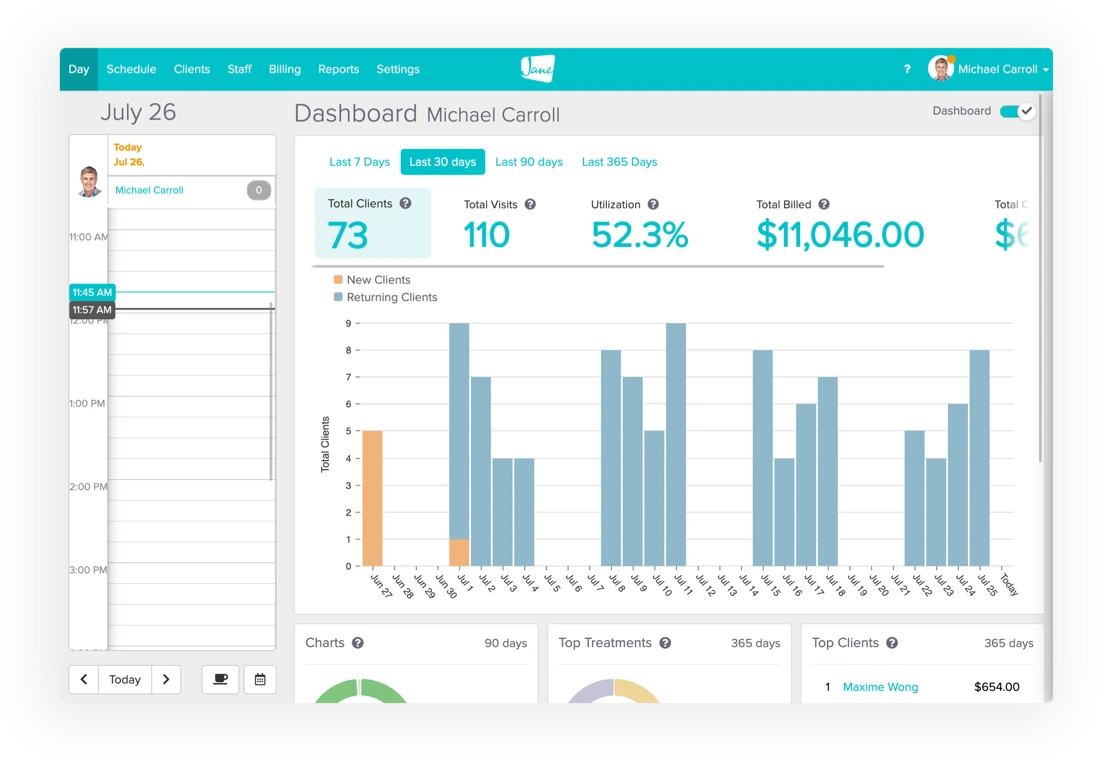
For clinic groups that combine clinical practice with multi-location operational complexity – aesthetic, medical, wellness, physiotherapy, or multi-specialty groups operating two or more sites in the UK or internationally – Pabau is the platform that most fully addresses both dimensions simultaneously. Its combination of medical-grade clinical documentation, unified multi-location management, GDPR-aligned data infrastructure, and consolidated reporting covers the operational requirements that define success at group scale. Reviewed against current G2 and Capterra user sentiment data and leading practice management platform positioning.
For clinic groups combining clinical practice with multi-location operations – particularly in the UK or internationally – Pabau is the most capable platform evaluated in this comparison. It provides a single unified dashboard for scheduling, clinical documentation, staff permissions, inventory, and reporting across all branches. Zenoti suits large beauty and wellness chains. Jane App serves North American allied health practices. SimplePractice and Carepatron are suited to solo practitioners rather than multi-site groups.
Yes – but only some platforms are built to do this natively. Pabau and Zenoti both provide centralised multi-location dashboards without requiring account switching. Jane App offers multi-location support with more manual effort required for consolidated reporting. SimplePractice and Carepatron do not natively support cross-branch consolidated management and are not designed for multi-site operations.
Platforms built for multi-location management – Pabau and Zenoti – offer site-level role-based permissions, allowing clinic groups to assign different access levels at each location. A clinic manager at one branch may be restricted from viewing financial data or client records at another branch unless explicitly granted access. Platforms designed for solo or small-group use, such as SimplePractice and Carepatron, offer more basic permission structures that are not granular enough for complex multi-site operations.
Three capabilities define whether a platform is genuinely suited to multi-location clinic management: a single sign-on dashboard with visibility across all branches, site-level staff permissions granular enough to control data access by location, and consolidated reporting that aggregates revenue, appointments, stock, and staff performance across all sites without manual data exports. Clinical documentation tools – treatment notes, consent forms, before-and-after photos – are additionally required for regulated clinical environments.
Yes. Pabau is purpose-built for multi-location clinic groups, with a unified dashboard that consolidates scheduling, clinical documentation, staff management, inventory, and reporting across all branches. It supports aesthetic, medical, wellness, physiotherapy, mental health, and multi-specialty disciplines from a single platform. It is particularly well-suited to UK and international clinic groups requiring GDPR-aligned data management and CQC-aware compliance workflows.
Platforms designed for multi-location operations – Pabau and Zenoti – provide consolidated reporting that pulls appointment utilisation, revenue, staff performance, and stock levels from all branches into a single view. This eliminates the manual data aggregation that clinic groups face when using per-location tools or exporting data from separate accounts. Platforms not designed for multi-location use, including SimplePractice and Carepatron, require manual reconciliation for any group-level reporting.